This site is supported by our readers. We may earn a commission, at no cost to you, if you purchase through links.

You scan a quick-moving bird through binoculars, glimpsing only a flash of white against brown feathers before it vanishes into the brush. That single white stripe just gave you more information than five minutes of studying overall color would have.
High-contrast markings cut through visual noise—crown stripes separate one sparrow from a dozen relatives, wingbars split warbler species into distinct camps, and tail flashes confirm identity when everything else blurs. These diagnostic patterns function as nature’s own field guide, letting you pin down species with surgical precision even when lighting fails or distance obscures finer details.
Mastering bird identification with white stripes transforms guesswork into certainty, turning every striped head, wing, and tail into readable text that reveals not just species names but age, sex, and breeding condition.
Table Of Contents
- Key Takeaways
- Key Features of Birds With White Stripes
- Identifying Sparrows by White Stripe Patterns
- Other Common Birds With White Stripes
- Habitat and Distribution of White-striped Birds
- Tips for Accurate Bird Identification
- Frequently Asked Questions (FAQs)
- Are grackles good or bad birds?
- What is a GREY bird with white markings?
- Are grosbeaks friendly birds?
- What bird has a white stripe on its back?
- How rare is a white-crowned sparrow?
- What kind of bird has stripes like a zebra?
- How do seasonal changes affect white stripe visibility?
- What time of day are white-striped birds most active?
- Do juvenile birds have different white stripe patterns?
- How do white stripes help birds during migration?
- Conclusion
Key Takeaways
- White stripes function as diagnostic field marks that achieve 83% accuracy in warbler and vireo identification by cutting through visual noise when distance, poor lighting, or dense foliage obscure overall plumage color.
- Crown stripes, wingbars, and tail flashes appear in predictable anatomical locations across bird families, letting you eliminate dozens of lookalike species instantly and distinguish age, sex, and breeding condition beyond simple species names.
- White-crowned and White-throated Sparrows demonstrate how stripe pattern combinations—black-and-white versus tan-and-brown crowns, pink versus gray bills, presence or absence of yellow lores—separate closely related species with surgical precision.
- Mastering white stripe identification transforms bird watching from uncertain guesswork into repeatable science by providing fixed anatomical signatures that remain reliable when seasonal plumage fades, migration brings unfamiliar species, or fleeting glimpses prevent detailed study.
Key Features of Birds With White Stripes
White stripes aren’t just decorative—they’re your most reliable tool for pinning down a bird’s identity in the field. These high-contrast markings appear in specific, predictable locations on a bird’s body, and knowing where to look separates beginners from confident identifiers.
Tail flashes and wing bars become even more critical when identifying birds during migration season, as unfamiliar species pass through quickly.
Let’s break down why these stripes matter, where you’ll find them, and how they help you tell similar species apart with 83% accuracy in warblers and vireos alone.
Importance of White Stripes in Identification
White stripes function as diagnostic field marks that separate similar species with impressive precision—they help you distinguish warblers and vireos correctly in 83% of identification challenges. When you scan a bird’s plumage, these high-contrast lines act as visual shortcuts, letting you eliminate dozens of lookalike species before examining finer details. Wingbars, crown stripes, and tail patterns stand out in dense foliage where overall color fades into background clutter. You’ll find that stripe pattern recognition speeds up avian identification features dramatically, especially with fast-moving songbirds. White stripe functions extend beyond simple species differentiation—they signal age, breeding status, and individual fitness, making them essential tools for serious bird identification work. For more details on how field marks and plumage help in distinguishing birds, see this.
White stripes act as visual shortcuts that let you eliminate dozens of lookalike species and achieve 83% accuracy identifying warblers and vireos
- Bold white wingbars catch your eye first on dull warblers, revealing identity when body color offers few clues
- Crown stripes on sparrows separate adults from juveniles instantly, clarifying age class at a glance
- Flight patterns of ducks and shorebirds become unmistakable when white wing patches flash against darker plumage
Typical Locations of White Stripes on Birds
Once you recognize white stripes as reliable field marks, you’ll spot them in predictable zones that make identification faster. Crown Stripe Patterns frame the head’s top, often forming three-lane designs with dark center and pale outer tracks. Head Stripe Variations include eyebrow lines—the supercilium—that run from bill to nape above the eye. Wingbar Locations sit midway down folded wings where covert feathers create one or two pale bands, while white wing stripes flash during flight as primary or secondary patches. Tail Feather Markings appear as white outer feathers or terminal bands, visible when birds fly or flick their tails.
These stripe patterns follow consistent anatomical places across families, so learning where wing bars and white wing markings typically appear sharpens your identification speed in any habitat. For more insights on bird habitats and behaviors, see this helpful guide to.
How White Stripes Aid Species Differentiation
Stripe pattern recognition transforms casual bird watching into precise species differentiation. When you compare white-crowned sparrows against white-throated sparrows, you’re reading visual field marks like a field guide—black-and-white crown stripes on one, bright throat patches and yellow lores on the other. White stripe functions extend beyond simple decoration; they flash during flight to coordinate flocks, signal aggression in territorial displays, and even reveal behavioral morphs. These identification techniques work because white stripes act as fixed anatomical signatures, letting you separate similar-sized birds in seconds rather than minutes.
- Diagnostic stripe counts—one wingbar versus two—narrow warblers to single species
- Bold white patches confirm IDs when seasonal plumage fades or dulls
- Unique combinations of crown, wing, and tail stripes distinguish overlapping families
- Stripe brightness hints at age, sex, or morph type within the same species
Stripe brightness and patterns also serve as indicators of age, sex, or morph type within the same species, further refining identification. By mastering these visual cues, birdwatchers can efficiently differentiate between species, even when dealing with similar-sized birds or faded plumage.
Identifying Sparrows by White Stripe Patterns
Sparrows can be tricky to identify, but white stripe patterns give you a reliable shortcut. The White-crowned and White-throated Sparrows show bold head stripes that set them apart from their plainer cousins, and regional variations add another layer of precision to your field observations.
The white-throated sparrow features a distinctive yellow loral spot and comes in two color morphs that can help you confirm your identification in the field.
Here’s what you need to spot these common species with confidence.
White-crowned Sparrow Characteristics

Look for the bold black and white crown stripes—your most reliable field marks for whitecrowned sparrow identification. Adults show crisp racing-stripe patterns on the crown, while immatures display brown and tan versions.
You’ll notice a clean gray breast without heavy streaking, two white wing bars, and a small conical bill with pinkish tones.
Males deliver clear whistled songs up to 15 times per minute, making them easy to detect while foraging on the ground for seeds and insects.
Regional Variations in White-crowned Sparrows
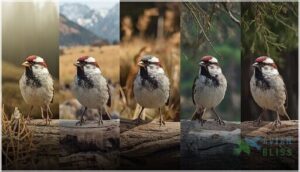
Across the continent, you’ll find five recognized White-crowned Sparrow subspecies, each showing distinct field marks shaped by geography. Pacific coastal Nuttall’s and Puget Sound forms sport yellow bills and shorter wings, while Interior West and Eastern Taiga birds flash pink bills with dark lores.
Gambel’s birds breeding in Alaska migrate thousands of kilometers south, but Nuttall’s stay put year-round along the coast.
Even song dialects shift regionally—California populations separated by Monterey Bay sing noticeably different phrases, making vocalization another reliable identification clue.
White-throated Sparrow Identification

When you identify the White-throated Sparrow, you’re looking for a distinctive package of field marks that sets it apart from other sparrow identification challenges, including the whitecrowned sparrow. This species delivers five crisp visual cues:
- Head Pattern: Bold black-and-white or tan-and-brown crown stripe patterns frame the face distinctly.
- Facial Markings: Bright yellow lores between bill and eye pop against darker head stripes.
- Throat Patch: Clean white bib outlined by thin dark borders creates sharp contrast with gray breast.
- Wing Bars: Two pale bars visible on folded wings add subtle confirmation when head is hidden.
- Body Structure: Medium-sized, chunky build measures 6 to 7 inches with warm rufous-brown upperparts.
White-striped morphs show higher contrast stripe patterns and more aggressive breeding habits, while tan-striped birds display softer tones and better parental care—a fascinating polymorphism among North American sparrows.
Comparison With Other Sparrows

In sparrow identification, you’ll separate White-crowned from White-throated by bill color—pink versus gray—and that yellow lore patch White-throated shows. White-crowned averages 5.9–6.3 inches, slightly smaller than White-throated’s 6.3–7.1 inches, yet both share brushy habitats during sparrow migration.
Compare stripe patterns, beak shape, and feather color across sparrow species comparison to master these field marks reliably.
Other Common Birds With White Stripes

Beyond sparrows, you’ll encounter several other birds where white stripes serve as unmistakable identification markers. These species span diverse habitats—from nighttime skies to mountain forests—and each displays white markings in ways that make field identification straightforward.
Let’s examine three distinctive birds whose white stripes you won’t confuse with anything else.
Common Nighthawk Distinctive Markings
When dusk falls and you spot a falcon-shaped bird with erratic, bat-like flight, check the wings—Common Nighthawk wing stripe patterns offer instant confirmation. These nightjars broadcast three diagnostic field marks for bird identification:
- Bold white wing bars – A single white stripe near each wingtip flashes against dark mottled plumage during flight identification
- Tail band features – Males show a narrow white band near the tail tip; females lack it entirely
- Throat markings – Males display bright white throat patches, while females show buff-colored cryptic plumage instead
Painted Redstart and White-headed Woodpecker
When you’re chasing mountain specialties, two black-and-white beauties simplify bird identification through contrasting wing stripes.
The Painted Redstart flashes bold white patches on wings and tail during acrobatic Redstart Foraging through pine-oak canyons, its bright red belly unmistakable.
In contrast, the White-headed Woodpecker shows crisp white “wrist” stripes and an all-white head against jet-black wood-boring plumage—its Woodpecker Diet of pine seeds and bark-dwelling insects shaping Redstart Nesting territory overlap in western conifer forests.
Eurasian Magpie and Loggerhead Shrike
Two large predators with dramatic white stripes reveal how stripe patterns drive bird identification across continents. The Eurasian Magpie—44–46 cm with bold white wing patches flashing against glossy black plumage—thrives in varied landscapes through adaptable Magpie Behavior. Meanwhile, the Loggerhead Shrike faces critical Bird Conservation challenges despite its striking black mask and white outer tail feathers, with Shrike Migration declining across grasslands where Nesting Habits once flourished alongside whitethroated sparrow populations.
Consider these field distinctions:
- Magpies weigh 210–272 g (males), dwarfing 35–50 g shrikes
- Magpie’s white scapulars create massive wing panels during flight
- Shrike’s hooked bill and raptor-like profile separate it from songbirds
- Black facial mask wraps entirely around shrike’s bill base
- Both use exposed perches, but shrikes hunt solo while magpies forage in groups
Habitat and Distribution of White-striped Birds

White-striped birds don’t stick to just one type of landscape—you’ll find them everywhere from dense forests to city parks. Where you spot these species depends on their habitat preferences, seasonal movements, and how well they’ve adapted to human-altered environments.
Let’s break down the key habitats where white-striped birds thrive and how their distribution shifts throughout the year.
Forest and Woodland Habitats
Forest interiors and edges harbor White-throated Sparrows and White-crowned Sparrows, birds you’ll identify by their bold white stripes on head and wing bars.
Canopy layers create habitat diversity—mature stands with dense understory support woodland ecology specialists, while second-growth forests with shrubby openings attract edge-loving species.
Mixed tree species woodlands prove most productive, hosting varied plumage patterns across successional stages.
Grassland and Open Field Dwellers
You’ll spot grassland dwellers like Lark Buntings—breeding males turn velvety black with striking white wing coverts—across shortgrass prairies and fallow field birds hunting seeds near road edges.
Vesper Sparrows, 15 to 16 centimeters long, display thin white eye rings and outer tail flashes in open field birds territory.
Killdeer show two black bands across white breasts in plowed grassland habitats, while Loggerhead Shrikes perch on fences, their large white wing patches visible as they scan short vegetation for prey.
Urban and Suburban Adaptations
White-crowned and White-throated Sparrows dominate suburban landscapes—both flash bold white stripes at feeders where native shrubs provide cover. In city wildlife corridors, these urban bird habitats now shape avian visual communication and bird behavior and signaling. White-crowned males boost song volume 8 to 9 dB in traffic noise, proving rooftop ecology matters:
- Green spaces on vegetated roofs host foraging sparrows 15 floors high
- Common Nighthawks nest on gravel rooftops, hunting insects over stadium lights
- Courtyard feeders become oases in downtown concrete blocks
Migration Patterns and Seasonal Occurrence
Beyond backyard feeders, migration patterns reveal how far your white-striped visitors travel. Gambel’s White-crowned Sparrows clock 2,500 to 4,300 km between Arctic tundra and California, tracing migration routes through the Cascades and Rockies in spring, then looping clockwise through eastern mountains each fall—seasonal bird changes you can track by habitat shifts in the Central Valley.
- Common Nighthawks migrate 2,500-6,800 km yearly, showing white wing bars during evening fall flights
- White-throated Sparrows pass through Wisconsin mid-April to late May on northbound journeys
- Painted Redstarts appear in Texas March 10-May 21, then vanish by mid-October
Tips for Accurate Bird Identification

You’ve spotted the white stripes, noted the habitat, and now you’re ready to clinch the identification. Accurate field identification demands more than recognizing one plumage feature—you need a systematic approach that combines visual detail, structural clues, and auditory signals.
Here’s how to sharpen your skills and turn those fleeting glimpses into confident identifications.
Using Plumage Patterns and White Stripes
Think of plumage patterns as your field guide in feather form. When you’re analyzing stripe variations, start by pinpointing wingbars—those white stripes across folded wings that separate warblers from vireos in seconds.
Species recognition hinges on noting whether you see zero, one, or two bars, a bird signaling trick that field marks use to distinguish lookalikes. Plumage analysis sharpens every outing.
Noting Size, Shape, and Behavior
Body Size Cues separate sparrow-sized birds from crow-sized species instantly—you don’t need perfect conditions to see that a 6-inch White-crowned Sparrow is half the bulk of a 9-inch Common Nighthawk. Combine that with Shape Analysis and Behavioral Patterns, and field marks click into place:
- Nighthawks zigzag at dusk with long, pointed wings flashing white patches
- Loggerhead Shrikes perch upright on wires, then dart down for prey
- Painted Redstarts flutter and fan their tails to flush insects
Flight Styles and Perching Habits improve species recognition fast.
Utilizing Bird Songs and Calls
Listen closely—bird songs and calls reveal avian species recognition in ways plumage alone can’t match. In dense forests, vocalizations lead to over 80% of bird identification before you ever glimpse a feather.
Sound Identification apps like Merlin and BirdNET analyze audio recordings, flagging likely species based on vocalization patterns and rhythm. You, however, still outperform technology for familiar bird calls and subtle regional dialects.
For instance, the “Oh sweet Canada” phrase instantly cues you to a White-throated Sparrow, while a Common Nighthawk’s sharp “peent” slices through dusk. Combine bird behavior cues with vocalizations, and you strengthen your bird identification techniques, making species recognition possible even when visual field marks are obscured.
Frequently Asked Questions (FAQs)
Are grackles good or bad birds?
Grackles aren’t simply good or bad—you need to weigh their ecological role. They crush thousands of pest insects and disperse seeds, yet their massive roosts damage crops, corrode structures, and create genuine health concerns in urban areas.
What is a GREY bird with white markings?
Several grey bird species display white markings that catch your eye instantly. White-crowned Sparrows show bold black and white head stripes, while Northern Mockingbirds flash white wing patches during flight, making grey bird identification straightforward.
Are grosbeaks friendly birds?
You might think grosbeaks are approachable, but these birds stay cautious around people. Rose-breasted grosbeaks tolerate distant observers yet aggressively defend nests, while evening grosbeaks focus on feeding rather than friendly social interactions.
What bird has a white stripe on its back?
Downy and Hairy Woodpeckers show bold white back stripes running down their spines, contrasting sharply with black wings.
This vertical panel helps you identify them quickly at feeders and on tree trunks.
How rare is a white-crowned sparrow?
White-crowned Sparrows rank among North America’s most abundant songbirds, with roughly 79 million individuals continent-wide. Despite modest population trends showing gradual declines, their global abundance and broad distribution across varied habitats confirm stable conservation status.
What kind of bird has stripes like a zebra?
You know that “little tree-climbing zebra”? That’s the Black-and-White Warbler, wearing high-contrast longitudinal stripes from crown to tail—sharper than any sparrow’s smudges, unmistakable when creeping along bark.
How do seasonal changes affect white stripe visibility?
Seasonal molting cycles sharpen or soften stripe visibility. Fresh fall feathers show buff fringes that veil white, while winter abrasion wears dark edges away, exposing bolder white wing stripes and crown bands by spring.
What time of day are white-striped birds most active?
Picture the first light piercing through forest shadows—that’s when white-striped sparrows launch their dawn chorus, singing and feeding intensely.
You’ll catch another burst at dusk as crepuscular species hunt insects.
Do juvenile birds have different white stripe patterns?
Yes—juvenile birds show duller, streakier plumage patterns than adults. Young White-crowned Sparrows display muted tan-and-brown head stripes instead of crisp black-and-white crowns, complicating age identification until their first molting process completes in late summer.
How do white stripes help birds during migration?
During migration, white stripes function as visual cues for flock coordination and help birds track neighbors against the sky.
They also create motion dazzle to confuse predators and offer aerodynamic benefits by reflecting solar radiation during long flights.
Conclusion
White stripes reveal identity when color fades, confirm species when distance deceives, and separate lookalikes when time runs short. You’ve learned that crown stripes distinguish sparrows, wingbars categorize warblers, and tail flashes verify nighthawks—each pattern functioning as diagnostic evidence rather than decorative detail.
Bird identification with white stripes transforms field observation from uncertain guesswork into repeatable science, giving you the precision tools that turn fleeting glimpses into confirmed sightings every single time.
- https://phoneskope.com/identify-birds-using-field-marks/
- https://www.allaboutbirds.org/guide/White-winged_Scoter/id
- https://www.basicsofbirding.com/blog/how-to-identify-birds-looking-for-key-field-marks
- https://avianreport.com/identification-woodpeckers-northeast/
- https://hawkwatch.org/raptor-id/raptor-id-fact-sheets/zone-tailed-hawk/