This site is supported by our readers. We may earn a commission, at no cost to you, if you purchase through links.
 You’ve probably watched birds disappear each fall and wondered where they’re headed.
Bird migration facts revealed show this isn’t just wanderlust—it’s pure survival instinct. Birds migrate to escape freezing temperatures, find abundant food sources, and locate ideal breeding grounds.
Some species travel over 44,000 miles annually, using magnetic fields and star patterns as their GPS.
Arctic terns hold the record for longest journeys, while hummingbirds cross entire oceans despite weighing less than a nickel.
Not all birds migrate though—owls and cardinals often stay put year-round.
These incredible journeys involve remarkable physiological adaptations that’ll blow your mind, showcasing the birds’ ability to use pure survival instinct in their migrations.
Table Of Contents
- Key Takeaways
- Bird Migration Basics
- Migration Types Explained
- Why Birds Migrate
- Bird Migration Patterns
- Migration Challenges Faced
- Conservation Efforts Needed
- Navigation and Physiology
- Migration Records and Speeds
- Bird Migration Facts Revealed
- Migratory Bird Species
- Frequently Asked Questions (FAQs)
- What are some interesting facts about bird migration?
- How do birds know when to come back from migration?
- What are some fun facts about migration?
- What percentage of birds survive migration?
- How do baby birds learn migration routes?
- Do birds migrate at different altitudes together?
- Can birds change their migration timing permanently?
- What happens when migratory birds get injured?
- Do urban birds migrate differently than rural?
- Conclusion
Key Takeaways
- You’ll witness incredible endurance as Arctic Terns complete 44,000-mile annual journeys between poles, while Bar-tailed Godwits fly 7,000 miles non-stop without landing—distances that would challenge any human athlete.
- You can observe birds using sophisticated navigation systems that combine magnetic field detection through specialized receptors in their beaks and eyes with celestial cues from star patterns and sun positions to traverse continents with remarkable precision.
- You’re seeing survival instincts in action as nearly 4,000 bird species migrate to escape freezing temperatures, find abundant food sources, and locate ideal breeding grounds, with some undergoing dramatic physiological changes like doubling their body weight through fat storage.
- You’ll discover that human activities create deadly obstacles for migrating birds, with building collisions killing millions annually and light pollution disrupting their natural navigation systems, making conservation efforts like habitat protection and reducing artificial lighting critical for their survival.
Bird Migration Basics
You’ve probably watched birds fly south for winter and wondered what drives this incredible journey across thousands of miles.
Bird migration represents one of nature’s most remarkable survival strategies, with nearly 4,000 species traveling between breeding grounds and wintering areas based on food availability, temperature changes, and daylight patterns, which is a key aspect of their migration.
Food and Shelter
Every migrating bird’s journey revolves around finding adequate food sources and shelter types along their route.
You’ll discover that successful migration depends on strategically located feeding stations and safe havens.
- Food Sources: Insects, seeds, nectar, and small fish fuel long-distance flights
- Shelter Types: Dense vegetation, caves, and urban structures provide essential protection
- Migration Stops: Wetlands and forests serve as critical refueling stations
- Bird Habitats: Diverse ecosystems support different species’ survival needs
Breeding and Nesting
While food and shelter drive birds to specific locations, you’ll discover that breeding grounds serve as nature’s nurseries where migratory birds reproduce.
These specialized bird habitats offer ideal conditions for mating rituals and nesting during breeding seasons. Birds select nesting sites based on safety, food availability, and suitable nesting materials.
| Migration Distance | Breeding Ground Examples | Nesting Materials | Breeding Season | Mating Rituals |
|---|---|---|---|---|
| Short-Distance | Local forests, parks | Twigs, leaves, moss | March-July | Simple courtship displays |
| Medium-Distance | Temperate woodlands | Grass, feathers, mud | April-August | Complex song patterns |
| Long-Distance | Arctic tundra | Lichens, down, stones | May-September | Elaborate aerial dances |
| Altitudinal | Mountain meadows | Pine needles, bark | June-August | Territory marking calls |
| Partial | Mixed habitats | Varied local materials | Extended seasons | Flexible courtship timing |
Understanding bird migration patterns reveals how breeding habits shape these incredible journeys, with each species timing their arrival to coincide with peak nesting conditions and abundant resources for raising their young.
Escaping Harsh Weather
Birds don’t just pack up and leave for vacation—they’re fleeing nature’s wrath. When temperature extremes plummet below freezing, your feathered friends face a life-or-death choice. Climate shift triggers their ancient survival tactics, forcing them to abandon frozen territories. Migration timing becomes everything as weather patterns dictate when species must escape to their wintering grounds.
Birds don’t migrate for adventure—they’re running from winter’s deadly grip, racing against time to reach safety before nature’s fury strikes.
Here’s how birds outsmart winter’s deadly grip:
- Seasonal movements begin when daylight hours shrink, signaling approaching migration seasons
- Bird migration patterns follow predictable routes to avoid the worst weather systems
- Altitudinal migration lets mountain species simply move downhill instead of traveling thousands of miles
- Arctic species time their departure before ice locks away their food sources completely
- Some birds delay migration until the last possible moment, gambling on mild weather patterns
Migration Types Explained

You’ll discover that bird migration isn’t just one simple journey, but actually consists of three distinct categories based on distance traveled and environmental factors.
Scientists classify these patterns as short-distance, medium-distance, and long-distance migration, with each type representing different survival strategies that birds have evolved to maximize their chances of finding food and suitable breeding habitats.
Short-Distance Migration
You’ll find short-distance migrants make local movements within hundreds of miles, adapting to regional patterns and seasonal travel needs.
These birds cross familiar terrain during altitudinal shifts, moving from mountains to valleys when winter arrives.
Unlike their long-distance cousins, they don’t need passport stamps—just enough energy to reach nearby warmer areas with abundant food sources, which is crucial for their survival during seasonal travel.
Medium-Distance Migration
You’ll discover that medium-distance migrants travel roughly 200-2,000 kilometers, striking the perfect balance between energy conservation and resource access.
These clever migratory birds use strategic stopover sites along established flyway routes, adapting their bird migration patterns based on real-time conditions.
Unlike their long-haul cousins, they can flexibly adjust migration routes and habitat use, making them remarkably efficient travelers through familiar flyway patterns.
Long-Distance Migration
When medium-distance journeys seem impressive, long-distance migration truly showcases nature’s incredible endurance limits.
You’ll witness Arctic Terns completing 44,000-mile round trips between poles, while Bar-tailed Godwits fly 7,000 miles non-stop across oceans.
These migratory birds follow complex flight patterns and migration routes, using sophisticated bird navigation systems to master avian migration’s most demanding longdistance flight challenges across continents, which is a remarkable example of avian migration.
Why Birds Migrate

You’ve probably wondered why millions of birds undertake these incredible journeys twice a year, risking their lives to travel thousands of miles.
The answer lies in three fundamental survival drives: instinctive genetic programming that’s hardwired into their DNA, environmental factors like temperature and daylight changes, and critical survival needs including food availability and breeding requirements.
These drives are the key to understanding the migrations, as they encompass environmental factors and critical survival needs, which ultimately dictate the birds’ behavior and decision-making processes.
Instinctive Behavior
Millions of years shaped avian navigation through genetic predisposition, creating an extraordinary survival instinct.
You’re witnessing behavioral adaptation at its finest when migratory birds respond to internal migration cues without any training.
- Genetic programming guides young birds on their first journey
- Innate navigation systems activate automatically each season
- Magnetic field detection occurs through specialized brain receptors
- Instinctive behavior triggers departure timing precisely
Environmental Factors
Environmental conditions act as nature’s alarm clock, triggering birds’ migration instincts.
You’ll witness how temperature fluctuations, changing weather patterns, and shifting food availability create powerful signals that birds can’t ignore.
Climate change disrupts these ancient rhythms, while habitat loss and light pollution throw additional wrenches into their environmental compass system.
Plumage adaptations also play a role, especially for mating purposes.
| Environmental Factor | Migration Trigger | Impact on Birds |
|---|---|---|
| Temperature Fluctuations | Seasonal cooling/warming | Activates hormonal changes |
| Weather Patterns | Storm systems, wind shifts | Determines departure timing |
| Food Availability | Resource scarcity/abundance | Influences route selection |
The combination of these factors, including temperature fluctuations, weather patterns, and food availability, significantly influences the birds’ behavior and decision-making during migration.
Understanding these dynamics is crucial for appreciating the complex interactions between birds and their environment, and how climate change affects their delicate balance.
Survival Needs
You’ll find that bird migration revolves around three core survival needs: securing adequate food sources, avoiding energy-depleting predators, and meeting physiological demands.
Resource acquisition drives these epic journeys when local food availability plummets, and energy conservation becomes critical as birds optimize routes to minimize caloric expenditure.
Route optimization helps them navigate around predator-rich areas while adapting to resource scarcity through remarkable adaptability.
Bird Migration Patterns
You’ll discover that birds follow four major flyways across North America, creating predictable highways in the sky that scientists have mapped through decades of research.
These migration patterns reveal how millions of birds navigate thousands of miles using celestial cues and magnetic fields, with some species like the Arctic Tern completing remarkable 44,000-mile annual journeys between polar regions.
Flyways and Routes

These aerial superhighways span continents like invisible bridges connecting Arctic breeding grounds to tropical wintering areas.
You’ll find four major North American flyways—Atlantic, Mississippi, Central, and Pacific—each supporting millions of travelers annually.
Migration routes follow geographical features like coastlines and river valleys, creating natural corridors.
Stopover sites provide essential refueling stations, while route obstacles and navigational errors challenge even experienced fliers during their epic journeys.
Migration Destinations

Birds choose their migration destinations like seasoned travelers selecting perfect vacation spots.
Wintering grounds offer abundant food and mild temperatures, while breeding grounds provide ideal nesting conditions.
These destinations connect through flyways, creating habitat connectivity that’s essential for survival.
Stopover sites serve as important rest areas, like highway pit stops for weary travelers making their epic journeys, providing a crucial stopover.
Seasonal Movements
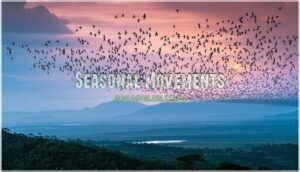
Most bird migration follows predictable seasonal movement patterns that you can witness twice yearly.
Spring migration timing centers on reaching breeding grounds when resource availability peaks, while fall journeys focus on escaping harsh conditions.
Climate impacts increasingly disrupt these ancient rhythms, affecting breeding success and stopover ecology. Bird migration routes remain consistent, though migration patterns adapt to environmental changes affecting bird migration programs worldwide, which can be critical to migration patterns.
Migration Challenges Faced

You might think birds simply spread their wings and glide effortlessly to their destinations, but migration presents life-threatening obstacles that test every species’ survival skills.
From dodging predators and weathering violent storms to traversing human-made hazards like skyscrapers and power lines, migrating birds face mortality rates that can reach 15-20% during a single journey, which is a significant challenge to their survival, making survival skills crucial.
Predation and Hunting
During migration, you’ll discover that predator avoidance becomes a life-or-death game for traveling birds.
Hawks, falcons, and other bird predators increase migration mortality rates substantially.
That’s why most species migrate at night—it’s their secret weapon against hunting impact.
Hunting regulations and protected species laws help, but wildlife still faces constant survival challenges throughout their epic journeys.
Harsh Weather Conditions
Unexpectedly fierce storms can devastate migrating flocks, forcing sudden Route Deviation that drains precious energy reserves.
These Climate Extremes create deadly bottlenecks where Mortality Rates skyrocket as birds struggle against powerful wind conditions and shifting weather patterns at dangerous altitudes.
The dangers of migration are highlighted by the fact that many birds face challenges that threaten their survival.
- Storm Impact forces birds off established flyways, increasing Energy Depletion by 40%
- Jet streams can either accelerate or completely halt migration progress
- Temperature drops below freezing kill thousands during overnight flights
- Seasonal changes now occur unpredictably, disrupting timing-dependent survival strategies
Human Activities
Modern civilization creates invisible barriers that derail avian journeys worldwide.
You’d be surprised how your everyday actions impact these incredible travelers.
Urban development fragments critical stopover sites, while deforestation eliminates essential resting areas.
Building collisions kill millions annually, and light pollution disorients nocturnal migrants off their ancient pathways.
| Human Activity | Impact on Migration |
|---|---|
| Habitat Destruction | Eliminates critical stopover sites |
| Building Collisions | Causes millions of deaths annually |
| Light Pollution | Disorients nocturnal flight patterns |
| Urban Development | Fragments essential migration corridors |
| Hunting Impacts | Reduces population numbers substantially |
The impact of human activities on bird migration is multifaceted, involving habitat destruction, building collisions, and other harmful effects.
Understanding these issues is crucial for mitigating the negative consequences of human actions on avian populations.
Conservation Efforts Needed

You can make a real difference for the billions of birds that face increasing threats during their epic journeys across continents.
Scientists have identified three critical conservation strategies that’ll help protect these remarkable travelers: preserving essential stopover habitats, reducing deadly light pollution in urban areas, and addressing climate change impacts that disrupt migration timing, which are essential for preserving the birds’ well-being and include reducing deadly light pollution.
Habitat Protection
Protected reserves serve as lifelines for migrating avian species, offering critical stopover sites along major flyway conservation corridors.
You’ll find habitat restoration projects actively reducing fragmentation across migration routes. These conservation efforts focus on habitat preservation while building climate resilience for future generations.
Supporting habitat recovery initiatives is essential for long-term success. Strategic habitat conservation creates connected networks that support millions of birds during their incredible journeys worldwide, ensuring climate resilience.
Reducing Light Pollution
Artificial light creates a deadly maze for migrating birds, disrupting their natural navigation systems and causing millions of deaths annually.
You can help protect these aerial travelers through targeted conservation actions:
- Dark Sky Initiatives – Support community programs that reduce unnecessary nighttime illumination
- Shielded Light Fixtures – Install downward-facing lights that minimize sky glow
- Responsible Lighting Design – Choose warm-colored LEDs and motion sensors
- Citizen Science Monitoring – Report bird strikes and participate in migration counts
Consider installing dark sky lighting to further reduce light pollution.
Climate Change Mitigation
Climate change throws migration routes into chaos, forcing birds to adapt or perish.
You’re witnessing species adaptation happening in real-time as altered flyways reshape ancient patterns.
Habitat preservation becomes your lifeline for conservation strategies that actually work.
Environmental changes demand immediate action—reducing emissions, protecting stopover sites, and creating climate corridors. Your conservation efforts today determine tomorrow’s skies, with habitat preservation and reducing emissions being crucial.
Navigation and Physiology

You’ve probably wondered how birds find their way across thousands of miles without GPS, and the answer lies in their remarkable navigation systems that combine celestial cues, magnetic field detection, and specialized physiological adaptations.
These feathered navigators use everything from star patterns and sun positions to Earth’s magnetic field through receptors in their beaks and eyes, while their bodies undergo incredible changes like increased fat storage and altered metabolic rates to fuel these epic journeys, utilizing their magnetic field detection and other physiological traits.
Their ability to use celestial cues and other navigational tools allows them to make these incredible journeys with precision and accuracy.
Celestial Navigation
Birds decipher the sky’s secrets through celestial navigation, reading nature’s ancient GPS system.
You’ll find these feathered navigators using multiple star-based guidance methods:
- Star patterns serve as their nighttime roadmap across thousands of miles
- Solar cues help determine direction during daylight hours
- Lunar navigation provides backup guidance on cloudy nights
- Genetic encoding programs their stellar navigation abilities from birth
- Atmospheric effects influence how they interpret celestial cues for precise avian navigation
Magnetic Field Navigation
You’ve learned about stellar navigation, but magnetic field detection offers birds another remarkable compass system.
Specialized magnetic receptors in their beaks and eyes sense Earth’s geomagnetic intensity variations.
This magnetoreception responds to field strength and angle influence, creating an internal GPS with genetic basis programming.
Birds achieve this impressive feat with a unique respiratory system that differs substantially from mammals.
Unfortunately, human disruption from power lines and cell towers can interfere with this precise avian navigation system, which is based on a genetic basis.
Physiological Adaptations
Marathon runners don’t hold a candle to migrating birds in terms of physiological transformations.
Your feathered friends undergo incredible changes through hyperphagia and energy management systems:
- Fat Storage – Birds double their body weight, storing energy for thousands of miles
- Muscle Development – Flight muscles strengthen while digestive organs shrink temporarily
- Metabolic Changes – Zugunruhe behavior triggers altered metabolic rates for endurance at high altitudes
Migration Records and Speeds

You’ll discover that some birds achieve migration records that would make Olympic athletes jealous, with Arctic Terns completing 44,000-mile round trips and Bar-tailed Godwits flying 7,000 miles without stopping.
These remarkable feats showcase how speed and endurance work together, as migrating birds can reach flight speeds of up to 60 miles per hour while maintaining incredible stamina across thousands of miles.
Longest Migration Journeys
The Arctic Tern reigns supreme, traveling 55,923 miles annually between poles.
This marathon champion’s Migration Endurance showcases nature’s ultimate endurance test.
Meanwhile, the Bar-tailed Godwit holds the nonstop flight record at 8,435 miles without rest.
These longest migration journeys face mounting Journey Challenges, making Conservation Implications critical for species survival.
| Species | Annual Distance | Route Description |
|---|---|---|
| Arctic Tern | 55,923 miles | Arctic to Antarctica, zigzag pattern |
| Bar-tailed Godwit | 8,435 miles nonstop | Alaska to Tasmania direct flight |
| Short-tailed Shearwater | 18,641 miles | Pacific Ocean circular route |
| Red Knot | 9,321 miles | Chile/Argentina to Canadian Arctic |
| Wandering Albatross | 18,641 miles | Southern Hemisphere ocean circles |
Fastest Migration Speeds
Beyond remarkable distances, you’ll discover that migration speeds vary dramatically among species.
Flight Speed Factors include wing morphology and body mass, while Tailwind Effects can boost velocities substantially. Energy Expenditure determines sustainable speeds over thousands of miles.
Here’s how the fastest bird species compare:
- Arctic Tern – Maintains 25 mph during its longest migration
- Bartailed Godwit – Reaches 35 mph on non-stop flights
- Peregrine Falcon – Achieves 60 mph during migration
Distance Correlation affects sustained speeds considerably. Many birds rely on established flyway routes during migration.
Unique Migration Behaviors
You’ll discover fascinating patterns like leapfrog migration, where northern populations fly farther south than their southern cousins.
Circular migration creates oceanic loops, while synchronized departures boost survival rates.
Nocturnal migration helps birds avoid predators and heat.
Altitudinal migration moves species vertically down mountains.
Irruptive behavior sends populations to unexpected areas when resources dwindle, creating spectacular wildlife viewing opportunities.
Bird Migration Facts Revealed
You’ve explored the science behind bird migration, and now it’s time to discover the remarkable statistics and feats that make this phenomenon truly extraordinary.
These migration facts reveal the incredible precision and endurance that over 4,000 bird species demonstrate annually, from billion-bird mortality rates to record-breaking journeys that span entire continents, showcasing their remarkable endurance.
Interesting Migration Statistics
When you examine the numbers, bird migration reveals staggering realities.
Over 4,000 species undertake these incredible journeys annually, yet Bird Mortality Rates tell a sobering story.
Window Collision Deaths claim nearly one billion birds yearly in the U.S. alone, while seven million more perish from various migration hazards.
These Species Migration Numbers highlight both nature’s resilience and our responsibility to protect these remarkable travelers.
Amazing Migration Feats
Record-breaking migration feats showcase nature’s incredible endurance.
The Arctic tern completes the longest migration, traveling 44,000 miles annually between poles.
Bar-tailed godwits achieve the longest nonstop flights, covering 7,000 miles without landing.
Transoceanic migrations demonstrate remarkable navigation accuracy across vast oceans.
These species-specific records reveal how birds conquer extreme altitude migration and navigate complex migration routes with precision.
Importance of Migration
Migration patterns serve as nature’s barometer, revealing ecosystem health through bird movement.
You’re witnessing environmental indicators that maintain genetic diversity and population regulation across continents. Animal migration creates food web stability by connecting distant habitats.
Here’s why bird migration facts matter:
- Pollination networks – spreading seeds across thousands of miles
- Pest control – managing insect populations naturally
- Nutrient cycling – transferring marine nutrients inland
- Climate monitoring – tracking environmental changes globally
Migratory Bird Species
You’ll discover that approximately 4,000 bird species, representing 40% of all birds worldwide, participate in regular migratory patterns driven by seasonal changes in food availability and breeding requirements.
Understanding which species migrate versus those that remain resident year-round reveals fascinating adaptations that allow different birds to survive in their specific environments, highlighting the importance of seasonal changes.
Species That Migrate

While scientists have documented over 4,000 migratory bird species worldwide, you’ll find some fascinating patterns in their journeys.
The Arctic Tern holds the record for longest migration routes, traveling 44,000 miles annually. New discoveries continue revealing declining populations among rare migrants, highlighting essential migration adaptations that help these remarkable bird species navigate vast distances during their seasonal movements.
Many enthusiasts seek a migratory bird guide to enhance their birdwatching experiences.
| Migration Distance | Notable Species | Unique Adaptations |
|---|---|---|
| Short-distance | American Robin | Partial migration flexibility |
| Medium-distance | Yellow Warbler | Fat storage increase |
| Long-distance | Arctic Tern | Magnetic field navigation |
| Ultra-long | Bar-tailed Godwit | Non-stop flight capability |
Species That Do Not Migrate

Not all bird species pack their bags when winter arrives.
Resident bird adaptations allow owls, woodpeckers, and chickadees to thrive year-round in harsh conditions.
These stationary bird behavior champions use local foraging strategies, finding hidden insects and cached seeds.
Their non-migratory survival depends on adaptability—thick feathers, flexible diets, and year-round habitats that support their remarkable survival skills.
Endangered Migratory Species

While some birds thrive in their habitats, many migratory species face an uphill battle against extinction.
Population decline threatens these remarkable travelers as habitat loss and climate impacts reshape their ancient journeys. You’ll discover that human intervention through conservation strategies offers hope for endangered species survival.
- Nearly half of the world’s migratory species are declining, with over 20% threatened with extinction
- Climate change acts as an "amplifier," disrupting migration timing and breeding patterns
- 277 species face danger from excessive hunting and collecting activities
- Only 14 CMS-listed species have shown improved conservation status recently
Bird migration patterns reveal nature’s fragility when human activities intersect with wildlife corridors. Species conservation efforts must address both immediate threats and long-term habitat protection to guarantee these aerial marathoners continue their epic journeys for future generations.
Frequently Asked Questions (FAQs)
What are some interesting facts about bird migration?
Feathered flyers follow four major flyways across continents, with Arctic Terns traveling 44,000 miles annually—that’s like circling Earth twice.
You’ll find nearly half of all bird species migrate using celestial navigation and magnetic fields.
How do birds know when to come back from migration?
You’ll find that internal biological clocks, called circadian rhythms, trigger hormonal changes when daylight increases in spring.
Temperature shifts and food availability also signal it’s time to head home for breeding season.
What are some fun facts about migration?
Though you might think migration’s boring, here’s the scoop: Arctic Terns fly 44,000 miles yearly—that’s like circling Earth twice.
Bar-tailed Godwits don’t stop for seven days straight, while Ruby-throated Hummingbirds cross entire gulfs nonstop, showcasing incredible endurance, with Arctic Terns being a prime example of this phenomenon.
What percentage of birds survive migration?
You’d find survival rates vary dramatically by species and journey length.
Short-distance migrants typically see 80-90% survival, while long-distance travelers face tougher odds at 60-70%.
Weather, predators, and human obstacles substantially impact these challenging journeys.
How do baby birds learn migration routes?
Like apprentices shadowing master craftsmen, young birds inherit genetic blueprints for migration routes.
They combine instinctive programming with learned behaviors, following experienced adults during their first journey to memorize landmarks and navigation cues.
Do birds migrate at different altitudes together?
You’ll notice different bird species don’t usually fly together at varying altitudes during migration.
Each species has its own preferred flight height based on energy efficiency, wind patterns, and navigation needs specific to their size and capabilities.
They make these choices to optimize their journey, taking into account factors such as energy efficiency.
Can birds change their migration timing permanently?
Birds can permanently shift their migration timing through genetic adaptation over generations.
You’ll see this happening as climate change forces species to evolve new schedules, with some populations already showing measurable changes in departure dates, illustrating the concept of climate change.
What happens when migratory birds get injured?
Devastatingly, you’ll find injured migratory birds face life-threatening challenges during their epic journeys.
They can’t complete migrations, become vulnerable to predators, and often die without immediate veterinary care or wildlife rehabilitation assistance.
Do urban birds migrate differently than rural?
Urban birds often skip long migrations entirely, staying put year-round thanks to heated buildings, abundant food sources, and artificial lighting.
You’ll find they’ve adapted to city life instead of following traditional migration patterns, which is made possible by abundant food sources.
Conclusion
Bird migration remains nature’s greatest puzzle, with each piece revealing extraordinary adaptations that defy logic.
You’ve discovered how these feathered marathoners navigate thousands of miles using internal compasses and celestial maps.
These bird migration facts revealed demonstrate the incredible resilience of species facing modern challenges like climate change and habitat loss.
Understanding their journeys helps you appreciate the delicate balance of ecosystems, and next time you spot migrating birds overhead, you’ll recognize the remarkable survival story unfolding above you.