This site is supported by our readers. We may earn a commission, at no cost to you, if you purchase through links.
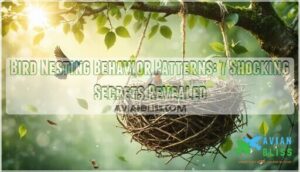 Bird nesting behavior patterns reveal nature’s sophisticated timing system.
You’ll discover that nesting cycles span 2-6 weeks with precise phases: nest building (3-10 days), incubation (10-30 days), and fledging periods that vary dramatically by species.
Small songbirds launch their young in just 12-14 days, while eagles nurture theirs for 6-12 weeks.
Seasonal triggers act like biological alarm clocks—longer daylight and warmer temperatures kickstart breeding when food becomes abundant.
Species showcase remarkable diversity: weaverbirds craft intricate suspended homes, while shorebirds create simple ground scrapes.
Predators slash success rates by 40-70%, forcing birds to adapt with clever camouflage and strategic placement.
These patterns hide surprising secrets about survival strategies and architectural mastery.
Table Of Contents
- Key Takeaways
- Key Patterns in Bird Nesting Behavior
- Factors Influencing Nesting Habits
- Types of Bird Nests and Structures
- Nest Building Materials and Techniques
- Nest Site Selection and Location Patterns
- Behavioral Aspects During Nesting
- Nesting Challenges and Threats
- Unusual and Adaptive Nesting Behaviors
- Post-Nesting Behavior and Parental Care
- Frequently Asked Questions (FAQs)
- What are common nesting behaviors?
- How long does nesting behavior last?
- What do birds do when they’re nesting?
- How do birds choose between multiple nesting sites?
- Do birds reuse old nests from previous years?
- How do weather patterns affect nest construction timing?
- Can birds relocate eggs to different nest locations?
- Conclusion
Key Takeaways
- You’ll discover that bird nesting cycles follow precise 2-6 week timelines, with small songbirds launching fledglings in just 12-14 days while eagles nurture theirs for 6-12 weeks, all triggered by seasonal cues like longer daylight and warmer temperatures.
- You’ll find that predators slash nesting success rates by 40-70%, forcing birds to develop sophisticated survival strategies including strategic camouflage, dense foliage placement, and distraction displays to protect their vulnerable offspring.
- You’ll observe remarkable architectural diversity as different species showcase specialized building techniques – from weaverbirds crafting intricate suspended structures to woodpeckers excavating precise cavities and modern urban birds incorporating plastic and metal debris into their construction.
- You’ll notice that birds carefully balance multiple factors when selecting nest sites, prioritizing proximity to food sources within 100 meters, reliable water access, and optimal concealment while adapting to human-made structures in urban environments.
Key Patterns in Bird Nesting Behavior
You’ll discover that bird nesting patterns follow remarkably predictable cycles, with most species timing their breeding to coincide with peak food availability and favorable weather conditions.
These behavioral patterns reveal fascinating insights into how birds balance energy investment, predator avoidance, and reproductive success through carefully orchestrated nesting timelines that vary dramatically across different species and geographical regions, which is influenced by the need to balance energy investment and predator avoidance.
Typical Nesting Timelines and Duration
You’ll discover that typical bird nesting cycles span 2-6 weeks, with distinct nesting phases.
The nest building stage takes 3-10 days, followed by incubation periods lasting 10-30 days depending on species size.
Fledging time varies dramatically – small songbirds leave nests within 12-14 days, while larger raptors require 6-12 weeks.
These nesting timelines represent nature’s precise biological scheduling system, and are a key part of the nesting cycles, which include the distinct phases of nest building.
Seasonal Triggers and Breeding Cycles
You’ll discover that breeding seasons act like nature’s alarm clock, triggering nesting cycles when daylight lengthens and temperatures rise.
Most birds time their reproductive cycles to coincide with peak food availability, typically spring through early summer.
Migration patterns directly influence when species return to establish territories and begin courtship rituals.
These seasonal triggers guarantee chicks hatch when insects and seeds are abundant, maximizing survival rates.
Variations Across Bird Species
Different bird species showcase remarkable variations in their nesting approaches, reflecting millions of years of evolutionary adaptation.
You’ll discover three distinct patterns:
- Architectural specialists – Weaverbirds craft intricate suspended structures while woodpeckers excavate precise cavities
- Ground nesters – Shorebirds create simple scrapes while ostriches dig elaborate depressions
- Aerial engineers – Swifts build cup nests on vertical surfaces while eagles construct massive platform aeries
Species diversity drives these contrasting nesting strategies and breeding patterns.
Understanding nesting site selection is vital to grasping the nuances of bird nesting behavior.
Factors Influencing Nesting Habits
You’ll discover that four main factors shape where and how birds build their homes, from dodging hungry predators to grabbing the best building supplies.
Understanding these influences reveals why your backyard robin chooses that specific tree branch while the neighborhood hawk selects a completely different strategy, based on factors like predators.
Predator Presence and Risk
Predators shape every nesting decision you’ll observe in birds.
Every nest placement decision revolves around outsmarting hungry predators lurking nearby
Species exposed to multiple predator types show 40-70% reduced nesting success compared to safer areas.
Birds facing avian threats choose denser foliage, while ground-nesters relocate when mammalian predator density rises.
This constant threat assessment drives remarkable survival strategies.
When predator calls echo through territories, parent birds increase nest-guarding time by 60% while reducing foraging trips.
This trade-off between feeding offspring and maintaining vigilance creates a delicate balance.
Birds demonstrate sophisticated risk assessment, timing nest visits during low-threat hours and employing distraction displays twice as frequently when known nest predators lurk nearby.
| Predator Type | Bird Response | Success Rate |
|---|---|---|
| Avian predators | Dense foliage nesting | 60% higher concealment |
| Mammalian threats | Frequent relocation | 30% increased mobility |
| Multiple predators | Enhanced selectivity | 40-70% reduced success |
Availability of Nesting Materials
You’ll find that Material Sources directly shape nest architecture through resource availability in your local environment.
Birds adapt their nest building techniques based on what nature provides within foraging range.
Essential Nesting Resources birds gather:
- Plant materials – twigs, leaves, moss, and bark strips for structural foundation
- Animal-derived elements – feathers, fur, and spider silk for insulation layers
- Inorganic components – mud, pebbles, and urban debris for reinforcement
- Specialized fibers – plant down, animal hair, and synthetic threads for binding
Environmental Impact determines Resource Allocation strategies, forcing birds to modify traditional nesting material gathering behaviors when preferred materials become scarce.
Environmental and Seasonal Changes
You’ll notice that Climate Shift and Seasonal Cues drive Nesting Timing like clockwork.
Environmental Pressures from temperature fluctuations and daylight changes trigger hormonal responses in birds.
These seasonal changes affect food availability, forcing birds to develop Adaptive Strategies.
Spring warming signals favorable conditions, while harsh winters delay breeding cycles.
Birds synchronize their nesting habits with peak resource availability, ensuring higher nesting success rates through precise environmental timing.
Species-specific Nesting Traits
Each bird species follows its own unique blueprint for nest construction, shaped by millions of years of evolution.
You’ll discover fascinating variations in nest architecture and species traits that reflect specialized bird adaptations:
- Weaver birds create intricate suspended spheres using precise knotting techniques
- Hummingbirds build tiny cup nests with spider silk and lichen
- Bald eagles construct massive stick platforms weighing over a ton
- Penduline tits craft elaborate entrance tunnels with false openings
- Hornbills seal females inside tree cavities during incubation
These species-specific nests showcase remarkable nesting strategies, with each bird’s nesting patterns perfectly matched to their environmental needs and behavioral requirements.
Types of Bird Nests and Structures
You’ll discover bird nests showcase remarkable architectural diversity, from simple ground scrapes to intricate suspended masterpieces.
These structures reflect millions of years of evolutionary engineering, with each design perfectly adapted to specific environmental challenges and survival needs, demonstrating evolutionary ingenuity.
Cup-shaped and Domed Nests

You’ll discover that cup-shaped nest architecture represents nature’s most efficient engineering solution.
These rounded structures, built with interwoven nesting materials like twigs and grass, cradle eggs perfectly.
Domed forms take bird engineering further, creating enclosed sanctuaries with small entrance holes.
Unlike basic cup type nest designs, domed nest construction requires advanced nest building techniques.
These bird nesting habits showcase remarkable adaptation—from robin’s mud-lined cups to wren’s intricate spherical homes.
The various types of bird nests, including those with complex nest building techniques, demonstrate the diversity of avian engineering skills and highlight the importance of nature’s engineering solutions.
Ground Nests and Aerial Nests
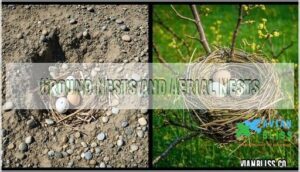
Two distinct Nest Architecture strategies define how you’ll spot ground nesting versus aerial nests in your backyard.
Ground Safety becomes paramount for species like killdeer, who craft simple scrapes using minimal nesting materials for camouflage.
Meanwhile, Aerial Designs showcase engineering marvels as robins construct sturdy platforms in Tree Canopies at varying Nesting Heights.
These bird nesting habits reveal nature’s brilliant nest building adaptations, showcasing brilliant examples of evolutionary ingenuity.
Suspended and Ball-shaped Nests
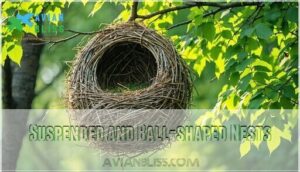
Architects of the air, many species craft suspended nests that hang like nature’s chandeliers.
These aerial constructions showcase remarkable nest architecture through ingenious suspension methods.
- Pendulum Engineering: Orioles weave intricate pouches using plant fibers, creating ball-shaped structures that sway safely from branch tips
- Woven Masterpieces: Weaverbirds employ grass strips in complex patterns, forming enclosed chambers with entrance holes for nest camouflage
- Flexible Foundations: Hummingbirds bind spider silk and lichen, constructing expandable cups that grow with developing chicks
These nesting patterns demonstrate sophisticated bird nest construction techniques that maximize protection while minimizing predator access.
Unique Architectural Adaptations
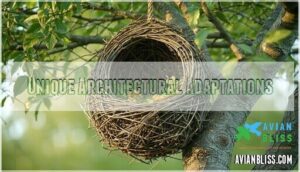
Beyond simple hanging structures, birds push architectural boundaries through ingenious Nest Architecture innovations.
Sociable weavers create massive Communal Nesting complexes weighing over 1,000 pounds, housing hundreds of birds. Hornbills seal females inside tree cavities with mud, leaving feeding slits.
These Innovative Designs showcase remarkable Adaptive Materials use – from spider silk reinforcement to Urban Nests incorporating plastic waste, proving bird architecture rivals human engineering sophistication.
The complexity of bird nests is evident in their use of natural building materials to construct elaborate structures.
Nest Building Materials and Techniques
You’ll discover that birds transform everyday materials into architectural masterworks through specialized techniques that rival human engineering.
From intricate weaving patterns using plant fibers to sophisticated stitching methods with animal hair, these feathered builders employ both traditional organic materials and surprisingly creative inorganic elements to construct their homes.
These birds utilize a variety of materials, employing both traditional organic materials and creative inorganic elements to build their nests.
Plant-based Materials

Plants provide birds’ primary nest building materials through diverse sources.
You’ll find species collecting Leafy Twigs for structural frameworks, while others gather Seed Fibers for soft interior linings.
Bark Strips offer flexible binding elements, and Floral Threads create intricate weaving patterns.
Grass Blades form cup foundations in many bird nesting techniques.
These plant-based nesting materials demonstrate sophisticated nest construction approaches across different species.
The use of leafy twig structures is a key aspect of bird nesting behavior, utilizing leafy twig elements for primary nest building.
Animal-derived Materials
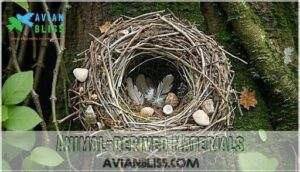
Birds transform into resourceful scavengers when collecting animal-derived nesting materials.
You’ll discover feather use from molted plumage creates insulation layers, while spider silk provides strong binding threads.
Hair incorporation from mammals adds warmth, and insect shells offer structural support.
Some species collect bone fragments for nest reinforcement, showcasing remarkable adaptability in nest construction beyond traditional plant materials, with techniques that demonstrate resourceful scavengers.
Inorganic and Artificial Materials

You’ll find over 60% of urban bird nests contain plastic, glass, or metal debris.
House sparrows and magpies lead this trend, incorporating synthetic fibers and human trash into 45% of their nests.
While plastic use provides waterproofing benefits, these artificial nest sites increase chick mortality by 10-16% through entanglement risks and microplastic ingestion from synthetic materials.
The use of plastic bird materials in nests is a growing concern among wildlife experts due to the potential harm caused by microplastic ingestion.
Weaving, Stitching, and Engineering Solutions

You’ll be amazed at how these feathered architects master nest construction through sophisticated weaving techniques and structural engineering.
Weaverbirds demonstrate remarkable material selection skills, interlacing grass strips with surgical precision to create suspended masterpieces.
Their nest architecture showcases advanced bird engineering principles, where each strand contributes to structural integrity.
These nesting patterns reveal how birds develop complex weaving techniques, transforming simple bird nesting materials into durable homes that withstand harsh weather conditions, exemplifying sophisticated construction skills.
Nest Site Selection and Location Patterns

You’ll find that birds carefully evaluate multiple factors when selecting nesting locations, prioritizing safety, resources, and environmental advantages.
Their choices reveal sophisticated decision-making processes that balance immediate needs with long-term survival strategies for their offspring, demonstrating complete concepts of evaluation and planning.
Camouflage and Concealment
Nature’s master architects employ sophisticated visual deception strategies when selecting nest locations.
Nest camouflage involves intricate color mimicry and pattern blending techniques that render nests nearly invisible to predators.
You’ll discover feather disguise methods where birds incorporate surrounding materials to achieve perfect concealment.
Visual deception through strategic placement creates optical illusions that protect vulnerable eggs and nestlings from detection.
Proximity to Food and Water
Strategic nest placement near abundant Food Sources and reliable Water Access dramatically reduces energy expenditure during critical breeding periods.
You’ll notice parent birds carefully calculate Foraging Distance to minimize time away from vulnerable eggs and nestlings.
Here’s how Resource Allocation drives smart Nest Placement decisions:
- Optimal foraging zones – Sites within 100 meters of primary food availability
- Water proximity – Nesting environments near streams or reliable moisture sources
- Energy conservation – Reduced flight time between nest and bird feeding habits locations
- Seasonal planning – Anticipating food source changes throughout breeding cycles
This calculated approach to nesting environments guarantees parents can maintain consistent provisioning while maximizing offspring survival rates through efficient bird foraging strategies.
Use of Human-made Structures
Modern birds have cracked the code on Urban Nesting by transforming humanmade structures into prime real estate.
You’ll spot them claiming Bridge Dwellings, Roof Tops, and Power Lines as their headquarters.
Building Facades become vertical neighborhoods where species build sophisticated nests.
Even simple birdhouses prove that when you can’t beat human development, you join it—turning our concrete jungle into their thriving habitat.
The availability of bird house products has further increased their nesting options.
Urban Adaptation and Colonial Nesting
Cities transform bird nesting behavior dramatically.
Urban environments create opportunities for colonial nesting, with some species showing 95% shifts toward human structures. These city habitats offer elevated sites that reduce predation while supporting dense breeding colonies through adaptive nesting strategies.
Urban adaptations in bird nesting habits include:
- Elevated Site Selection – Birds choose building ledges and rooftops over ground-level locations for enhanced safety
- Colonial Behavior Intensification – Dense urban populations encourage group nesting for shared defense and resources
- Artificial Substrate Utilization – Species incorporate urban materials like wire, plastic, and metal into nest construction
- Flexible Nesting Strategies – Urban roosting patterns adapt to city rhythms, with modified timing and location choices
Understanding colonial nesting patterns is essential for conservation efforts in urban areas.
Behavioral Aspects During Nesting

You’ll witness remarkable transformations when birds shift from nest-building to protective parenting mode. Their behaviors become highly specialized, with intricate cooperation patterns and energy allocation strategies that guarantee reproductive success.
Shelter and Protection of Eggs
You’ll discover that bird nesting habits involve sophisticated egg shielding mechanisms that go beyond simple nest building.
Brood protection includes strategic egg camouflage through speckled patterns and earth-toned coloring.
Nest insulation utilizes layered materials like down feathers and moss for temperature regulation.
Predator deterrents involve false nest entrances and defensive positioning, while brooding behavior guarantees constant coverage and nest defense strategies protect vulnerable offspring.
Parental Roles and Cooperation
Partnership isn’t just about sharing space—it’s about survival strategy. In over 90% of bird species, both parents tackle the demanding work of raising young, creating a delicate balance of cooperation and occasional conflict that determines their offspring’s fate.
- Biparental Care Systems – Both sexes contribute to feeding and brooding, with males providing up to 60% of food deliveries during peak periods
- Cooperative Breeding Networks – Helper birds increase chick survival by 15-30% through additional provisioning in species like Florida Scrub-Jays
- Workload Negotiation – Parents adjust feeding rates based on their partner’s investment, compensating when one reduces effort
- Role Flexibility – Sex-specific duties shift during adverse weather, with males increasing incubation when females are compromised
Courtship and Display Behaviors
Love takes flight when male birds exhibit their most dazzling courtship displays.
You’ll witness elaborate mating rituals featuring synchronized dances, complex songs, and stunning vibrant plumage that signals genetic fitness.
These bird courtship displays aren’t just show-offs—they’re sophisticated genetic signals revealing health, parasite resistance, and breeding quality.
Males invest tremendous energy creating these mate attraction performances, ensuring only the fittest genes survive.
Energy Investment and Maintenance
While courtship captures attention, the real work begins once you’ve committed to building. Nest Energy demands massive Resource Allocation – you’re basically running a 24/7 construction and security operation. Parental Effort includes constant Maintenance Costs as weather and wear threaten your investment.
Your Energetic Expenditure breaks down into three critical areas:
- Construction phases – Initial building burns 15-30% of daily energy
- Ongoing repairs – Storm damage and predator interference require immediate fixes
- Temperature regulation – Insulation adjustments consume additional calories throughout incubation
This bird energy investment determines bird offspring survival rates, making efficient nest maintenance essential for successful bird nesting habits.
Nesting Challenges and Threats
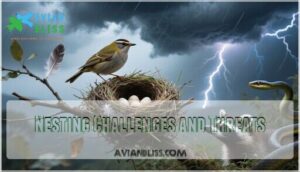
You’ll face countless threats that can destroy your carefully constructed nests, from cunning predators to devastating weather events.
These challenges test every bird’s survival instincts and force rapid adaptations to protect their precious offspring from an increasingly hostile world.
Predation and Environmental Hazards
You’ll find that nest predators pose constant threats throughout the breeding season.
Birds face environmental hazards from storms, temperature extremes, and habitat destruction that can wipe out entire broods.
Predator evasion becomes a daily balancing act between feeding and protection.
| Predation Risk | Environmental Threat |
|---|---|
| Snakes raid 40% of ground nests | Storms destroy 25% of exposed nests |
| Cats kill millions of nestlings annually | Heat waves cause egg abandonment |
| Crows target smaller bird species | Cold snaps freeze developing embryos |
| Raccoons climb to tree nests | Flooding drowns ground-nesting birds |
| Hawks patrol nesting territories | Drought forces nest site abandonment |
Survival strategies include building multiple decoy nests, timing breeding with peak food availability, and selecting locations that offer natural camouflage.
Hazard avoidance behaviors help parents minimize exposure while maintaining essential care duties.
Human Disturbance and Abandonment
Beyond natural predators lurk human-caused threats that force birds to abandon their carefully constructed homes.
Human interaction creates significant nest disturbance, triggering abandonment behaviors that devastate breeding success.
Your mere presence near active nests can prompt immediate evacuation, while construction activities destroy established nesting sites entirely.
Critical human disturbance factors include:
- Physical nest handling – touching eggs or nestlings
- Excessive foot traffic near nesting areas
- Construction noise disrupting territorial boundaries
- Habitat modification removing essential cover
- Pet interference from unrestrained dogs and cats
Research shows abandonment rates spike 40-60% in areas with frequent human activity.
Nest destruction from development projects eliminates thousands of breeding opportunities annually, while seemingly innocent birdwatching can stress parent birds into deserting their young.
Infestation and Food Scarcity
Nest Infestation threatens your bird’s breeding success when parasites invade their carefully constructed homes.
Insect infestations force parents to abandon nests, while Food Shortage during critical periods weakens both adults and chicks.
Parasite Control becomes impossible once mites or lice establish colonies, and Scarcity Effects ripple through entire populations, reducing reproductive rates and survival skills essential for future generations.
Urbanization Impacts
Urban environments crush bird nesting dreams with ruthless efficiency.
City Habitats force dramatic Nesting Adaptations as Urban Noise disrupts breeding cycles, starting them weeks early.
Human Impact creates Environmental Pressures through habitat destruction, reducing nesting diversity by 35-60%.
You’ll witness bird conservation battles as species abandon traditional nesting environments for survival.
Unusual and Adaptive Nesting Behaviors

You’ll be amazed at how creatively birds adapt their nesting behaviors when faced with unusual circumstances or changing environments.
From building homes in traffic lights to weaving plastic into their architecture, these feathered engineers constantly surprise researchers with their resourcefulness and flexibility.
Nesting in Unconventional Sites
You’ll discover birds breaking free from traditional expectations, choosing human structures over natural tree cavities.
Urban nesting has revolutionized bird nesting behavior, with species selecting traffic lights, mailboxes, and building ledges.
From rock crevices to abandoned burrows, these unconventional nest locations showcase remarkable adaptability.
Nesting environments once considered unsuitable now support thriving populations, proving that nesting habits evolve with changing landscapes and available opportunities, demonstrating remarkable adaptability.
Use of Creative Materials
You’ll discover birds transforming everyday trash into architectural masterpieces.
Crows weave plastic strips with natural fibers, while robins incorporate urban debris like paper scraps into traditional mud construction.
These recycled materials don’t compromise structural integrity – they enhance it.
Species-specific nests showcase remarkable plant weaving techniques, with orioles stitching shopping bags alongside grass.
This creative nest building material selection demonstrates how bird nesting habits adapt to modern environments, proving that innovation drives successful nest construction patterns, and that bird nesting habits are highly adaptable.
Communal and Cooperative Nesting
You’ll find that approximately 9% of bird species worldwide practice cooperative breeding, where multiple birds share parenting duties at a single nest.
Communal nesting benefits include reduced predation risk, improved thermoregulation, and enhanced foraging efficiency.
Florida Scrub-jays exemplify this behavior, with helpers defending territories and provisioning chicks, demonstrating social learning within these groups.
This social learning transmits nest building material techniques across generations, creating stable traditions that boost survival rates.
Behavioral Responses to Changing Environments
Climate change forces you to witness remarkable bird nesting behavior patterns as species demonstrate extraordinary nesting flexibility.
Environmental stress triggers adaptive behavior responses that showcase ecological resilience in ways that’ll surprise you. These bird environmental adaptations reveal how threat response mechanisms help birds survive challenging conditions.
Understanding seasonal migration patterns is essential to grasping the complexity of bird nesting behaviors.
- Temperature regulation – Birds adjust nest depth and insulation materials based on climate adaptation needs
- Material substitution – Species incorporate urban debris and synthetic materials when traditional resources become scarce
- Timing shifts – Breeding schedules change to match altered food availability and weather patterns
- Location flexibility – Birds relocate to microclimates that provide better protection from environmental extremes
Post-Nesting Behavior and Parental Care
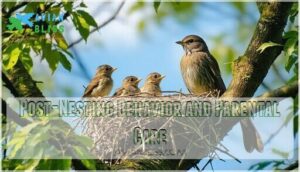
You’ll discover that the nesting story doesn’t end when chicks hatch—it’s just the beginning of an intricate parental care system that can last weeks or even months.
From teaching fledglings essential survival skills to establishing nighttime roosting routines, parent birds orchestrate a complex behavioral sequence that determines their offspring’s success in the wild, which is a key part of their intricate system.
Nestling Development and Independence
Your nestlings aren’t freeloaders forever. Most species maintain consistent nestling growth rates at 0.66 grams daily, peaking at 1.05 grams between days two and seven.
The fledgling stage arrives when wing development reaches critical thresholds, typically after 27-38 days in the nest. During this nestling phase, rapid wing growth determines nest exit timing more than weather or body weight.
Once fledglings take flight, independence acquisition spans 5-9 weeks, with survival rates varying dramatically between species based on their nesting habits and parental care strategies. Understanding bluebird parental care is vital for comprehending the nuances of nestling development and independence.
Continued Parental Guidance
Once nestlings leave the nest, you’ll witness bird parenting that extends far beyond the initial chick rearing phase.
Parent birds continue investing in fledgling support through critical teaching periods, demonstrating foraging techniques, identifying safe roosting spots, and providing ongoing brood management.
This parental investment guarantees young birds master essential survival skills before achieving complete independence from their caregivers.
Roosting and Nocturnal Nesting Habits
You’ll witness fascinating nocturnal behavior patterns as birds shift from daytime nesting to nighttime roosting strategies.
These Dark Adaptation techniques showcase remarkable behavioral flexibility during post-breeding periods.
- Roost Site selection prioritizes sheltered locations like dense foliage or tree cavities for thermal protection
- Nocturnal Roosting involves communal gatherings where multiple species share warming benefits through heat conservation
- Moonlight Behavior triggers altered activity patterns, with some species adjusting brooding schedules based on lunar cycles
- Nighttime Nesting maintenance continues as parents perform quiet nest inspections and repairs under cover of darkness
- Bird roosting hierarchies establish dominance patterns that influence prime sleeping spot access and territorial positioning
Preparation for Subsequent Breeding Cycles
After roosting behaviors wind down, you’ll notice birds begin preparing for their next breeding cycle months before spring arrives.
Their bodies start producing hormones that trigger egg formation processes, and many species assess whether to engage in nest reuse or construct entirely new structures.
Successful parents often return to previous territories, using fledgling success rates to guide location choices, demonstrating how bird reproductive cycles connect seamlessly.
This preparation phase shows how experienced pairs exhibit improved nesting patterns through learned parental care strategies, highlighting the connection between breeding cycles and successful parenting.
Frequently Asked Questions (FAQs)
What are common nesting behaviors?
Like architects of the sky, you’ll observe birds constructing homes with precise precision. They select secure locations, gather materials strategically, build cup-shaped or domed structures, and defend territories while providing parental care.
How long does nesting behavior last?
You’ll observe nesting behavior spanning several distinct phases throughout breeding seasons.
Pre-nesting site selection and territory establishment typically occurs 2-4 weeks before egg-laying, followed by active nest construction lasting 3-14 days depending on species complexity and material availability.
What do birds do when they’re nesting?
During nesting, birds painstakingly construct safe havens using twigs, leaves, and other materials.
They’re constantly busy gathering supplies, weaving structures, and defending territories from intruders while preparing for their offspring’s arrival.
How do birds choose between multiple nesting sites?
When push comes to shove, you’ll find birds evaluate multiple nesting sites by evaluating predator threats, food accessibility, shelter quality, material availability, and territorial boundaries.
Before selecting ideal locations for reproductive success, they consider these factors to ensure the best possible outcome for their offspring.
Do birds reuse old nests from previous years?
Birds often reuse nests, but it varies by species.
Some birds renovate old structures annually, while others abandon them after breeding seasons due to parasites, wear, or territorial changes affecting nest viability.
How do weather patterns affect nest construction timing?
Like a clock synchronized to nature’s rhythm, you’ll notice weather patterns drive birds to time their nest construction with remarkable precision.
Temperature shifts, rainfall patterns, and seasonal daylight changes trigger hormonal responses that initiate building behaviors, ensuring ideal conditions for successful reproduction, which is timed to coincide with remarkable precision to guarantee the best possible outcome.
Can birds relocate eggs to different nest locations?
Most birds can’t physically move their eggs once laid.
You’ll find that attempting relocation risks cracking delicate shells or triggering abandonment.
However, some waterfowl occasionally roll eggs short distances to adjust nest positioning for safety.
Conclusion
Nature’s master architects follow blueprints perfected over millions of years – much like how GPS satellites synchronize global timing, bird nesting behavior patterns coordinate with precise environmental cues.
You’ve explored how these feathered engineers balance survival against predation, adapt materials creatively, and time reproduction flawlessly.
From weaverbird tapestries to eagle fortresses, each species demonstrates remarkable problem-solving abilities.
Understanding these patterns reveals evolution’s ingenious solutions to life’s greatest challenge: successfully raising the next generation while surviving nature’s constant threats, and ultimately, ensuring the next generation.
- https://nestwatch.org/learn/general-bird-nest-info/nesting-cycle/
- https://www.frontiersin.org/journals/ecology-and-evolution/articles/10.3389/fevo.2023.1258185/full
- https://www.lyricbirdfood.com/birding-hub/behavior/nesting-habits/
- https://www.massaudubon.org/nature-wildlife/birds/bird-nest-situations-solutions
- https://www.robertefuller.com/blogs/blog/master-builders-the-genius-of-bird-nests