This site is supported by our readers. We may earn a commission, at no cost to you, if you purchase through links.
 Creating stunning bird photos starts with mastering your backgrounds. You’ll want clean, uncluttered scenes that make your feathered subject pop. Shoot during golden hour when soft light creates that creamy bokeh we all love.
Get down to the bird’s eye level—yes, that means crawling around like you’re searching for a lost contact lens. Use apertures between f/5.6 and f/8 for sharp subjects with beautifully blurred backgrounds. Telephoto lenses are your secret weapon for compressing distant backgrounds into smooth, dreamy backdrops.
These bird photography background tips transform ordinary shots into gallery-worthy images, but the real magic happens when you combine these techniques with strategic positioning and timing.
Table Of Contents
- Key Takeaways
- Choose Clean Backgrounds for Bird Photography
- Master Golden Hour Lighting Techniques
- Select The Perfect Shooting Angle
- Apply Composition Rules for Better Backgrounds
- Control Depth of Field Effectively
- Work With Natural Environmental Settings
- Enhance Backgrounds Through Camera Settings
- Frequently Asked Questions (FAQs)
- Conclusion
Key Takeaways
- Master your camera settings: Use f/5.6-f/8 for sharp subjects with creamy backgrounds, shoot during golden hour for soft light, and get down to the bird’s eye level for intimate shots that eliminate ground clutter.
- Choose clean backgrounds strategically: Look for simple, uncluttered scenes and use wide apertures like f/2.8-f/4 to blur distracting elements like branches or power lines into smooth bokeh.
- Work with natural lighting conditions: Take advantage of overcast days for even, shadowless lighting and position yourself so directional light sculpts your bird’s features while avoiding harsh midday shadows.
- Use telephoto lenses for maximum separation: Longer focal lengths naturally compress backgrounds into creamy blur while keeping you at a respectful distance from wildlife, and position birds far from their backdrop for better isolation.
Choose Clean Backgrounds for Bird Photography
You’ll struggle to create compelling bird photos if cluttered branches, power lines, or busy foliage compete with your subject for attention. Clean backgrounds separate your bird from distractions and let its colors, patterns, and behaviors shine through your lens.
Identifying Distracting Elements in Your Frame
You’ll spot unwanted objects like branches, power lines, and trash that create visual noise around your bird. Cluttered backgrounds with busy patterns distract viewers from your main subject. Look for color clashes between your subject and background that fight for attention. Check for light imbalance where bright spots pull focus away from the bird.
Eliminating unwanted elements enhances subject isolation and reduces distractions substantially. You can improve your shots by understanding how to attract birds.
Using Aperture to Blur Unwanted Details
Once you’ve spotted distracting elements, your aperture becomes your best friend for creating that dreamy blurred background. Wide apertures like f/2.8 or f/4 work magic for background separation, turning cluttered branches into smooth bokeh. Your lens compression at longer focal lengths enhances subject isolation even more. Consider investing in a wide aperture lens to enhance this effect.
- Use f/2.8-f/4 for maximum background separation and bokeh quality
- Find your lens’s aperture sweet spot (usually f/5.6-f/8) for sharp subjects
- Apply selective focus to keep your bird crisp while blurring distractions
- Position yourself farther from background elements to increase blur effect
- Remember that telephoto lenses naturally compress backgrounds, reducing distractions
Master Golden Hour Lighting Techniques

You’ll capture your best bird shots when you time your photography with golden hour’s soft, warm light. This magical lighting window occurs during the first hour after sunrise and the last hour before sunset, when birds are most active and the gentle illumination creates stunning backgrounds without harsh shadows.
Early Morning Vs Late Afternoon Light Quality
You’ll notice morning light runs cooler than afternoon’s warm golden hour lighting. Early sunrise delivers softer atmospheric effects with less shadow contrast, while late afternoon brings richer color saturation.
Bird activity peaks at dawn when they’re actively feeding, making sunrise ideal for capturing sharp details. Sunset’s warmer light temperature creates dramatic backgrounds but requires careful shade positioning.
Photographers should be aware that natural light changes constantly throughout the day.
Working With Soft, Directional Light
Once you’ve found the right timing, directional light becomes your secret weapon. Position yourself so the sun hits your bird at an angle—this creates depth and dimension that flat lighting can’t match. The diffused light during golden hour acts like nature’s softbox, eliminating harsh shadows while maintaining detail.
Here’s how to optimize soft, directional light:
- Work the angles: Move around your subject until the light sculpts the bird’s features perfectly
- Use natural reflectors: Bright sand or snow bounces fill light into shadow areas
- Control shadow direction: Position shadows to complement your composition, not fight it
This lighting technique transforms ordinary bird photography into gallery-worthy images.
Avoiding Harsh Midday Shadows
Midday sun creates harsh shadows that turn bird photography into a nightmare. Your subject gets raccoon eyes while the background becomes a chaotic mix of bright spots and dark patches.
Seek open shade areas where diffused light wraps around your bird naturally. Adjust white balance to compensate for cooler shade temperatures.
When you can’t find shade, use fill flash sparingly to balance harsh contrasts and salvage the shot.
Using Overcast Conditions to Your Advantage
Gray skies aren’t photography’s enemy—they’re your secret weapon. While bright sun creates harsh shadows, overcast conditions deliver soft light benefits that boost your bird photography. This even lighting produces shadowless detail and diffused highlights that make colors pop.
Here’s why overcast light transforms your images:
- Enhanced color saturation boost – Feather details show richer, more vibrant tones
- Perfect background control – Clean, distraction-free compositions emerge naturally
- Technical flexibility – Shoot from any angle without fighting harsh directional light
Overcast days provide opportunities to capture more nuanced textures. Bump your ISO to 1600-3200 and open that aperture wide.
Select The Perfect Shooting Angle
Your shooting angle transforms ordinary bird photos into professional-quality images that capture the viewer’s attention.
You’ll want to position yourself at the bird’s eye level whenever possible, as this creates an intimate connection and eliminates distracting ground clutter from your background.
Getting Down to Eye Level With Birds

Eye-level shots create intimate connections between viewers and your feathered subjects. You’ll need to crouch, kneel, or even lie flat to match a bird’s natural perspective. This positioning transforms ordinary bird photography into compelling images that draw viewers in.
| Shooting Position | Best For | Camera Angle |
|---|---|---|
| Crouching | Medium-sized perched birds | Slightly downward tilt |
| Kneeling | Ground-feeding songbirds | Parallel to ground |
| Prone | Small ground birds | Slight upward angle |
| Sitting | Water birds at pond edge | Level with water surface |
| Standing bend | Tall wading birds | Minimal downward tilt |
**This approach requires patience and respect for wildlife boundaries.
Using Low Angles for Dramatic Effect

Beyond eye level, shooting from below creates dramatic perspective that transforms ordinary bird photography. Position yourself low to emphasize scale and showcase birds against sky backgrounds.
This unique vantage point makes small songbirds appear majestic while isolating them from cluttered ground compositions. The upward angle adds power to your shots, placing viewers directly in the birds’ world for compelling background separation.
Working Around Natural Obstacles and Barriers

Natural obstacles don’t have to ruin your shot. You’ll face branches, fence posts, and cluttered backgrounds regularly. Smart placement turns these challenges into creative opportunities.
Overcoming Visual Obstructions requires patience and movement:
- Move laterally – Step left or right to hide unwanted elements behind your subject
- Change your height – Crouch lower or stand taller to eliminate foreground distractions
- Use shallow depth of field – Wide apertures blur obstacles into smooth backgrounds
- Wait for movement – Birds often shift locations, clearing visual barriers naturally
- Embrace natural frames – Branches can create beautiful borders when placed thoughtfully
Creating Depth through careful placement transforms cluttered environments into clean compositions. Capturing birds during the golden hour’s soft light can dramatically improve your shots.
Apply Composition Rules for Better Backgrounds

You’ll transform ordinary bird shots into striking images when you apply composition rules that create visual balance and draw viewers to your subject.
Strategic use of negative space around the bird and natural framing elements like branches or foliage will guide the eye while adding depth to your backgrounds.
Creating Negative Space Around Your Subject
Once you’ve positioned yourself at the bird’s eye level, focus on creating ample negative space around your subject. Smooth backgrounds with slight natural textures can easily drive a viewer’s eye to a clear and recognizable form of a bird.
Leave intentional blankness in your image composition for a minimalist composition that emphasizes isolating birds. Background simplicity creates subject emphasis through strategic intentional blankness rather than cluttered frames.
Framing Birds With Natural Environmental Elements
How can you transform ordinary bird shots into compelling environmental stories? Use foreground elements like branches, leaves, or flowers to create natural leading lines that guide viewers’ eyes toward your subject. This habitat integration technique enhances contextual storytelling by showing birds within their natural environment.
Seasonal backdrops add depth while environmental bird photography captures authentic bird behavior, making your composition more engaging than isolated portraits.
Control Depth of Field Effectively
You’ll control depth of field with your aperture settings to create that smooth, blurred background that makes your bird pop off the page.
Start with f/4 to f/5.6 on telephoto lenses—this sweet spot gives you enough separation without sacrificing sharpness on your feathered subject.
Choosing The Right Aperture Settings
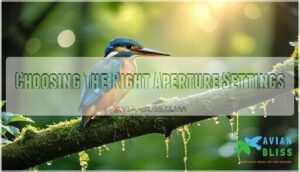
Which aperture setting delivers the sharpest bird photos while creating beautiful background blur? The aperture sweet spot for bird photography sits between f/5.6 and f/8, where most photographers capture 90% of their shots. This range maintains critical depth control across your subject while producing smooth background blur.
Wide apertures like f/4 enhance light sensitivity but risk losing wing details to shallow focus.
Using Telephoto Lenses for Maximum Separation
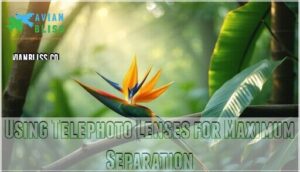
Telephoto lenses work magic through lens compression—they squash distant backgrounds into creamy background bokeh while keeping your bird tack-sharp. A 400mm lens at minimum focus distance practically erases cluttered branches behind your subject. The distance impact matters too: position birds far from their backdrop for maximum separation.
Longer glass demands proper stabilisation needs—camera shake kills the effect. These bird photography techniques transform ordinary shots into stunning wildlife photography portraits. Many photographers find success using specialized birding equipment.
Balancing Sharp Subject With Smooth Backgrounds

Getting sharp subjects with creamy backgrounds requires careful aperture control and positioning. Set your aperture between f/4-f/8 for ideal subject isolation while maintaining adequate depth of field. Position yourself to increase background distance from your bird.
Telephoto compression naturally creates smoother backgrounds by reducing depth perception. A great option is using a specialized birding lens for this purpose.
Use selective focus techniques to direct attention to your subject’s eye while letting distracting elements melt away into beautiful negative space.
Work With Natural Environmental Settings

You’ll transform ordinary bird shots into stunning images when you learn to work with your subject’s natural surroundings instead of fighting against them. Whether you’re shooting in dense forest canopy or against open sky, these environmental elements become powerful compositional tools that add context and visual impact to your photographs.
Incorporating Habitat Elements Into Compositions
Context matters in bird photography. You’ll want to include branches, leaves, or flowers that tell a story about the bird’s habitat. These natural leading lines guide viewers’ eyes toward your subject while maintaining environmental balance.
Position yourself so habitat elements frame your bird without overwhelming it. A warbler perched among spring blossoms creates contextual framing that showcases bird interaction with its surroundings. This approach transforms simple portraits into environmental bird photos that reveal where and how birds live.
To further improve your shots, consider how native plants attract birds.
Working With Forest and Woodland Backgrounds
Forest scenes offer rich, layered backgrounds that create natural frames for your subjects. **Light filtering through woodland canopies creates dramatic woodland hues and forest depth.
** These natural settings create a mood and atmosphere that transforms ordinary shots into compelling stories.
**Use wide apertures to blur complex foliage shapes while maintaining habitat context in your environmental bird photos.
** Position yourself to capture foreground elements that complement your composition without overwhelming the bird.
Capturing Birds Against Sky and Cloud Formations
When dramatic skies roll in, you’ve struck gold for bird photography. **Position yourself so cloud formations create natural frames around your subject.
Backlighting birds against colorful skies produces stunning silhouette shots that emphasize shape and behavior.
**
Different cloud types offer varying textures—puffy cumulus clouds provide soft contrast, while stormy formations add drama. Watch how sky color changes throughout golden hour, shifting from deep blues to warm oranges.
These environmental bird photos tell compelling stories about habitat and mood, making your composition stand out from typical perched-bird shots.
Enhance Backgrounds Through Camera Settings

Your camera’s internal settings can transform even ordinary backgrounds into stunning backdrops. Smart ISO adjustments keep noise levels low while maintaining proper exposure for your subject and background. Switch between metering modes to handle tricky lighting—spot metering works great when your bird contrasts sharply with the background. White balance settings help you capture natural colors that complement your composition. A fast shutter speed is needed for birds in flight.
Here are three essential camera settings for better backgrounds:
- Enable focus peaking to guarantee sharp subjects against beautifully blurred backgrounds.
- Use back-button focus to maintain precise control over your aperture and depth of field.
- Activate noise reduction when shooting at higher ISOs to keep backgrounds smooth and clean.
The key is understanding how these bird photography settings work together. Your aperture controls background blur, but ISO and metering modes determine how that background renders. Practice switching between these settings quickly—birds won’t wait while you fumble through menus.
Frequently Asked Questions (FAQs)
What camera settings work best for windy conditions?
Boost your shutter speed to 1/2000s or faster to freeze motion blur from wind-induced movement. Use continuous autofocus and higher ISO if needed. Consider image stabilization features.
How to photograph birds through glass windows effectively?
Position yourself at an angle to minimize reflections. **Use a lens hood and get close to the glass.
** Clean the window first, then shoot wide open to blur any remaining spots or dirt.
How to handle reflections when shooting near water?
Move to eliminate reflections by changing your shooting angle. **Polarizing filters cut glare effectively.
**
Shoot during overcast conditions when possible.
Use longer focal lengths to compress perspective and reduce water surface visibility.
What backup plans work when ideal backgrounds unavailable?
Backup brilliance begins with blurring distracting elements using wide apertures. You’ll reposition yourself for cleaner angles, crop tighter to eliminate chaos, or embrace creative shallow depth-of-field techniques when perfect backgrounds simply aren’t there.
Conclusion
Mastering these bird photography background tips is like learning to paint with light itself—each technique becomes a brushstroke in your visual story. You’ve now got seven powerful tools to transform cluttered, distracting scenes into professional-quality images.
The best backgrounds don’t just happen—they’re created through careful positioning, proper settings, and patience. Practice these techniques during your next outing, and you’ll notice immediate improvements in your shots. With consistent application of these bird photography background tips, you’ll develop the instincts that separate amateur snapshots from stunning wildlife photography.
- https://www.tonywhitehead.com/wildlight/archives/16948
- https://akariphototours.com/resources/wildlife-photography-tutorials/bird-photography-composition-guide/
- https://news.mylio.com/bird-photography-getting-started/
- https://www.reddit.com/r/wildlifephotography/comments/115mij5/bird_photography_advice/
- https://www.kevinpepperphotography.com/blog/eliminating-cluttered-backgrounds-in-your-wildlife-photos