This site is supported by our readers. We may earn a commission, at no cost to you, if you purchase through links.
 You’ll transform your bird photography when you master natural light like a pro.
Shoot during golden hours—that magical time just after sunrise or before sunset when light becomes buttery soft and wraps around your feathered subjects like silk.
Harsh midday sun? Skip it. It’ll turn your beautiful cardinal into a shadow puppet with blown-out highlights.
Position yourself so the sun kisses the bird’s plumage, revealing those stunning colors that make people stop scrolling.
Fast shutter speeds capture wing details that’d otherwise blur into streaks.
Think of light as your paintbrush—it can make ordinary backyard visitors look absolutely extraordinary.
The real magic happens when you understand how different angles create drama.
Table Of Contents
Key Takeaways
- Master golden hour timing – You’ll capture stunning bird photos by shooting just after sunrise or before sunset, when soft, warm light wraps around your subjects and enhances their natural colors without harsh shadows.
- Use backlighting and rim lighting creatively – You can create dramatic glowing halos around birds by positioning yourself so the sun illuminates their feathers from behind, revealing translucent details and separating subjects from backgrounds.
- Adjust your camera settings for natural light conditions – You’ll need fast shutter speeds (1/500s minimum for perched birds, 1/1000s+ for flight), proper ISO adjustments for lighting conditions, and spot metering to expose correctly for your bird subjects.
- Practice ethical photography with patience – You’ll get better shots by maintaining respectful distances, avoiding nesting areas, and letting birds behave naturally, rather than forcing dramatic moments that stress wildlife.
Capturing Golden Hour
Golden hour gives you the perfect chance to capture birds bathed in soft, golden light that enhances their natural beauty.
Those magical moments when feathers glow like amber jewels—golden hour transforms ordinary birds into extraordinary art.
With the sun low on the horizon, shadows are gentle, colors pop, and every feather seems to glow.
Soft Warm Light
Golden Hour transforms bird photography with its soft, warm light.
This diffused lighting enhances feather details and boosts color saturation, making reds richer and yellows glow.
Natural light photography thrives here due to the lower light temperature.
- Highlight subtle plumage tones with warm light.
- Capture vibrant, natural light bird photos.
- Showcase enhanced textures and colors effortlessly, which helps to capture the best moments.
Minimizing Harsh Shadows
Soft, warm light isn’t just beautiful—it also helps soften shadows.
During golden hour, the low sun angle creates diffused light, reducing harsh shadows on your bird subjects.
Adjust your angle to maximize shadow fill naturally.
Overcast benefits work too, offering even light.
Reflectors usage can boost brightness subtly.
Remember, natural light photography thrives on balance, not extremes.
| Technique | Benefit | Tip |
|---|---|---|
| Diffused Light | Reduces harsh shadows | Shoot during golden hour |
| Shadow Fill | Brightens dark areas | Adjust shooting angles |
| Reflectors Usage | Enhances light on subjects | Use lightweight reflectors |
| Overcast Benefits | Provides even lighting | Embrace cloudy days |
| Angle Adjustment | Minimizes shadow impact | Position sun behind or to side |
Enhancing Natural Colors
Capture dazzling plumage coloration by embracing golden hour’s magic.
The lower color temperature during this time enriches bird colors, making reds pop, yellows glow, and blues deepen.
Use natural light to enhance color saturation and reveal subtle feather detail.
Warm tones from the light spectrum bring out hidden hues, creating vibrant, lifelike images.
These bird photography tips reveal nature’s true palette.
Lighting Effects Techniques
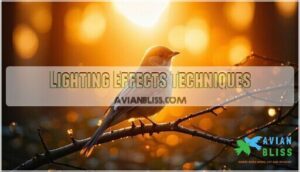
You can use natural light creatively to highlight a bird’s beauty, from soft halos around feathers to rich, glowing colors.
By mastering techniques like backlighting and rim lighting, you’ll add depth and drama to your shots while keeping the details crisp and vivid.
Low Sun Angle Benefits
When the sun sits low, it’s like nature’s spotlight for bird photography.
This angle casts a warm coloration that enhances feather detail and brings out vibrant color saturation.
Shadows soften, revealing subtle textures and making plumage glow.
It’s a perfect time for capturing the intricate beauty of birds, where natural light works magic on every shot, and the result is a truly vibrant display of color and texture.
Backlighting Advantages
Backlighting in bird photography adds magic by creating a glowing halo effect around the bird, separating it from the background.
Feather translucence shines beautifully, revealing intricate details, while silhouette creation offers dramatic compositions.
Edge highlighting enhances plumage colors, and mastering exposure balance is essential to avoid losing shadow details, making backlighting one of the most rewarding natural light techniques for stunning shots.
Rim Lighting Applications
While backlighting adds glow, rim lighting takes bird photography lighting up a notch.
It highlights the edges of plumage, enhancing feather definition and creating dramatic effects.
You’ll notice translucent details shimmer, especially around wings, giving your subject a glowing outline.
This edge enhancement separates the bird from its background, making silhouettes pop.
Golden hour provides ideal conditions for capturing these effects, as seen in Golden hour provides techniques.
Mastering bird photographic rim techniques adds sophistication to your shots, with dramatic effects that enhance the overall image.
Optimal Shooting Times
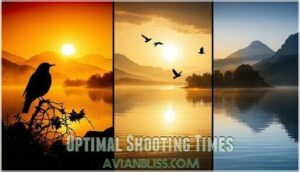
If you want your bird photos to shine, timing is everything.
Early mornings and late afternoons offer soft, golden light, while midday’s harsh sun can leave your shots looking flat and unflattering.
Early Morning Sessions
Early morning photography offers unmatched serenity, with soft light bathing the scene in a golden glow.
Golden hour transforms every feather into a masterpiece bathed in nature’s perfect spotlight.
The sunrise advantages are clear—birds are most active, their dewy feathers shimmering in calm atmospheres.
This golden hour creates warm light that enhances plumage details beautifully.
For bird photography tips, embrace these moments; nature’s calm and vibrant bird activity make early mornings truly magical.
Late Afternoon Sessions
Late afternoon photography offers magical golden light, perfect for evening birding.
The warm hues enhance feather details, while shadow play adds depth to your shots.
Use these bird photography tips for stunning results:
- Capture sunset silhouettes for dramatic effects.
- Focus on soft, golden hour lighting.
- Highlight subtle plumage textures.
- Experiment with backlighting.
- Adjust exposure for balanced highlights.
Consider how high ISO settings affect image quality.
Avoiding Midday Sun
Midday’s harsh light problems can ruin your bird photography lighting, creating strong shadows and washing out details.
Instead, seek midday shade or use reflected light to soften the scene.
Overcast day shooting offers diffused light options, perfect for feather details.
Avoid the harsh midday sun when possible; it’s like photographing under a spotlight—unflattering and unforgiving.
Camera Settings Essentials
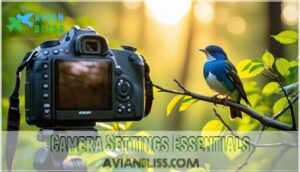
Getting your camera settings right is the key to capturing sharp, well-lit bird photos.
With a few adjustments to aperture, ISO, and shutter speed, you’ll be ready for any lighting challenge nature throws your way, and capturing sharp, well-lit bird photos will become easier.
Aperture Priority Mode
Aperture Priority (Av) mode is your secret weapon for bird photography lighting.
It lets you focus on creativity while the camera handles shutter speed.
Use it for:
- DOF control to blur backgrounds beautifully.
- Light adaptation in changing conditions.
- Exposure balance for tricky scenes.
- Creative applications like glowing backlight.
- Effortless adjustments to master bird photography tips.
ISO Settings Adjustments
Adjusting ISO settings is like finding the perfect volume on a radio—too high, and noise creeps in; too low, and details fade.
In low light, bumping ISO avoids blur, but stick close to base ISO for dynamic range. Modern cameras with ISO invariance handle this well.
Understanding camera ISO settings is essential for photographers seeking high-quality image quality. Balance lighting conditions carefully to keep your photography lighting crisp and your camera settings sharp.
| ISO Setting | Lighting Condition | Noise Level | Detail Retention | Recommendation |
|---|---|---|---|---|
| 100 (Base ISO) | Bright daylight | Minimal | Maximum | Best for sunny scenes |
| 400 | Overcast/cloudy | Low | High | Ideal for soft lighting |
| 800 | Early morning/evening | Moderate | Good | Great for golden hours |
| 1600 | Indoor/low light | Noticeable | Fair | Use with stabilization |
| 3200+ | Night photography | High | Limited | For artistic effects |
Shutter Speed Requirements
Mastering shutter speed in bird photography means understanding the delicate dance between freezing motion and maintaining proper light balance.
Your camera’s shutter becomes the gatekeeper of sharp images.
Essential shutter speed guidelines for bird photography:
- Static birds: 1/500s minimum for perched subjects
- Bird flight: 1/1000s to 1/2000s depending on species speed
- Small songbirds: 1/1250s for quick movements and takeoffs
- Large raptors: 1/800s often sufficient for soaring flight
- Action shots: 1/2500s+ for diving or rapid wing beats
Fast shutter speeds demand higher ISO sensitivity and wider apertures.
Blur avoidance trumps noise concerns—stabilization needs increase with telephoto lenses.
Remember, lighting conditions dictate your flexibility with bird photography techniques.
Essential Gear Recommendations
You’ll need a telephoto lens with at least 300mm reach to capture birds without disturbing their natural behavior.
The right gear won’t guarantee perfect shots, but it’ll give you the tools to make the most of golden hour lighting when those magical moments finally happen, along with a sturdy tripod that keeps your camera steady during those long waiting periods, utilizing telephoto lens capabilities.
Telephoto Lens Options
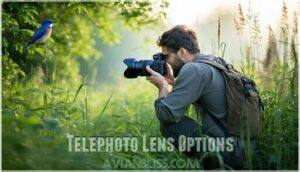
Looking for the perfect telephoto lens can feel overwhelming, but here’s what matters most.
Budget considerations shouldn’t stop you—the used lens market offers excellent deals on quality glass.
Prime vs zoom lenses each have advantages: primes deliver sharper images, while zooms provide flexibility.
For Canon users, the RF lens system offers phenomenal reach.
Prioritize autofocus performance and lens stabilization for sharp bird photography shots.
Sturdy Tripod Importance
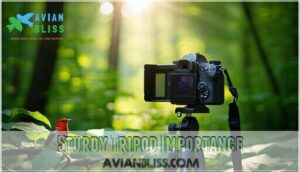
Beyond handheld shots, your tripod becomes the foundation for razor-sharp bird photography.
This essential gear transforms shaky captures into professional results through vibration reduction and lens support.
Key stability benefits include:
- Sharpness improvement during golden hour low-light conditions
- Ground level positioning for eye-level bird shots
- Telephoto lens support reducing camera shake
- Extended waiting periods without fatigue
- Consistent framing for behavioral sequences
For ideal stability, consider exploring a high quality option.
Mastering Composition Techniques
You’ll transform ordinary bird photos into compelling images by mastering three fundamental composition techniques that professional photographers rely on daily.
These proven methods—applying the rule of thirds, filling your frame strategically, and using natural elements as frames—work together to create visually striking shots that capture viewers’ attention and showcase your feathered subjects in their best light.
Rule of Thirds Application
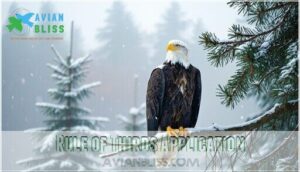
Bird photography composition transforms when you position your feathered subject along the rule of thirds grid overlay.
Place the bird’s eye at a focal point intersection for maximum visual impact. This compositional harmony creates natural subject placement that draws viewers in.
Your camera’s grid overlay guides positioning, ensuring visual balance that makes ordinary shots extraordinary. Trust this time-tested photographic composition technique to create a visual balance that enhances your photography.
Filling The Frame

You’ll transform ordinary shots into enchanting images by filling your frame completely with your feathered subject.
This bird photography composition technique achieves powerful subject isolation while creating beautiful background blur that makes your bird pop.
Detail emphasis becomes your strength as every feather shows clearly.
The compositional impact rivals professional work, and smart cropping benefits help eliminate distracting elements that compete for attention.
Experimenting with different angles can also lead to unique and engaging shots.
This approach allows for a beautiful background blur that enhances the overall quality of the image.
Natural Framing Elements

Use your surroundings as natural frames to elevate your bird photography.
Leafy overhangs create intimate portraits, while branch arches draw attention to your subject.
Water reflections double visual impact, and rock outcrops provide sturdy borders.
Sky openings frame birds against dramatic backdrops, guiding viewers’ eyes directly to your feathered subjects.
These natural elements transform ordinary shots into compelling compositions, making your photographs more engaging and interesting, with the surroundings acting as natural frames.
Technical Considerations Tips
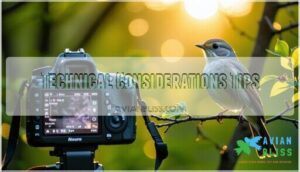
Getting your camera settings right can make the difference between a decent bird photo and one that truly captures the magic of natural light.
You’ll need to master exposure compensation, white balance adjustments, and spot metering to handle tricky lighting situations where your camera’s automatic settings might struggle with bright skies or shadowy perches.
Exposure Compensation
Perfect exposure doesn’t always come straight from your camera’s meter. Exposure compensation gives you creative control over bird photography lighting, letting you brighten or darken shots beyond what metering modes suggest.
- Histogram analysis reveals clipped highlights before you miss the shot
- Shadow recovery works better when you slightly underexpose initially
- Creative underexposure adds drama while preserving feather detail
White Balance Adjustments
Getting your white balance right makes the difference between dull and dazzling shots.
Set your camera to daylight preset (5600K on the Kelvin Scale) for sunny conditions, or switch to cloudy mode when overcast.
Custom White Balance gives you pinpoint Color Temperature control, while shooting RAW allows Post Correction flexibility.
Warm Light during golden hour benefits from higher kelvin settings to enhance those magical tones.
Accurate colors are achievable by understanding the Kelvin scale.
Spot Metering Advantages
Spot metering pinpoints accurate exposure on your feathered subject, ignoring distracting background details that fool other metering modes.
When you’re dealing with tricky lighting situations—like a bright sky behind a dark bird—this precise tool becomes your best friend.
It reads light from a tiny area, ensuring those intricate feather details shine through perfectly in challenging conditions, making spot metering a valuable asset.
Ethical Photography Practices
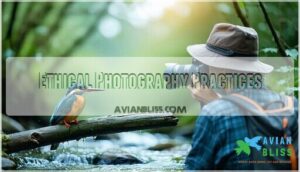
Your camera’s capabilities mean nothing if you’re disrupting the very subjects you’re trying to photograph, so responsible bird photography starts with understanding that wildlife welfare trumps any shot.
You’ll capture far better images when birds remain calm and natural, which happens only when you maintain respectful distances, avoid sensitive nesting areas, and let patience guide your approach rather than forcing dramatic moments.
Respecting Bird Habitats
Protecting bird habitats starts with understanding your environmental footprint during photography sessions.
Ethical distance and conservation awareness go hand-in-hand when accessing bird sanctuaries and natural areas.
Here’s how to respect wildlife through responsible practices:
- Maintain designated trails – Stick to established paths to prevent habitat preservation issues and minimize trampling of sensitive vegetation areas.
- Avoid nesting disruption – Keep cameras silent during breeding seasons and never approach active nests or roosting sites.
- Consider feeding impact – Don’t alter natural food sources or use bait that could create dependency or behavioral changes.
- Practice ethical bird photography – Research local regulations and seasonal restrictions before visiting bird photographic access points.
Minimizing Disturbance
You’ve learned about respecting bird habitats, but that’s just the foundation.
Ethical bird photography means avoiding stress on your subjects through quiet observation and minimal impact techniques.
Keep your distance, move slowly, and never chase birds for better shots.
Respecting wildlife means understanding that their comfort matters more than your perfect photograph, ensuring ethical considerations guide every decision.
This approach is crucial for maintaining a positive and respectful relationship between photographers and the birds they capture, emphasizing the importance of minimal impact techniques.
Patient Photography Approach
Beyond respecting habitats, patience transforms ordinary bird photography into extraordinary art.
The waiting game demands observation skills that reveal when birds will move, feed, or display. You’ll discover that quiet movements and maintaining respectful distance create authentic photographic opportunities.
- Study bird behavior patterns before raising your camera
- Practice anticipating behavior through careful observation
- Master the art of stillness while waiting for perfect moments
Frequently Asked Questions (FAQs)
How do overcast conditions affect bird photography?
Overcast skies become your soft-box, diffusing harsh sunlight into even illumination that reduces shadows and highlights intricate feather details.
You’ll capture richer textures, but colors may appear muted compared to golden hour’s warm glow.
What metering modes work best for backlit birds?
Spot metering becomes your absolute lifesaver when photographing backlit birds.
It’ll measure light directly on your subject, preventing underexposure while those glowing backgrounds stay beautifully bright, giving you perfectly exposed feathers every time, with spot metering being crucial for this outcome.
When should manual mode be used instead?
You’ll want manual mode when lighting stays consistent, like overcast days or shaded areas.
It prevents exposure fluctuations between shots, letting you lock in settings and focus purely on composition and timing.
How to handle mixed lighting forest environments?
Use spot metering to expose for your bird’s feathers, not the bright canopy gaps.
Dial in +1/3 to +2/3 exposure compensation to lift shadows.
Position yourself where dappled light hits your subject’s eye for natural catchlight and depth.
What white balance settings suit different times?
Dawn’s amber glow demands daylight white balance (5200K), while noon’s harsh rays need auto settings.
You’ll capture truer feather colors during golden hour with daylight mode, but switch to auto when clouds roll in unexpectedly.
Conclusion
Mastering these bird photography tips natural light techniques will transform your images from snapshots to stunning works of art.
You’ll capture feathers that shimmer with golden warmth, eyes that sparkle with life, and wings that freeze mid-flight with crystal clarity.
Natural light becomes your greatest ally when you understand its rhythms and moods.
Practice these methods consistently, and you’ll discover that extraordinary bird photographs aren’t just lucky accidents—they’re the result of patient observation and technical skill.
You’ll find that with time and practice, natural light will enhance your photography, making each image a unique and captivating piece of art.
- https://www.imogenwarrenphotography.net/
- http://www.featheredphotography.com/blog/2017/03/06/the-significance-of-catch-lights-in-bird-photography/
- https://birdphotographylife.com/bird-photography-tips-lighting-conditions/
- https://www.audubon.org/news/how-compose-perfect-bird-photo
- https://www.digitalcameraworld.com/buying-guides/best-lenses-for-bird-photography