This site is supported by our readers. We may earn a commission, at no cost to you, if you purchase through links.
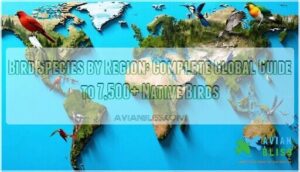 Different regions around the world support wildly different bird communities, thanks to their unique landscapes and climates. North America is home to more than 900 species, everything from those colorful warblers flitting through eastern forests to tough desert birds that thrive in the scorching Southwest.
But even that impressive number pales next to the Neotropics, which absolutely dominates the bird world with 3,400 species. That’s nearly half of every bird species on the planet.
Island chains like the Galápagos showcase evolution in action, while wetlands and grasslands foster specialized communities. Climate change is reshuffling these patterns, with some species expanding northward while others struggle to adapt.
Places like Colombia, Madagascar, and Hawaii are losing birds fast as their habitats disappear.
What’s fascinating is how tracking these patterns shows us that the cardinal in your yard might share migration routes with exotic species from thousands of miles away.
Table Of Contents
Key Takeaways
- You’ll discover that the Neotropical region dominates global bird diversity with 3,400 species—that’s 41% of all birds on Earth, making Central and South America the ultimate birding destination.
- You can predict which birds you’ll see by understanding habitat patterns—wetland specialists stick to marshes, forest canopy birds prefer specific climate zones, and urban adapters thrive in cities worldwide.
- You’re witnessing dramatic population shifts as climate change pushes species northward at 1.5 kilometers yearly, while habitat loss threatens critical migration corridors that millions of birds depend on.
- You’ll find conservation hotspots in places like Colombia, Madagascar, and Hawaii where unique endemic species face urgent threats from development, invasive species, and climate impacts.
North American Bird Species by State
North America hosts over 900 bird species across its 50 states—from Alaska’s arctic terns to Florida’s roseate spoonbills.
Each state showcases unique species that have adapted to local habitats, whether you’re watching desert roadrunners dart across Arizona landscapes or listening to woodland warblers sing through Vermont’s forests.
Eastern United States Endemic Species
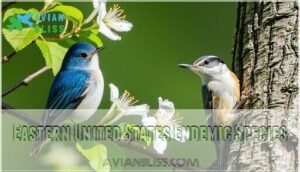
The Southeast is home to some incredible bird species you won’t find anywhere else. Take the Cerulean Warbler singing high in Appalachian treetops, or the quirky Brown-headed Nuthatch that’s perfectly at home in coastal pine forests.
Each of these birds has evolved special traits that help them thrive in their specific corner of the eastern states.
You’ll find plenty of eastern birds making themselves at home in suburbs and cities these days.
But the birds that need specific habitats? They’re facing real pressure from development and climate shifts.
Understanding regional bird identification patterns helps protect these distinct bird species populations across eastern forests and coastal ecosystems.
Western Mountain and Desert Birds

Out in the American West, mountains and deserts become home to some truly remarkable birds that have mastered life in extreme conditions. Desert Adaptations here aren’t just survival tricks—they’re evolutionary masterpieces.
Take the Mountain Endemics you’ll encounter at higher elevations. Rosy-finched Flocks brave frigid alpine zones most birds can’t handle, while Pinyon Jays work these rugged landscapes like they own the place. But even these tough Regional wildlife champions are struggling. Development keeps chewing up their territory, and shifting climate patterns are rewriting the rules they’ve lived by for millennia.
The Western Migration routes tell an incredible story of endurance, linking breeding grounds high in the mountains to winter refuges across vast desert stretches. Understanding these Bird habitats and ranges makes identification so much easier—elevation and rainfall basically draw the map for you.
Conservation Efforts are racing to protect the corridors these birds depend on. Species Maps show just how precisely elevation and precipitation carve out each species’ niche in this unforgiving but spectacular landscape.
Great Lakes Region Waterfowl

The Great Lakes region serves as a major waterfowl migration corridor, with over 350 bird species relying on these waters as critical stopover sites each spring.
You’ll find waterfowl migration highways crossing the Great Lakes region, where over 350 bird species use these waters as critical stopover sites each spring.
Regional wildlife includes mallards, wood ducks, and blue-winged teal nesting in glacial potholes and bottomland forests.
Habitat loss and pollution impacts threaten these birds, making conservation efforts essential for protecting waterfowl species during their seasonal journeys.
Pacific Coast Seabirds

Along the Pacific Coast, you’ll encounter an amazing variety of seabirds that call these waters home. California’s regional wildlife includes pelicans diving for their seabird diet, while breeding colonies of cormorants cover rocky headlands.
Species identification becomes easier when you know brown pelicans from elegant terns.
Coastal conservation efforts help protect these birds from oil spills and plastic ingestion threats that endanger their survival during your bird species exploration.
Arctic and Subarctic Species

Arctic adaptations help bird species survive harsh tundra habitats where temperatures drop below freezing. Alaska hosts notable examples like Snowy Owls and Gyrfalcons. These species show unique migratory patterns, with some staying year-round while others migrate south.
Climate impacts threaten traditional ranges as warming temperatures shift habitat boundaries. Range maps reveal changing distributions. Conservation challenges grow as ice melts and prey availability shifts, making bird identification and species exploration increasingly important for monitoring population health.
Global Hotspots for Bird Diversity
Five key regions hold over 70% of the world’s bird species, with the Neotropical region topping the charts at 3,400 species.
You’ll find the world’s richest bird diversity in just five key regions that house over 70% of all known species.
The Neotropical region leads with 3,400 species, while Southeast Asia, Madagascar, Australia, and New Zealand each offer unique collections of endemic birds you can’t see anywhere else on Earth.
Neotropical Region Species Richness

The Neotropics? It’s basically birder paradise. We’re talking about 4,600 species crammed into Central and South America – that’s nearly half of all birds on Earth in one incredible region.
The Neotropical region stands as Earth’s foremost birding destination, hosting around 4,600 species across Central and South America. This represents 41% of global avian diversity packed into one striking region.
- Colombia leads with 1,829 recorded species – more than any other country
- Brazil and Peru follow closely with 1,780 and 1,897 species respectively
- Amazon Avifauna includes countless undiscovered tropical migrants
- Andean Birds showcase noteworthy Neotropical Endemism at high elevations
Conservation Challenges threaten this astounding diversity, making bird species exploration and birding location discovery more urgent than ever. Researchers are using validated data to improve conservation decision guidance.
Southeast Asian Forest Birds

Southeast Asia’s forests harbor over 308 Endemic Species, but they’re facing a crisis. Deforestation Impact has eliminated 50% of original forest cover, with Logging Threats proceeding at 1.3% annually. Habitat Loss affects 89% of forest birds, while wildlife trade compounds the problem. Your bird database searches reveal 41% show declining populations. This is exacerbated by the fact that palm oil production is a major cause of deforestation in the region.
Conservation Efforts focus on protecting remaining fragments before 90 species vanish by 2100.
Madagascar Endemic Species

Madagascar’s evolutionary isolation creates peerless endemism drivers among bird species. You’ll find over 110 endemic birds on this island, representing 44% of all native species. Habitat loss threatens these unique populations, making conservation efforts critical for protecting lemur interactions and adaptive evolution patterns that shaped Madagascar’s remarkable ornithology landscape.
- The Madagascar Pochard was rediscovered after being presumed extinct, with fewer than 100 individuals remaining
- Five bird families including vangas and ground-rollers exist nowhere else on Earth
- Over 90% of forest specialist birds are endemic, the highest rate of any large island globally
- Forty-two species face global threats, with 25% of all Madagascar bird species at risk of extinction
Australian Continental Birds

Australia’s continent hosts around 830 bird species, with Australian Endemism reaching 45%. You’ll find Outback Birds like the Rainbow Lorikeet and Galah thriving in arid regions, while Coastal Species include pelicans and terns.
Introduced Species impact native taxonomy and distribution information. Conservation Efforts focus on protecting subspecies from habitat loss and invasive competitors threatening Australia’s unique avifauna.
New Zealand’s Unique Avifauna

New Zealand stands apart as nature’s laboratory for Endemic Birdlife evolution. You’ll find flightless birds like kiwis and kakapo that developed without mammalian predators. Introduced Predators now threaten 80% of native species, making Conservation Efforts critical. Habitat Loss compounds these challenges. Avibase provides extensive taxonomy and distribution information for ornithological research.
- Imagine a world where birds forgot how to fly—that’s New Zealand’s striking story
- Every kiwi egg has only a 5% survival chance in the wild today
- Sixteen flightless species still call these islands home despite overwhelming odds
Island and Archipelago Bird Communities

Islands work like isolated laboratories where birds develop fascinating evolutionary traits.
You’ll find that islands create natural laboratories where bird species evolve in wondrous ways.
These isolated habitats produce some of the world’s most unique birds, from the Galápagos finches that helped Darwin understand evolution to Hawaii’s colorful honeycreepers.
Galápagos Endemic Species
Twenty-nine endemic species call the Galápagos home, making any field guide essential for proper bird identification. You’ll spot Darwin’s finches with their specialized beaks showing evolutionary adaptations to different food sources.
Volcanic impacts shaped these islands, creating unique habitats.
Conservation challenges from introduced species threaten native populations. Range maps in wildlife ID guides help track these notable birds across the archipelago’s diverse ecosystems.
Hawaiian Native and Introduced Birds
Hawaii’s unspoiled islands host 50 native bird species, yet introduced species now dominate the landscape. Endemic Hawaiian Birds face severe Conservation Challenges from Habitat Loss and Avian Diseases brought by non-native competitors.
- Native honeycreepers like the ‘I’iwi struggle with mosquito-borne diseases
- Introduced mynas and cardinals outcompete native species for food sources
- Range maps show dramatic shrinking of endemic species territories
- Habitat Loss from development threatens remaining native bird populations
- Bird identification guides help distinguish natives from introduced species
Caribbean Island Specialties
Caribbean islands showcase exceptional Island Endemism with 185 unique species found nowhere else. You’ll discover todies on Greater Antilles and the distinctive Palmchat on Hispaniola.
Habitat Loss threatens these treasures, while Invasive Species disrupt ecosystems.
Conservation Initiatives aid populations, though Ecotourism Impact requires careful management. Regional species exploration and Wildlife identification guides help spot specialties.
Mediterranean Island Endemics
Mediterranean islands showcase exceptional Island Bird Evolution with unique species shaped by isolation. You’ll find treasures like Corsican Nuthatch and Cyprus Warbler. These specialized birds face threats from Habitat Loss Impacts and Introduced Species. Wildlife identification guides help birders spot these endemic gems during Insular Birding Tourism adventures. Conservation Strategies focus on protecting critical habitats across these island hotspots.
- Corsican Nuthatch – France’s only endemic bird species
- Cyprus Warbler – breeds on Cyprus, migrates south
- Cyprus Wheatear – second endemic songbird of Cyprus
- Corsican Finch – shared between Corsica and Sardinia
- Marmora’s Warbler – Mediterranean scrubland specialist
Pacific Island Seabirds
Across the Pacific, remote islands harbor some of the world’s most extraordinary Endemic Seabirds that depend entirely on Island Conservation efforts. You’ll find massive Breeding Colonies on protected atolls where millions of albatrosses, petrels, and boobies nest safely.
However, these Bird species face growing Climate Impacts from rising seas and severe storms. Plastic Ingestion kills thousands yearly as birds mistake debris for food.
Your birding checklists should include checking bird identification resources to spot these threatened specialists during bird sightings.
Habitat-Based Regional Distribution Patterns
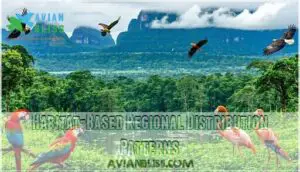
Birds pick their homes based on where they can find food and safe spots to nest.
You’ll find that different bird species choose specific habitats based on their feeding needs and nesting requirements.
Understanding these habitat patterns helps you predict which species you’re likely to spot in wetlands, forests, grasslands, cities, and coastal areas around the world.
Wetland and Marsh Species
You’ll find wetland and marsh species showcase remarkable Marsh Bird Adaptations across Regional Wetland Variations worldwide. These specialized waterbirds face growing Wetland Habitat Loss and Invasive Marsh Species challenges, making Waterbird Conservation efforts critical for birdwatching enthusiasts seeking bird species information through wildlife identification guides.
Key wetland bird categories include:
- Wading birds like herons and egrets
- Rail species in dense vegetation
- Diving ducks and grebes
- Shorebirds along muddy edges
Forest Canopy Birds by Climate Zone
Forest canopy birds show considerable climate influence across different zones. Tropical rainforests harbor the highest canopy biodiversity with colorful toucans and parrots. Temperate forests nurture woodpeckers and nuthatches in distinct forest strata. Boreal regions feature hardy species like crossbills. Climate change threatens these habitat specialists as temperature shifts alter their traditional ranges.
| Climate Zone | Key Canopy Species |
|---|---|
| Tropical Rainforest | Toucans, Parrots, Tanagers |
| Temperate Deciduous | Woodpeckers, Nuthatches, Vireos |
| Boreal Coniferous | Crossbills, Siskins, Kinglets |
| Mediterranean | Warblers, Flycatchers, Bee-eaters |
| Cloud Forest | Quetzals, Hummingbirds, Wrens |
Grassland and Prairie Specialists
Open spaces hide exceptional regional species adapted to life without trees. Prairie bird decline reaches 53 percent, making these grassland habitat loss survivors incredibly special.
Over 60 percent of native grasslands have vanished. Specialist adaptations like ground nesting and fire ecology relationships help these birds thrive.
Conservation strategies now focus on preserving remaining habitat for regional species exploration and protecting these resilient animal and plant species.
Urban-Adapted Regional Species
Thriving in concrete jungles, urban birds have mastered city life like seasoned residents. House Sparrows and European Starlings dominate city park birds, while Rock Pigeons claim building nesting spots.
Urban bird feeders attract Cardinals and Blue Jays year-round.
Birders use specialized checklists to track introduced urban species and urban migration patterns. These adaptable survivors turn skyscrapers into cliffs and streetlights into perches.
Coastal and Marine Birds
When scanning coastal waters, you’ll spot seabirds facing new challenges from human activities. These marine specialists depend on healthy ocean ecosystems, but Coastal Habitat Loss threatens nesting sites while Plastic Pollution Effects disrupt Marine Bird Diets.
Three critical conservation concerns include:
- Oil Spill Impacts destroying waterproof feathers
- Climate change altering Seabird Migration patterns
- Overfishing reducing food sources
Avibase provides Bird species information and Bird conservation status data, helping track these Habitat changes affecting coastal populations.
Conservation Status Across Bird Regions
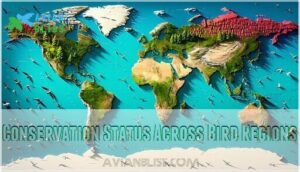
Bird populations are struggling worldwide. Since 1970, some regions have lost nearly 30% of their species across every continent.
You’ll discover that bird populations face serious challenges across every continent, with some regions losing nearly 30% of their species since 1970.
Understanding these conservation patterns helps you identify which birds need protection most and where you can make the biggest difference through your birding activities.
Population Decline Trends by Continent
Continental Loss Rates reveal alarming trends across every region. North America’s lost nearly three billion birds since 1970, while Europe’s farmland species declined 40% between 1990-2022.
Agricultural Impacts and Habitat Destruction drive these patterns, with Africa’s raptors facing 90% population drops.
Conservation Efforts struggle against Climate Effects as Bird species information shows specialist migrants suffering steepest declines in Conservation Status.
Climate Change Impact on Range Shifts
Birds are on the move like never before. As temperatures rise, entire species pack up and head north—we’re talking about 1.5 kilometers every single year.
It’s like watching a slow-motion exodus driven by one simple need: finding cooler places to call home.
Climate shifts are reshaping where birds live across the globe. You’ll find species moving north at 1.5 kilometers yearly as they chase cooler temperatures.
Habitat loss makes these journeys harder, while shifting migration patterns create timing mismatches with food sources.
Species adaptation varies widely—some birds expand their range successfully, while others can’t keep up with rapid changes.
Endangered Species Regional Hotspots
Bird populations face their greatest challenges in specific regions where habitat loss and poaching threats converge. Conservation efforts now target these critical areas where species lists show alarming declines. Here’s where you’ll find the most urgent conservation status alerts:
- Colombia harbors nearly 2,000 species with 140 nationally threatened
- Madagascar is home to 115 endemic birds with 37 facing extinction risks
- Indonesia ranks third globally with 126+ threatened species
- Australia contains 20% of world’s endangered parrots
- Hawaiian Islands host highest U.S. concentration of critically endangered birds
Explore hotspots where genetic diversity hangs by a thread.
Threats Facing Migratory Corridors
Migration routes face mounting pressures that threaten bird populations worldwide. Habitat loss from development fragments critical stopover sites, while climate change disrupts timing and food availability. Human development creates deadly obstacles through buildings and light pollution impact. Conservation efforts focus on protecting these corridors, but challenges persist.
| Threat Type | Primary Impact | Affected Species |
|---|---|---|
| Habitat Loss | Stopover site destruction | 100+ Afro-Eurasian migrants |
| Climate Change | Resource timing mismatch | All long-distance migrants |
| Light Pollution | Navigation disruption | 100M-1B birds annually |
| Infrastructure | Physical barriers | Urban-adapted species |
Understanding these threats helps bird identification resources and ornithology research guide conservation status assessments for vulnerable migratory populations.
Frequently Asked Questions (FAQs)
What birds migrate through specific geographic corridors?
Think you’re tired of traffic jams? Try being a warbler! Birds use four main highways in North America: Atlantic, Mississippi, Central, and Pacific flyways, creating predictable routes for millions of feathered travelers moving between breeding and wintering grounds.
Which species thrive in urban environments globally?
You’ll find house sparrows, rock pigeons, and European starlings dominating cities worldwide. Peregrine falcons now use skyscrapers as nesting sites, while barn swallows and crows have mastered urban living.
How do seasonal patterns affect regional distributions?
Seasonal changes drive major shifts in bird distributions as species follow food sources, breeding grounds, and favorable weather.
You’ll see northern species move south in winter, while others chase insect blooms across continents.
What birds indicate healthy ecosystem conditions regionally?
You’ll spot healthy ecosystems by watching for woodpeckers, raptors, and songbirds that need diverse habitats. These species respond quickly to environmental changes and reflect overall ecosystem health .
Which species require cross-border conservation coordination?
Nearly half of all migratory species face population decline. You’ll find Arctic Terns, Whooping Cranes, and Sandhill Cranes need international cooperation across North America’s flyways.
Conclusion
Picture a living tapestry woven across continents, where each thread represents countless winged travelers finding their perfect home. Understanding bird species by region opens your eyes to nature’s amazing diversity—from Colombia’s 1,800+ species to Madagascar’s unique evolutionary showcase.
Understanding bird species by region reveals nature’s incredible diversity, from Colombia’s 1,800+ species to unique evolutionary showcases worldwide
You’ve discovered how geography shapes avian communities, creating distinct neighborhoods for different birds. Whether you’re watching backyard visitors or planning birding adventures, this regional knowledge helps you appreciate the striking connections between local habitats and global migration patterns.
Every region tells its own feathered story.
- http://mailto:hello
- http://merlin.allaboutbirds.org/
- https://www.audubon.org/news/audubon-researchers-publish-key-study-conserve-bird-diversity-neotropics
- https://www.exoticbirding.com/neotropical-birding/country-comparisons.html
- https://www.frontiersin.org/journals/ecology-and-evolution/articles/10.3389/fevo.2021.697511/full