This site is supported by our readers. We may earn a commission, at no cost to you, if you purchase through links.
North America hosts over 900 bird species, yet most people walk past dozens of them without registering anything beyond “small brown bird.” That gap between seeing and identifying is where birding gets interesting.
A bird’s bill tells you what it eats. Its leg color narrows the family. The way it pumps its tail while perching can name the species before you even lift your binoculars.
This bird species identification guide cuts through the noise—field marks, vocalizations, digital tools, and the trickier stuff like juvenile plumages and look-alikes that trip up even experienced observers.
Table Of Contents
- Key Takeaways
- Essential Bird Identification Techniques and Methods
- Key Field Marks for Accurate Species Identification
- Digital Tools and Field Guides for Bird ID
- Common North American Bird Species Profiles
- Advanced Identification Challenges and Solutions
- Frequently Asked Questions (FAQs)
- What are the 4 keys to bird identification?
- How are bird identification guides organized?
- What are the 5 S’s of birding?
- What is the best bird identification book?
- How do seasonal plumage changes affect identification?
- What lighting conditions provide optimal bird photography?
- Which binoculars work best for beginner birdwatchers?
- How does weather impact bird activity patterns?
- What ethical guidelines should birders follow outdoors?
- How do weather conditions affect bird identification accuracy?
- Conclusion
Key Takeaways
- Bird identification relies on stacking multiple independent field marks—bill shape, wing bars, tail markings, leg color, and behavior—rather than trusting any single visual clue.
- Digital tools like Merlin Bird ID now identify species in seconds through photo analysis and sound recognition, while print field guides and online databases like eBird give you deeper context on range, habitat, and seasonal patterns.
- A bird’s bill shape directly reveals its diet and foraging strategy, making it one of the most reliable identification shortcuts before you even check plumage or listen for calls.
- Seasonal plumage changes, juvenile feathers, and look-alike species create the toughest identification challenges, so confirming with structure, habitat, and behavior becomes essential when colors and patterns shift or overlap.
Essential Bird Identification Techniques and Methods
Identifying a bird comes down to reading the clues it gives you in the moment. The more techniques you have in your toolkit, the faster those clues start to make sense.
From eye rings and wing bars to tail shape, key bird-watching field marks explained give you a sharper eye for spotting those clues in real time.
Here are the core methods that’ll sharpen your eye and ear in the field.
Observing Physical Characteristics and Size
Size is your first clue. Compare the bird to something familiar — is it sparrow-sized or closer to a crow? From there, work through its bird anatomy systematically. Check body shape and wing span. Note tail length and beak size. Even leg proportions tell a story.
Then look at bird plumage — feather patterns, coloration, bare parts like eye rings. These field marks stack up fast, giving you solid bird identification tips grounded in what you actually see. You can sharpen your skills further by studying to quickly distinguish between different species.
Analyzing Behavioral Patterns and Habits
Once you’ve logged the shape and size, behavior becomes your next lens. Bird behavior analysis often clinches an ID when field marks fall short. Watch how a bird moves and feeds — these foraging strategies are surprisingly species-specific:
- Woodpeckers cling vertically and hammer; nuthatches spiral headfirst down bark
- Sandpipers probe mud steadily; plovers run, stop, and snatch
- Diving ducks vanish below the surface; mallards tip-up, tails high
- Territorial displays peak in spring, with males returning to the same song posts
Daily activity rhythms matter too. Flocking behavior tells its own story — tight, wheeling groups signal certain blackbirds; scattered feeders suggest something else entirely. These bird identification techniques cost nothing but attention. Some species may join mixed-species flock formations with birds of similar foraging behavior, which can offer additional clues for accurate identification.
Recognizing Vocalizations and Bird Calls
Behavior gives you a solid footing, but sound takes bird identification to another level. Each species has its own vocalization types — songs claim territory, calls signal danger. Most bird songs sit between 2 and 8 kHz, which is why they cut through background noise so cleanly.
Pay attention to pitch patterns and frequency analysis: is the call rising, falling, or flat? Spectrogram tools make those shapes visible. Apps with call recognition, like Merlin, match recordings instantly and help you identify birds by ear with real confidence.
Understanding Habitat and Geographic Range
Sound gets you far, but knowing where a bird lives seals the ID. Habitat Preferences and geographic range narrow your options fast — before you even raise your binoculars.
Here’s what shapes a bird’s range:
- Range Maps in field guides show breeding, wintering, and year-round zones by season
- Geographic Barriers like mountain ranges split look-alike species across regions
- Migration Patterns and Endemic Species ties reveal which birds belong — and which don’t
Key Field Marks for Accurate Species Identification
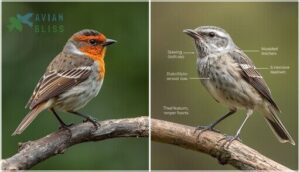
Every bird carries a set of physical clues that, once you know what to look for, make identification much easier. These field marks are the real building blocks of accurate birding.
Here are the key ones worth focusing on.
Bill Shape and Size Variations
A bird’s bill is one of the most reliable field marks you’ll ever use. Bill structure tells you what a bird eats, where it feeds, and sometimes even how it behaves. These morphological traits are the result of bill evolution shaped over millions of years — and they’re yours to read in the field.
Once you can read bills, feathers, and markings together, the full picture snaps into focus — this bird identification characteristics guide walks you through each trait in plain, practical terms.
A bird’s bill reads like a field guide — millions of years of evolution visible at a glance
Hummingbirds carry bills 15–25% longer than frugivores, built precisely for tubular flowers. Raptors have hooked bills designed to tear meat. Warblers carry thin, straight bills for plucking insects. Each beak function reflects a feeding adaptation you can spot at a glance.
| Bill Type | Shape | Example |
|---|---|---|
| Seed-cracking | Short, conical | House Finch |
| Nectar-feeding | Long, curved | Ruby-throated Hummingbird |
| Meat-tearing | Hooked, strong | Red-tailed Hawk |
Recognizing these avian physical characteristics sharpens your bird species identification and identification skills fast.
Plumage Patterns and Coloration
Feathers are one of your best tools for avian identification. Color sources fall into three categories: melanins for blacks and browns, carotenoids for yellows and reds, and feather nanostructures that produce iridescent colors like vivid blues.
Plumage variation shifts with seasons too — breeding birds wear brighter field marks than their winter counterparts. Understanding molt patterns and these color sources helps you lock in bird species identification with real confidence.
Wing Bars and Tail Markings
Wing bars and tail markings are like signposts on a bird — once you know how to read them, your identification speed doubles. Wing bars form when pale feather tips create stripes across the folded wing, and their number matters: two, one, or none each points to different species.
Tail spots, meanwhile, can look mostly dark from above but nearly white from below. Watch both views before making your call.
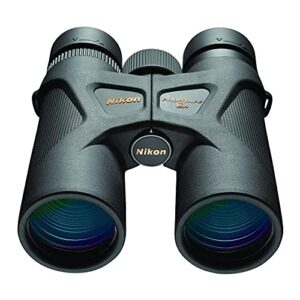
- Multilayer-coated lenses and silver-alloy mirror coatings deliver bright, sharp, true-color images — great for picking out fine details like feather patterns and tail spots.
- Waterproof, fogproof, and filled with nitrogen, so they hold up on early morning hikes or unexpected rain without missing a beat.
- Turn-and-slide eyecups make them comfortable for eyeglass wearers, and focusing is smooth and easy to dial in on a moving bird.
- Low-light performance takes a hit, so dawn and dusk birding sessions — when many species are most active — may leave you wanting more brightness.
- The lens caps feel cheap for a premium product, which is a small but annoying letdown right out of the box.
- The diopter ring can be stiff and hard to adjust, which gets frustrating when you need a quick correction in the field.
Leg Color and Body Proportions
Legs don’t lie. When plumage looks the same on two birds, leg color often breaks the tie — yellow versus black can be the deciding field mark. Shorebirds make this especially clear, where subtle gray, flesh, or pink tones separate similar sandpipers at a glance.
Pair leg color with body shape analysis: a tall, long-legged silhouette points toward waders, while compact proportions suggest songbirds.
Build your identification skills by scanning head to toe, locking in multiple field marks before naming the bird species.
Digital Tools and Field Guides for Bird ID

The right tools can make all the difference when you’re standing in a field trying to name a bird before it flies off. Luckily, there’s no shortage of resources built specifically to help you get there faster.
Here are some of the best digital tools and field guides worth keeping in your kit.
Merlin Bird ID and AI-Powered Apps
Your smartphone is now one of the most powerful bird ID tools in the field. Merlin Bird ID uses machine learning to help you identify birds three ways:
- Snap a photo for instant Bird Photo ID analysis
- Record calls with Sound Recognition in under two seconds
- Answer a quick quiz based on size, color, and location
- Access offline species packs for field use without data
- Link sightings to eBird’s citizen science database
This AI Birding platform covers Bird Species Identification across six continents, making Merlin Features genuinely useful whether you’re a beginner or a seasoned observer.
Comprehensive Print Field Guides
Print field guides still hold their ground. A guide like National Geographic’s 8th edition packs 4,000 Visual Plates, detailed Species Accounts, and eBird-powered Range Maps across 1,150 species into one weather-resistant book. Guide Organization puts field marks within seconds of your fingertips — no signal needed. Print Durability means it survives rough days outdoors.
Nearly half of birders pair print field guides with apps, blending both bird identification methods for sharper bird species identification.
Online Databases and Sound Libraries
Beyond a field guide’s pages, online databases open up a world of sound. The Macaulay Library houses over two million digital recordings spanning roughly 10,000 species — a resource that transforms how bird identification works in practice. Xeno-canto adds 575,000 more, each tagged with location and habitat data.
What makes these platforms genuinely useful for your bird ID skills:
- Spectrogram analysis lets you see a song’s shape while you listen
- Macaulay Library audio guides download cleanly for offline field use
- Bird calls are filtered by region, matching local dialects
- Bird sounds pair directly with images for faster confirmation
- Sound archives support Merlin’s real-time identification engine
Explore online birding courses that use these same libraries — learning by ear sticks faster than you’d expect.
Regional Species Checklists and EBird Data
eBird Tools take regional checklists further than any sound library can. Pull a hotspot list for your county, and you’ll see every bird species reported there — sorted by what’s showing up right now. Species Filters narrow results by location and season, while Bar Chart Data shows weekly frequency patterns across North American Birds.
| eBird Feature | What It Shows | Bird Watching Benefit |
|---|---|---|
| Hotspot Lists | Species at specific sites | Target birds before you arrive |
| Bar Chart Data | Weekly frequency trends | Know peak arrival windows |
| Species Filters | Seasonally filtered results | Focus your Species Identification |
Regional Checklists make Bird Identification sharper, faster, and grounded in real local data.
Common North American Bird Species Profiles
North America is home to thousands of bird species, and knowing where to start makes all the difference. A few key groups show up most often — whether you’re scanning your yard, a wetland, or an open sky.
Here’s a look at the ones you’re most likely to encounter.
Backyard Birds and Feeder Visitors

Your backyard habitat is one of the easiest places to start bird species identification. Northern Cardinals, House Finches, and American Goldfinches are among the most common North American bird species at feeders.
Feeder types matter — nyjer tubes draw goldfinches, while platform feeders attract Mourning Doves below.
Smart feeder placement, fresh bird seed, and basic bird safety practices keep your bird watching rewarding all year.
Raptors and Birds of Prey

From feeder birds to the sky’s top hunters — raptors are a whole different challenge. Raptor identification starts with flight patterns: Red-Tailed Hawks soar in wide circles on broad, fanned tails, while accipiters like Cooper’s Hawks flap-and-glide through dense trees.
Identifying raptors means reading their hunting tactics too — watch how they perch, dive, or hover. Raptor migration brings thousands through hawk-watch ridges each fall, making bird species identification both exciting and surprisingly achievable.
Waterfowl and Shorebirds

Wetlands and coastlines are where waterfowl and shorebird identification really sharpens your skills. These birds reward close attention — Beak shapes alone tell a story. A Northern Shoveler’s spoon-shaped bill strains surface water, while a sandpiper’s long, probing bill digs through mudflats.
Watch for these reliable field marks:
- Mallards show iridescent green heads and a purple speculum in feather patterns
- Northern Pintails carry unmistakable needle-thin tail feathers
- Killdeer display two bold black breast bands and bright bird leg color
- Western Sandpipers show rufous-toned backs during waterfowl migration season
- Hooded Mergansers reveal a striking expandable white crest in shorebird habitat
Bird species identification here means reading behavior, body proportions, and field marks together.
Songbirds and Warblers

North America is home to over 50 warbler species, each adapted to specific habitat zones. Songbird plumage plays a crucial role in identification, with features like thin streaks, eye rings, and feather patterns distinguishing species beyond size alone. Bird vocalization recognition is equally important, as many warblers remain hidden within foliage.
| Species | Key Field Marks |
|---|---|
| Yellow Warbler | Bright yellow, cinnamon breast streaks |
| Black-and-White Warbler | Bold striped pattern, creeping behavior |
| Northern Parula | Short tail, thin pointed bill |
Advanced Identification Challenges and Solutions

Some birds look so alike that even seasoned birders do a double-take. Knowing where the tricky spots are makes all the difference between a confident ID and a long walk home wondering.
Here’s where the real challenges show up — and how you can work through each one.
Distinguishing Similar Species and Look-Alikes
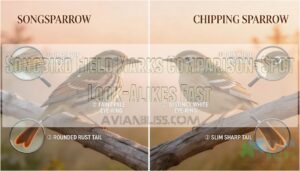
Some birds are nearly twins. Subtle plumage differences, bill proportions, and head markings are what separate lookalikes like Purple Finch from House Finch. Species differentiation gets easier once you know what to look for. Use these key field marks for birds as your checklist for sharper visual identification:
- Compare bill shape and length
- Check crown and eyebrow patterns
- Note breast streaking or clean coloring
- Observe belly and flank markings
- Confirm geographic range for similar species
Identifying Birds in Flight and at Distance
A bird half a mile out tells its story through shape, not color. Silhouette ID and Wingbeat Styles are your sharpest tools at distance. Turkey Vultures rock on a shallow V; crows flap steadily. These flight patterns reveal species before field marks ever come into focus.
| Distant Viewing Cue | What It Tells You |
|---|---|
| Wing shape | Lifestyle and bird species group |
| Wingbeat rhythm | Narrows identification skills quickly |
| Tail-to-wing ratio | Separates similar bird behavior |
Recognizing Juvenile and Seasonal Plumages
Young birds don’t look like their parents — that’s your first challenge with juvenile plumage. Fluffy feathers and streaky underparts are the clearest field marks for age identification.
Molting cycles begin within weeks of hatching, and seasonal coloration can shift dramatically between breeding and winter. Feather wear fades edges over time, changing plumage patterns entirely.
Watch for mixed fresh and worn feathers — that signals a first-year bird species.
Using Multiple Field Marks for Confirmation
One field mark isn’t enough — think of it as a single clue in a bigger case. Reliable bird identification means stacking independent evidence until the picture is clear. Your Confirmation Techniques should combine at least three traits that don’t depend on each other:
- Bill shape and body proportions tell you about structure
- Wing bars, tail markings, and plumage coloration confirm the finer details
This kind of Field Mark Analysis sharpens your Identification Strategies fast. Diagnostic Features like head pattern paired with leg color are your strongest Verification Methods — your key field marks for birds that separate one species from another with confidence.
Frequently Asked Questions (FAQs)
What are the 4 keys to bird identification?
There are four keys to bird identification: size and shape, color patterns, behavioral traits, and habitat analysis.
Together, these identification techniques help you recognize field marks and bird calls across any bird species you encounter.
How are bird identification guides organized?
Most guides follow a taxonomic layout, grouping related families like waterfowl, raptors, and warblers together.
Visual indexes, quick keys, and navigation aids help you find field marks and sharpen your identification skills fast.
What are the 5 S’s of birding?
The 5 S’s of birding—Shape, Shade, Size, Sound, and Space—form your core field marks.
These silhouette recognition and sound identification tools help you identify bird species quickly, whether you’re watching backyard visitors or distant shorebirds.
What is the best bird identification book?
Choosing the right birding resources feels like finding your anchor in a sea of wings. The Sibley Guide to Birds balances depth with usability through detailed illustrations covering 900+ North American species—perfect for serious identification work at home or car-based bird watching resources.
How do seasonal plumage changes affect identification?
Molt cycles transform field marks dramatically. Spring breeding colors fade to dull winter tones, especially in warblers and shorebirds.
You’ll need to rely on structure, behavior, and consistent traits when seasonal plumage variation obscures identification skills.
What lighting conditions provide optimal bird photography?
Less light often works better—golden hour and soft lighting reveal feather detail lost in midday sun.
Natural light near sunrise and sunset helps you capture bird species with rich color and clear behavioral features.
Which binoculars work best for beginner birdwatchers?
You’ll get steady, bright views with 8×42 binoculars — the magnification shows detail without amplifying hand shake, while 42-millimeter lenses gather enough light for dawn outings.
Look for close focus distance around six feet and ergonomic design with twist-up eyecups.
How does weather impact bird activity patterns?
Weather shifts bird behavior daily. Cold mornings drive small songbirds to feeders early to replace fat reserves. Light rain slows activity briefly, while heavy storms send birds to shelter. Wind changes migration routes.
Understanding temperature effects, rainfall patterns, wind impact, climate shifts, and storm responses helps you predict when and where to find active bird species during your outings.
What ethical guidelines should birders follow outdoors?
Ethical birding practices center on minimizing disturbance. Avoid playback overuse, stay back from nests, and respect laws and property boundaries.
Additionally, share locations carefully and support habitat protection to guarantee wildlife conservation and community courtesy.
How do weather conditions affect bird identification accuracy?
Poor visibility from fog, rain, and cloud cover washes out field marks by up to 90 percent. Wind alters flight patterns. Snow blends silhouettes. Detection rates drop 50 percent in challenging conditions.
Conclusion
Like learning a new language, this bird species identification guide approach gets easier the more you practice. Your eyes will start catching field marks automatically—the flash of white in a tail, the subtle eye ring, the foraging rhythm.
You won’t need to consult every reference or second-guess each sighting. The birds were always there. Now you’ll actually see them, know them, and understand the distinctions that make each species unmistakable in the field.
- https://www.allaboutbirds.org/news/bird-id-skills-field-marks/
- https://www.aba.org/field-identification-of-subspecies/
- https://www.flockingaround.com/post/how-to-identify-a-bird
- https://indianaaudubon.org/2025/07/01/birding-101-how-to-identify-a-bird/
- https://www.thelookoutaz.com/weekly-articles/understanding-using-range-maps