This site is supported by our readers. We may earn a commission, at no cost to you, if you purchase through links.
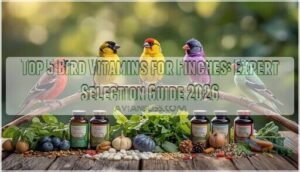
Your finch just regurgitated its breakfast for the third morning this week—and you’re wondering if that discount seed mix was really the bargain you thought. Seed-based diets lack critical micronutrients, leaving 60-70% of companion finches chronically deficient in vitamins A, D3, and calcium despite appearing outwardly healthy.
These deficiencies don’t announce themselves with dramatic symptoms; instead, they erode immune function, weaken bones, and compromise feather quality over months before you notice respiratory distress or skeletal deformities.
Selecting species-appropriate bird vitamins for finches requires understanding your bird’s baseline diet, life stage demands, and the biochemical roles of each vitamin—because generic “bird supplements” often deliver incorrect ratios or potentially toxic doses for small passerines.
Table Of Contents
Key Takeaways
- Seed-based finch diets lack critical vitamins A, D3, and calcium—leaving 60-70% of companion finches chronically deficient despite appearing healthy, which silently erodes immune function, bone strength, and feather quality over months before visible symptoms emerge.
- Fat-soluble vitamins (A, D3, E, K) accumulate in liver tissue and cause severe toxicity when overdosed—hypervitaminosis A triggers liver scarring while excess D3 calcifies kidneys and soft tissues, making precise dosing and avoiding supplement combinations essential.
- Supplement selection must match your finch’s baseline diet and life stage—seed-fed birds need calcium and vitamins A/D3 supplementation while pellet-fed finches require minimal additions, and breeding hens demand higher nutrient levels than molting juveniles.
- Weekly body weight monitoring (watching for 10% loss), droppings consistency checks, and feather quality assessments allow you to catch nutrient imbalances early and adjust supplementation before deficiencies progress to irreversible organ damage or secondary infections.
Essential Vitamins for Healthy Finches
Your finch’s health hinges on a tight-knit group of vitamins that regulate everything from bone strength to immune response. Without adequate levels of vitamins A, D3, E, K, and the B-complex group, you’ll start seeing telltale signs—from feather plucking to curled toes—that signal something’s off.
Early detection matters—watching for subtle finch nutritional deficiency signs can help you catch vitamin imbalances before they escalate into serious health issues.
Let’s break down which vitamins your finch actually needs, what each one does, and how to spot a deficiency before it becomes a real problem.
Getting these nutrients from a well-balanced finch diet is the foundation, but vitamins play a starring role in keeping everything running smoothly.
Key Vitamins Needed by Finches
Your finch needs a precise roster of vitamins to thrive—not guesswork, but evidence-based finch nutrition that bolsters avian wellness at every level. Bird vitamins fall into two categories:
During molting periods especially, choosing safe, nutrient-dense foods becomes critical to support feather regrowth and immune function.
- Fat-soluble vitamins (A, D3, E, K) regulate vision, calcium absorption, antioxidant defense, and blood clotting—but carry vitamin toxicity risks when overdosed
- Water-soluble B-complex vitamins power energy metabolism and nervous system function with safer margins
- Mineral cofactors work synergistically through vitamin interactions to maintain finch health
Understanding these nutrients and ensuring adequate vitamin D3 supplements protects your bird’s long-term health.
Roles of Vitamins A, D3, E, K, and B-Complex
Each vitamin plays a distinct role in your finch’s biology. Vitamin A defends epithelial barriers—respiratory, digestive, and renal—against infection while supporting vision and reproduction. Vitamin D3 orchestrates calcium homeostasis, regulating intestinal absorption, bone mobilization, and renal reabsorption. Vitamin E shields cell membranes from oxidative damage, safeguarding feather quality and fertility. Vitamin K activates coagulation factors, preventing hemorrhage. B-complex vitamins drive energy metabolism—thiamine for neural function, biotin for carboxylase reactions—ensuring sturdy avian health.
Understanding the role of vitamins in maintaining peak health is vital for providing a balanced avian nutrition plan.
| Vitamin | Primary Role |
|---|---|
| A | Epithelial integrity, immune defense, vision |
| D3 | Calcium absorption, bone strength, beak health |
| E | Antioxidant protection, reproductive performance |
Common Signs of Vitamin Deficiencies in Finches
When baseline nutrition falls short, your finch signals distress through predictable physical changes. Respiratory issues—nasal discharge, sneezing, crusted nostrils—flag vitamin A deficiency. Feather problems such as dull coloration and brittle plumage point to vitamin E or general malnutrition. Beak deformities and neurological signs like ataxia reveal vitamin D3 or B-complex gaps. Recognizing these vitamin deficiencies early allows you to correct imbalances with targeted avian vitamin and mineral supplements before secondary infections take hold.
- White oral plaques indicate chronic hypovitaminosis A
- Limb weakness or ataxia suggests vitamin E or thiamine deficiency
- Overgrown, flaky beaks signal vitamin A or protein imbalance
Choosing The Right Finch Vitamin Supplement
Not every finch needs the same vitamin support—your bird’s diet and life stage determine what works. A seed-fed finch has different gaps than one eating fortified pellets, and a breeding hen requires nutrients a molting juvenile doesn’t.
Before adding anything to their water or feed, check avian vitamin requirements to avoid doubling up on nutrients your finch already gets.
Here’s what you need to evaluate before choosing a supplement for your finch.
Matching Supplements to Finch Diet and Life Stage
You can’t fix what you don’t understand—and your finch’s nutritional gaps depend entirely on what’s already in the bowl and where they’re in life. Seed-fed birds need calcium and mineral supplements, while pellet-based diets often contain adequate avian vitamin and mineral supplements. Breeding finches demand higher vitamin A and calcium than nonbreeding adults—supplement timing matters.
| Diet Type | Primary Vitamin Needs | Life Stage Considerations |
|---|---|---|
| Seed-based | Vitamin A, D3, calcium | 57.8% consume inadequate vitamin A |
| Pellet-based | Minimal supplementation | Formulated for nutrient balance |
| Breeding birds | Increased A, D3, calcium | Critical for egg production |
Forms of Supplements: Liquid, Powder, Tablet
Supplement administration comes down to three main formats—each with distinct dosage control advantages. Liquid vitamins mix into drinking water or food, delivering fast-absorbing nutrients flock-wide; powder formulations adhere to moist diets for targeted intake; tablet benefits include slow-release minerals via self-regulated pecking.
Your choice hinges on flock size, housing, and whether you need precise individual dosing or convenient group coverage.
Quality Markers: Certifications and Ingredient Transparency
GMP certification and third-party testing guarantee that your finch supplement meets documented batch-control protocols and contaminant-free standards—look for NASC seals confirming independent lab analysis.
You’ll find more guidance on evaluating supplement quality and other preventive care steps in this finch health care tips resource.
Ingredient transparency matters: compliant labels list every added vitamin by name (vitamin A supplement, vitamin E supplement) in descending weight order, enabling you to verify nutrient content and avoid unapproved additives that pose toxicity risks.
Top 5 Bird Vitamins for Finches
You’ve narrowed down what your finches need—now it’s time to look at specific products that deliver those nutrients safely and effectively.
The supplements below represent formulations designed for small birds, each offering different nutrient profiles and administration methods.
Here’s what you should know about each option before making your selection.
1. Oasis Probiotic Bird Health Tablets
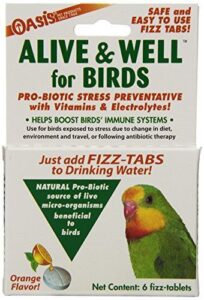
Oasis Alive & Well Effervescent Tablets combine probiotics, vitamins, and electrolytes in a water-soluble format designed specifically for small caged birds—including your finches. You’ll dissolve one tablet in approximately 4 ounces of drinking water, replacing this supplemented solution every 24 hours to maintain probiotic viability and prevent bacterial contamination.
The formulation targets bird immunity and digestive health during stressful periods: travel, environmental changes, or breeding cycles. While marketed broadly for avian health supplements, finch-specific efficacy data from controlled trials remain unavailable in published retail materials.
| Best For | Finch and small bird owners looking for an easy way to support their pets’ immune and digestive health during stressful times like travel, breeding, or environmental changes. |
|---|---|
| Form | Tablet |
| Target Species | Small caged birds |
| Life Stage | All stages |
| Primary Benefit | Immune support |
| Weight | 0.634 oz |
| Origin | USA |
| Additional Features |
|
- Dissolves directly in drinking water, making it simple to give finches probiotics and vitamins without the hassle of measuring powders or forcing medication
- Combines multiple benefits in one tablet—probiotics for gut health, vitamins for immunity, and electrolytes for hydration support
- Specifically formulated for small caged birds like finches and canaries, with clear dosing instructions (one tablet per 4 ounces of water)
- Some users report the tablets don’t dissolve well and need to be crushed manually before adding to water
- No finch-specific clinical trial data available to confirm effectiveness, with claims based on general “caged bird” results
- Results seem inconsistent across users, with some reporting no noticeable improvement in their bird’s health
2. Vitofarma Bird Vitamin Supplement
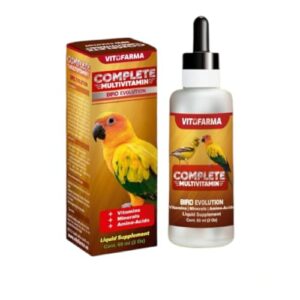
Vitofarma Bird Evolution delivers a complete spectrum of vitamins, minerals, and amino acids targeting immune system stimulation, plumage quality, and appetite support—particularly valuable for finches recovering from illness or molting stress.
You’ll administer 3–4 drops directly into the beak or mixed into dry seed for reliable dosing in small species.
The liquid format includes thiamine (vitamin B1), cobalamin (B12), folic acid, biotin, and iron, covering key nutritional gaps in seed-dominated finch diets without the fat-soluble vitamin toxicity risks seen with excessive supplementation.
| Best For | Finch owners looking for a liquid multivitamin that’s easy to dose directly into the beak or mix with seed, especially during molting, illness recovery, or winter months when birds need extra immune support. |
|---|---|
| Form | Liquid |
| Target Species | Small breed birds |
| Life Stage | All stages |
| Primary Benefit | Immune support |
| Weight | 2 oz |
| Origin | Not specified |
| Additional Features |
|
- Simple dosing for small birds—just 3–4 drops into the beak or mixed with food makes it practical for finches that don’t reliably drink supplemented water.
- Covers key nutritional gaps with water-soluble B vitamins, folic acid, biotin, and iron that finches on seed-heavy diets often lack.
- Supports immune function and feather quality during high-stress periods like molting, illness recovery, or post-antibiotic treatment.
- Requires careful measurement and direct administration for tiny birds, which can be tricky if your finch is skittish or hard to handle.
- Results vary by individual bird—some may show noticeable plumage improvement while others respond less dramatically.
- No specific safety data or side effect warnings provided, so consulting an avian vet before starting supplementation is smart.
3. Hari Mineral Block For Birds

Calcium deficiency drives egg binding, skeletal deformities, and metabolic disorders—making Hari Mineral Block for Birds essential for finches on seed-heavy diets.
This block delivers 36.3–40.8% calcium carbonate plus dried vegetables (carrot, parsnip, leek), supporting bone health, eggshell formation, and nerve function while doubling as beak conditioning enrichment.
You’ll clip it to cage bars for ad libitum access, letting your finch self-regulate intake through natural scraping and chewing—satisfying foraging instincts without the toxicity risks of fat-soluble vitamins.
| Best For | Finches and small birds on seed-based diets that need calcium supplementation for bone health, egg laying, or beak maintenance. |
|---|---|
| Form | Block |
| Target Species | Small birds |
| Life Stage | All stages |
| Primary Benefit | Bone health |
| Weight | Not specified |
| Origin | Not specified |
| Additional Features |
|
- High calcium content (36.3–40.8%) supports strong bones, eggshell formation, and proper nerve function without oversupplementation risks
- Encourages natural beak trimming and foraging behavior through scraping and chewing, keeping birds mentally stimulated
- Includes cage clip for clean, easy mounting—plus dried vegetables add flavor variety beyond plain mineral blocks
- May not mount flush against all cage bar designs, potentially leaving gaps or unstable positioning
- Some customers report receiving cracked or damaged blocks during shipping
- More expensive than basic cuttlebone alternatives, though it offers additional nutrients and enrichment features
4. Vitakraft Egg Food Supplement for Birds
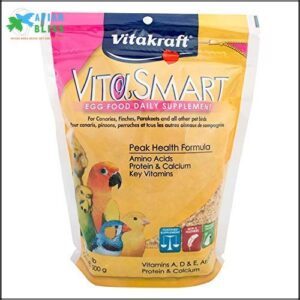
Your finch won’t eat pellets, and that seed-only diet just set up a nutritional minefield—which is where Vitakraft Egg Food Supplement for Birds steps in as your safety net.
This vitamin-enriched crumble delivers 17.5% protein, 49,940 IU/kg vitamin A, and 4,400 IU/kg vitamin D3 through dried egg, honey, and fortified grains, targeting the deficiencies plaguing 57.8% of seed-fed cage birds.
You’ll sprinkle 2 tablespoons daily over seed or moisten it into a crumble texture finches devour—especially during molting, breeding, and stress when amino acid and calcium demands spike beyond maintenance levels.
| Best For | Finch and canary owners whose birds refuse pellets and need targeted vitamin A, D3, and protein support beyond seed-only diets, especially during molting, breeding, or stress periods. |
|---|---|
| Form | Seeds |
| Target Species | All bird species |
| Life Stage | All stages |
| Primary Benefit | Daily nutrition |
| Weight | 1.1 lbs |
| Origin | Not specified |
| Additional Features |
|
- Delivers 17.5% protein plus guaranteed vitamins A, D3, E, and B-complex that seed diets lack, addressing the nutritional gaps in 57.8% of seed-fed birds
- Flexible serving options—sprinkle dry over seed or moisten into a crumble—make it easy to adapt to picky eaters and mix with medications when needed
- Specifically formulated for high-demand life stages like molting and breeding with added lysine, methionine, and calcium for feather and bone health
- Priced higher than basic supplements, which adds up for multi-bird households or long-term daily use
- Packaging quality issues reported by some buyers, including damaged or open containers upon delivery
- Requires daily preparation if moistened, with leftovers needing refrigeration and removal within 24 hours to prevent spoilage
5. Oasis Vita Drops Multivitamin for Small Birds
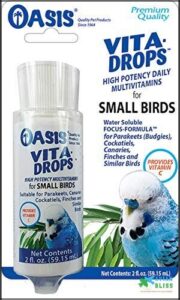
When your finch barely sips water, you need precision—that’s why Oasis Vita Drops Multivitamin for Small Birds delivers 2,960 IU vitamin A and 1,480 IU vitamin D3 per fluid ounce through a dropper bottle designed for finch-scale dosing. This liquid supplement format ensures accurate vitamin dosage without the guesswork tablets demand—critical when 98.5% of seed-fed birds fall short on vitamin D3.
You’ll add just 1 drop per 2 ounces of drinking water daily, replacing it every 1–3 days to maintain potency, or place drops directly onto moist foods if water intake drops.
| Best For | Finch, canary, and small bird owners who need precise vitamin dosing through drinking water, especially for seed-heavy diets lacking vitamin D3 and A. |
|---|---|
| Form | Liquid |
| Target Species | Small birds |
| Life Stage | All stages |
| Primary Benefit | Growth support |
| Weight | 2 oz |
| Origin | USA |
| Additional Features |
|
- Dropper bottle delivers exact 1-drop-per-2-ounces dosing for finches—no crushing tablets or measuring powders when water intake is minimal.
- Packs 2,960 IU vitamin A and 740 mg vitamin C per fluid ounce to address the most common deficiencies in seed-fed small birds.
- Flexible application lets you add drops directly to moist foods when birds aren’t drinking enough water.
- Diluted water must be replaced every 1–3 days to maintain vitamin potency, adding daily maintenance compared to weekly powder schedules.
- Ingredient concentrations are trade secrets, so you can’t verify exact per-drop nutrient levels against your bird’s specific needs.
- Liquid format requires refrigeration after opening for longest shelf life, unlike stable powder supplements.
Safe Supplementation Practices for Finches
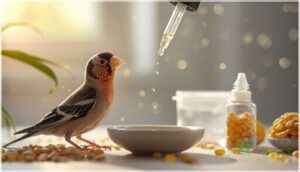
You’ve picked out a quality vitamin supplement—now you need to use it correctly. Even beneficial vitamins become dangerous when administered improperly, and finches are particularly vulnerable to dosing errors due to their small body size.
Let’s walk through the essential practices that keep supplementation safe and effective for your birds.
Proper Dosing and Administration Methods
Accurate vitamin mixing separates safe supplementation from nutritional chaos. You’ll protect pet bird health by following species-specific dosing schedules—most water supplements for finches require 1 cubic centimeter per 3 ounces of drinking water, replaced daily. Consider supplement rotation to balance intake:
- Mix vitamin A, vitamin D3, and vitamin E formulations 1–3 times weekly in fresh water
- Apply powdered bird vitamins to moist food at measured rates
- Use oral administration with calibrated droppers for precise individual dosing
Risks of Over-Supplementation and Toxicity
Too much of a good thing becomes poison—fat-soluble vitamins like A, D3, E, and K accumulate in your finch’s liver and tissues, where they trigger cascading damage long before you spot the warning signs.
Fat-soluble vitamins accumulate in your finch’s liver and tissues, triggering cascading damage long before symptoms appear
Hypervitaminosis A causes crusty eyelids, weight loss, and liver scarring. Vitamin D3 overdose deposits calcium in kidneys and soft tissues—calcifying vessels, destroying renal function, and killing birds through gout.
You’ll prevent avian poisoning by never doubling doses or mixing multiple vitamin supplements simultaneously.
Monitoring Finch Health and Adjusting Supplementation
Preventing vitamin toxicity demands vigilant health indicators tracking—you’ll weigh your finch weekly on a gram scale, watching for 10-percent body-weight loss that signals nutrient imbalance requiring immediate supplement adjustments.
Monitor these parameters to maintain ideal finch vitamins and bird health and nutrition:
- Droppings consistency and color shifts indicating malabsorption or over-supplementation
- Feather quality deterioration suggesting vitamin deficiencies or toxicity
- Behavioral changes—aggression, self-mutilation, lethargy—prompting finch supplements reassessment
- Life-stage transitions (molt, breeding, illness recovery) requiring temporary pet bird vitamins modifications
- Base diet composition alterations that eliminate need for continued supplement adjustments and ensure toxicity prevention through nutrient balance verification
Frequently Asked Questions (FAQs)
Can finches get vitamins from fresh foods alone?
While vibrant vegetables and fruits deliver essential nutrients, your finch won’t thrive on fresh food alone—seed-heavy diets commonly fall short on vitamin A, D3, and calcium, creating dangerous nutritional gaps that targeted supplements fill.
How does lighting affect vitamin D3 needs?
Natural sunlight drives vitamin D3 synthesis through UVB exposure, while indoor lighting blocks essential wavelengths—window glass filters out UVB completely.
Without adequate UVB, your finch requires higher dietary vitamin D3 to prevent deficiencies.
Do breeding finches need different vitamin amounts?
Regarding reproductive needs, breeding finches are in a different ballgame—they require higher vitamin dosage for vitamin D3, E, and B-complex to support egg production, fertility, and chick development successfully.
Should water-soluble vitamins be given daily or weekly?
Water-soluble vitamins aren’t stored long-term in finches, so you’ll need them several days per week—not necessarily daily unless your bird’s diet lacks balance or the product label specifically directs continuous use.
Can multivitamins replace a balanced finch diet?
No—multivitamins fill nutrient gaps but can’t supply complete protein, essential fatty acids, or fiber. Seed-only diets supplemented with vitamins remain deficient, risking malnutrition and over-supplementation toxicity in finches.
Conclusion
Feather-fluffing finches flourish when you fortify their diets with species-specific micronutrients—not guesswork disguised as generic supplements.
Your selection of bird vitamins for finches determines whether subclinical deficiencies progress to irreversible organ damage or whether your flock maintains sturdy immune function through breeding seasons and molts.
Match supplement form to your management style, dose conservatively using body weight calculations, and monitor droppings weekly for the subtle shifts that signal emerging problems before they require veterinary intervention.
- https://www.ladygouldianfinch.com/why-supplement.aspx
- http://www.finchinfo.com/diet/nutritional_requirements.php
- https://www.avi-sci.com/DIETS/CanaryFinchDiets.html
- https://www.vitakraft.com/us/en/product-world/birds/sunseed-vita-prima-canary-finch-food-2-lb-87535597649
- https://pmc.ncbi.nlm.nih.gov/articles/PMC3126843/