This site is supported by our readers. We may earn a commission, at no cost to you, if you purchase through links.
 You’ll capture stunning bird photos with the right bird watching camera settings.
Typically, you’ll use fast shutter speeds, medium to high apertures, and low to medium ISOs, depending on the lighting and type of photography.
For instance, you might use a shutter speed of 1/1000th of a second to freeze a bird’s wings.
By adjusting these settings, you’ll be well on your way to taking pro-like photos, and with a few more tweaks, you can discover the secrets to truly exceptional bird photography.
Table Of Contents
- Key Takeaways
- Bird Photography Basics
- Camera Mode Settings
- Focusing and Autofocus
- Optimal Camera Settings
- Advanced Camera Techniques
- Frequently Asked Questions (FAQs)
- What camera setting is best for birding?
- What ISO should I use for birding?
- What should my shutter speed be for bird photography?
- What AF mode should I use for bird photography?
- What lens is best for bird photography?
- How to handle camera in cold weather?
- Can I use flash for bird photos?
- What about camera settings for nocturnal birds?
- How to protect camera from rain outdoors?
- Conclusion
Key Takeaways
- You’ll capture stunning bird photos by adjusting your camera’s shutter speed, aperture, and ISO settings to suit the lighting and type of photography you’re doing.
- To freeze a bird’s motion, you’ll want to use a fast shutter speed, like 1/1000th of a second, and you can also use the panning technique for more dramatic shots.
- You’ll need to master different autofocus modes, such as back-button autofocus or continuous AF mode, to quickly and accurately focus on your feathered subjects.
- When it comes to camera settings, you’ll want to use Manual Mode with Auto ISO and exposure compensation for ideal birding camera settings, and don’t be afraid to experiment with different ISOs, shutter speeds, and apertures to find what works best for you.
Bird Photography Basics
You’ll need to master three fundamental camera settings to capture stunning bird photos that truly showcase these magnificent creatures.
Mastering camera settings is key to capturing stunning bird photos
Understanding how shutter speed, aperture, and ISO work together will transform your bird photography from blurry snapshots into frame-worthy images.
That capture every feather detail and moment of natural behavior.
Shutter Speed Techniques
Freezing motion is your secret weapon, especially for sharp bird flight shots.
Start with a fast shutter speed—try 1/3200 for birds in flight—and lean on Shutter Priority mode for quick changes.
Get close, keep a steady grip, and practice the panning technique.
Bird proximity and precise camera settings are what keep feathered subjects crisp, not a blurry memory.
Aperture and Depth of Field
With aperture, you’re the artist.
Dial it wide open—think f/4 or f/5.6—for creamy background bokeh and subject isolation.
Want more environmental sharpness? Stop down a notch to hit your aperture sweet spot, usually around f/6.3.
In bird photography, changing depth of field using aperture priority mode helps you adapt your camera settings to every feathered portrait.
ISO and Exposure Management
You’ve dialed in your aperture—now, tackle ISO and exposure management.
Set your camera to Auto ISO for changing light, use Exposure Compensation to avoid highlight blowout, and watch those overexposed highlights using your histogram.
If you underexpose, don’t sweat it; shadow recovery helps.
For tricky lighting, tweak ISO settings and use noise reduction to maintain exposure balance.
Camera Mode Settings
You’re about to learn how to master camera mode settings for stunning bird photography.
By understanding manual mode with auto ISO, aperture priority mode, and shutter priority mode, you’ll be able to capture perfect shots of birds in various settings and conditions.
Manual Mode With Auto ISO
You’ll master Manual mode with Auto ISO, balancing exposure compensation and dynamic range.
Consistent lighting helps, and metering modes aid noise control, allowing you to adjust ISO, aperture, and shutter speed for ideal camera settings, utilizing Manual mode effectively.
Aperture Priority Mode
You’ll love Aperture Priority Mode for bird watching camera settings, as it balances depth of field and background blur, allowing for creative effects and sharpness balance, all while controlling light with ideal aperture settings and exposure settings in your bird watching camera.
This mode is useful for controlling depth of field, which is a key aspect of achieving the desired visual effects in bird photography with ideal aperture settings and proper exposure settings.
Shutter Priority Mode
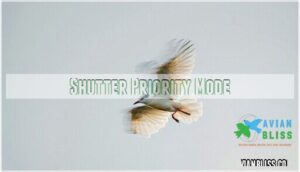
While shutter priority mode gives you direct control over shutter speed for motion capture, it’s not recommended for bird photography.
This mode can create sharpness tradeoffs by forcing narrow apertures in challenging light conditions.
- Aperture Control: Camera automatically narrows aperture, reducing light and sharpness
- Light Limitations: Struggles in low-light situations common during golden hour birding
- Creative Applications: Better suited for intentional motion blur effects than sharp wildlife shots
Focusing and Autofocus
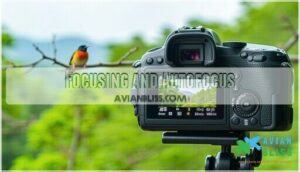
You’re now going to learn about focusing and autofocus techniques that will help you capture sharp images of birds.
By mastering back-button autofocus, mirrorless camera autofocus, and DSLR autofocus techniques, you’ll be able to quickly and accurately focus on your feathered subjects.
Back-Button Autofocus
Manual mode’s flexibility is great, but let’s talk about back-button autofocus—a real game changer for bird photography.
With focus separation, you assign autofocus to a button on the back, not the shutter, giving you control for continuous tracking.
DSLRs shine here, but mirrorless alternatives offer their own customization options.
Consider products for sale to enhance your back button autofocus setup.
Tweak your AF settings for quicker responses and tracking improvements.
Mirrorless Camera Autofocus
You’ll find mirrorless cameras excel in autofocus bird photography, offering superior tracking performance, eye autofocus, and subject detection, with faster autofocus speed, even in low-light AF conditions.
Making them ideal for capturing sharp images of birds in flight or perched, with adjustable AF settings and various focus modes.
For best results, photographers often use continuous autofocus mode to maintain focus on moving subjects, utilizing continuous autofocus to ensure sharp images.
DSLR Autofocus Techniques
Switching from mirrorless to DSLR autofocus bird photography means leaning into focus points and fine-tuning AF modes.
Use backbutton autofocus for snappier shots, set tracking sensitivity based on bird movement, and pick central AF points for quick focusing.
Understanding AF-area modes helps photographers adapt to different shooting conditions.
Explore custom settings for lens stabilization and try burst mode—sometimes, nabbing “the one” feels like playing whack-a-mole with autofocus settings.
Optimal Camera Settings
Getting sharp, vibrant shots of birds means mastering three settings: shutter speed, aperture, and ISO.
You’ll want to adjust these quickly—because birds don’t pose for retakes, no matter how politely you ask.
Shutter Speed for Bird Movement
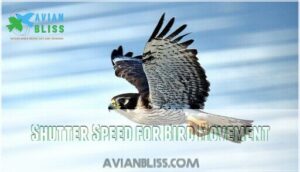
Catching birds mid-flight depends on picking the right shutter speed.
You’ll often want to freeze motion—try 1/3200 for fast flyers, but slow it down and use the panning technique for dramatic motion blur.
With Shutter Priority, let bird speed and lighting guide your bird photography settings.
Experiment, and watch how camera settings for birding shift your results.
- Falcons locked in mid-air
- Egrets gliding, wings sharp
- Ducks “running” across water
- Hummingbirds—check those wings!
- Silhouetted owls at dusk
Aperture for Depth of Field
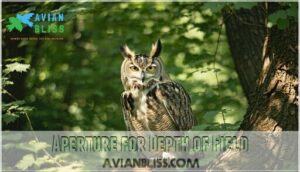
You control depth of field with aperture settings.
| Aperture | Depth of Field |
|---|---|
| f/2.8 | Shallow |
| f/4 | Medium |
| f/5.6 | Medium |
| f/6.3 | Deep |
| f/8 | Deep |
For subject isolation, use a wide aperture.
ISO for Lighting Conditions
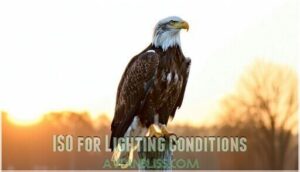
Beyond achieving the right depth of field, mastering ISO settings transforms your bird photography across different lighting conditions.
Your camera’s ISO controls sensor sensitivity, directly impacting image quality and your ability to capture sharp shots.
Here’s your ISO roadmap for various lighting scenarios:
- Sunny Day ISO: Start with ISO 100-400 for crisp, noise-free images in bright sunlight
- Overcast ISO: Bump up to ISO 400-800 when clouds reduce available light
- Low-Light ISO: Push to ISO 800-3200 during golden hour or shaded forest environments
- Auto ISO: Set maximum limits (1600-3200) to prevent excessive high ISO noise
- ISO Noise: Monitor your camera’s sweet spot – most models handle ISO 1600 well before noise becomes problematic
Understanding your camera ISO performance helps you adapt quickly to changing lighting conditions while maintaining image quality through proper high ISO noise reduction techniques.
Adjusting ISO helps balance exposure, but remember that high ISO introduces noise.
Advanced Camera Techniques
Once you’ve mastered the fundamentals, you’ll want to explore advanced techniques that can transform your bird photos from good to exceptional.
These methods require precise timing and technical understanding, but they’ll help you capture images that truly stand out from the crowd, using techniques that can make your photos exceptional.
Panning and Motion Blur
Master the panning technique to create artistic motion blur while keeping your bird subject sharp.
Capture birds in motion with smooth panning technique
Use slower shutter speeds around 1/250 with continuous autofocus as you smoothly track flying birds. This creates stunning background blur and creative effects that showcase movement.
One way to improve is to keep in mind the rule of thirds for subject placement.
The key is maintaining steady camera movement to avoid unwanted camera shake while capturing dynamic panning shots.
Exposure Compensation and Bracketing
Now that you’re panning like a pro, let’s tweak exposure. Use exposure compensation to fine-tune brightness. Metering modes affect exposure settings, so experiment.
Check the histogram and highlight alert to avoid blown highlights. You can find an exposure compensation camera online. Highlight recovery can save overexposed areas.
- Shadow detail is easier to recover than blown highlights.
- Bracketing benefits include capturing a range of exposures.
- Exposure blending combines the best parts of multiple shots.
- Understand your camera’s metering.
Frequently Asked Questions (FAQs)
What camera setting is best for birding?
You’ll want to use Manual Mode with Auto ISO and exposure compensation for ideal birding camera settings, allowing for full control and flexibility in varying lighting conditions.
What ISO should I use for birding?
Cut to the chase, you’ll want to use a low ISO, like 200-400, for best exposure in bright sunlight, or adjust as needed for changing lighting conditions to minimize noise.
What should my shutter speed be for bird photography?
You’ll need a shutter speed of at least 1/1000th of a second for birds in flight, adjusting based on their movement and your focal length for sharp images.
What AF mode should I use for bird photography?
You should use back-button autofocus or continuous AF mode for bird photography, allowing for quick and accurate focusing on your feathered subjects.
What lens is best for bird photography?
When you’re hoping to hit the bullseye, reach for a 500mm or 600mm telephoto lens with fast autofocus.
These lenses let you fill the frame with birds, even from a distance, without scaring them off.
How to handle camera in cold weather?
You’ll want to keep your camera batteries warm and dry, and consider using a camera glove to maintain dexterity in cold weather conditions to guarantee smooth operation.
Can I use flash for bird photos?
You’ll rarely use flash for bird photos, as it can startle them.
But in low-light conditions, a flash with a diffuser can help, though it’s not always the best option available.
What about camera settings for nocturnal birds?
When shooting nocturnal birds, you’ll need higher ISOs, slower shutter speeds, and wider apertures to capture sharp images in low light conditions, don’t be afraid to experiment.
How to protect camera from rain outdoors?
You’ll need a waterproof camera housing or rain cover to protect your gear from rain outdoors, ensuring your device stays dry and functional in wet conditions always.
Conclusion
Mastering bird watching camera settings is like solving a puzzle, you’ll find the right pieces.
You’ll capture stunning shots by adjusting shutter speed, aperture, and ISO.
With practice, you’ll discover the perfect bird watching camera settings for your needs, and it won’t be long before you’re taking pro-like photos with ease, using the right bird watching camera settings that involve adjusting camera settings.