This site is supported by our readers. We may earn a commission, at no cost to you, if you purchase through links.
You can sink thousands into bird watching gear and supplies, but most of it will gather dust in your closet. I’ve watched countless beginners load up on equipment they’ll never use—ultra-premium optics they can’t handle, cameras too complex for field conditions, and accessories that seemed essential until they weren’t.
The truth? You need maybe ten items to succeed, and half of them cost less than dinner for two. The difference between spotting that rare warbler and missing it entirely rarely comes down to having the most expensive binoculars—it’s about having the right tools you’ll actually grab when you head out the door.
What matters is matching your gear to how you actually bird, not how you imagine you’ll bird. Whether you’re chasing pelagic species off windswept coasts or documenting backyard visitors from your kitchen window, the essentials remain surprisingly consistent once you strip away the marketing noise.
Table Of Contents
- Key Takeaways
- Top 10 Bird Watching Gear and Supplies
- 1. Moshi Touchscreen Winter Gloves
- 2. Portable Mosquito Repellent Device
- 3. Binocular Chest Harness Strap System
- 4. Waterproof High Power Monocular Telescope
- 5. Mobile Phone Camera Lens Kit
- 6. Camera Backpack For Daily Use
- 7. Waterproof Birding Journal Notebook
- 8. Wildlife Trail Camera System
- 9. Nikon Monarch High Quality Binoculars
- 10. Canon eos rebel t5i dslr camera
- Essential Optics for Bird Watching
- Bird Photography Equipment and Accessories
- Comfort and Carrying Solutions
- Field Documentation and Identification Tools
- Weather Protection and Outdoor Comfort
- Technology for Backyard Bird Watching
- Choosing Gear for Different Birding Environments
- Maintenance and Care for Bird Watching Equipment
- Frequently Asked Questions (FAQs)
- Conclusion
Key Takeaways
- You only need about ten core items to succeed at bird watching, with quality 8×42 binoculars, a waterproof notebook, and weather-appropriate clothing forming the foundation—most expensive gear ends up unused because beginners buy for an idealized version of birding rather than how they’ll actually use it in the field.
- Optical quality matters more than magnification power, with fully multi-coated lenses providing 20% better light transmission than basic coatings and ED glass eliminating the color fringing that ruins identification of high-contrast plumage details.
- Environment-specific gear makes the difference between frustration and success—coastal birders need spotting scopes with 20-60x magnification for distant shorebirds, while forest watchers require wide-field binoculars to track movement through dense canopy gaps.
- Proper maintenance extends your equipment’s lifespan by decades, with simple practices like using microfiber cloths for lens cleaning, storing optics with silica gel packets to prevent fogging, and managing rechargeable batteries strategically to avoid dead devices during critical migration periods.
Top 10 Bird Watching Gear and Supplies
You don’t need a truckload of fancy equipment to become a capable birder—just the right tools that’ll actually see action in the field. After years of watching enthusiasts waste money on gear that stays in closets, I’ve narrowed down what matters when you’re standing in a marsh at dawn or tracking warblers through dense canopy.
Here are ten items that’ll transform your outings from frustrating guesswork into rewarding observation.
1. Moshi Touchscreen Winter Gloves
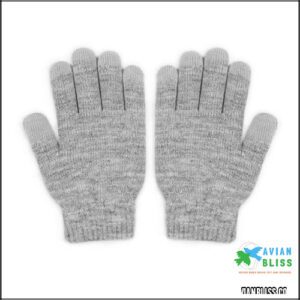
You won’t get far on a winter birding expedition with frozen fingers fumbling your phone. That’s where Moshi Touchscreen Winter Gloves come in—dual-layer knit with microfleece lining keeps your hands warm while conductive fingertips let you tap field apps without missing a beat.
The GripTrak palm pattern grips binoculars and cameras securely, and they’re surprisingly dexterous for outdoor gear. Hand washable and available in three sizes, they balance winter comfort with the finger dexterity serious birdwatching gear demands.
Best For: Bird watchers and outdoor enthusiasts who need to use touchscreen devices in cold weather without sacrificing warmth or grip.
- All ten fingertips work on touchscreens with good accuracy, so you can use field apps and cameras without exposing your hands to the cold.
- GripTrak rubberized palm pattern keeps binoculars, phones, and cameras from slipping, even in wet conditions.
- Microfleece lining and dual-layer knit provide solid warmth for winter outings while maintaining enough dexterity to handle gear.
- Some users find them too thick or bulky for precise tasks, and sizing can run inconsistent depending on hand shape.
- The knit fabric can snag on Velcro straps or rough surfaces, leading to pilling or small holes over time.
- Not fully windproof or suitable for extreme cold or wet conditions—they’re best for moderate winter weather.
2. Portable Mosquito Repellent Device
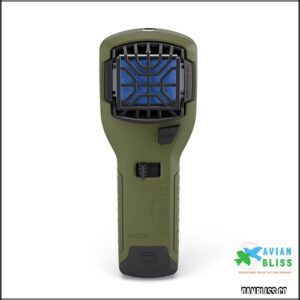
Mosquitoes can turn productive birding sessions into miserable slap-fests, especially during dawn and dusk when both birds and bugs are most active. Portable repellent devices like the Thermacell create a 15-foot protection zone without coating your skin in DEET—essential when you’re stationary at a marsh or woodland edge waiting for warblers.
The scent-free, pet-friendly design won’t spook wildlife, and refillable cartridges last about 12 hours. Just remember that wind reduces effectiveness, so position yourself strategically and complement with spray repellents when you’re moving through heavy vegetation.
Best For: Birders who spend long periods stationary in mosquito-heavy areas like marshes or woodland edges during dawn and dusk.
- Creates a 15-foot scent-free protection zone that won’t spook wildlife or require applying chemicals directly to your skin.
- Pet-friendly and DEET-free formula makes it safer for use around animals and avoids the greasy feel of traditional sprays.
- Refillable cartridges provide up to 12 hours of coverage, perfect for extended birding sessions without constant reapplication.
- Wind can significantly reduce the protection zone’s effectiveness, requiring careful positioning and backup spray repellent.
- Refill cartridges and mats add ongoing costs that can become expensive for frequent outdoor users.
- Not 100% effective against all mosquito species, and some users report mixed results depending on local insect populations.
3. Binocular Chest Harness Strap System
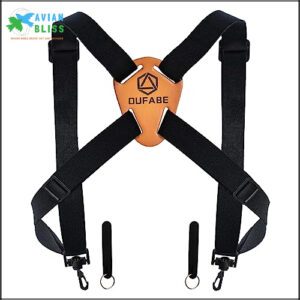
Nothing drains your enthusiasm faster than a throbbing neck after three hours of tracking thrushes. Traditional straps concentrate your binoculars’ weight on vulnerable vertebrae, but a chest support strap system redistributes that load across your shoulders and back—field testers report up to 50% less perceived weight during long hikes.
The X-shaped ergonomic design keeps your optics secure and accessible against your chest, eliminating bounce while you scramble up ridgelines. Look for breathable support materials with reinforced stitching that’ll survive hundreds of on-off cycles without losing tension.
Best For: Birders, hunters, and hikers who spend hours in the field and want to eliminate neck strain while keeping their binoculars secure and ready to use.
- Cuts perceived weight by up to 50% during long outings by spreading the load across your shoulders and back instead of your neck.
- X-shaped design keeps binoculars stable against your chest, so they don’t bounce around when you’re moving through rough terrain.
- Quick access means you can grab your optics in under three seconds without fumbling with straps or clips.
- The elastic straps can lose their stretch over time, especially with daily use in the field.
- Thin leather connectors may wear out faster than the rest of the harness, requiring replacement or repair.
- Setup instructions can be confusing at first, so expect a learning curve when you’re figuring out the adjustments.
4. Waterproof High Power Monocular Telescope
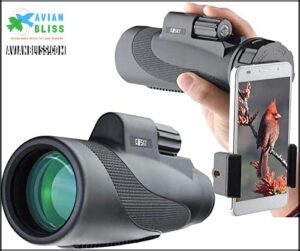
Sometimes you want binoculars’ optical clarity without the bulk—that’s where a waterproof high power monocular shines. Models with 12x magnification and 50mm objective lenses deliver bright, detailed views while weighing under a pound, perfect for long treks where every ounce matters.
BAK-4 prisms and multi-coated telescope lenses guarantee true colors even in challenging light. The waterproof designs handle rain, fog, and dust without compromising performance, and most include smartphone adapters for quick field documentation.
It’s birdwatching equipment that adjusts to your pace.
Best For: Hikers, birdwatchers, and travelers who need lightweight, durable optics that deliver sharp magnification without the weight of binoculars.
- Waterproof, fog-proof, and shockproof construction handles rough weather and outdoor conditions without losing optical clarity.
- 12x magnification with 50mm objective lens and BAK-4 prism delivers bright, detailed views even in low light.
- Includes smartphone adapter for capturing photos and videos, plus weighs under a pound for easy all-day carrying.
- Image quality can soften at maximum zoom levels, especially without tripod stabilization for steady shots.
- Smartphone holder doesn’t fit all phone models securely and can be tricky to align properly for digiscoping.
- Some users find extended handheld use tiring due to weight distribution and may need frequent breaks or a tripod mount.
5. Mobile Phone Camera Lens Kit
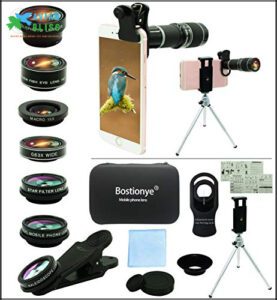
Your smartphone’s camera unlocks serious birding potential with the right telephoto lens kit—think 20x magnification reaching 600mm focal length for capturing distant warblers without hauling bulky digital photography equipment. Universal clip-on systems adapt to most phones, turning everyday outdoor photography into legitimate bird watching equipment.
Over 80% of birders report better species identification from mobile lens quality shots, while smartphone optics paired with bird photography tips and mobile apps deliver solid results at a fraction of traditional phone camera accessories costs. Quick-mount systems mean you won’t miss that fleeting moment.
Best For: Budget-conscious birders and casual wildlife observers who want extended zoom capability without investing in professional camera gear or carrying heavy equipment on trails.
- Turns your existing smartphone into a 20x magnification birding tool for around $30—way cheaper than the $500 you’d spend on entry-level spotting scopes or dedicated cameras.
- Clip-on design means you can pack it light and attach it in seconds when a bird appears, which matters when you’re hiking and don’t want to lug around bulky gear.
- Over 80% of users report actually identifying more species from their photos compared to using their phone’s native camera alone.
- Image quality drops in low light conditions like dawn or dusk when birds are most active, since these attachments can’t gather light as well as real birding optics.
- Aligning the lens with your phone’s camera—especially if you’ve got multiple rear cameras—can be fiddly, with about 22% of users struggling to get sharp focus.
- Manual focus means you’re slower tracking moving birds compared to autofocus binoculars or scopes, so fast-flying species are tougher to capture.
6. Camera Backpack For Daily Use
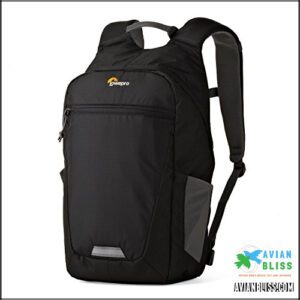
You need a camera backpack that actually moves with you in the field—16-liter designs with body-side access let you grab your mirrorless gear without removing the pack while tracking a warbler’s movement. Look for ergonomic design with moisture-wicking padding and convertible camera protection compartments that transform into standard daily storage when you’re not shooting.
Travel security features matter too: TSA-approved locks and RFID-blocking pockets protect your photography gear during those cross-country birding trips, while proper backpack materials guarantee your optical equipment survives unpredictable weather.
Best For: Photographers and content creators who need quick camera access during daily activities, travel, or outdoor adventures without carrying a bulky, obvious camera bag.
- Body-side hatch access lets you grab your camera without taking off the pack, perfect for capturing spontaneous moments on the move.
- Converts easily from camera bag to regular daypack by removing the padded compartment, giving you real versatility for non-shooting days.
- Includes thoughtful travel features like TSA-approved locks, RFID protection, and a rain cover to keep gear safe in various conditions.
- No external attachment points or real hip belt limits your ability to carry extra gear like tripods or water bottles securely.
- The 16-liter capacity won’t accommodate larger DSLR setups or much laptop space, so it’s best for compact mirrorless systems.
- Some durability concerns with stitching and thread wear reported by users over time.
7. Waterproof Birding Journal Notebook
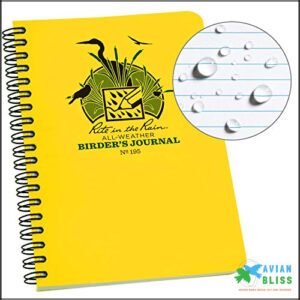
You’ll lose every observation when rain hits unless you’re writing in something built for the field—that’s where waterproof notebooks with Polydura covers and water-resistant paper come in.
The Rite in the Rain Birder’s Journal (4.625″ x 7″, 64 pages) gives you pre-formatted fields for date, location, and species alongside space for field sketching, all while repelling mud and sweat. Wire-O binding keeps pages intact during backcountry hikes, and at around $9-16, these birding logs beat scrambling to protect regular field guides when weather turns.
Best For: Birders and field naturalists who need reliable note-taking gear in wet, muddy, or unpredictable weather conditions where standard notebooks would fall apart.
- Waterproof paper and Polydura cover handle rain, sweat, and mud without your notes disintegrating or smearing in the field.
- Pre-formatted fields for date, location, and species keep observations organized, plus room for quick sketches to document what you’re seeing.
- Wire-O binding stays intact through heavy backpack use and the compact size (4.625″ x 7″) fits in pockets while still giving you decent writing space.
- Only 64 pages means active birders will burn through notebooks quickly and need to buy replacements more often than they’d like.
- Some users find the size awkward—either too cramped for detailed notes or too bulky for minimalist gear setups.
- Costs more than regular notebooks ($9-16), which adds up if you’re going through several per season.
8. Wildlife Trail Camera System
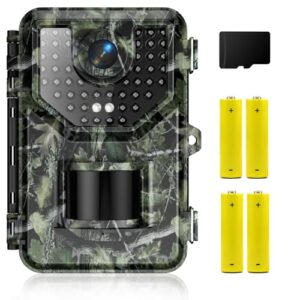
Trail cameras let you monitor bird activity when you can’t be there—feeders, nesting sites, or water sources reveal patterns you’d never catch with binoculars alone.
Modern camera trap systems with 4K 48MP resolution and 0.05s trigger speed capture sharp images across a 130° detection range, while night vision settings using no-glow infrared LEDs extend wildlife observation after dark.
Motion detection tracks visits to 30m, and IP66 waterproof ratings handle weather extremes. Around $200 gets you reliable outdoor gear for serious wildlife monitoring without disturbing your subjects.
Best For: Wildlife enthusiasts and property owners who want hands-free monitoring of bird feeders, game trails, or backyard activity without spending all day outside.
- 4K 48MP resolution and 0.05s trigger speed capture sharp, detailed images of fast-moving wildlife day or night, so you won’t miss quick visits to feeders or nesting sites.
- IP66 waterproof rating and durable build handle rain, snow, and temperature swings, meaning you can leave it outside for months without constant maintenance.
- 130° wide detection range covers large areas up to 30m away, reducing the number of cameras you need for comprehensive property or habitat monitoring.
- Performance drops in extreme weather, and night image quality sometimes falls short of expectations despite the infrared LEDs.
- Some users report reliability issues, screen distortion, and micro-SD card formatting problems that interrupt long-term monitoring.
- Requires 4-8 batteries with no solar option built in, so you’ll need to check and replace batteries every few months depending on usage.
9. Nikon Monarch High Quality Binoculars
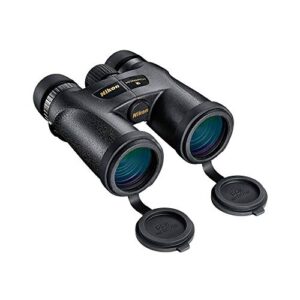
When optical quality and field performance matter, Nikon Monarch binoculars deliver ED glass clarity that transforms bird watching into precision wildlife observation. The 8×42 model offers a 6.4-degree angular field of view with 19.5mm eye relief—perfect for eyeglass wearers tracking warblers through dense foliage.
Dielectric prism coatings and nitrogen-purged waterproofing handle dawn mist to afternoon downpours. Binocular comparison reviews consistently rank Monarch HG models among top outdoor optics for birding techniques requiring sharp detail recognition.
At 2.5-meter close focus, you’ll catch every feather detail during backyard observation sessions.
Best For: Birdwatchers and wildlife enthusiasts who need reliable optics with excellent clarity for extended field use in varying weather conditions.
- ED glass and dielectric prism coatings deliver sharp, high-contrast images with accurate color reproduction for precise bird identification
- Nitrogen-purged waterproof and fog-proof construction handles rain, humidity, and temperature changes without compromising performance
- 2.5-meter close focus distance and 19.5mm eye relief make it comfortable for eyeglass wearers and versatile for both distant and nearby observation
- Some users report a “rolling ball effect” during panning that can cause motion sickness or discomfort
- Stiff diopter adjustment and over-damped focus knob may slow down quick target acquisition in the field
- Eye piece caps fit poorly and adjustment indicators can be too narrow for easy use
10. Canon eos rebel t5i dslr camera

Capturing that fleeting warbler moment demands camera settings you can adjust fast—the Canon EOS Rebel T5i delivers with its 18MP sensor and 9-point cross-type autofocus for sharp wildlife photography. The 5 fps continuous shooting and touchscreen LCD let you track movement through changing light, while lens compatibility with Canon’s telephoto lenses extends your focal length options for distant subjects.
Image quality holds up to ISO 12800, essential for dawn shoots. Scene Intelligent Auto simplifies shooting modes when you’re focused on the bird, not digital photography technicalities.
Best For: Beginner to intermediate bird photographers who want reliable autofocus and lens flexibility without breaking the bank.
- 9-point cross-type autofocus locks onto birds quickly, even in tricky lighting down to EV –0.5, while 5 fps continuous shooting helps you catch flight sequences.
- Compatible with Canon’s entire EF and EF-S lens lineup, so you can add telephoto reach as your birding adventures grow.
- Vari-angle touchscreen makes low-angle shots and awkward compositions easier to frame without lying in the mud.
- No built-in image stabilization means you’ll rely entirely on lens-based IS, which can limit your budget lens options.
- Battery drains fast in Live View mode (180 shots vs 440 through the viewfinder), so you’ll need spares for full-day outings.
- Video recording caps at 29 minutes per clip, which can interrupt longer behavioral observation sessions.
Essential Optics for Bird Watching
Your optics are your gateway to the field—without them, you’re basically wandering around hoping birds land at your feet. The right glass transforms a distant silhouette into a wood thrush checking you out from fifty yards, and trust me, there’s a world of difference between budget binoculars and gear that actually delivers.
Without quality optics, you’re just wandering around hoping birds land at your feet—the right glass transforms distant silhouettes into detailed observations from fifty yards out
Let’s break down what you need to know before dropping cash on the optical equipment that’ll define every birding trip you take.
Choosing The Right Binoculars

Your binoculars make or break your birding adventures, so let’s cut through the marketing hype. For most birders, 8×42 models hit the sweet spot—they deliver solid field visibility without the jitters you get from higher binocular magnification. Here’s what actually matters:
- Lens coatings: Look for fully multi-coated optics (95%+ light transmission beats basic coatings by 20%)
- Waterproof features: Nitrogen-purged models prevent fogging in wetlands
- Weight balance: Midsize options (around 600g) won’t tire you during dawn-to-dusk sessions
- Optical quality: Phase-correction coatings sharpen detail for tricky field marks
Premium birdwatching essentials cost more upfront, but that contrast and clarity? Worth every penny when you’re splitting warblers. Understanding the impact of binocular magnification is essential for choosing the right gear.
Spotting Scopes Vs Monoculars

When you’re tracking shorebirds across mudflats, spotting scopes deliver 20x to 60x magnification—perfect for confirming distant field marks that binoculars miss. But here’s the trade-off: they’re tripod-bound and heavy (47-53 oz).
Monoculars? They’re your grab-and-go option at under 12 oz, offering 300+ feet field views for forest scanning. Eye relief and portability issues matter more than optical quality reviews suggest.
For ideal viewing, consider investing in a spotting scope for its higher magnification capabilities.
Magnification and Lens Quality Considerations
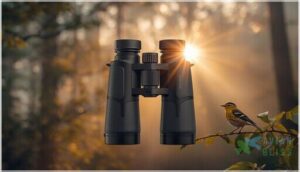
You’ll want 8x magnification for balanced clarity and steady hand-held views—10x shows finer details but magnifies shake. Look for fully multi-coated lenses hitting 90-95% light transmission; cheaper glass loses 40% of available light in forest canopies.
Here’s what separates field-worthy optics from shelf decorations:
- ED glass eliminates color fringing on high-contrast plumage
- Phase-correction coatings boost resolution 10-15% in roof prisms
- 42mm objective lenses gather enough light for dawn/dusk sessions
- Wide field of view (390+ feet at 1,000 yards) tracks erratic flyers
Waterproof and Fog-Proof Features
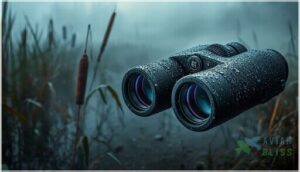
Morning mist and sudden downpours separate functional optics from paperweights. Nitrogen purging displaces internal moisture, preventing fogging when you move from air-conditioned vehicles into humid marshes. O-ring seals block water entry during rainstorms. Premium models like the Nikon Monarch 7 combine both weather resistance features, maintaining clarity when cheaper binoculars turn into glorified fog machines mid-observation.
| Feature | Real-World Impact |
|---|---|
| Nitrogen Purging | Prevents internal condensation during temperature shifts |
| O-Ring Seals | Blocks rain, snow, and humidity from entering optical chambers |
| Anti-Fog Coatings | Maintains surface clarity in high-moisture environments |
| Waterproof Construction | Allows use during storms without equipment damage |
Bird Photography Equipment and Accessories
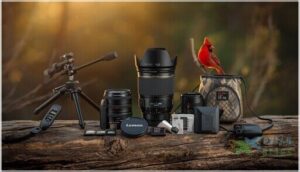
Capturing birds in their natural habitat requires more than just enthusiasm—you need the right photography setup to freeze those fleeting moments. Whether you’re shooting a warbler’s first spring song or a hawk’s dramatic dive, your gear makes the difference between a blurry blob and a frame-worthy shot.
Let’s break down the photography essentials that’ll help you document what you’re seeing in the field.
DSLR Cameras for Bird Photography
You’ll want a DSLR that won’t quit when that perfect warbler finally sits still. The Nikon D850’s 45.7MP sensor delivers stunning detail, while the Canon EOS 90D offers solid autofocus speed and weather resistance without breaking the bank.
Look for full-frame sensors if you’re serious—they handle low light beautifully during dawn outings. Battery life beats mirrorless every time for those long field sessions.
Telephoto and Zoom Lens Options
Glass matters more than your camera body when you’re chasing sharp images of distant raptors. Start with at least 300-400mm focal length—anything shorter leaves you cropping heavily and losing detail.
- Zoom flexibility: Modern 100-400mm or even 200-800mm telephoto zoom lenses let you adapt quickly as birds move
- Image stabilization: Look for 5+ stops of correction to shoot handheld without blur
- Lens coatings: Premium optical quality reduces chromatic aberration in harsh backlight
Weather-sealed builds survive real field conditions.
Tripods and Stabilization Gear
Telephoto lenses demand rock-solid support—your carbon fiber tripod becomes the difference between sharp portraits and blurred disappointments. Choose models under 4 lbs that handle 20+ lb loads, giving you freedom to trek miles without shoulder fatigue.
Gimbal heads shine for tracking flight, while ball heads work beautifully for perched subjects. Flip-locks beat twist-locks when you’re racing against golden hour light.
Smartphone Adapters for Digiscoping
Your phone’s camera transforms into serious optical equipment with the right adapter—over 60% of birders now digiscope regularly. Look for these must-haves:
- Three-axis alignment cuts vignetting by 30% at high magnification
- Anodized aluminum construction delivers 50% better stability than plastic models
- Universal phone compatibility (60-90mm width) fits most devices
Pair with tripod-based image stabilization and Bluetooth remote shutters—you’ll slash motion blur by 60% while capturing those fleeting warbler moments through your spotting scope.
Comfort and Carrying Solutions

You can’t enjoy a full day in the field if your neck’s screaming from dangling binoculars or your shoulders are wrecked from an awkward backpack. The right carrying gear turns a grueling trek into something you’ll actually want to repeat.
Here’s what works when you’re covering miles or sitting tight for hours.
Binocular Harness Systems
A neck strap might feel fine for 30 minutes, but try a full morning in the field—you’ll understand why support systems have become essential birding gear.
These optical equipment reviews consistently highlight ergonomic design benefits: adjustable straps distribute weight across your shoulders, support materials like Cordura handle weather extremes, and comfort features keep binoculars steady at chest level for quick one-handed access without strain.
Backpacks Designed for Birding
Your best field days happen when backpacks work as hard as you do—hauling optics, field guides, and lunch without feeling like a pack mule.
Camera backpack designs built for birding gear prioritize these features:
- Ergonomic design with padded shoulder straps reducing fatigue during long treks
- Outdoor durability using weather-resistant backpack materials protecting electronics
- Birding compartments offering quick-access pockets for binoculars
- Weight distribution systems with chest straps balancing heavier outdoor gear and equipment
- Hydration compatibility supporting extended bird watching equipment and gear sessions
Straps and Weight Distribution Options
Chest rigs beat neck straps every time—they spread binocular weight across your shoulders and upper back, preventing the stiff neck you’d otherwise nurse for weeks.
Look for ergonomic straps with adjustable buckles that work over winter layers. Padded designs with quick-release clips let you deploy optics fast when that warbler finally shows.
Your body will thank you after mile six.
Portable Seating and Field Chairs
Your feet won’t hold you for hours, and wet logs make terrible seats. Look for foldable designs under two pounds with ergonomic frames and a weight capacity around 300 pounds. Closed-cell foam padding and waterproof chair materials handle muddy conditions better than your dignity will.
Most birding gear reviews favor tri-fold models with backpack straps—they pack flat in your hiking gear and deploy faster than you can update your field notebook.
Field Documentation and Identification Tools

You can’t truly break free in the field if you’re constantly second-guessing what you’re seeing or scrambling to remember details after the moment passes. The right documentation and ID tools let you capture observations quickly, confirm tricky species on the spot, and build a record you’ll actually want to revisit.
Here’s what works when you’re out there chasing birds instead of sitting at home wishing you’d.
Waterproof Field Notebooks
Rain won’t wait for your field notes to dry. Waterproof notebooks using synthetic materials like stone paper protect your data collection efforts during unexpected downpours or humid mornings.
These eco-friendly field guides stay legible when conventional paper would dissolve, letting you record behavior patterns and plumage details without worrying about smudged ink.
Most birding gear lists overlook them—experienced field researchers never do.
Digital Vs Paper Field Guides
Keeping documentation in the field splits birders into two camps. Paper field guides give you 100% uptime—no dead batteries when a rarity appears—and excel in bright sun where screens glare out. Digital tools like Merlin Bird ID counter with instant species identification, real-time guide updates, and multimedia features that paper can’t match. Your user preferences matter more than any trend, though 70% of North American birders now carry both formats for different situations.
- Paper guides offer faster cross-referencing for experienced birders during time-sensitive identification challenges
- Digital photography integration lets birding apps suggest IDs directly from your smartphone shots
- Guide updates happen twice yearly in digital formats versus waiting 4–6 years for print revisions
Bird Identification Mobile Apps
Your phone’s become a powerful identification tool with AI integration transforming mobile ID. Merlin Bird ID leads with 85% photo accuracy on North American species and 81% sound recognition—that’s reliable bird identification across both visual and audio channels.
These birding apps handle species tracking automatically, learning as you go. App accuracy keeps improving through machine learning, turning field observations into confident IDs within seconds.
Download regional packs for offline bird recognition anywhere.
Audio Recording Devices for Bird Calls
Sound is your secret weapon. Modern recorders like the Zoom F3 dodge audio clipping and thrive in rain, giving you reliable field recordings for bird vocalizations. Rugged outdoor gear means recorder durability isn’t a gamble.
With acoustic analysis and AI, you’ll boost bird identification and bird conservation. Why just watch when you can listen—and truly know your birds?
Weather Protection and Outdoor Comfort

Birding isn’t always sunshine and gentle breezes—sometimes it’s mud, mosquitoes, and sudden rain. If you want to stay out longer and spot more birds, comfort and protection matter.
Here’s what you’ll want for facing the elements without missing a moment.
All-Weather Clothing for Birders
Ever tried stalking a warbler in misty woods without the right gear? You need waterproof jackets with breathable fabrics—otherwise, you’ll sweat and freeze in minutes. Layer up with thermal insulation, and don’t skip UV protection for those long sun-soaked hours.
Quiet clothing matters too; rustling pants can ruin a moment. Invest in outdoor gear that respects bird conservation and your comfort.
Touchscreen-Compatible Gloves
Ever tried snapping a photo of a rare finch with frozen fingers? Touchscreen-compatible gloves are a breakthrough for birding and nature photography.
Modern glove materials—think graphene and Thinsulate—balance winter insulation, hand dexterity, and finger sensitivity. Moshi Digits shine for touchscreen accuracy.
With outdoor gear like this, you won’t sacrifice warmth for access during outdoor activities.
Insect Repellent Solutions
Mosquitoes don’t care if you’re on a quest for the elusive warbler. Whether you reach for Chemical Options like DEET or Picaridin, or prefer Natural Repellents and Wearable Devices, pick solutions that won’t harm birds or your Outdoor Gear.
Spatial Repellents and even Insect Masks can save your skin—and sanity—during Nature Watching and other Outdoor Activities. Wildlife Conservation starts here.
Sun Protection and Rain Gear
Why risk a sunburn or a soggy notebook when you can armor up? UPF Clothing blocks nearly all UV rays—far more than sunscreen alternatives.
Lightweight waterproof jackets keep you dry without spooking birds, thanks to quiet, earth-toned fabrics.
Smart birding accessories like these mean you can chase rare sightings, focus on nature photography equipment, and enjoy outdoor activities, rain or shine.
Technology for Backyard Bird Watching

If you want to see more than just the usual backyard visitors, technology can help you catch every feathered moment.
These gadgets make it easy to spot, record, and identify birds right from your porch. Here’s what you’ll want to have on hand.
Smart Bird Feeders With Cameras
Curiosity thrives at a Smart Bird Feeder. With AI Technology, 2K Camera Features, and real-time Bird Identification, you’re not just feeding visitors—you’re monitoring wildlife from your kitchen table.
Feeder designs now boast solar panels and app alerts, making bird watching bold and seamless. It’s the rebellious answer to backyard birding, turning every feathered guest into a discovery.
Wildlife Trail Cameras
Trail cameras bring wildlife monitoring into your hands with motion sensors and night vision that capture what you’d miss at dawn or dusk. These outdoor gear reviews confirm PIR sensors detect temperature shifts, triggering the camera instantly—perfect for elusive species. Plus, cellular models stream footage straight to your phone, making wildlife observation methods feel rebellious and free.
- Passive Infrared (PIR) camera triggers detect temperature changes to capture movement precisely
- Infrared LED night vision records clear black-and-white images in low-light conditions
- Cellular connectivity transmits real-time photos directly to smartphones for remote monitoring
- Weather-resistant housings protect electronics from rain, snow, and harsh field conditions
- Wildlife photography tips: position cameras at bird height and near feeders for ideal detection
Motion-Activated Recording Systems
Beyond standard trail cameras, motion-activated recording systems enhance wildlife monitoring with AI-powered species recognition and real-time alerts directly to your phone. These systems achieve a 95% detection accuracy, capturing bird tracking data day and night through infrared night vision. You’ll obtain detailed footage for wildlife monitoring without disturbing your feathered subjects—ideal for bird conservation, research, or improving your wildlife photography skills.
| Feature | Technology | Benefit |
|---|---|---|
| Camera Triggers | PIR + AI Recognition | Auto-identifies species visiting feeders |
| Night Vision | Infrared LEDs | Records nocturnal birds without disturbance |
| Detection Range | Up to 70 feet adjustable | Captures wide feeding zones accurately |
| Resolution | 42MP sensors available | Crystal-clear images for behavior study |
| Connectivity | Wi-Fi + smartphone alerts | Instant notifications when birds arrive |
Remote Monitoring Apps and Features
Smart phone birding apps now connect you directly to backyard camera systems, sending real-time feeds and bird alerts whenever motion detection spots activity. Apps like Merlin enable automated ID through AI tracking of sounds and photos—even offline. You’ll receive instant notifications categorizing birds, animals, or other visitors, transforming your photography gear setup into an intelligent monitoring station that works while you’re away.
- Merlin Bird ID: Offers photo ID, sound ID, and offline identification with global bird pack downloads
- Birdfy Smart Feeder App: Provides motion detection filters and 30-day free cloud storage for bird visit recordings
- eBird Integration: Shares community sightings within 30 miles and assists citizen science data collection
- BirdsEye: Delivers real-time mobile apps alerts of rare species spotted nearby by fellow birders
Choosing Gear for Different Birding Environments
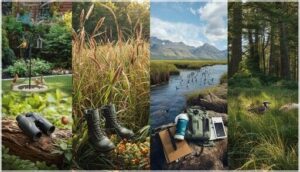
Not all birding spots are created equal, and the gear that works perfectly in your backyard won’t cut it when you’re trudging through a salt marsh or climbing to alpine meadows. Each environment throws different challenges at you—wind, water, altitude, obstacles—and your equipment needs to match the terrain.
Let’s break down what you actually need for the four main birding environments you’ll encounter.
Coastal and Wetland Birding Equipment
Coastal wetlands demand optics that can handle humidity and distance—your standard bird watching setup won’t cut it here. You’ll want 8×42 or 10×42 waterproof binoculars for waterbird identification across tidal zones, plus a spotting scope with 20-60x magnification for those distant shorebirds.
Multi-coated ED glass transforms murky marsh light into crystal-clear views, while fog-proof seals keep your coastal binoculars functional when conditions get soggy.
Forest and Woodland Watching Essentials
Dense forest habitats shift the game—you need 8×42 binoculars with wide fields of view to track woodland birds darting through tree canopy gaps. About 68% of forest birders choose this setup for quick bird identification across forest floors where light gets tricky.
Waterproof optical equipment extends your gear’s life by 30% in damp conditions, while binocular harnesses let you navigate trails hands-free during bird migration seasons.
Mountain and High-Altitude Gear
High altitude transforms birding into an endurance sport—you need 8x to 10x binoculars with waterproof and fog-proof features to handle rapid weather swings. Don’t forget touchscreen-compatible gloves and waterproof notebooks for documenting species at elevation where birds shift upslope annually.
Over 60% of mountain backpacks incorporate thermal insulation-compatible compartments for layered clothing systems, while breathable yet weather-resistant outdoor gear keeps you comfortable during strenuous climbs.
Urban and Backyard Birding Setup
You don’t need to trek miles for exceptional bird watching—95% of birders (that’s 91 million people) watch from home.
Your backyard birding setup thrives with 8x to 10x binoculars, smart bird feeders with cameras (adoption jumped 25% recently), and bird-friendly plants that attract local bird species.
Add waterproof notebooks, mobile phone camera lens kits, and strategically placed bird houses to transform your urban habitat into a birding hotspot.
Maintenance and Care for Bird Watching Equipment
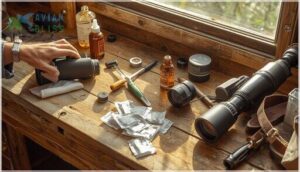
Your binoculars won’t stay sharp forever, and that trail camera isn’t waterproof just because the box said so. Taking care of your gear means the difference between reliable tools that last decades and expensive paperweights gathering dust in your closet.
Here’s how to keep everything running smoothly so you’re ready when that rare warbler shows up.
Cleaning and Storing Optical Gear
Your binoculars deserve better than a dusty shelf—optical gear maintenance separates casual observers from serious birders. Proper lens cleaning tips and storage environments protect your investment from the 82% of damage caused by careless handling.
- Use microfiber cloths with isopropyl alcohol-based cleaning solutions instead of paper towels that scratch coatings
- Store between 15-25°C with silica gel packets to prevent that dreaded internal fogging
- Always blow off grit before wiping to avoid scratching your lenses during routine gear maintenance
Protecting Electronics From Moisture
Your camera and birding apps won’t survive long in wetland humidity without proper moisture proofing. Water resistance ratings (IP67 or higher) separate gear that lasts from junk that corrodes, while electronic shields with nitrogen-purged housings prevent internal fogging during temperature swings.
| Protection Method | Best For | Cost Range |
|---|---|---|
| Silica gel storage | Optical equipment, photography gear | $5-15 |
| Waterproof hard cases | DSLR cameras, mobile apps devices | $40-120 |
| Anti-corrosion spray | Metal components, tripod joints | $12-25 |
| Nitrogen-purged seals | Binoculars, spotting scopes | Built-in feature |
| Dehumidifier cabinet | Long-term storage, multiple items | $80-200 |
Store waterproof notebooks and digital devices with fresh desiccants, keeping humidity between 30-50% to prevent the slow death of rust and circuit failure.
Battery Management for Field Devices
Keeping your trail cameras and smart feeders running means mastering rechargeable battery strategies. Lithium AA batteries deliver over 4000 shots even in winter cold, while 18650 cells push 5000–6000 images before needing a charge.
Field-Tested Battery Management:
- Label and rotate rechargeable packs to track cycle counts
- Pair solar charging panels with portable power banks for extended deployments
- Monitor voltage regularly—dead batteries mid-migration ruin your data
- Use wide-input devices (5V-12V) for flexible energy sources
- Disable infrared on photography gear when night vision isn’t critical
Solar-powered systems now run for months with adequate sunlight, cutting your maintenance trips while your optical equipment and mobile apps keep humming. Energy efficiency isn’t boring—it’s freedom to chase rarities without constantly swapping batteries.
Lens Calibration and Repair Tips
Your Nikon Monarch binoculars won’t stay sharp forever—diopter adjustment calibrates each eyepiece for your unique vision, while collimation techniques realign double images using tiny screws near the hinge. Lens cleaning starts with a rubber blower; never spray directly on glass.
Focus calibration involves covering one eye, sharpening a distant target, then repeating.
Master these optical maintenance basics and you’ll avoid expensive repairs on cameras, monoculars, and other optical equipment.
Frequently Asked Questions (FAQs)
What gear do beginners need first?
Start with quality optics—78% of beginners invest in binoculars first. You’ll want 7x-8x magnification paired with a solid field guide or birding app. These three essentials launch your birding journey from day one.
How much should I budget for equipment?
Budget planning for optical equipment starts around $200 for entry-level binoculars and essential accessories. Mid-range setups run $500-$1,000, while serious equipment investment including cameras and telephoto lenses can reach $2,000-$3,
Can I use regular cameras for birding?
Yes, but bridge cameras or older DSLRs with telephoto lenses work better than smartphones. You’ll need at least 400mm focal length and image stabilization for sharp shots of those fast-moving warblers.
Whats the ideal binocular magnification for birding?
Most birders find 8x magnification hits the sweet spot—you’ll track moving species easily without shakiness.
Forest watchers prefer this versatility, while open-field enthusiasts often choose 10x binoculars for distant identification, though stability becomes trickier.
Are expensive optics worth the investment?
Premium optics offer sharper images in low light and better durability, but you’ll hit diminishing returns after $800.
For serious birders in challenging conditions, they’re absolutely worth it—casual backyard watchers can thrive with budget-friendly binoculars.
Conclusion
My colleague dropped $4,000 on premium bird watching gear and supplies before realizing she needed just three things: quality binoculars, weatherproof notebook, and comfortable vest. Two years later, those remain her workhorses.
Skip the paralysis-by-analysis trap. Start with the essentials that match your actual birding style—not some idealized version—then add specialized equipment only when field experience proves you need it. Your wallet and that warbler waiting in the willows will both thank you.