This site is supported by our readers. We may earn a commission, at no cost to you, if you purchase through links.
 You’ll transform your bird photography when you master the fundamentals that separate stunning shots from ordinary snapshots.
Bird wildlife photography guides emphasize three core principles: understanding your subject’s behavior, using proper camera settings, and practicing ethical fieldwork.
Start with telephoto lenses (400mm minimum) and fast shutter speeds to freeze wing motion.
Learn to anticipate flight patterns and focus on capturing sharp eyes – they’re the window to compelling images.
Timing matters more than expensive gear; golden hour light creates magical results.
Patience trumps technique every time, since birds operate on their schedule, not yours, and mastering specific techniques that most photographers overlook is key.
The secrets to consistently capturing those breathtaking moments lie in mastering these principles.
Table Of Contents
- Key Takeaways
- Bird Photography Basics
- Choosing Locations
- Capturing Bird Action
- Ethical Photography Practices
- Essential Gear and Equipment
- Mastering Bird Photography Techniques
- Post-Processing and Editing
- Advanced Bird Photography Skills
- Frequently Asked Questions (FAQs)
- What are the best bird photography settings?
- Do you know the basics of bird photography?
- How do I find a good bird photography location?
- What should a professional wildlife photographer do?
- How do you create compelling bird photography?
- What makes a good bird photography kit?
- How do weather conditions affect bird photography?
- What backup equipment should photographers always carry?
- How to photograph birds in crowded areas?
- What are the best seasons for migration photography?
- Conclusion
Key Takeaways
- Master your camera settings – You’ll need 1/1000s shutter speed for flight shots, f/5.6-f/8 aperture, and continuous autofocus to consistently capture sharp images of moving birds.
- Practice ethical field techniques – You’ll respect wildlife by maintaining a 15-20 feet distance, avoiding flash photography, and never using baiting or excessive playback calls that disrupt natural behaviors.
- Time your shoots strategically – You’ll get the best results during golden hour lighting and by researching seasonal migration patterns to position yourself where target species naturally gather.
- Focus on the bird’s eyes – You’ll create compelling images by using single-point autofocus on the nearest eye, as sharp eye contact transforms ordinary shots into captivating portraits that connect with viewers.
Bird Photography Basics
Bird photography requires patience, proper technique, and understanding of your feathered subjects to capture compelling images that showcase their natural beauty and behavior.
You’ll need to master camera settings, focusing methods, and bird behavior patterns to consistently create stunning wildlife photographs that stand out from the crowd.
Essential Camera Settings
You’ll need to master five key camera settings to capture sharp, well-exposed bird photos.
These settings work together like a symphony, each playing its part in creating stunning images.
- Aperture Priority mode – Start with f/5.6 to f/8 for ideal sharpness while maintaining fast autofocus
- Shutter Speed – Use 1/500s minimum for perched birds, 1/1000s+ for flight shots
- ISO Control – Begin at ISO 100-200, increase as needed to maintain proper shutter speeds
- Focus Modes – Switch to Continuous AF for moving subjects, Single AF for stationary birds
- Metering Modes – Use spot metering to expose correctly for the bird, not the background
Mastering Focusing Techniques
Sharp focus separates good bird photography from great shots.
Back-button focus gives you control over when your camera locks onto subjects.
Use continuous autofocus for birds in flight, switching to single-point for stationary subjects.
Pre-focusing on likely perches speeds up capture when birds land.
Manual focus works well for predictable behavior patterns, while focus tracking follows moving subjects smoothly.
Understanding Bird Behavior
Bird behavior patterns reveal the secret to anticipating perfect shots.
Study feeding patterns to position yourself where birds naturally gather.
Position yourself where birds naturally gather for effortless encounters.
Watch for mating rituals during breeding seasons, as these create dramatic photo opportunities.
Learn migratory habits to time your visits when target species arrive.
Listen for vocalizations that signal nearby birds, and observe social interactions that reveal group dynamics and hierarchy within flocks.
Choosing Locations
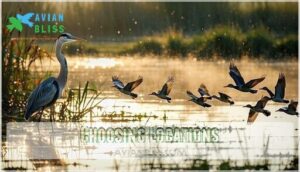
You’ll find your best bird photography opportunities by researching specific habitats where your target species thrive, from wetlands teeming with waterfowl to forest edges where warblers migrate through.
Timing your visits around seasonal patterns and daily routines means the difference between empty shots and frames filled with active, photogenic birds, which can be considered key moments.
Researching Bird Habitats
Successfully researching bird habitats transforms your photography from random shooting to strategic hunting.
Start by studying habitat types—wetlands support over 40% of North American bird species, while forests harbor the largest songbird diversity.
Use eBird’s database and local birding hotspots to identify productive locations.
Understanding seasonal changes helps predict species presence, while learning bird calls aids detection.
Match species behavior to specific habitats for targeted photography success.
Timing Visits for Species Presence
You’ll discover that timing makes all the difference when pursuing specific bird species.
Seasonal migration patterns, nesting seasons, and daily routines create windows of opportunity that can make or break your bird photography adventures. GPS tracking systems now offer precise migration data.
- Track seasonal migration – Research when target species pass through your area during spring and fall migrations
- Study nesting seasons – Visit bird hotspots during breeding periods when species are most active and territorial
- Learn feeding patterns – Time visits around dawn and dusk when birds are actively foraging in their habitats
- Monitor weather influence – Plan shoots after storms when birds concentrate in sheltered areas or during clear days for ideal lighting
Capturing Bird Action
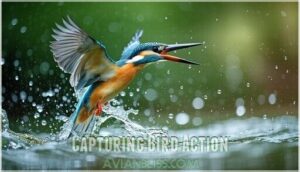
Bird action photography requires split-second timing and sharp reflexes to capture dynamic moments.
You’ll need to master anticipation, continuous shooting modes, and precise focus techniques to freeze birds in motion and create compelling images.
Anticipating Flight Patterns
Understanding takeoff angles and landing zones transforms bird photography from guesswork into strategic art.
Most birds face into wind for easier liftoff, while species variation affects flight patterns—hummingbirds dart erratically, hawks glide predictably.
Weather influence shapes timing; dawn activity peaks offer prime opportunities.
Master these field techniques by studying bird behavior patterns, positioning yourself along natural flight corridors for stunning birds in flight photography, which requires understanding of bird behavior.
Using Continuous Burst Mode
When capturing birds in flight, continuous burst mode becomes your secret weapon for freezing split-second moments that would otherwise slip away.
High frame rates increase your chances of nailing that perfect wing position.
- Frame Rate Impact – Use 8-10 fps for most action photography, ensuring you don’t miss critical moments
- Memory Card Speed – Choose fast cards (UHS-I or better) to prevent buffer overflow during extended sequences
- Buffer Capacity – Monitor your camera’s buffer to avoid shooting interruptions when birds take flight
- Action Sequence Selection – Review burst sequences carefully, selecting frames with ideal wing positions and sharpest autofocus
Focusing on Bird Eyes
Sharp eyes make stunning bird photos. Focus directly on the bird’s eye for instant emotional connection with viewers.
Eye contact creates powerful images that captivate audiences.
Guarantee perfect sharpness using single-point autofocus on the nearest eye. Catchlights add life and sparkle to avian portraits.
These natural eye reflections enhance image quality dramatically. Position yourself at eyelevel perspective for intimate shots.
Master focusing skills through consistent practice with slower birds first, and remember single-point autofocus, eye contact, and catchlights to create stunning images.
Ethical Photography Practices
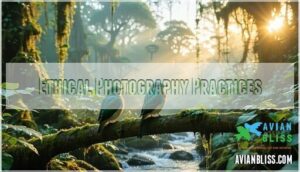
Great bird photography means being a responsible photographer who puts the birds’ well-being first. You’ll need to master techniques that capture stunning shots while respecting wildlife and their natural behaviors.
Respecting Bird Space
Ethical bird photography begins with maintaining safe distances from your subjects, especially during nesting season.
You’ll want to keep at least 15-20 feet away from most birds to avoid causing stress. Think of it as giving them their personal bubble – birds need space to feel secure.
During breeding periods, increase this distance substantially. Limit call usage and avoid baiting, as these practices can disrupt natural behaviors and endanger bird populations.
Using telephoto lenses helps maintain a respectful distance.
Minimizing Disturbance
Beyond maintaining proper distance, you’ll want to master several techniques that keep birds comfortable.
Use blind usage to become invisible—portable hides let you get closer without causing stress.
Practice call ethics by limiting recorded sounds, especially during nesting season when birds are most vulnerable.
Avoid baiting concerns by never using food to lure birds into unnatural positions.
These ethical considerations guarantee your bird photography ethics don’t compromise animal safety while still capturing stunning shots.
Avoiding Harmful Techniques
Flash photography poses serious risks to bird welfare, causing stress and disorientation that can disrupt natural behaviors.
Baiting concerns arise when artificial food sources create dependency and increase predation vulnerability.
Call usage guidelines emphasize restraint, as playback sounds trigger territorial disputes and distract from essential activities.
Nesting safety requires maintaining buffer zones during breeding seasons to prevent abandonment.
Distance respect through telephoto lenses protects birds while capturing quality images without intrusion.
Essential Gear and Equipment
You’ll need the right equipment to capture sharp, professional bird photos without disturbing your subjects.
The essential gear includes telephoto lenses, sturdy tripods, and cameras with fast autofocus systems designed for wildlife photography.
Telephoto Lenses and Tripods
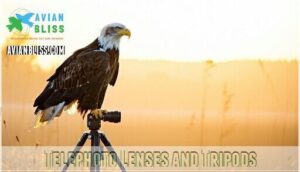
Your telephoto lens becomes your lifeline in bird photography, with 300mm being the minimum reach you’ll need.
Pair it with a sturdy tripod for sharp results, especially with lenses 500mm or longer.
Consider these telephoto lens features:
- Lens Stabilization – Vibration Reduction technology compensates for camera shake during handheld shooting
- Tripod Heads – Gimbal heads provide smooth tracking for birds in flight
- Teleconverter Usage – Extends your lens reach while maintaining autofocus capabilities
Quality Lens Coatings reduce flare and boost contrast in challenging lighting conditions.
You can find resources for telephoto lens needs.
Camera Features for Bird Photography
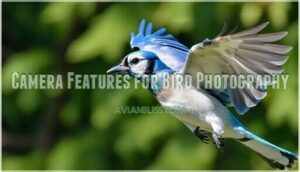
Modern cameras pack essential features that make bird photography achievable for everyone.
Advanced Autofocus Systems with bird-eye detection lock onto subjects instantly, while Image Stabilization compensates for telephoto lens shake.
Burst Mode captures fleeting moments at 20+ fps, ensuring you’ll nail that perfect wing position.
Many resources are available to help photographers master autofocus bird photography.
| Feature | Benefit | Impact |
|---|---|---|
| Autofocus Systems | Tracks moving birds precisely | Sharp, professional results |
| Weather Sealing | Protects in harsh conditions | Shoot anywhere, anytime |
| Low-Light Performance | Clean images at high ISO | Dawn and dusk opportunities |
Fast shutter speed freezes action while wide aperture creates stunning background blur.
Accessories for Enhanced Shooting
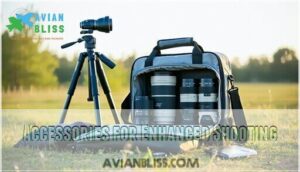
A sturdy tripod anchors your telephoto lens while beanbags support provide flexible positioning.
Pack extra batteries, memory cards, and rain gear in your camera bag. Remote trigger reduces vibrations for sharp shots.
Lens filters enhance colors and reduce glare. Many photographers find a need for a telephoto lens tripod for stability. Quality backpack solutions distribute weight evenly during long hikes, keeping your gear accessible and protected.
Mastering Bird Photography Techniques
Getting up close to birds takes patience and skill that you can develop with practice. Master these field techniques to capture stunning images while respecting your subjects’ natural behaviors.
Stalking Birds Effectively
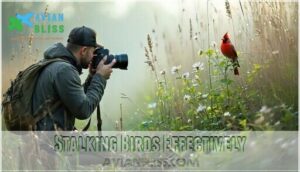
Stalking birds effectively requires slow movements and natural cover to avoid detection.
Your patience pays off when birds acclimate to your presence.
Minimize noise by stepping carefully and using terrain features like trees or rocks.
Advanced bird photography techniques demand understanding that wildlife photography success comes from reading bird behavior.
These field techniques help you get closer without disturbing your subjects.
Planting native trees offers essential food and shelter for attracting birds, which is an essential part of creating a welcoming environment for bird photography.
Using Camouflage and Hides

Camouflage patterns and bird hides dramatically reduce your detectability by up to 60% in open habitats.
Proper blind placement 20-30 meters from activity areas allows close approaches without disturbing birds. Hide construction using natural materials blends seamlessly with environments.
Movement strategies inside blinds require staying still—sudden motion increases bird alertness fourfold.
Ethical considerations demand respecting nesting areas and monitoring for stress signs in target species, which is crucial for maintaining a safe and respectful environment, emphasizing the importance of ethical considerations.
Shooting During Golden Hours
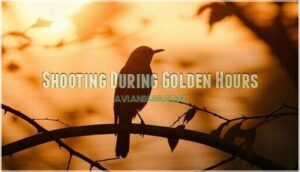
Why wait for harsh midday sun when golden hour transforms your bird photography?
Shoot during early morning or late afternoon for soft light that enhances warm tones and creates stunning shadow play.
Active behavior peaks during these times, while lighting conditions produce gorgeous bird silhouettes.
Master golden hour bird photography settings to capture nature’s perfect lighting conditions effortlessly, and make the most of this perfect lighting.
Post-Processing and Editing
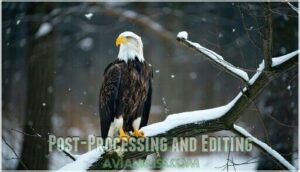
You’ve captured the perfect shot, but raw bird photos often need polish to truly shine.
Post-processing transforms good images into stunning portraits that showcase every feather detail and vibrant color your camera recorded, making the image a stunning representation of the original capture.
Enhancing Images Naturally
Through bird photography editing, focus on exposure adjustments and white balance first—these form your foundation.
Color correction brings out natural plumage tones while noise reduction cleans up high-ISO shots.
Sharpening techniques should enhance feather detail without creating harsh edges.
Adobe Lightroom excels at basic postprocessing, while Photoshop and Capture One offer advanced control.
Selective editing allows precise adjustments for professional results.
Keep edits natural-looking and ensure that they enhance the image without over-processing, using tools like Adobe Lightroom for a balanced finish.
Using Software for Advanced Edits
Beyond basic adjustments, powerful photo editing software like Adobe Lightroom and Photoshop reveal advanced techniques.
Master selective adjustments to enhance specific image areas, apply noise reduction for cleaner shots, and use dodging burning to control light and shadow.
Color grading transforms mood while removing distractions creates cleaner compositions.
Capture One offers professional-grade postprocessing capabilities for detailed refinement, including the ability to make advanced adjustments similar to Adobe Lightroom.
Advanced Bird Photography Skills
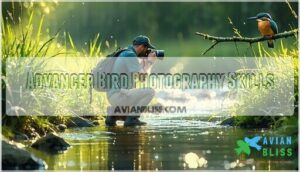
Once you’ve mastered the fundamentals, you’ll want to tackle bird photography’s most challenging scenarios.
Advanced techniques like capturing intimate courtship displays and photographing rare species require patience, specialized knowledge, and refined skills that separate amateur snapshots from professional-quality images.
Capturing Courtship and Mating Rituals
Spring courtship displays reveal nature’s most spectacular performances.
You’ll witness elaborate mating dances, ritualistic feeding between partners, and intricate nest building activities.
Lek photography captures multiple males competing through synchronized displays.
Understanding these bird mating rituals requires patience and behavioral knowledge.
Position yourself respectfully distant during incubation behavior.
Time your shots during peak activity periods for stunning avian photography results.
Photographing Rare and Elusive Species
Finding rare bird species demands specialized approaches beyond typical bird photography.
Use remote camera traps near known feeding areas to capture elusive birds without human presence. Master camouflage techniques with natural blinds and earth-toned clothing.
Success requires patience and persistence—some photographers wait weeks for single shots.
Practice ethical photography by maintaining safe distances and avoiding nesting sites. Document encounters to support conservation storytelling and bird conservation efforts through compelling wildlife photography.
Refining Technique Through Practice and Study
Practice makes perfect in bird photography. Start with Common Bird Practice on slower, accessible species to master your camera settings and field techniques. This foundation builds confidence before tackling challenging subjects.
Here’s how to accelerate your growth:
- Study Award-Winning Analysis – Examine winning photos to understand composition, lighting, and timing secrets that separate good shots from great ones.
- Master Continuous Burst Mastery – Practice anticipating bird movements and using burst mode effectively to capture peak action moments.
- Perfect Eye Focus Impact – Train yourself to nail sharp eye focus consistently, as this single element transforms ordinary bird photos into compelling portraits.
Regular practice with Camouflage Effectiveness techniques will improve your stealth approach, allowing closer encounters with wary subjects.
Frequently Asked Questions (FAQs)
What are the best bird photography settings?
Pro photographers capture sharp bird shots at 1/1000s shutter speed, f/6 aperture, and ISO 400- Use continuous autofocus, back-button focus, and aperture priority mode for consistent results.
Do you know the basics of bird photography?
Bird photography fundamentals include using telephoto lenses (300mm+), fast shutter speeds (1/500s+), continuous autofocus, and understanding bird behavior.
You’ll need patience, ethical practices, and proper timing during golden hours for successful shots.
How do I find a good bird photography location?
Like a treasure map leading to gold, research transforms your bird photography from guesswork to success.
Study local hotspots, seasonal migration patterns, and specific species’ daily routines through birding apps and local guides to discover prime shooting locations.
What should a professional wildlife photographer do?
You’ll master technical skills like fast autofocus and telephoto lenses, develop patience for behavioral shots, prioritize ethics over perfect images, and build expertise through consistent practice with diverse species.
How do you create compelling bird photography?
Like medieval knights armed with crossbows, you’ll need patience and precision to capture stunning bird photos.
Focus on their eyes, use fast shutter speeds, and maintain respectful distances while studying their behaviors for compelling shots.
What makes a good bird photography kit?
You’ll need a telephoto lens (300-600mm), fast autofocus camera, sturdy tripod, extra batteries, and weather protection. This combination guarantees you can capture distant birds with sharp detail and reliability.
How do weather conditions affect bird photography?
When the weather turns sour, you’ll find opportunities in every cloud.
Rain creates stunning reflections, while overcast skies provide soft, even lighting that eliminates harsh shadows.
However, you’ll need weather-resistant gear to protect your equipment from moisture, and this is crucial for capturing images in various conditions, especially when dealing with moisture.
What backup equipment should photographers always carry?
Always pack extra batteries, multiple memory cards, lens cleaning kit, rain cover, and backup camera body.
You’ll also want a portable charger, spare CF/SD cards, and basic repair tools for unexpected equipment failures, including a lens cleaning kit.
How to photograph birds in crowded areas?
Like threading a needle in a hurricane, photographing birds in crowded areas requires patience and timing.
You’ll need to blend into the crowd, use longer lenses to maintain distance, and wait for natural moments when birds ignore the surrounding chaos.
What are the best seasons for migration photography?
Spring and fall offer peak migration photography opportunities.
You’ll capture diverse species during these seasons as birds travel established flyways.
Early morning hours provide the best lighting and most active bird behavior for stunning shots.
Conclusion
Mastering bird wildlife photography guides transforms every outing into an extraordinary adventure filled with countless breathtaking opportunities.
You’ve learned the essential techniques that separate amateur snapshots from professional masterpieces. Remember, patience and practice create the foundation for consistently capturing stunning images.
Your telephoto lens becomes a powerful tool when combined with proper timing and ethical practices. The golden hour rewards dedicated photographers with magical lighting conditions.
Most importantly, respect your feathered subjects while pursuing that perfect shot. These thorough bird wildlife photography guides provide the roadmap to success in this rewarding hobby.