This site is supported by our readers. We may earn a commission, at no cost to you, if you purchase through links.
Somewhere between 20x and 80x magnification, casual birdwatching turns into something closer to obsession.
A quality spotting scope doesn’t just bring distant birds closer—it reveals field marks invisible to the naked eye, turning a blurry shape on a mudflat into a definitive species ID.
The difference between a mediocre scope and a great one shows up fast when you’re tracking a warbler through dense brush at dusk.
With optics technology advancing quickly and price points spanning from budget‑friendly to bank‑breaking, sorting through birding spotting scope reviews takes more than skimming star ratings.
The right scope depends on where you bird, how far you carry it, and what you’re willing to spend—so getting this decision right matters.
Table Of Contents
- Key Takeaways
- Essential Features of Birding Spotting Scopes
- Top Birding Spotting Scopes Reviewed
- How to Choose The Best Spotting Scope
- Birding Tips for Maximizing Your Scope
- Market Trends and Innovations in Spotting Scopes
- Frequently Asked Questions (FAQs)
- Are spotting scopes suitable for birdwatching?
- What is a good scope for bird watching?
- How far can you see a bird with a spotting scope?
- Which spotting scope should you buy?
- What eyepiece options work with most scopes?
- How do I clean spotting scope lenses?
- Can scopes be used for astronomy viewing?
- What tripod height works best for birding?
- How long do quality spotting scopes last?
- How do spotting scopes compare to binoculars?
- Conclusion
Key Takeaways
- Optical quality — especially ED glass and multi-coated lenses — matters more than raw magnification, since sharper glass at 45x beats blurry glass at 80x every time.
- Your birding environment should drive every buying decision: coastal flats call for large 80–90mm objectives and high zoom, while trail birding demands a compact scope under 800 grams.
- Weatherproofing isn’t optional — argon purging, O-ring seals, and IPX7-rated waterproofing are what separate a scope that lasts decades from one that dies in a coastal squall.
- Digital tools like digiscoping adapters, AI-powered ID apps, and real-time sound recognition are turning spotting scopes into full field systems, not just glass on a stick.
Essential Features of Birding Spotting Scopes
spotting scopes are not built the same, and those differences matter more than you’d think once you’re out in the field. Before you spend a dime, it helps to know which features actually move the needle for birding.
If you want a solid breakdown of what actually matters for birding optics, this guide to the best spotting scopes for birds cuts through the noise and helps you match features to real field conditions.
Here’s what to look for.
Magnification Power and Objective Lens Size
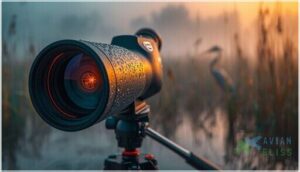
Two numbers define how well your spotting scope performs in the field: magnification and objective lens diameter. Most birdwatching equipment spans a 20-60x zoom range, letting you scan open wetlands at 20x before locking onto a distant shorebird at 60x. Objective lens size determines how much light reaches your eye — an 80 mm lens gathers considerably more than a 60 mm lens, which matters at dawn.
- Zoom Range Selection: 20-30x for initial spotting, higher for detail
- Lens Diameter Impact: 65-80mm balances brightness and portability
- Low Light Performance: Larger objectives shine during early morning sessions
- Tripod Stability: Above 30x, a sturdy tripod isn’t optional
Wider field of view at lower magnification helps you track moving birds before zooming in for identification.
larger objective lenses gather more light improves low‑light performance.
ED Glass and Advanced Optical Coatings
Once you’ve sorted magnification, optical quality becomes the next deciding factor.
ED glass—extra‑low dispersion glass—deals with chromatic aberration reduction by converging light wavelengths to a single focal point, eliminating that telltale purple fringing around white egrets or backlit raptors. Nikon’s ED glass cuts color fringing by up to 70 % at high magnification, and Kowa pairs fluorite alternatives for even sharper ED glass color fidelity.
Multi-coating light transmission pushes brightness above 90 % across the visible spectrum.
Add dielectric prism benefits—reflecting 99 % of light without degradation—and phase‑correction technology that realigns split beams in roof prisms, and you get image clarity that holds up from dawn choruses through midday glare.
Lens coatings aren’t a luxury; they’re how spotting scopes earn their keep. The scope’s fully multi‑coated lenses guarantee higher image quality.
Durability, Weight, and Portability
Optics only matter if your scope survives the trip. magnesium alloy bodies with rubber armor absorbs knocks and stay grippy in wet conditions without adding unnecessary bulk.
Compact design options with 50–60mm objectives keep weight manageable for long hauls through marshes or airports.
tripod compatibility before buying, and consider travel cases with padded shoulder straps.
Good outdoor gear should hold up, not slow you down.
Weatherproofing and Build Quality
A lightweight body doesn’t mean much if rain sends it to an early retirement. Weatherproofing is where build quality proves itself.
Look for argon purging over standard nitrogen — argon’s lower thermal conductivity keeps internal fogging minimal in cold, humid conditions.
O-ring seals lock out moisture and dust at every joint. IPX7-rated waterproof scopes survive submersion up to one meter for 30 minutes.
Rubber armor absorbs field knocks without shifting your optics.
Hydrophobic lens coatings like hydrophobic finishes shed water instantly.
- IPX7 or higher waterproof rating
- Argon purging for enhanced fogproof performance
- O-ring seals at all joints
- Rubber armor coating for shock resistance
- Hydrophobic lens coatings for rain clarity
Top Birding Spotting Scopes Reviewed
Not every scope earns its place in a birder’s kit — but a few consistently stand out in the field.
After hands-on testing across different environments and skill levels, two models proved worth your attention.
Here’s how they hold up where it matters most.
1. OPTIVORA 20-80x90mm Spotting Scope
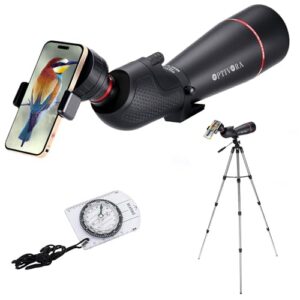
OPTIVORA 20-80x90mm bridges the gap between budget glass and serious field optics. The 90mm objective lens is especially larger than the 60mm or 80mm lenses you’ll find on most mid-range competitors, which means more light reaching your eye during those early morning marsh walks or late evening hawk watches.
The BAK4 prism keeps the exit pupil clean and round, reducing that annoying edge darkening during long glassing sessions.
Fully multi-coated lenses boost contrast, so subtle plumage details actually pop instead of washing out.
The zoom range — 20x for scanning, 80x for locking onto a distant shorebird — covers most birding situations well.
It ships with a tripod, phone adapter, and sunshade, so you’re genuinely field-ready from day one.
- The 90mm objective pulls in noticeably more light than smaller lenses — great for dawn or dusk sessions
- BAK4 prism keeps images sharp and bright edge-to-edge during long glassing sessions
- Comes ready to go with a tripod, phone adapter, and sunshade right out of the box
- Image softens at higher magnification, so 80x is more of a "nice to have" than a reliable workhorse
- The tripod is lightweight, which means wind or rough terrain can throw off your view
- The phone mount works in theory, but getting it dialed in takes some patience
2. Barska Blackhawk Spotting Scope Tripod Combo
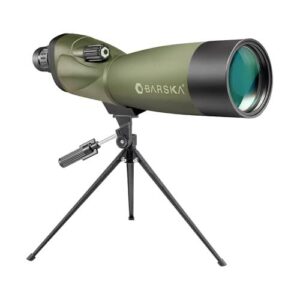
Barska Blackhawk Spotting Scope Tripod Combo punches reasonably well for what it costs. You’re getting 20‑60x magnification paired with a 60mm objective lens, which manages shoreline scanning and mid‑distance shorebird watching without complaint.
Multi-coated optics improve light transmission noticeably, and the fully waterproof, fogproof housing means you won’t panic when a coastal squall rolls in.
The included compact tripod gets you set up immediately, though don’t expect much height flexibility.
Optical sharpness won’t rival ED glass at this price point, but if you’re stepping up from binoculars for the first time, the Blackhawk gives you a solid, field‑ready starting place.
- 18–36x magnification with a 50mm objective lens gives you solid range for wildlife watching and target spotting
- Waterproof, fogproof, and shockproof build means it can handle real outdoor conditions
- Comes ready to use out of the box with a foldable mini tripod and carrying case included
- Optics aren’t as sharp as pricier models, so don’t expect crystal-clear views at max magnification
- Eye relief can get uncomfortable at higher zoom levels, which is tough on glasses wearers
- The front lens cap tends to come loose easily, and the tripod has no height adjustment
How to Choose The Best Spotting Scope
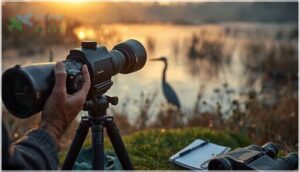
Picking the right spotting scope isn’t just about specs — it’s about finding the one that actually fits how you bird.
A few key factors will narrow your options fast and point you toward a scope you’ll actually enjoy using.
Here’s what to weigh before you buy.
Matching Scope Features to Birding Needs
Your birding habitat should dictate every feature decision. Stationary observers at wetlands or coastal flats benefit most from habitat-specific magnification in the 60–80x range with large 80–90mm objectives for excellent low-light performance at dawn and dusk.
Trail birders need compact spotting scopes under 800 grams. Don’t overlook user comfort ergonomics—eye relief and angled versus straight design matter during long sessions.
Tripod stability solutions become critical at higher magnifications, where even slight vibration washes out field marks completely.
Balancing Price and Performance
The sweet spot for most birders sits firmly between $350 and $900 — and that’s not an opinion, it’s where value for money genuinely peaks.
A proper value tier analysis shows that mid-range scopes now pack ED glass and fully multi-coated lenses that once cost twice as much.
Budget-optics trade-offs are real but manageable when you prioritize objective lens size over brand name. Consider what matters most:
- Opt quality over zoom range — sharper glass beats raw magnification every time
- ROI of durability — a $600 scope with a lifetime warranty often outperforms a $300 replacement cycle
- Cost-per-magnification — mid-tier scopes deliver usable 60x performance; budget models often fall apart past 45x
Digital Integration and Smartphone Connectivity
Your spotting scope is only half the story — what you do with the image matters just as much.
Modern digiscoping turns optical instruments into content tools: smartphone adapter types range from universal mounts to precision‑threaded options like Kowa’s RP series, while Wi‑Fi eyepiece cameras such as the SVBONY SC001 stream live views wirelessly. Real‑time species ID apps pair directly with your feed, and cloud photo syncing keeps every sighting logged automatically.
| Feature | Option | Best For |
|---|---|---|
| Camera Adapters | Celestron NexYZ, Gosky | General digiscoping |
| Wi‑Fi Cameras | SVBONY SC001, Bresser Spektar | Wireless birdwatching |
| Digiscoping Image Processing | Merlin Bird ID, Birda app | Real‑time species ID |
Portability for Field and Travel Birding
A scope that stays in your car is useless on a ridgetop at dawn. That’s the real test of portability — will you actually carry it? Compact scope weight matters enormously here. Travel‑ready spotting scopes with 50–60 mm objective lenses usually stay under 750 g, keeping your full birding gear kit under 3 kg with a foldable tripod design. Quick‑release mounts let you set up in seconds, not minutes.
A scope that stays in your car is useless on a ridgetop at dawn
For outdoor recreation and travel birding, look for:
- Modular carry cases with padded dividers built for scope‑plus‑tripod transport
- Foldable tripods collapsing to 30–35 cm for airline carry‑on compliance
- Integrated sunshade features that reduce glare without adding bulk
Lighter setups simply mean more days in the field.
Birding Tips for Maximizing Your Scope
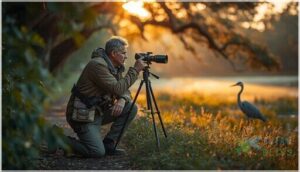
Owning a great scope is only half the equation — knowing how to use it well is what separates a frustrating outing from a rewarding one.
A few solid habits can make a real difference in what you spot and how much you enjoy your time in the field.
Here’s what experienced birders do to get the most out of every session.
Setting Up for Optimal Viewing
Getting your setup right makes all the difference. Position your tripod low — scope at or just above seated eye level — and keep legs short on windy days to reduce shake.
Start every session at 20–25× magnification to lock onto your target before zooming in for detail.
Set eye relief to about 12–15mm, or collapse the eyecup if you wear glasses.
Face the sun behind you for clean light positioning, and hang a bag from the center hook when gusts threaten your field of view.
Bird Identification Techniques Using a Scope
Once your tripod is locked and your view is steady, the real work starts — reading the bird, not just finding it.
Start with the head. Eye‑color patterns around the orbit, bill‑shape analysis at the tip and curve, and crown stripes on sparrows all surface quickly at 40× through a quality spotting scope. At 60×, throat patches on ducks and whisker marks on gulls become unmistakable. That’s optical performance actually earning its keep.
Use your field of view wide to locate, then zoom tight to confirm. Birdwatching sharpens when you layer cues:
- Wing Bar Detection on folded vireo wings at 60×
- Tail Projection Comparison separating Arctic from common terns mid‑flight
- Behavioral Cue Observation — tail bobbing, posture, feeding rhythm
- Digiscoping captures what your eye confirms
Never trust one mark alone. Stack the evidence.
Recording Observations and Using Birding Apps
Once you’ve stacked your field marks and confirmed the ID, don’t let that sighting disappear into memory. Log it.
eBird Sync pushes your checklist directly to your account the moment you’re back on signal, and GPS Route Logging maps exactly where you walked and what you found.
Merlin’s Sound ID Integration listens in real time, tagging vocalizations you might otherwise miss.
For serious Wildlife Observation records, Field Note Templates keep your entries consistent — date, habitat, behavior, count.
App Data Export lets you pull your history into spreadsheets for seasonal pattern analysis.
In Birdwatching, the birder who records well sees more over time, not just more often.
Ethical Birding and Respecting Wildlife
Logging sightings is only half the equation. The other half is earning the trust of the birds you’re watching.
Disturbance Minimization starts with distance — nesting seabirds need at least 15 feet, and endangered species mandate 600 yards under the Migratory Bird Treaty Act. Audio Playback Ethics matter too: keep bursts under 30 seconds, low volume, and skip playback entirely in high-traffic refuges. Nest Proximity Rules aren’t suggestions — flushing a nesting bird for a better shot crosses a clear line.
Group Size Management helps as well; parties over six people get loud fast. Leave No Trace, stay on trails, and let your optics do the work your feet shouldn’t.
Market Trends and Innovations in Spotting Scopes
The spotting scope market isn’t standing still — it’s moving fast, and the technology coming out right now is genuinely changing how birders work in the field.
From smarter optics to digital integration, there’s a lot worth knowing before you make your next gear decision.
Here’s a look at the trends and innovations shaping what’s ahead.
Growth of The Birding Optics Market
Birdwatching optics are quietly becoming big business. The spotting scopes for birding market hit USD 300 million in 2024, with projections pointing well past USD 500 million by 2033 — solid CAGR drivers include rising consumer demographics of outdoor enthusiasts and an e‑commerce surge making premium optics more accessible than ever.
Emerging markets across Asia‑Pacific are joining North America’s lead, fueling investment trends that push manufacturers to deliver better value for money. That competition? It flows directly to you in sharper, lighter, more capable birdwatching gear.
AI and Augmented Reality in Birding
Smart optics and mobile tech are rewriting the rules of bird identification. Swarovski’s AX Visio binoculars now deliver Real‑Time Detection across more than 8,000 species worldwide, using onboard AI and GPS to flash an AI Species Overlay directly in your viewfinder — no fumbling with a field guide. Pair that with apps like Merlin, and Sound‑Based Identification becomes genuinely powerful, matching bird calls against 750,000 recordings in seconds.
Here’s what’s changing the game for birders right now:
- AR Migration Maps overlay live range data and GPS hotspots onto your smartphone screen
- Smart Field Guides inside apps like Birda identify birds from blurry photos or natural-language descriptions
- Digiscoping integration connects your Spotting Scopes to smartphones, turning solid Optics and Image Quality into shareable field records
Birdwatching has never been this connected.
Future Technologies for Birders
The next wave of birding scopes is arriving faster than most birders expect.
Integrated AI Identification, Smart Display Overlays showing GPS coordinates and compass headings, and Real‑time Cloud Sync are moving from prototypes into production models.
Carbon fiber and magnesium alloy chassis are already pushing weights below 20 oz, making long days in the field noticeably easier.
Modular Component Design means you’ll replace an eyepiece or electronics board rather than the whole scope.
Solar Power Modules and USB‑C charging extend battery life off‑grid.
Meanwhile, Digiscoping benefits directly from better ED glass and fluorite crystal elements, lifting optical performance and image quality to match dedicated cameras.
| Technology | Key Benefit |
|---|---|
| Integrated AI Identification | Real-time species recognition |
| Smart Display Overlays | Live GPS and compass data |
| Modular Component Design | Upgrade parts, not whole scope |
| Solar Power Modules | Off-grid extended runtime |
Frequently Asked Questions (FAQs)
Are spotting scopes suitable for birdwatching?
Absolutely. Spotting scopes are purpose-built for wildlife viewing, delivering 15x–60x magnification that binoculars simply can’t match. For birdwatching in open wetlands or coastal flats, they’re the reference optic.
What is a good scope for bird watching?
For birding, a good scope balances optical performance, portability, and field of view.
Compact travel scopes with ED glass and solid field ergonomics handle most situations well without breaking your budget.
How far can you see a bird with a spotting scope?
With a quality scope, you can spot birds clearly at 100 to over 400 yards, depending on Magnification Range, Objective Lens Diameter, Tripod Stability, Field of View, and Atmospheric Limits affecting Optical Performance.
Which spotting scope should you buy?
It depends on your budget tiers and how often you’ll actually use it. Match optical performance to your needs—don’t overpay for features the field never demands.
What eyepiece options work with most scopes?
Most scopes fall into two camps: proprietary mounts using M37 thread mounts or S1 adapters fitting 51–60mm eyepieces, and 25-inch eyepieces for crossover models.
Zoom eyepiece ranges of 20–60x cover most birding situations well.
How do I clean spotting scope lenses?
Start with a lens blower, not a cloth. A soft brush sweeps the eyepiece and objective lens next.
Use optical fluid with a microfiber in spiral motions. Skip paper towels — they scratch coatings instantly.
Can scopes be used for astronomy viewing?
Yes, birding spotting scopes double surprisingly well as entry-level telescopes.
At 60x, you can spot Moon Craters, Jupiter Moons, and Saturn Rings clearly — though Field-of-View Limits and Low-Light Performance won’t match dedicated optics.
What tripod height works best for birding?
Funny how nobody talks about tripod height until their neck is screaming at mile two.
For most birders, 58–60 inches works perfectly standing on flat ground, while angled scopes let you drop the setup 5–6 inches lower comfortably.
How long do quality spotting scopes last?
A premium spotting scope, properly cared for, can easily last 20 to 30 years. Lens coating longevity, body material durability, and maintenance frequency all determine how long yours stays field-ready.
How do spotting scopes compare to binoculars?
Apples and oranges, really.
Spotting scopes win on magnification and light gathering; binoculars take portability and field of view.
Your choice depends on stability requirements, zoom flexibility, and how far you’re birding.
Conclusion
Picking patiently through birding spotting scope reviews separates the casual glancer from the confident identifier.
The right scope doesn’t just magnify distance—it sharpens your entire approach to the field, from the mudflats at dawn to a forested ridge at dusk.
Match the glass to your birding style, trust your priorities over spec sheets, and you’ll stop second-guessing every silhouette.
The bird won’t wait. Neither should your decision.
- https://www.birdwatchingdaily.com/gear/spotting-scopes/best-spotting-scopes-for-birding/
- https://optics4birding.com/collections/vortex-viper-hd-spotting-scopes
- https://www.bestbinocularsreviews.com/spotting-scopes/review.php?id=13
- https://mavenbuilt.com/blogs/blog/new-cs-2a-26-66x85mm-spotting-scope
- https://avibirds.com/best-spotting-scopes-for-birding/