This site is supported by our readers. We may earn a commission, at no cost to you, if you purchase through links.
 Some birds, like warblers, thrushes, and sparrows, migrate at night to avoid predators and conserve energy.
By flying in the cooler, calmer nighttime air, they reduce the risk of overheating and make their journeys more efficient. These nocturnal migrants use the stars, Earth’s magnetic field, and even sunset cues as natural roadmaps to guide their way.
Nighttime flights also mean fewer hawks or falcons swooping down for a quick meal. However, challenges like light pollution and building collisions make the journey tricky.
Curious how they learn such precise navigation skills? Their strategies are nothing short of extraordinary.
Table Of Contents
- Key Takeaways
- Birds Migrating at Night
- Nocturnal Migration Benefits
- Navigation Methods Used
- Threats to Nocturnal Migrants
- Research and Conservation
- Frequently Asked Questions (FAQs)
- Which bird will come out at night?
- Can you hear migrating birds at night?
- What type of birds migrate at night?
- What flock of birds fly at night?
- Do birds fly in formation at night?
- What bird comes out at night?
- How do nocturnal migration patterns vary globally?
- What roles do weather patterns play in migration timing?
- How do birds adapt to sleep deprivation?
- What influences young birds’ first migration decisions?
- Conclusion
Key Takeaways
- You’ll find that birds like warblers, thrushes, and sparrows migrate at night to avoid predators and conserve energy by flying in cooler, calmer air that reduces their risk of overheating.
- When you observe nocturnal migration, you’re witnessing birds using stars, Earth’s magnetic field, and sunset cues as natural navigation tools to guide their long journeys with remarkable precision.
- You can help protect migrating birds by being aware that light pollution creates serious threats through disorientation and building collisions, which claim millions of bird lives each year.
- If you’re interested in conservation, you can contribute through citizen science programs that use acoustic monitoring and other techniques to track nocturnal migration patterns and protect bird habitats.
Birds Migrating at Night

When birds migrate at night, they take advantage of cooler temperatures, stable air, and reduced predation risks.
This survival strategy also allows them to use the stars and moon as navigation tools, ensuring safer and more efficient long journeys.
Nocturnal Migration Patterns
Millions of birds undertake an incredible journey through the night skies, following carefully chosen migration flyways.
A breathtaking spectacle unfolds each night as millions of birds trace intricate migration flyways across vast, star-lit skies.
These nocturnal bird migration patterns are a tribute to evolved survival strategies, enabling species to conserve energy and guarantee safer passage.
Birds rely on stable atmospheres, cooler temperatures for temperature regulation, and celestial navigation to maintain precise bird migration routes.
Species like thrushes and warblers use nocturnal flight calls to communicate mid-flight, avoiding collisions.
This fascinating behavior underscores nature’s brilliance, balancing energy conservation with night migration patterns for successful seasonal travel.
Benefits of Nighttime Migration
Nocturnal migration is like nature’s secret path for bird survival.
Flying at night offers several advantages:
- Predator avoidance guarantees safer passage, as most hunters are asleep.
- A stable atmosphere makes flights smoother and saves energy.
- Cooler temperatures reduce overheating during these endurance journeys.
- Clear skies with moonlight and stars aid precise navigation.
These survival strategies allow birds to conserve energy, travel efficiently, and avoid threats, proving nighttime is perfect for migratory success.
Species That Migrate at Night
Under the quiet blanket of night, many migratory bird species take to the skies, plotting their paths with precision and grace. Birds like sparrows, warblers, orioles, thrushes, and even ducks rely on nocturnal migration to travel vast distances safely.
Each species brings unique adaptations to these nighttime journeys. For example, warblers depend on sharp night vision, while sparrows use short, cryptic night flight calls to communicate and avoid collisions. Thrushes follow the stars, their internal compasses offering reliable north-south guidance. Ducks, though partial night migrants, also demonstrate remarkable navigation skills through memory and magnetic sensing.
The Migratory Bird Treaty Act protects these species and their habitats.
Here’s a snapshot of nocturnal bird migration:
| Species | Unique Trait | Distance Traveled |
|---|---|---|
| Warbler | Excellent night vision | Up to 3,000 miles |
| Sparrow | Night flight calls | 1,000–2,000 miles |
| Oriole | Magnetic sensing | Up to 2,000 miles |
Understanding these migratory bird species opens a window into nature’s quiet nighttime marvel, showcasing their remarkable navigation skills and unique adaptations.
Nocturnal Migration Benefits
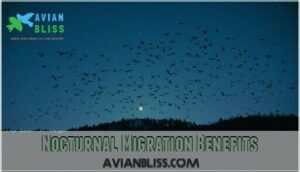
Migrating at night helps birds avoid predators, take advantage of calmer air, and conserve energy during their long journeys.
The cooler temperatures also prevent them from overheating, ensuring safer and more efficient travel.
Avoiding Predators
Under the cover of darkness, migratory birds use evolved strategies to avoid predators and boost nighttime safety.
Darkness limits the abilities of daytime predators like hawks and falcons, offering safer passage.
Birds rely on several predator avoidance strategies:
- Nocturnal bird migration minimizes detection since low light reduces visibility.
- Natural nocturnal camouflage blends birds into the dark environment, lowering risk.
- Reduced predator activity during the night sharpens their survival odds.
To further enhance their safety, they also leverage Earth’s magnetic field for navigation.
These nocturnal adaptations are essential for managing migration risks during long journeys, demonstrating how predator-prey dynamics have shaped effective methods for safer migrations over time.
Calmer Air and Smoother Flights
For migratory birds, the nighttime air provides a perfect flying environment.
Atmospheric stability reduces turbulence, while lower air density and minimal wind resistance make flights smoother.
Birds maintain energy efficiency as they glide effortlessly along migration flyways at night.
With fewer weather effects disrupting migration routes, these ideal conditions help birds stick to preferred altitudes.
Ensuring their nocturnal migration is both efficient and safe helps birds complete their journeys successfully.
Reduced Risk of Overheating
Cooler temperatures during nocturnal migration help birds avoid overheating, keeping their metabolic rate steady.
This supports flight efficiency and energy conservation, letting birds travel further without exhaustion. Lower thermal conditions reduce dehydration risks, aiding water conservation.
By flying at night, birds manage temperature regulation effectively, ensuring survival during long journeys where conserving energy and maintaining ideal body conditions are essential for their incredible endurance.
Navigation Methods Used
When birds migrate at night, they use impressive natural tools to stay on course.
From reading the stars to sensing Earth’s magnetic field, these methods guarantee their incredible journeys remain precise and efficient.
Celestial Navigation

Birds use celestial navigation to chart their night flights, employing cosmic signs for precise travel.
A star compass aids directional accuracy, decoding rotational cues in star patterns. Moonlight navigation provides extra guidance under varying lunar phases, guaranteeing steady progress.
Nocturnal flight calls help flock dynamics, keeping birds aligned.
- Star Patterns offer consistent routes for long distances.
- Lunar Guidance refines celestial pathways.
- Rotational Cues guarantee navigational accuracy.
Earth’s Magnetic Field

When clouds obscure the stars, Earth’s magnetic field becomes a silent guide for night-flying birds.
Through Magnetic Field Navigation, they sense geomagnetic forces using a unique ability called magnetoreception.
These built-in "compasses," influenced by Magnetoreception Genes, help birds align with Earth’s magnetic lines, steering them accurately across massive distances.
Scientists theorize this Evolutionary Significance lies in how birds overcome disorienting Magnetic Anomalies to stay on course.
This remarkable bird navigation technique is essential when navigation tools like celestial cues are unreliable, highlighting the depth of bird navigation research into these finely-tuned survival instincts.
Star Compass Navigation

Under the vast night sky, birds tap into star patterns as a built-in map. Using stellar cues, birds deploy rotational guidance for precise travel.
This celestial orientation system guarantees navigational accuracy over long migrations. Birds also use celestial cues combined with mental maps for accurate travel.
Here’s how it works:
- Align routes to stars.
- Track constellations for direction.
- Combine star maps with Earth’s magnetic field.
- Stay on course with innate bird navigation strategies.
Threats to Nocturnal Migrants
When birds migrate at night, they face serious risks from artificial light, including disorientation and exhaustion.
These dangers often lead to collisions with buildings and other structures, resulting in millions of fatalities each year, which can be attributed to exhaustion.
Light Pollution Effects

Artificial light at night (ALAN) doesn’t just light up cities—it disrupts bird migration.
Artificial light at night disrupts bird migration, disorienting nocturnal travelers and increasing collision risks, endangering their incredible journeys.
Skyglow confuses their natural celestial guides, leading to bird disorientation, collision fatalities, and ecosystem impacts.
Disoriented birds may veer off course, wasting energy and increasing risks.
Structural collisions, a direct result of light pollution effects, claim millions of lives yearly.
Here’s an overview:
| Issue | Cause | Consequence |
|---|---|---|
| ALAN Disorientation | Skyglow blocks navigation | Risky detours, exhaustion |
| Collision Fatalities | Bright city structures | Increased bird deaths |
| Habitat Degradation | Altered migration routes | Ecosystem imbalance |
Effective mitigation strategies include reducing urban lighting to protect birds and their habitats.
Artificial Light Disorientation
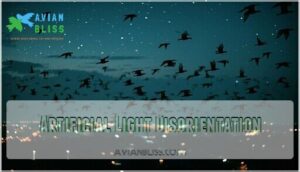
When cities glow under artificial light at night (ALAN), migrating birds face chaos.
Light pollution effects disrupt their celestial navigation, causing disorientation and leaving them off-course.
These disorientation causes sap energy, increasing risks as tired birds struggle to find safety.
Worse, bird disorientation often leads to fatal collisions with buildings or exhaustion.
Mitigation strategies like Lights Out benefits protect these nocturnal travelers by minimizing ALAN.
By cutting unnecessary lighting, you can support safer skies for migrating birds.
Increased Collision Risk

Migrating birds face serious threats from building collisions and tower strikes at night.
Bright urban lights and artificial light at night (ALAN) increase wildlife disorientation, drawing birds off course. Reflections on glass surfaces mimic open skies, further confusing them.
High mortality rates result from these hazards, but mitigation strategies like turning off lights during peak migration can help.
- Common causes of bird collisions:
- Disorienting artificial lights.
- Poorly placed towers or antennas.
- Glass façades reflecting skies.
- Light attraction near urban areas.
Research and Conservation

You can play a key role in bird conservation by supporting research efforts that track nocturnal migration.
Tools like sound capture technology and citizen science participation help scientists understand migration patterns, reducing risks and protecting habitats, which is crucial for bird conservation.
Acoustic Monitoring Techniques
Acoustic monitoring birds is revolutionizing how researchers track nocturnal migrations. Using advanced microphone technology, scientists capture night flight calls, separating them from background noise with software applications.
Spectrograms visually map these calls, aiding in detailed species identification and offering insights into bird migration patterns. These tools reveal trends in nocturnal flight calls, enabling efficient bird call identification.
Understanding bird habitat identification enhances acoustic monitoring by connecting detected calls with likely geographical origins. Such data analysis supports conservation impact, pinpointing high-risk areas for migrating birds.
By refining techniques, researchers guarantee night travelers enjoy safer skies and uninterrupted journeys.
Citizen Science Participation
You can play a part in bird conservation through citizen science birding. By joining public educational outreach programs, you’ll help researchers gather data collection on nocturnal bird migration patterns using tools like acoustic monitoring birds to record nocturnal flight calls.
You can further enhance your monitoring with specialized recording equipment. This community effort boosts public awareness and deepens our understanding of bird behavior studies.
Every recording contributes to the conservation impact, ensuring safer skies for migrating birds. Get involved to help protect their journeys!
Assessing Bird-Habitat Interactions
Tracking bird migration patterns gives insight into how migratory bird behavior shifts with habitat quality.
Factors like resource availability, urban habitats, and landscape connectivity impact survival during nocturnal flight.
Habitat fragmentation disrupts natural corridors, making urban areas vital for rest stops.
Research on nocturnal migration patterns helps develop bird-safe landscapes, supporting species traversing human-altered environments.
Understanding bird habitat evaluation is essential for effective conservation.
The goal is clear: secure spaces for birds to thrive as they make their migratory journeys, ensuring their survival through nocturnal flight and urban habitats.
Frequently Asked Questions (FAQs)
Which bird will come out at night?
Like a quiet traveler under moonlight, the owl is your quintessential nighttime bird.
Owls thrive in darkness, hunting with sharp talons and keen night vision, making them masters of the nocturnal world.
Can you hear migrating birds at night?
Yes, you can hear migrating birds at night.
Many species use short, distinct calls while flying to communicate and navigate.
These subtle chirps help them stay together, avoid collisions, and warn of obstacles.
They are essential for the birds’ safe migration.
What type of birds migrate at night?
Under the quiet blanket of stars, small songbirds like warblers, sparrows, and thrushes take flight.
Ducks, vireos, and cuckoos join them.
These nighttime journeys shield them from predators and overheating, guided by moonlight and starlight.
What flock of birds fly at night?
You’ll find flocks of sparrows, warblers, orioles, thrushes, and ducks flying at night.
These nocturnal travelers rely on the stars, cooler temperatures, and stable air to navigate safely while avoiding predators and conserving energy, utilizing the stars to guide them.
Do birds fly in formation at night?
Picture a midnight symphony overhead—birds rarely form neat formations at night.
Instead, they fly independently or in loose groups, relying on star navigation and soft calls to maintain connection and avoid mid-air collisions, which is crucial for their safety as they use these methods to prevent accidents.
What bird comes out at night?
Owls, such as barn or great horned owls, are classic nighttime birds.
They’re expert hunters, relying on their sharp vision and silent flight to catch prey.
You’ll often hear their haunting calls echoing after dark.
How do nocturnal migration patterns vary globally?
Nocturnal migration patterns vary globally based on geography, climate, and available resources.
Birds in different regions adapt their schedules to avoid predators, harsh weather, and light pollution, using stars and unique cues for navigation.
What roles do weather patterns play in migration timing?
Weather acts like nature’s green light, signaling when it’s safe for migration.
You’ll see birds timing their journeys with tailwinds, avoiding storms, and choosing clear nights to conserve energy and guarantee smoother, safer flights.
How do birds adapt to sleep deprivation?
Birds handle sleep deprivation by napping briefly during flight, using one brain hemisphere at a time.
Their brains prioritize critical functions, allowing rest while staying alert for navigation, predators, and flock communication during migration, which involves complex processes.
What influences young birds’ first migration decisions?
Young birds rely on instinct, inherited navigation systems, and environmental cues like star patterns, magnetic fields, and weather changes for their first migration.
They may also follow experienced adults to learn safe routes and stopovers.
Conclusion
Traversing through the night sky might seem like magic, but for birds that migrate at night, it’s a finely tuned science.
They rely on natural cues like stars and Earth’s magnetic field to chart their paths while dodging predators and conserving energy in cooler air.
However, modern challenges such as light pollution and building collisions threaten these incredible journeys.
By understanding their navigation and supporting conservation efforts, you can help guarantee these nocturnal travelers continue their extraordinary migrations for generations to come.