This site is supported by our readers. We may earn a commission, at no cost to you, if you purchase through links.
 Conserving migratory bird populations requires protecting critical habitats along their flyways—the ancient highways these remarkable travelers use twice yearly.
You’ll find success through habitat restoration, reducing window strikes with bird-friendly building designs, and supporting sustainable agriculture practices that maintain stopover sites.
Climate change disrupts timing and food availability, making adaptive management essential.
International cooperation proves indispensable since birds don’t recognize borders—what happens in breeding grounds affects wintering areas thousands of miles away.
Simple actions like keeping cats indoors, reducing pesticide use, and creating backyard bird sanctuaries make real differences.
The intricate web connecting local actions to global conservation reveals surprising strategies that amplify your impact.
Table Of Contents
- Key Takeaways
- Migratory Bird Conservation
- Laws and Regulations
- Conservation Initiatives
- Threats to Migratory Birds
- Conservation Strategies
- Frequently Asked Questions (FAQs)
- Are wild migratory birds protected in Canada?
- What is the biggest threat to migratory birds?
- How do weather patterns affect migration timing?
- What role do stopover sites play?
- How are urban environments impacting bird routes?
- What diseases threaten migratory bird populations?
- How do wind farms affect migration corridors?
- Conclusion
Key Takeaways
- You’ll achieve conservation success by protecting critical habitats along entire flyways – not just single locations, since migratory birds need connected corridors from breeding grounds to wintering areas spanning thousands of miles.
- You can make an immediate impact through simple local actions – keep cats indoors, reduce pesticide use, create backyard bird sanctuaries, and advocate for bird-friendly building designs to prevent window strikes.
- You need to support international cooperation efforts – birds don’t recognize borders, so effective conservation requires coordinated policies, habitat protection, and monitoring across multiple countries along migration routes.
- You’re racing against time with climate change disrupting migration patterns – rising temperatures and shifting seasons are forcing 60% of species to alter their timing, creating mismatches between food availability and breeding cycles that reduce survival rates.
Migratory Bird Conservation
You’re witnessing one of nature’s most remarkable phenomena when millions of birds traverse continents twice yearly, yet these incredible journeys face unprecedented threats.
Effective migratory bird conservation requires coordinated efforts to protect critical habitats, implement sustainable practices, restore damaged ecosystems, and educate communities about these species’ essential ecological and economic contributions.
Protecting Habitats and Ecosystems
You’ll find that protecting migratory bird habitats requires strategic ecosystem conservation across flyways.
Wildlife corridors connecting fragmented landscapes guarantee birds access to critical resources during migration.
Habitat conservation maintains ecological balance while preserving biodiversity.
These ecosystem services—from pollination to pest control—benefit both wildlife and communities.
Bird habitat protection isn’t just about single species; it’s safeguarding entire ecological networks that support countless organisms, which is crucial for maintaining ecological balance and preserving ecosystem services.
Restoring Degraded Habitats
When your restoration project breathes life back into degraded landscapes, you’re basically performing ecosystem surgery.
**You’re wielding nature’s green scalpel, healing landscapes one habitat at a time.
Habitat renewal begins with soil conservation techniques that rebuild the foundation migratory birds depend on.
Wetland restoration creates critical stopover sites, while biodiversity recovery efforts reestablish native plant communities.
These ecosystem repair initiatives transform barren areas into thriving bird habitat protection zones, demonstrating how targeted habitat restoration can reverse decades of environmental damage.
Effective conservation strategies often rely on understanding bird migration patterns to inform restoration efforts, which is a key part of habitat restoration and helps in environmental damage reversal, ultimately leading to thriving bird habitat.
Conserving Bird Populations Through Sustainable Practices
You can protect migratory bird species through sustainable land use practices that support both development and wildlife preservation.
Bird Friendly Cities implement green infrastructure like native plant corridors and reduced lighting that guides safe migration.
Conservation biology shows these eco conservation approaches maintain healthy bird population trends while allowing urban growth.
Strategic habitat conservation within developed areas creates wildlife-friendly spaces that benefit both communities and bird conservation efforts, supporting healthy bird population trends.
Raising Awareness of Migratory Bird Importance
You’ll discover that Bird Education and Conservation Outreach programs transform communities into conservation champions.
Public Awareness campaigns highlight the Ecological Value of migratory bird species, showing how these travelers pollinate plants, control pests, and support ecosystems.
Community Engagement initiatives connect people to bird migration patterns, fostering deeper appreciation for bird conservation efforts and inspiring local migratory bird conservation action, which ultimately makes them conservation champions.
Laws and Regulations

You’ll need to understand the complex web of international treaties and domestic laws that protect migratory birds across their vast migration routes.
These legal frameworks work together to guarantee bird populations can thrive while balancing human activities with conservation needs.
International Treaties and Agreements
Global conservation efforts have established thorough frameworks through the Convention on Migratory Species, uniting 130+ countries under shared conservation pacts.
These international treaties create binding commitments for habitat protection, with the Migratory Bird Treaty Act serving as a cornerstone for cross-border collaboration.
Treaty enforcement mechanisms guarantee coordinated action across flyways, establishing bird sanctuaries and monitoring systems that transcend political boundaries through international cooperation, and these mechanisms guarantee that all parties will safeguard the conservation goals.
Domestic Laws and Policies for Bird Conservation
Within America’s borders, you’re protected by a robust framework of Federal Regulations and Conservation Acts.
The Migratory Bird Treaty Act serves as the cornerstone of domestic laws, while Wildlife Laws and Bird Permits regulate activities affecting migratory species.
These conservation policies create a safety net that’s both thorough and enforceable.
Enforcement of Laws and Regulations
Law enforcement officers patrol critical habitats to catch violators, though funding limits coverage in remote areas.
Modern technology like drones and thermal imaging helps detect illegal activities, increasing violation detection rates substantially.
Effective enforcement strategies include:
- Community Reporting Systems – Citizens report violations, boosting detection by 45% in engaged regions
- Cross-border Operations – Joint patrols between countries recover thousands of illegally captured birds annually
- Asset Seizure Programs – Authorities dismantle major trafficking rings by targeting commercial poaching operations
- Visible Deterrence – Regular patrol presence increases compliance rates by 28% compared to underpatrolled areas
Permitting and Licensing for Bird Conservation
Understanding permits and licenses is your gateway to legal bird conservation work.
You’ll encounter various permit types for research, rehabilitation, and banding activities, each carrying specific license fees and conservation fees.
Bird sanctuaries require special permits under bird protection laws, ensuring regulatory compliance with conservation legislation.
These permits aren’t roadblocks—they’re tools that help agencies track conservation efforts while protecting vulnerable species.
Bird conservation regulations streamline the process, making it easier for researchers and conservationists to contribute meaningfully to migratory bird protection.
This process is crucial for the success of bird conservation work, and understanding the role of permits and licenses is essential, as they are tools for conservation efforts.
Conservation Initiatives
You can make a real difference for migratory birds through targeted conservation initiatives that protect critical habitats and restore damaged ecosystems.
These efforts combine habitat restoration, sustainable tourism practices, research programs, and collaborative partnerships to address the alarming 30% decline in North American bird populations since 1970, which is a critical issue that requires targeted conservation initiatives.
Habitat Conservation and Restoration

You’ll find habitat conservation and restoration form the backbone of protecting migratory bird populations.
Wetland restoration projects recreate critical stopover sites, while forest regeneration provides nesting grounds.
Grassland conservation maintains breeding habitats, and coastal protection safeguards wintering areas.
Effective ecosystem management connects these efforts, ensuring wildlife habitat management supports complete bird migration patterns throughout their annual cycles.
The use of bird habitat products is essential for creating suitable environments for various bird species, which is crucial for wildlife habitat management and overall bird migration patterns.
Ecotourism and Sustainable Tourism Practices

You can transform bird watching into a powerful conservation tool through Bird Friendly Tourism and Eco Lodges.
Sustainable Travel companies now offer Wildlife Viewing experiences that directly fund bird conservation efforts.
When you choose Responsible Tourism operators, your ecotourism dollars support local communities protecting critical habitats.
These sustainable tourism practices create economic incentives for wildlife conservation, making bird protection profitable for local stakeholders.
By participating in bird friendly tours, travelers can contribute to the conservation of migratory bird populations.
Research and Monitoring of Migratory Bird Populations
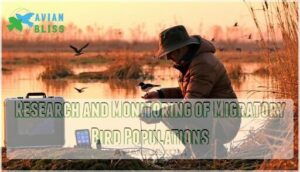
Research drives effective migratory bird conservation through systematic data collection and analysis. Scientists employ sophisticated monitoring techniques to track population changes and understand species’ ecological needs across vast geographic ranges.
Modern Bird Surveys and Species Tracking methods include:
- Satellite telemetry – GPS devices reveal precise Migration Patterns and stopover site usage
- Acoustic monitoring – Automated stations record nocturnal flight calls during peak migration periods
- Citizen science programs – Volunteers contribute observations covering 500,000+ locations annually
- Genetic analysis – DNA samples identify Population Dynamics and breeding ground connectivity
Habitat Mapping through remote sensing helps researchers identify critical areas needing protection. This migratory bird research provides the foundation for evidence-based conservation strategies, ensuring bird population monitoring efforts target the most vulnerable species and habitats effectively.
Collaborative Conservation Efforts With Partners

Building effective bird conservation partnerships requires strategic stakeholder engagement and cooperative funding models.
You’ll find success through joint research initiatives that combine resources from government agencies, nonprofits, and private organizations.
Community outreach programs connect local volunteers with conservation scientists, creating powerful partnership models.
These collaborative approaches leverage diverse expertise while sharing costs, which is crucial for migratory bird conservation efforts.
Bird conservation organizations increasingly rely on these conservation partnerships, recognizing that migratory bird conservation efforts succeed when multiple stakeholders unite behind common goals.
Effective conservation strategies often involve understanding global bird conservation efforts to inform local initiatives.
Threats to Migratory Birds
You’re witnessing one of nature’s most alarming crises as migratory bird populations face unprecedented threats that jeopardize their survival across the globe.
From towering skyscrapers that create deadly collision courses to vanishing habitats and shifting climate patterns, these remarkable travelers encounter dangers at every stage of their epic journeys, facing unprecedented threats.
Habitat Loss and Degradation

Habitat loss devastates migratory bird populations, with deforestation and wetland destruction eliminating critical stopover sites you depend on for conservation success.
Fragmentation effects compound these challenges, isolating remaining habitats.
Four devastating impacts you’re witnessing:
- Deforestation removes 10 million hectares of forest habitat annually
- Wetland Destruction eliminates 70% of original wetlands globally
- Grassland Decline threatens 40% of grassland bird species
- Coastal Erosion destroys nesting sites faster than restoration efforts
Climate Change and Its Impacts on Bird Populations

Climate change disrupts migratory birds’ lives in ways you can’t ignore.
Rising temperatures and shifting seasons are forcing millions of birds to rewrite their ancient migration schedules.
Temperature shifts force 60% of species to alter migration patterns, arriving 2-5 days earlier each spring.
Sea level rise threatens coastal habitats while altered precipitation affects food availability for nearly half of all species.
These environmental changes create mismatches between peak insect emergence and breeding seasons, reducing chick survival rates by 30%.
Climate modeling reveals that 35% of populations have already shifted their ranges northward, fundamentally changing bird behavior across continents, due to climate change.
Human Disturbances and Collisions With Structures

Every year, countless migratory birds face deadly encounters with man-made structures across their flight paths.
These collisions represent a substantial threat to bird conservation efforts worldwide.
Major human-caused hazards include:
- Window Collisions – Glass surfaces confuse birds, causing millions of deaths annually
- Light Pollution – Artificial lighting disrupts bird migration patterns and navigation systems
- Wind Turbines and Power Lines – Rotating blades and electrical infrastructure create fatal obstacles
Building Design modifications can markedly reduce these human disturbances to migratory birds.
Illegal Hunting and Poaching

Beyond structural hazards, illegal hunting poses another grave threat to migratory birds.
Wildlife Crime syndicates kill an estimated 25 million birds annually worldwide, targeting species like the Black-faced Spoonbill along established Smuggling Routes.
Despite existing Hunting Laws and conservation laws, weak Enforcement Tactics allow poachers to exploit vulnerable populations.
Effective Poaching Control requires strengthening international cooperation and community-based bird conservation initiatives to combat this destructive practice threatening migratory bird conservation efforts.
Understanding bird conservation status is essential for developing strategies to protect these species.
Conservation Strategies
You’ll need effective conservation strategies to reverse the alarming 30% decline in North American bird populations since 1970.
These proven approaches combine cutting-edge technology with community action to protect migratory species across their entire journey.
Adaptive Management and Strategic Planning
You’ll find success in migratory bird conservation through adaptive approaches that respond to changing conditions.
Effective conservation strategies require continuous learning and flexible decision frameworks that adjust based on new data and emerging threats.
- Risk Assessment – Evaluate threats using population modeling to identify vulnerable species and prioritize conservation efforts
- Adaptive Governance – Implement decision frameworks that allow rapid policy adjustments when monitoring reveals habitat conservation planning needs
- Ecosystem Services Integration – Balance bird conservation initiatives with human needs through strategic habitat conservation planning approaches
Citizen Science and Community Engagement
When you participate in citizen science, you’re joining a powerful conservation movement that’s transforming migratory bird research.
Over 1 million volunteers worldwide contribute data through Bird Surveys and Volunteer Programs, creating an unprecedented database for scientists.
| Engagement Type | Impact |
|---|---|
| Community Outreach Events | Reached 200,000+ people globally |
| Educational Programs | Integrated into 1,000+ schools |
| Mobile Apps & Platforms | 40% increase in data submission |
Through Citizen Research and Public Education initiatives, communities become conservation champions.
You’ll find that 80% of participants report increased knowledge about migratory birds after involvement, while social media campaigns have engaged over 500,000 users in bird conservation topics.
The success of these initiatives relies on bird conservation efforts to protect migratory bird populations.
Remote Sensing and Monitoring Technologies
Advanced technology transforms how you monitor bird populations across vast landscapes.
Researchers now deploy sophisticated tools that track movements with unprecedented precision, revolutionizing migratory bird conservation efforts.
Modern remote sensing combines multiple approaches:
- Satellite Tracking – GPS tags provide real-time location data for individual birds
- Radar Technology – Weather radars detect massive migration events across continents
- Aerial Surveys – Drones equipped with sensor technology map habitat changes
- GIS Mapping – Data analytics integrate multiple datasets for thorough ecological monitoring
These innovations help scientists understand migration patterns, identify critical stopover sites, and measure habitat quality changes over time.
The use of bird tracking devices has substantially enhanced the accuracy of migration route mapping.
International Cooperation and Cross-border Conservation Efforts
Across continents and oceans, migratory bird conservation depends on global partnerships that transcend political boundaries.
International agreements like the Convention on Migratory Species unite 131 countries in protecting shared species.
Cross-border initiatives restore critical habitats while transboundary cooperation guarantees ecological sustainability through coordinated monitoring and enforcement efforts.
Frequently Asked Questions (FAQs)
Are wild migratory birds protected in Canada?
Yes, Canada protects approximately 450 migratory bird species under the Migratory Birds Convention Act,
This federal law prohibits intentional or unintentional harming, disturbance, or killing of migratory birds, including their nests and eggs.
The country’s conservation efforts are guided by migratory bird laws to guarantee the protection of these species.
What is the biggest threat to migratory birds?
Habitat loss destroys homes,
climate change disrupts timing,
collisions kill millions—you’re witnessing a perfect storm threatening these remarkable travelers.
As they navigate an increasingly dangerous world filled with human-made obstacles.
How do weather patterns affect migration timing?
Weather patterns act like nature’s GPS for you to understand bird migration.
Rising temperatures shift departure dates earlier by roughly five days, while changing precipitation affects food sources that fuel their journeys, which can be considered a key factor in nature’s GPS.
What role do stopover sites play?
Delaware Bay’s horseshoe crab spawning beaches serve as critical refueling stations for red knots during their epic migration.
You’ll find that stopover sites act like highway rest stops—they’re essential for birds to replenish energy reserves and survive long journeys between breeding and wintering grounds, which can be considered critical for their survival.
How are urban environments impacting bird routes?
Urban sprawl forces you to navigate around towering buildings and artificial lights that disrupt your internal compass.
Collisions with glass structures and communication towers create deadly obstacle courses along traditional flyways, which can be considered artificial lights.
What diseases threaten migratory bird populations?
You’ll face several diseases if you’re tracking bird health.
Highly pathogenic avian influenza and West Nile virus pose the biggest threats, spreading rapidly through migratory flocks and decimating populations across continents.
The spread of diseases among birds is often linked to bird migration patterns, which can facilitate the transmission of pathogens across different regions, highlighting the importance of understanding bird migration and diseases.
How do wind farms affect migration corridors?
Turbines disrupt flight paths like invisible barriers.
You’ll find birds altering their traditional routes to avoid turbines, creating energy-costly detours.
Soaring birds experience habitat loss in movement corridors, while collision risks increase in critical migration zones, posing a significant threat to their survival with increased collision risks.
Conclusion
Every year, nearly three billion birds vanish from North America’s skies—a staggering 29% decline since 1970.
This dramatic loss underscores the urgent need for conserving migratory bird populations through coordinated global action.
You can make a meaningful difference by supporting habitat restoration projects, advocating for bird-friendly policies, and implementing simple changes like reducing window strikes at your home.
Success requires combining international cooperation with local stewardship, as these remarkable travelers depend on protected corridors spanning continents for their survival.