This site is supported by our readers. We may earn a commission, at no cost to you, if you purchase through links.
Nearly 3 billion birds have vanished from North American skies since 1970—a loss so staggering it barely registers until you notice the silence where a forest once rang with song.
Deforestation sits at the center of this collapse, systematically dismantling the ancient flyways that migratory birds have followed for millennia. When chainsaws clear a forest tract in the tropics, the consequences don’t stay local; they ripple northward along routes spanning entire continents.
The deforestation effects on migrating birds reach far beyond habitat loss alone, unraveling stopover networks, disrupting breeding cycles, and straining adaptations that took thousands of years to evolve. What follows maps the full scale of that damage—and where recovery remains possible.
Table Of Contents
- Key Takeaways
- Deforestation and Bird Migration Patterns
- Habitat Loss and Its Impact on Migratory Birds
- Forest Fragmentation and Migratory Bird Survival
- Ecological Consequences for Migratory Bird Species
- Conservation Strategies for Migratory Birds
- Frequently Asked Questions (FAQs)
- How does deforestation affect birds?
- What is the biggest threat to migratory birds?
- How does deforestation affect migration?
- How does light pollution affect migrating birds?
- Can bird feeders support migrants during deforestation?
- Which bird species migrate the longest distances annually?
- How do invasive species worsen migratory bird survival?
- Conclusion
Key Takeaways
- Nearly 3 billion birds have disappeared from North American skies since 1970, a loss driven directly by deforestation stripping away the habitats, food sources, and rest stops that migratory species can’t survive without.
- Fragmented forests don’t just shrink available habitat — they isolate bird populations, weaken genetic diversity, and push local groups toward extinction when patches drop below the size needed for recovery.
- Migratory birds anchor entire ecosystems through seed dispersal, pollination, and pest control, so when their numbers collapse, the damage ripples outward into forests, farms, and food webs far beyond the birds themselves.
- Practical solutions already exist — wildlife corridors, native reforestation, shade-grown agriculture, and community-led conservation — and they work best when individuals make deliberate choices that support them.
Deforestation and Bird Migration Patterns
Every year, millions of birds migrate — but those routes are disappearing.
These ancient routes—shaped by stars, magnetic fields, and generations of memory—are breaking down faster than birds can adapt, and tracking which species are most at risk starts with understanding who’s making the journey.
Deforestation is quietly rewriting the rules of migration, and the consequences reach further than most people realize.
Here’s what’s changing and why it matters.
Disruption of Traditional Flyways
For migratory bird species, flyways aren’t just routes — they’re lifelines built over thousands of years. Flyway disruption breaks these ancient highways.
Deforestation and habitat fragmentation shatter the connected forest belts that guide bird navigation across continents. In the East Asian flyway alone, over 90 percent of forest-breeding species have lost forest cover somewhere along their range.
Without conservation efforts to address habitat loss, stopover ecology collapses, and migration patterns unravel entirely. The interconnectedness of these flyways is increasingly threatened by climate change impacts on migration.
Altered Timing and Routes of Migration
When flyways fragment, migration patterns don’t just shift — they unravel. Deforestation forces many species to reroute around cleared landscapes, adding hundreds of extra kilometers to already grueling journeys. These detours strain flight adaptations and compress timing strategies that evolved over millennia.
Wood thrushes, for instance, now depart degraded wintering grounds earlier but arrive at breeding sites exhausted and mistimed, a direct impact of deforestation on bird species survival. Habitat restoration efforts like those detailed in vital role of reforestation are essential for preserving migration routes and supporting bird populations.
Loss of Critical Stopover Sites
Exhausted birds don’t just need a destination — they need rest stops along the way. Stopover ecology shows us that deforestation and habitat loss are erasing these lifelines.
Forest fragmentation funnels bird populations into shrinking refuges, where ecosystem disruption intensifies competition and disease risk. When habitat restoration doesn’t keep pace, migration patterns collapse, and bird behavior adapts poorly under pressure.
Conservation efforts can’t afford to wait.
Habitat Loss and Its Impact on Migratory Birds
When birds lose their forest habitat, they lose almost everything at once.
Without trees to nest, feed, and shelter in, many species quickly edge toward extinction, as seen across dozens of vulnerable bird species.
Habitat loss doesn’t just shrink the map — it cuts off the migratory resources birds depend on at every stage of their journey.
Here’s a closer look at what’s disappearing, and why it matters.
Reduction of Nesting and Breeding Areas

When forests fall, the birds that depend on them don’t simply find somewhere else to go. Nest site loss hits hard — mature trees with natural cavities disappear, and fragmented landscapes offer little replacement.
Edge effects push predators deeper into remaining patches, driving population decline. Habitat loss and forest fragmentation don’t just shrink breeding habitat; they quietly dismantle it.
Conservation efforts and habitat restoration can help, but only if they scale fast enough.
Decreased Food Availability During Migration
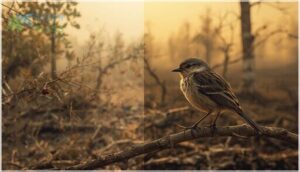
Food scarcity along migration routes is quietly reshaping how bird species survive their journeys.
Deforestation strips away the fruiting shrubs, native insects, and wild seeds that fuel stopover ecology — leaving bird populations arriving at degraded patches with little to refuel on.
Habitat loss disrupts foraging behavior and seed dispersal networks that once ran like clockwork. Conservation efforts can help restore these food webs, but migration patterns won’t wait.
Increased Exposure to Predators
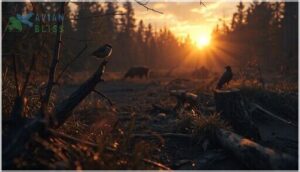
Vulnerability follows deforestation like a shadow. When habitat loss fragments forests, edge habitat effects reshape predator prey dynamics in ways that cost bird populations dearly.
Raccoons, crows, and feral cats exploit these exposed boundary zones, driving nesting success rates down sharply — in some Midwestern patches, up to 80 percent of nests failed. Migration mortality climbs as fragmentation impacts push birds into open landscapes with fewer places to hide.
Forest Fragmentation and Migratory Bird Survival

Forest fragmentation doesn’t just shrink the world for migratory birds — it breaks it into pieces that are harder to navigate, harder to survive in, and harder to recover from.
When forests get carved up by roads, farms, and development, the damage runs deeper than it looks on a map. Here’s what that actually means for birds trying to make it through the year.
Edge Effects and Microclimate Changes
When deforestation shrinks a forest into isolated patches, edge temperature rises 2 to 5 degrees Celsius above interior levels — and that microclimate shift changes everything for a migratory bird mid-journey.
Forest fragmentation turns these fragments into ecological traps, where habitat disruption from drier soils and reduced invertebrates leaves birds with fewer options. The ecological consequences of deforestation aren’t always visible, but habitat loss at the edges is quietly devastating.
Population Isolation and Genetic Diversity Loss
When forest fragmentation cuts across what were once open breeding corridors, bird populations don’t just shrink — they splinter.
Isolation effects reduce gene flow between patches, accelerating genetic drift and stripping away rare alleles that help birds adapt.
Fragmentation impacts can trap specialized populations in shrinking remnants where inbreeding quietly takes hold.
Without conservation strategies for bird species that restore connectivity, habitat loss pushes already fragile populations closer to the edge.
Increased Risk of Local Extinctions
When habitat loss and fragmentation effects combine, local extinctions don’t just happen gradually — they can cascade. Once remaining patches drop below a critical threshold, bird populations lose the stepping-stone connections they need to recover after a bad season.
Deforestation accelerates this collapse, turning once-stable metapopulations into isolated remnants. Biodiversity conservation depends on recognizing that population decline in one fragment often signals extinction risk across an entire region.
Ecological Consequences for Migratory Bird Species

The damage doesn’t stop at lost habitat or broken migration routes — it ripples outward, reshaping entire ecosystems in ways that are hard to reverse.
Migratory birds hold more ecological weight than most people realize, and when their populations collapse, the consequences follow. Here’s what’s actually at stake when we look at the ecological fallout for these species.
Decline in Bird Populations and Biodiversity
The numbers don’t lie — North America has lost nearly 3 billion birds since 1970, a 29% drop tied directly to Habitat Destruction and Habitat Loss. Biodiversity Loss accelerates as Deforestation erases the forest specialists first.
North America has lost nearly 3 billion birds since 1970, a silent collapse driven by deforestation and habitat destruction
Species Vulnerability grows when Bird Populations shrink into fragmented patches, raising Extinction Risk and triggering Ecosystem Disruption across entire flyways.
- Grassland migrants down 53% since 1970
- 1 billion birds lost from forest habitats alone
- Over one-third of U.S. bird species now face conservation concern
Disrupted Ecosystem Services Provided by Birds
Losing birds means losing the Ecosystem Services they do. Bird Species quietly run systems you depend on — Seed Dispersal, Pollination Services, Nutrient Cycling, even Scavenging Loss after wildlife die.
When Deforestation shrinks Bird Populations, Ecosystem Services unravel fast. Frugivorous birds once moved seeds across kilometers; now fragmented Habitat Loss slows forest recovery by nearly 38%. That erosion quietly drains Ecosystem Resilience from the ground up.
Vulnerability to Climate Change and Diseases
Climate Shift Impacts don’t arrive alone — they team up with Deforestation to hit Bird Species from two directions at once. Warmer temperatures push breeding ranges poleward, while cleared land blocks the path.
Add Disease Transmission through mosquito-dense deforested edges, and Bird Immunity weakens fast. Chronic stress from Habitat Loss lowers a bird’s ability to fight infection, accelerating Ecosystem Disruption and pushing vulnerable populations closer to Species Extinction.
Conservation Strategies for Migratory Birds

The good news is that birds don’t have to lose this fight — and neither do you.
Researchers and local communities have already identified practical strategies that work, from protecting key habitats to restoring what’s been lost.
Here’s what’s making a real difference on the ground.
Protected Areas and Wildlife Corridors
Protected areas form the backbone of wildlife conservation, but they can’t work in isolation. Thoughtful corridor design and wildlife connectivity are what turn scattered forest patches into functional flyways.
Conservation planning in places like Colombia and Central America shows that linking reserves through ecosystem restoration dramatically reduces the impact of forest fragmentation. These conservation strategies for bird species give migratory birds what they need most: a connected, protected path forward.
Reforestation and Habitat Restoration Efforts
Corridors matter, but so does what fills them. Habitat restoration gives those connections real ecological value.
Planting native forests along major flyways creates stopover hotspots where migrants can rest and refuel. Agroforestry systems, like shade-grown coffee farms, support twice the bird species of conventional plantations.
Even urban renewal efforts reduce habitat loss by turning degraded land into usable refuge, advancing meaningful bird conservation against deforestation’s reach.
Community Involvement and Sustainable Practices
Behind every thriving forest is a community that chose to protect it. Community engagement turns passive bystanders into active stewards — and that shift changes everything for migratory birds.
- Local brigades in Mexico documented 221 bird species through community-led monitoring
- Shade-grown coffee promotes sustainable forestry while preserving migration corridors
- Eco-friendly practices like agroforestry keep tree cover on working farms
- Community involvement in bird conservation drives local conservation agreements
- Bird-friendly ecotourism funds sustainable forest management and bird conservation directly
Your choices — what you buy, how you engage locally — shape the prospects of migratory bird species.
Frequently Asked Questions (FAQs)
How does deforestation affect birds?
Deforestation impact on bird habitat loss is devastating.
As forest ecosystems shrink, avian populations lose nesting sites, food sources, and migration corridors — pushing wildlife conservation efforts to their limits and accelerating decline.
What is the biggest threat to migratory birds?
Habitat loss from human activity stands as the single greatest threat to migratory birds.
Deforestation, habitat destruction, and ecosystem disruption combine to accelerate bird extinction at a pace that no species can outfly.
How does deforestation affect migration?
Think of migration as a relay race — forest loss removes the handoff zones.
Habitat fragment and ecosystem disruption break those essential links, forcing birds off course and driving the impact of deforestation on bird populations even higher.
How does light pollution affect migrating birds?
Urban lighting throws migration patterns into chaos.
Light pollution causes bird disorientation, pulling migrants off course and into ecological traps where survival odds drop sharply — a serious threat to conservation of migratory bird species.
Can bird feeders support migrants during deforestation?
Bird feeders can offer real support during deforestation, acting as supplemental food stations that aid migrant refueling at stopover sites.
When paired with native plantings, feeder placement becomes a practical conservation strategy for displaced bird species.
Which bird species migrate the longest distances annually?
Among long distance fliers, the Arctic Tern migration tops all others, covering nearly 60,000 miles annually.
Sooty Shearwater routes reach 40,000 miles, while bar-tailed godwits complete extraordinary nonstop ocean crossings within their annual migration cycles.
How do invasive species worsen migratory bird survival?
Invasive species stack the odds against migratory birds at every turn — disrupting food webs, spreading parasites, and shifting migration patterns in ways that compound the consequences of habitat loss for birds already under pressure.
Conclusion
The deforestation effects on migrating birds don’t end at the forest’s edge—they follow every songbird across continents, season after season. What you protect here shapes what survives there.
Corridors restored, forests left standing, communities engaged: these aren’t small gestures. They’re the architecture of survival for species that can’t renegotiate their routes mid-flight.
The silence that replaced 3 billion missing birds is still spreading. You still have the chance to answer it.
- https://www.pnas.org/doi/10.1073/pnas.2203511120
- https://pmc.ncbi.nlm.nih.gov/articles/PMC10460791/
- https://news.mongabay.com/2019/04/deforested-habitats-leave-migratory-birds-ill-prepared-for-journey-north/
- https://abcbirds.org/news/insect-freefall-what-does-it-mean-for-birds/
- https://pubs.usgs.gov/publication/70039109