This site is supported by our readers. We may earn a commission, at no cost to you, if you purchase through links.
 You’re looking at one of the most common mix-ups in the bird world.
Here’s the truth: budgies ARE parakeets. The difference between budgie and parakeet isn’t really a difference at all—it’s more like comparing apples to fruit.
Budgerigars (budgies) are simply one specific type of parakeet, while "parakeet" is the umbrella term for over 100 species of small, long-tailed parrots.
In America, people often use "parakeet" to mean budgie specifically, but scientifically, cockatiels, lovebirds, and many other colorful birds fall under the parakeet category too.
Understanding this relationship reveals fascinating insights about bird classification and pet selection.
Table Of Contents
- Key Takeaways
- What is a Budgie?
- What is a Parakeet?
- Budgerigar Vs Parakeet: Etymology
- Budgerigar Vs Parakeet: Species and Subspecies
- Budgerigar Vs Parakeet: Popularity as a Pet
- Breeding Differences
- Frequently Asked Questions (FAQs)
- Are a budgie and parakeet the same?
- Do budgie birds like to be held?
- Can parakeets live with budgies?
- Do budgies recognize their owners?
- Are parakeets and budgies the same species?
- Are English budgies a different type of budgie?
- Why are budgies called parakeets in America?
- What is the difference between a budgerigar and a parakeet?
- Are there any other names for budgies or parakeets?
- Which bird lives longer on average?
- Conclusion
Key Takeaways
- Budgies are parakeets – You’re not choosing between different birds, but rather between one specific type of parakeet (budgie) and the broader parakeet family that includes over 115 species.
- All budgies are parakeets, but not all parakeets are budgies – You’ll find that budgies represent just one species within the massive parakeet umbrella, making this a classic case of specific vs. general classification.
- Regional naming creates confusion – You’ll hear budgies called "parakeets" in America due to pet trade terminology, while other countries use "budgerigar" or "budgie" to distinguish them from other parakeet species.
- Size and lifespan vary significantly across parakeet species – You’ll get 5-10 years from budgies, but other parakeets can live 15-25 years and range from 7-18 inches in size, affecting your long-term commitment and care requirements.
What is a Budgie?
Understanding what a budgie is starts with knowing its scientific name: Melopsittacus undulatus. This small Australian parrot, commonly called a budgerigar, represents one of the world’s most beloved pet birds.
Meet the budgerigar: Australia’s tiny green parrot that won hearts worldwide as the ultimate feathered friend.
Budgie Origins trace back to Australia’s vast outback, where Wild Budgies roam in massive flocks across grasslands and open woodlands. These naturally occurring birds showcase the classic green and yellow plumage that’s become their trademark.
In terms of Budgie Size, you’re looking at compact companions measuring about 7 inches long and weighing just 30-40 grams. Their petite stature makes them perfect apartment pets.
Budgie Colors have expanded dramatically through selective breeding. While wild budgerigars sport traditional green bodies with yellow heads, captive varieties now include blue, white, and violet mutations. Petco, for example, sources budgies, and color availability varies based on breeder practices.
Budgie Sounds range from cheerful chirping to impressive speech mimicry, especially in males. These vocal abilities, combined with their friendly nature, explain why budgies consistently rank among top parakeet choices for first-time bird owners seeking an engaging, manageable pet.
What is a Parakeet?
Parakeets encompass over 115 species of small to medium-sized parrots with distinctive long tail feathers.
You’ll find incredible diversity among parakeet types, from tiny 7-inch budgerigars to larger 18-inch Indian Ringnecks. These vibrant birds inhabit various parakeet habitats across continents, thriving in forests, grasslands, and urban areas.
Their parakeet diet includes seeds, fruits, and vegetation, while parakeet sounds range from melodic chirps to complex vocalizations. Different parakeet genera display unique parakeet traits – some excel at mimicking speech, others prefer quieter communication.
Parakeet size varies dramatically between species, affecting parakeet care requirements and parakeet lifespan expectations. While parakeets are known for their social nature, the smaller parrotlet can be territorial, requiring experienced owners.
- Species Diversity: Parakeets include budgies, monk parakeets, Indian ringnecks, and many others, each with distinct characteristics and care needs.
Budgerigar Vs Parakeet: Etymology

Word origins reveal fascinating differences between budgie vs parakeet terminology. You’ll discover that "budgerigar" likely stems from Aboriginal Australian languages, though linguistic analysis shows uncertain etymology.
Meanwhile, "parakeet" traces back to French "perroquet," meaning parrot. Historical usage demonstrates how regional terms evolved differently across continents.
In the US, these names often create confusion since budgies are commonly called parakeets, showing how name evolution varies by location. While parakeets are known for their friendly nature, parrotlets show aggression if not properly socialized.
| Term | Origin | Etymology | Regional Usage | Historical Context |
|---|---|---|---|---|
| Budgerigar | Australian Aboriginal | Uncertain/debated | Australia, UK | Native terminology |
| Budgie | English | Shortened budgerigar | Worldwide | Modern abbreviation |
| Parakeet | French | "Perroquet" (parrot) | US, Europe | Colonial influence |
Budgerigar Vs Parakeet: Species and Subspecies

While budgerigars belong to a single species, parakeets encompass over 115 diverse species across multiple genera.
The budgerigar (Melopsittacus undulatus) represents just one branch of the parakeet family tree, making all budgies parakeets, but not all parakeets budgies.
Taxonomic distinctions reveal fascinating differences in species origin and evolutionary history.
Budgies originated exclusively in Australia, while parakeets evolved across various continents.
This geographic separation influenced their conservation status and hybridization potential between different parakeet species.
Considering another popular pet bird, parrotlets need more space due to their energetic behavior.
| Aspect | Budgerigar | Other Parakeets |
|---|---|---|
| Species Count | Single species | 115+ species |
| Geographic Origin | Australia only | Worldwide distribution |
| Subspecies | None recognized | Multiple per species |
| Genus | Melopsittacus | Various genera |
| Evolutionary Path | Isolated development | Diverse adaptations |
Understanding these budgie vs parakeet differences helps you appreciate the complexity within the parakeet family and recognize why budgie parakeet difference matters for proper identification.
Budgerigar Vs Parakeet: Popularity as a Pet

When choosing between budgies and parakeets as pets, several factors influence their popularity among bird enthusiasts.
Budgies and parakeets each bring unique charm and personality, making them favorites for bird lovers everywhere.
| Comparison Factor | Budgies | Parakeets (Other Species) |
|---|---|---|
| Pet ownership costs | Lower initial and ongoing expenses | Higher costs for larger species |
| Child-friendly pets | Excellent with gentle handling | Good, but size varies by species |
| Noise levels | Moderate chirping and chatter | Varies widely by species |
| Ease of training | Highly trainable, responsive | Species-dependent difficulty |
Budgies consistently rank among the top three most popular pet birds in the United States due to their manageable size and speech-mimicking abilities.
Their 5-10 year lifespan appeals to families seeking shorter commitments. Parakeets offer greater color diversity and longer lifespans (7-12 years), attracting owners wanting vibrant, long-term companions.
Both species’ social nature encourages keeping pairs, while their apartment-friendly size suits urban dwellers perfectly.
Many owners prioritize meeting nutritional requirements to guarantee their pet bird’s health and longevity.
Breeding Differences
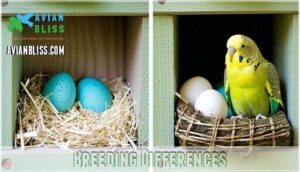
Several key factors distinguish budgie vs parakeet breeding patterns. Understanding these differences helps you make informed decisions about bird breeding and care.
Breeding age and timing differences:
- Clutch size: Budgies typically lay 4-6 eggs per clutch, while parakeets produce 4-8 eggs, offering slightly larger broods for successful reproduction.
- Incubation period: Budgie eggs hatch after 18 days of incubation, compared to parakeets’ 16-21 day range, affecting your breeding timeline expectations.
- Chick rearing: Both species reach sexual maturity around 6 months, but parakeets often require more varied nesting environments than budgies’ preferred tree cavity conditions.
Genetic mutations appear more frequently in captive budgie breeding programs, while parakeets show greater natural genetic diversity across their multiple species. Understanding the importance of safe nesting locations can greatly improve breeding success. These breeding differences impact everything from cage setup to feeding schedules during reproductive seasons.
Frequently Asked Questions (FAQs)
Are a budgie and parakeet the same?
You’ll discover budgies and parakeets aren’t exactly the same. All budgies are parakeets, but not all parakeets are budgies. Budgies are one specific species within the broader parakeet family.
Do budgie birds like to be held?
Most budgies don’t enjoy being held initially.
You’ll need patience and trust-building through gentle interaction.
Start with finger training, then gradually work toward brief handling sessions.
Some budgies never love being held but enjoy perching on you.
Can parakeets live with budgies?
Yes, parakeets can live with budgies since budgies are actually a type of parakeet. They’re the same species (Melopsittacus undulatus), so they’ll get along perfectly and share similar care requirements.
Do budgies recognize their owners?
Your budgie recognizes you through voice, appearance, and body language. They’ll show excitement when you approach, respond to your voice, and often prefer you over strangers, demonstrating clear owner recognition.
Are parakeets and budgies the same species?
Over 115 species fall under the parakeet umbrella, yet budgies represent just one specific type.
Yes, budgies and parakeets share the same species classification as Melopsittacus undulatus, making them scientifically identical despite different common names used regionally, which highlights their regional differences.
Are English budgies a different type of budgie?
English budgies aren’t a different species—they’re the same Melopsittacus undulatus as American budgies.
You’ll notice English budgies are larger, fluffier, and have rounder heads due to selective breeding for show standards.
Why are budgies called parakeets in America?
In America, you’ll hear budgies called parakeets because the pet trade adopted this broader term when budgerigars first arrived from Australia.
This created lasting confusion between the specific species and general parakeet family.
What is the difference between a budgerigar and a parakeet?
Don’t put all your eggs in one basket when choosing between these birds.
A budgerigar is actually a specific type of parakeet.
All budgies are parakeets, but not all parakeets are budgies, since parakeet describes over 100 different species.
Are there any other names for budgies or parakeets?
You’ll find budgies called budgerigars, shell parakeets, or lovies. Parakeets go by many names including conures, cockatiels, lovebirds, and grass parakeets, depending on their specific species and region.
Which bird lives longer on average?
Parakeets outlive budgies substantially.
While your budgie might grace you with 5-10 years of chatter, parakeets can stick around for 15-25 years, making them the marathon runners of the small parrot world.
Conclusion
Amazingly, the difference between budgie and parakeet has confused countless bird enthusiasts for decades.
Now you know that budgies are simply one type of parakeet, not a separate species entirely.
When you’re choosing your next feathered companion, remember that all budgies are parakeets, but not all parakeets are budgies.
You’ve got over 100 parakeet species to explore, each with unique characteristics and care requirements.
Whether you call them budgies or parakeets, these intelligent birds make wonderful pets when properly cared for.