This site is supported by our readers. We may earn a commission, at no cost to you, if you purchase through links.
Grab any trail camera off a shelf, point it at your backyard feeder, and you’ll probably end up with blurry thumbnails of a chickadee that looks like a flying cotton ball. Trail cameras are built to catch a deer at 40 yards—not a finch at four feet.
The difference between trail cameras and bird cameras comes down to what each was engineered to solve. One hunts movement across a wide field; the other locks onto a small, fast subject and holds it sharp. Knowing which tool fits your situation saves you money, frustration, and a memory card full of useless shots.
Table Of Contents
- Key Takeaways
- Trail Cameras Vs Bird Cameras: Key Differences
- Core Features That Set Them Apart
- How to Match Camera Resolution to Your Mission
- Top 9 Trail Cameras for Outdoor Wildlife Monitoring
- 1. Master Lock Python Cable Lock
- 2. Vikeri Trail Camera With Night Vision
- 3. Wildgame Innovations Trail Camera
- 4. SpyPoint Cellular Trail Camera
- 5. Bushnell Trophy Trail Camera
- 6. Wosports Mini Trail Camera
- 7. Wosoda Trail Camera With Night Vision
- 8. Reconyx Hyperfire Trail Camera
- 9. Bushnell Core S 4K Trail Camera
- Choosing The Best Camera for Backyard Bird Watching
- Frequently Asked Questions (FAQs)
- Conclusion
Key Takeaways
- Trail cameras are built for distant, heat-generating animals, so pointing one at a backyard feeder will get you blurry, useless shots of small birds every time.
- The real difference comes down to focus and detection: bird cameras lock on at inches away with pixel-based motion sensing, while trail cameras need bigger heat signatures and wider distances to trigger.
- Matching resolution and IR type to your setup matters — 940nm no-glow LEDs protect shy birds at night, while 4K resolution lets you crop deep and still keep a sharp, frame-worthy image.
- If you’re serious about feeder photography, skip the workarounds and get a dedicated bird camera; it’s the only tool that’s actually engineered for the job.
Trail Cameras Vs Bird Cameras: Key Differences
These two cameras look similar on the outside, but they’re built for completely different jobs.
It’s the same idea with binoculars—roof prism vs. Porro prism designs can look nearly identical but handle light and depth in totally different ways.
Picking the wrong one means missing the shots you actually care about.
Here’s what sets them apart.
Purpose and Primary Use Cases

Think of it this way — a trail camera and a BirdCam aren’t competing. They’re solving different problems.
Trail cameras dominate wildlife monitoring, tracking deer, bears, and hogs across wide game trails. BirdCams sit close to feeders, locking into bird behavior at just inches away.
Trail cameras rely on motion sensor and infrared technology to capture images of elusive animals both day and night.
| Use Case | Best Camera Type |
|---|---|
| Deer scouting | Trail Camera |
| Backyard bird watching | BirdCam |
| Property surveillance | Game Camera |
| Feeder observation | Wildlife Camera |
Design and Build Considerations
Build tells the whole story before a single photo gets taken.
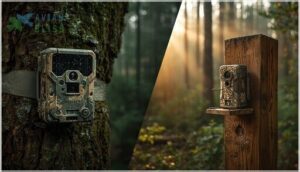
Trail cameras lean hard into rugged housing — camo design, rubber-gasketed doors, weatherproof seals built for weeks unattended in rain and mud.
Bird cameras? Cleaner, compact, sealed against seed dust and droppings. A key advantage is how trail cameras enable you to monitor wildlife with minimal interference through infrared nighttime photography.
| Feature | Trail Camera |
|---|---|
| Housing Materials | Rugged camo plastic |
| Weather Sealing | IP66 waterproof rated |
| Camera Durability | Heavy field use |
| Lens Quality | Wide, distance-optimized |
| Build Ergonomics | Strap-and-tree mount |
Ideal Environments for Each Camera Type

Where you set up matters as much as the camera itself.
Trail cameras own forest habitats, wildlife corridors, and water sources — anywhere deer, foxes, or elk move predictably. BirdCam thrives in bird sanctuaries, urban landscapes, and backyard feeders within arm’s reach.
| Environment | Trail Camera | BirdCam |
|---|---|---|
| Forest & Corridors | ✔ Ideal | ✘ Too far |
| Water Sources | ✔ Strong | ✘ Limited |
| Backyard Feeders | ✘ Too wide | ✔ Perfect |
Core Features That Set Them Apart
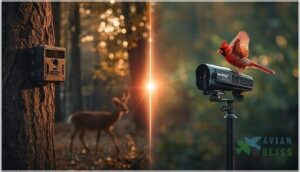
Once you get past the purpose argument, the real differences come down to hardware.
Things like focus range, trigger speed, and how each camera deals with low light — that’s where trail and bird cameras really split off.
Here’s a closer look at the four features that matter most.
Focus Range and Close-Up Capability
This is where trail cameras really fall short for birds. Most are fixed-focus and calibrated for subjects 3 to 5 meters out — so anything closer just looks soft.
Bird cameras flip that script with autofocus, macro focus capability, and close focus distances under a meter. Better lens design means tighter depth field control, which translates directly to sharper image quality and better close up detail.
Motion Detection and Trigger Speed
Motion sensors are where these two cameras go their separate ways. Bird cameras use pixel-based detection — perfect for fast, small subjects in tight Detection Zones. Trail cameras rely on passive infrared, which needs bigger heat changes to trigger.
That sensitivity gap matters a lot in small spaces, which is why pixel-based detection wins for backyard birding where tiny birds move fast and heat signatures barely register.
Bird cameras react to pixels; trail cameras wait for heat
Here’s what that means for you:
- Faster Trigger Speed (under 0.4s) means fewer missed shots
- Lower False Triggers keep your storage clean
- Shorter Recovery Time captures every repeat visit
Field of View and Lens Specifications
Your lens choice is the difference between a blurry speck and a sharp chickadee portrait.
Trail cameras lean on wide-angle lenses with short focal lengths — think 2.4 to 4mm — for broad diagonal coverage across game trails. Bird cameras go tighter, using longer focal lengths so small subjects fill the frame.
Sensor size shapes it all.
| Spec | Trail Camera | Bird Camera |
|---|---|---|
| Focal Length | 2.4–4mm | 25–400mm equiv. |
| Horizontal FOV | 80–120° | 40–70° |
| Sensor Size | 1/3″ typical | APS-C or larger |
Infrared Flash and Nighttime Performance
Two infrared wavelengths run the show — 850nm low glow and 940nm no glow — and picking the wrong one wrecks your night vision results.
- 850nm LEDs boost flash range and image quality but throw a faint red glow
- 940nm LEDs go invisible, protecting shy birds in nest boxes
- Motion-triggered bird cameras moderate IR power so close subjects don’t blow out
- Low light performance drops slightly with 940nm, but feeder shots stay sharp within 1–2 meters
How to Match Camera Resolution to Your Mission
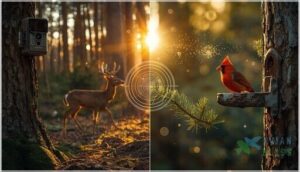
Resolution sounds like a simple numbers game, but it’s really about knowing what you’re trying to capture.
The right choice depends on your lighting conditions, storage limits, and how long you need the camera running on a single set of batteries.
Here’s how the three main factors break down so you can pick what actually fits your setup.
4K Vs 1080p for Wildlife and Bird Photography
4K resolution sounds like overkill until you’re trying to ID a warbler that spent half a second at your feeder. With 4K birding cameras, you can crop heavily in video editing and still export a clean 1080p clip.
Camera settings and sensor size matter too, but frame rates seal the deal — 1080p trail cameras at 60fps beat 4K30 for fast, fluid motion every time.
Low-Light Performance and Digital Noise
Low-light performance is where sensor size quietly wins or loses the fight. Trail cameras push ISO sky-high to catch distant game, and that’s when digital noise turns your nighttime image quality into a grainy mess.
Bird cameras, sitting just inches from feeders, stay at lower ISO — so their night vision captures clean feather detail that most trail cameras can’t touch, even with noise reduction cranked up.
Storage, Battery, and Long-Term Use
Resolution means nothing if your camera dies or fills up mid-deployment. Match your storage and power setup to how you actually shoot.
- 32 GB SD cards handle weeks of still images, but 4K video eats through storage space fast — go 128 GB minimum
- Lithium AAs outlast alkalines in the cold, protecting battery life when temps drop
- Check Storage Limits before leaving cameras unattended for months
- Schedule Data Backup runs every two weeks to avoid missing key captures
Top 9 Trail Cameras for Outdoor Wildlife Monitoring
Not every trail camera is built the same, and picking the wrong one can mean missed shots and wasted money.
These nine options cover a solid range of budgets, features, and use cases for monitoring wildlife in the field. Here’s what made the cut.
1. Master Lock Python Cable Lock
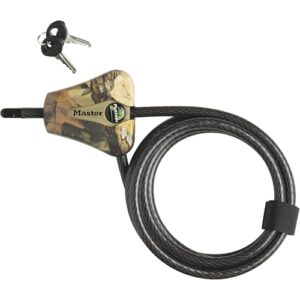
Your trail camera means nothing if someone walks off with it. That’s where the Master Lock earns its place in your kit.
The 6-foot braided steel cable wraps around trees or posts and cinches tight with an adjustable locking head — no separate padlock needed. It’s cut-resistant, weather-tough, and backed by a lifetime guarantee. At under 10 ounces, you won’t even notice it in your pack until you actually need it.
| Best For | Hunters, campers, and outdoor enthusiasts who want a lightweight, no-fuss way to secure gear like trail cameras, tools, or ATV accessories in the field. |
|---|---|
| Brand | Master Lock |
| Color | Camo |
| Weight | 9.6 oz |
| Weather Resistance | Weather-resistant |
| Storage Support | N/A |
| Primary Use | Security/Locking |
| Additional Features |
|
- The adjustable locking head keeps things simple — no extra padlock to lose or forget
- Cut-resistant braided steel and weather-resistant build hold up in rough outdoor conditions
- At under 10 ounces with a lifetime guarantee, it’s solid value for the weight
- Bolt cutters can still get through it, so it’s not the right call for high-security situations
- Six feet might feel short if you’re trying to secure something bulky or oddly shaped
- The key can be a little finicky — you might need a few tries to get it to release cleanly
2. Vikeri Trail Camera With Night Vision
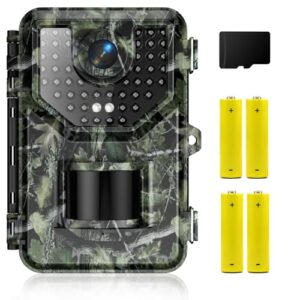
Now that your camera’s locked down, let’s talk about what’s actually doing the watching. The Vikeri A1 packs 48MP resolution and 4K video into a rugged IP66-rated body — and that 0.05-second trigger speed means you’re not missing the buck that disappears in a blink.
Its 48 no-glow IR LEDs stay invisible to wildlife at night, covering up to 80 feet in darkness. The 130° detection angle is wide enough to catch movement you didn’t even know was happening.
| Best For | Hunters, wildlife enthusiasts, and property owners who want reliable trail coverage without spooking animals or missing fast-moving targets. |
|---|---|
| Brand | Vikeri |
| Color | Green |
| Weight | 1.54 lbs |
| Weather Resistance | IP66 Waterproof |
| Storage Support | Micro SD |
| Primary Use | Wildlife monitoring |
| Additional Features |
|
- 48MP and 4K video means your footage is sharp enough to actually tell what you’re looking at
- Those no-glow IR LEDs won’t tip off deer or other skittish wildlife at night
- The 0.05-second trigger speed is fast — blink and it’s already captured the shot
- No Wi-Fi or cellular means you have to physically check the camera to see what it caught
- Battery life could be a concern if you’re placing it somewhere remote and hard to reach
- A few users have run into inconsistencies with the detection range, so placement matters more than you’d think
3. Wildgame Innovations Trail Camera
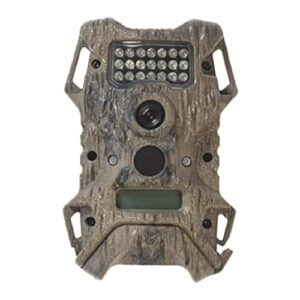
If the Vikeri feels like overkill for your needs, the Wildgame Innovations Trail Camera keeps things simple without leaving you empty-handed. It shoots 14MP stills and 720p video, with 21 IR LEDs reaching out to 65 feet at night.
Not flashy, but solid, it runs on 8 AA batteries and accommodates up to a 32GB SD card. Weather-resistant build, easy bungee mounting, and an affordable price — sometimes the no-frills option is exactly what the job calls for.
| Best For | Hunters and property owners who want a reliable, no-fuss trail camera without spending a lot. |
|---|---|
| Brand | Wildgame Innovations |
| Color | Bark |
| Weight | 14 oz |
| Weather Resistance | Weather-resistant |
| Storage Support | Up to 32GB SD |
| Primary Use | Wildlife/Hunting |
| Additional Features |
|
- 14MP stills and 720p video give you clear enough footage day or night
- 21 IR LEDs reach up to 65 feet, so you’re covered in low-light situations
- Weather-resistant build and bungee mounting make setup quick and easy
- Battery life takes a hit when you lean on video mode
- Bungee cords can struggle with larger trees
- Some users have run into durability issues and found customer support lacking
4. SpyPoint Cellular Trail Camera
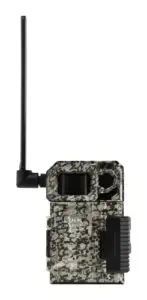
Want to cut down your field trips and let the camera do the work? That’s exactly where the SPYPOINT Cellular Trail Camera earns its keep.
It fires in 0.3 seconds, picks up movement 100 feet out, and shoots 40MP photos straight to your phone over LTE. No more hiking out every week just to pull a card.
You get 100 free photo transmissions monthly, and unlimited plans run about $10. Compact, fast, and genuinely useful for remote monitoring.
| Best For | Hunters and outdoor enthusiasts who want to monitor remote locations without constantly making trips to check their camera. |
|---|---|
| Brand | SPYPOINT |
| Color | Multi |
| Weight | 0.35 kg |
| Weather Resistance | Not specified |
| Storage Support | Micro SD |
| Primary Use | Hunting/Surveillance |
| Additional Features |
|
- Sends photos straight to your phone over LTE — no card pulls needed
- Blazing fast 0.5-second trigger speed so you don’t miss a thing
- Free plan includes 100 photo transmissions a month, which is a solid starting point
- Doesn’t work in Canada and requires LTE coverage, so remote dead zones are a problem
- Picture quality lags behind some competitors despite the 10MP sensor
- Subscription required beyond the free tier, and customer support has been a pain point for some users
5. Bushnell Trophy Trail Camera
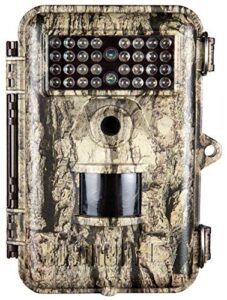
The Bushnell Trophy Trail Camera is built for hunters who don’t have time to mess around. It snaps photos at 0.15 seconds, recovers in under a second, and detects movement out to 80 feet.
You get 20MP images and 1080p video with audio — solid for both wildlife tracking and home surveillance. Battery life in picture mode can stretch to 8 months on lithium AAs, which means fewer swap-outs and more time watching what actually matters.
| Best For | Hunters and outdoor enthusiasts who want a reliable trail camera for tracking wildlife, monitoring game, or keeping an eye on their property. |
|---|---|
| Brand | Unbranded |
| Color | Unspecified |
| Weight | Unspecified |
| Weather Resistance | Not specified |
| Storage Support | Up to 32GB SD |
| Primary Use | Hunting/Wildlife |
| Additional Features |
|
- 20MP photos and 720p HD video with audio give you clear, detailed shots day or night
- 80 ft PIR sensor and night vision flash means you won’t miss activity even in total darkness
- Fully programmable settings let you dial in trigger intervals, multi-shot mode, and more to fit your setup
- Maxes out at a 32GB SD card, so you’ll need to swap it out more often on busy cameras
- The menu navigation uses small text and can be tricky to work through in the field
- Battery life and durability have been hit or miss for some users depending on conditions
6. Wosports Mini Trail Camera
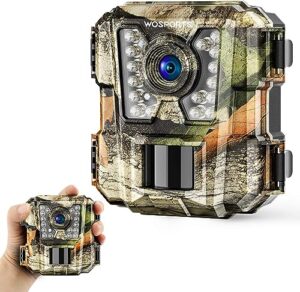
Small but capable, the Wosports Mini Trail Camera punches above its weight for anyone who needs discreet wildlife monitoring without hauling bulky gear. It runs on just four AA batteries, shoots up to 16MP stills, and records 720p video with a 70-degree field of view.
The IP54 weatherproof housing withstands rain and dust just fine. Trigger speed averages around 0.8 seconds, and the IR night vision reaches 49 feet — solid coverage for trail setups, backyard feeders, or tucked-away security spots.
| Best For | Hunters, wildlife watchers, and anyone who wants a compact, no-fuss trail camera that’s easy to hide and set up without a steep learning curve. |
|---|---|
| Brand | Unbranded |
| Color | Unspecified |
| Weight | Unspecified |
| Weather Resistance | Waterproof |
| Storage Support | Up to 32GB SD |
| Primary Use | Wildlife/Security |
| Additional Features |
|
- Tiny and easy to conceal — great for spots where a bulky camera would stick out
- Fast 0.8-second trigger speed means you’re not missing much
- IR night vision reaches 49 feet, which covers most trail and backyard setups well
- Red LEDs can give away the camera’s position at night, so it’s not fully covert
- No battery indicator means you’re guessing when to swap them out
- Some users ran into file corruption issues, so a quality SD card is a must
7. Wosoda Trail Camera With Night Vision
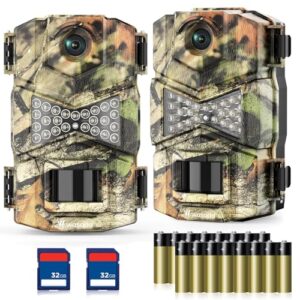
The Wosoda Trail Camera with Night Vision is a solid two-for-one deal — you get a pack of two cameras ready to cover more ground right out of the box. Each unit shoots 30MP stills and 1080p HD video, with a 0.3-second trigger speed that catches fast movers without missing a beat.
The 850nm low-glow IR reaches up to 80 feet in complete darkness. Just know the battery compartment seal isn’t the tightest, so moisture can sneak in over time.
| Best For | Hunters, homesteaders, and anyone who wants to keep tabs on wildlife or watch over their property without breaking the bank. |
|---|---|
| Brand | WOSODA |
| Color | 2 Pack |
| Weight | 3.03 oz |
| Weather Resistance | Waterproof |
| Storage Support | SD card |
| Primary Use | Wildlife/Security |
| Additional Features |
|
- Two cameras in one pack means you can cover more spots without buying extra gear
- 30MP photos and 1080p video with a 0.3-second trigger catches fast-moving animals before they disappear
- 850nm low-glow IR night vision reaches up to 80 feet without spooking wildlife
- The battery compartment seal is weak, so moisture can creep in and cause rust over time
- Video quality won’t cut it for professional use or large prints
- Battery life takes a hit in cold weather, which limits how useful it is in winter months
8. Reconyx Hyperfire Trail Camera
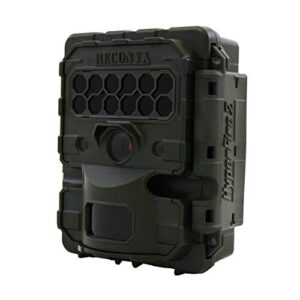
If you’re serious about wildlife monitoring, the Reconyx Hyperfire HF2X is basically the benchmark — and it earns that reputation.
The 0.2-second trigger speed is one of the fastest out there, so quick-moving animals don’t stand a chance at slipping past it. You get 1080p widescreen images, 720p video with audio, and a no-glow IR flash that won’t spook anything.
Battery life hits around 40,000 images. It’s expensive, but you’re paying for reliability that actually holds up in the field.
| Best For | Wildlife researchers, serious hunters, and anyone who needs a trail camera that just works — no babysitting required. |
|---|---|
| Brand | SPYPOINT |
| Color | Gray |
| Weight | 1.1 lbs |
| Weather Resistance | Not specified |
| Storage Support | SD card |
| Primary Use | Remote monitoring |
| Additional Features |
|
- Blazing fast 1/4-second trigger means you actually catch the animal, not the spot where it was standing
- No-glow IR flash reaches 150 feet without spooking wildlife, day or night
- Battery lasts up to 40,000 images — you can leave it out for months without worrying
- It’s pricey, and you’ll definitely feel that at checkout
- Video maxes out at 10 seconds, which feels short if you want real behavioral footage
- The interface can be a bit clunky, so expect a learning curve when setting it up
9. Bushnell Core S 4K Trail Camera
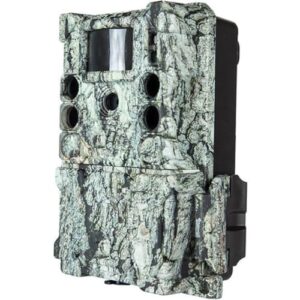
If you want 4K detail without breaking the bank, the Bushnell Core S 4K is worth a hard look. It shoots 30MP stills and 4K video, and the 0.2-second trigger means you’re not missing the shot.
The no-glow IR flash reaches 110 feet — solid for nighttime monitoring without spooking deer or anything else. Runs on 6 AA batteries and accepts up to 512GB SD cards, so you can leave it out for weeks. A reliable workhorse for the money.
| Best For | Hunters and wildlife watchers who want pro-level image quality and fast capture without spending a fortune. |
|---|---|
| Brand | RECONYX |
| Color | Green |
| Weight | 1.45 lbs |
| Weather Resistance | Not specified |
| Storage Support | SD card |
| Primary Use | Wildlife monitoring |
| Additional Features |
|
- 4K video and 30MP stills give you seriously sharp footage, day or night
- 0.2-second trigger speed means you’re catching the moment, not the aftermath
- Holds up to 512GB SD cards, so you can leave it running for weeks without a trip out
- Files save as MOV format, which can be a pain if your software doesn’t play nice with it
- Full-size SD cards are harder to find and usually pricier than micro SD
- Battery life can take a hit in night video mode, so keep an eye on that
Choosing The Best Camera for Backyard Bird Watching

Picking the right camera for your backyard birds comes down to knowing what you actually need.
A trail camera can work, but only if you set it up the right way.
Here’s what to think about before you buy or adjust what you already have.
Positioning Near Feeders, Baths, and Nest Boxes
Where you put your camera matters just as much as which one you buy. For bird feeder placement, set up 2 to 6 feet away to catch feather detail.
Aim your bird bath camera 3 to 5 feet high for solid wildlife viewing distances. With nest box orientation, point the lens downward to frame eggs, chicks, and all four corners clearly.
Camera angle tips like these make backyard habitat design work.
Trail Camera Setup Tips for Small Birds
Getting camera placement right for small birds takes a little trial and error. They move fast and rarely stay put.
Here’s what actually works:
- Set motion sensitivity high — small birds barely register on standard settings.
- Use burst mode with a trigger speed under 0.3 seconds.
- Mount at 5–7 feet, angled 30–45 degrees downward.
- Keep the camera 5–10 feet from a known perch.
Bird behavior rewards patience, not guesswork.
When a Dedicated Bird Camera is The Better Choice
Once you’ve wrestled with trail camera placement long enough, the truth becomes clear — for close-up feeder interaction, nothing beats a dedicated BirdCam.
Wingscapes BirdCam locks focus as tight as 6 inches, so you catch bird behavior, fine feather detail, and even birdsong capture through its built-in mic.
For serious backyard bird watching and bird photography of small birds, it’s just the smarter tool.
Frequently Asked Questions (FAQs)
What is the number one rated trail camera?
The Bushnell Core DS 4K No Glow consistently tops trail reviews and outdoor testing charts. In wildlife camera comparisons, it scores 93/100 — hard to beat for serious wildlife monitoring.
Do you need Wi-Fi for a bird camera?
No, you don’t need Wi-Fi for a bird camera. Many models record offline to an SD card just fine.
Wi-Fi only matters if you want live alerts, remote viewing, or cloud backup.
Can trail cameras work in extreme cold weather?
Yes, trail cameras can handle extreme cold — but battery life is the real weak point.
Lithium batteries stay strong past -40°F, while alkaline cells can die fast once temperatures drop below zero.
How long do trail camera batteries typically last?
Battery life on a trail camera is a slow burn — or a fast drain, depending on how you use it.
Expect one to three months on alkaline AA batteries under normal conditions.
Are bird cameras compatible with smart home systems?
Yes, many bird cameras support Smart Home Integration out of the box.
With WiFi Connectivity, you get Live Streaming to Echo Show, Motion Alerts, Voice Command control, Cloud Storage, and even AI-powered Image Recognition for bird ID.
Can bird cameras stream footage live to phones?
Absolutely, and it’s effortless. BirdCam models with WiFi connectivity beam live streaming straight to mobile apps on your phone.
Some even tap cellular networks and 4G LTE cellular camera tech for anywhere access.
Conclusion
Wrong camera, wrong shot. Wrong setup, wasted season. The difference between trail cameras and bird cameras isn’t just specs on a box—it’s the gap between a blurry smear of feathers and a frame worth keeping.
Once you match the tool to the target, everything clicks. Pick the camera built for your mission, position it right, and let it do the work. Your backyard has better stories than you think.
- https://camovue.com/blog/wild-game-trail-camera/
- https://www.willfine.com/birdwatching/where-to-position-a-bird-feeder-a-strategic-guide-combining-ecological-insight-and-smart-monitoring/
- https://brinkshome.com/smartcenter/game-cameras-for-home-security-a-quick-guide
- https://www.trailcampro.com/pages/2024-detection-shootout-trail-camera-comparison
- https://naturespy.org/blogs/help-articles/trail-camera-detection-zones-explained