This site is supported by our readers. We may earn a commission, at no cost to you, if you purchase through links.
Every year, roughly 281 million people live outside their country of birth—but the paths they took to get there look nothing alike. A software engineer relocating from Mexico City to Houston follows a completely different route, with different risks and paperwork, than a family fleeing conflict in Sudan toward the Mediterranean coast.
The differences in migration routes aren’t random. Geography, economics, political instability, and even the season of departure all steer people toward certain paths and away from others. Understanding what shapes each route reveals a map not just of movement, but of the forces that push and pull millions of lives across borders.
Table Of Contents
- Key Takeaways
- Key Global Migration Routes Compared
- Factors Shaping Migration Route Choices
- Differences Between Voluntary and Forced Migration Routes
- Geographic and Demographic Variations in Routes
- Impacts and Challenges Along Migration Routes
- Frequently Asked Questions (FAQs)
- What are the main migration routes?
- What are the six different kinds of migration?
- What are the different types of migration process?
- How do remittances shape future migration decisions?
- What role do diaspora networks play in routing?
- How does education access influence destination choices?
- What legal pathways exist for economic migrants?
- How do language barriers affect settlement locations?
- Conclusion
Key Takeaways
- Whether someone moves by choice or by force shapes everything about their route — a planned economic move follows familiar corridors, while a refugee crisis turns survival into the only compass.
- Geography, politics, and climate change don’t just influence migration routes — they actively redirect them, as seen when the EU-Turkey deal nearly shut down one path and pushed hundreds of thousands through Libya instead.
- Money is a quiet engine behind global movement, with remittances hitting $669 billion in 2023 and wage gaps as high as 5-to-1 making certain corridors — like Latin America to the US or South Asia to the Gulf — nearly impossible to ignore.
- The human cost of irregular migration is stark: in 2024 alone, nearly 9,000 people died or went missing on these routes, a number that reflects just how little protection exists for those who can’t access legal pathways.
Key Global Migration Routes Compared
Migration routes aren’t random — they follow geography, policy, and human need.
Understanding which birds move and which stay put gets a lot easier when you explore eastern U.S. bird identification and habitat patterns.
Millions of people move along a handful of well-worn paths every year, and each one tells a different story.
Here’s a look at the key routes that define global migration today.
Major Corridors by Region (e.g., Mexico–US, Central Mediterranean)

Across the world, migration corridors reveal surprisingly consistent patterns — people follow paths where others have gone before. As these patterns reveal, the largest migration corridors globally are shaped by a complex mix of economic, political, and environmental drivers.
Three corridors stand out in global migration today:
- Mexico–US: ~11 million Mexican-born residents in the US, with 2.5 million border encounters recorded in 2023.
- Latin America–North America: roughly 27 million migrants along this broader corridor.
- Central Mediterranean: over 150,000 crossings in 2023 alone.
Regional trends and corridor dynamics shift constantly, but geographic barriers and refugee crisis pressures keep these international migration routes active.
Sea Vs. Land Routes

Sea routes and land routes each carry their own trade-offs.
The Central Mediterranean sees thousands of deaths yearly, with overcrowded boats creating serious migrant safety concerns. Land corridors through deserts bring environmental risks like dehydration and heat.
Smuggling fees on land can reach $7,500, paid in stages across multiple borders. Meanwhile, border patrols and border control efforts push both migration patterns into increasingly dangerous terrain.
Recent reports have highlighted the toll of migration-related deaths over the past decade.
Shifts in Popular Migration Paths Over Time

Routes don’t stay fixed. Migration trends shift as border policies tighten or conflicts erupt.
In 2015, nearly 885,000 people crossed via Turkey to Greece — then EU-Turkey cooperation nearly closed that path. Global movements rerouted through Libya instead.
These international migration patterns show that when one door closes, migration routes adjust quickly, reflecting broader demographic shifts and an ever-changing refugee crisis landscape.
Factors Shaping Migration Route Choices
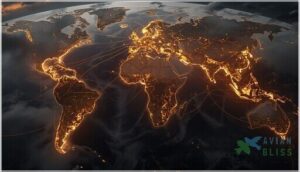
No one picks a migration route by flipping a coin — there’s always something pushing or pulling people toward a particular path. A mix of forces shapes these decisions, and they’re rarely simple.
Even urban environments play a role — as cities expand, White Ibis habitat and migration behavior shifts, with many birds settling year-round rather than following traditional routes.
Here’s a closer look at the key factors that guide where people go and why.
Economic Drivers and Opportunities
Money moves people. Wage disparities between countries — sometimes 5 to 1 or higher — make economic incentives powerful enough to reshape entire international migration patterns.
Remittance flows hit $669 billion globally in 2023, with India alone receiving $125 billion. Labor markets in destination countries actively shape immigration policies and skill matching corridors, driving migration and development across regions as economic factors in global migration trends grow stronger.
Political Instability and Conflict
War displacement doesn’t just uproot lives — it rewires entire migration systems. Conflict zones like Syria, Ukraine, and Sudan push millions into forced displacement, triggering refugee crises that strain border control and security across continents.
The Venezuelan crisis alone displaced 7.7 million people. Humanitarian aid struggles to keep pace, and without stronger refugee protection frameworks, human rights and migration remain dangerously out of balance.
Environmental and Climate-related Influences
Climate change doesn’t just shift weather — it redirects entire migration routes. Environmental factors in migration are reshaping who moves, where, and why.
Sea level rise alone could displace up to 13 million U.S. coastal residents by 2100. Key pressures driving environmental migration include:
- Drought migration across the Sahel toward North African transit hubs
- Heat stress reducing outdoor labor income in South Asia and Africa
- Land degradation expanding desert crossings as rangelands shrink
Family Reunification and Social Ties
Family ties don’t just pull people toward a destination — they shape the exact path taken. When diaspora communities and social networks are already rooted somewhere, newcomers follow those same corridors because the groundwork is laid.
In 2022, family reunification accounted for roughly two-thirds of permanent immigration to OECD countries. Kinship dynamics, reunification policies, and the information relatives share all quietly steer international migration patterns before a single step is taken.
Differences Between Voluntary and Forced Migration Routes

Not all migration paths look the same, and the biggest reason comes down to one simple question: did someone choose to leave, or were they forced to?
That difference shapes everything — the route taken, the risks involved, and who controls the journey.
Here’s a closer look at what sets these paths apart.
Characteristics of Voluntary Migration Paths
When you choose to move, the path looks very different from someone fleeing overnight. The path is shaped by economic factors like job demand corridors — Latin America to the US, South Asia to the Gulf — and is influenced by social networks and chain migration.
You’re planning border crossings, timing departures, and following human migration patterns that relatives already tested. Route planning here is deliberate, not desperate.
Refugee and Asylum Seeker Routes
Refugee and asylum seeker routes don’t follow a plan — they follow a crisis. When conflict or persecution forces you out, migration routes become survival corridors, not choices.
The Central Mediterranean saw over 1,800 deaths in 2024 alone. Border crossings trigger asylum processes, often in holding facilities before you’re relocated inland. Sea transit, refugee camps, and UNHCR registration shape nearly every step of these migration patterns.
Smuggling and Trafficking Networks
Behind many migration routes, there’s a hidden economy. Smuggling and trafficking networks don’t operate like crime movies — they run like franchises, with local brokers, corrupt officials, and transporters each taking a cut.
- Network Structures coordinate land, sea, and air movement using encrypted apps and forged documents.
- Smuggling Tactics shift routes constantly to outmaneuver border control.
- Trafficking Methods trap vulnerable people through debt and deception.
Geographic and Demographic Variations in Routes
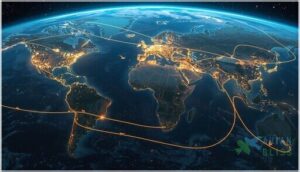
Migration routes don’t follow a single pattern — they shift depending on where you’re in the world, how old you are, and even what time of year it’s.
These differences aren’t random; they reflect real geographic forces that shape which paths people and species actually take.
Here’s a closer look at what drives those seasonal variations.
Regional Geography Influencing Route Selection
Where you travel depends largely on what the land allows. Mountain barriers, like the Himalayas and Andes, push migration routes toward lower passes. Desert crossings, through the Sahara, concentrate movement along infrastructure corridors near water.
Coastal routes and river valleys guide millions toward accessible ports and cities.
| Geographic Barrier | Region | Route Redirected To |
|---|---|---|
| Himalayas | South Asia | Indo-Gangetic Plain |
| Sahara Desert | North Africa | Agadez–Libya corridor |
| Aegean Sea | Europe/Turkey | Greek island crossings |
Age and Gender Differences in Migration Paths
Geography shapes where people go, but who’s moving shapes how they get there.
Youth migration patterns show that teens and young adults, ages 15 to 24, more often accept risky irregular routes when legal options feel slow.
Gendered route choices matter too — women lean on family dynamics and kin networks, while men follow labor corridors.
Smuggler dependence rises sharply when age risk factors combine with incomplete documents.
Seasonal and Temporal Route Variations
Timing shapes migration routes just as much as geography does. Weather patterns and seasonal constraints push people to adapt constantly — Sahara crossings shift northward when central desert temperatures exceed 45°C, while Mediterranean departures drop sharply in winter storms.
- Temporal shifts cluster night-time crossings for cover
- Adaptive routing uses real-time apps to dodge checkpoints
- Climate change is reshaping traditional geographic barriers, echoing transhumance patterns and forcing route adaptation year-round
Impacts and Challenges Along Migration Routes

Every migration route comes with its own set of obstacles, and understanding them helps you see the full picture.
The challenges range from physical barriers at borders to the deeper struggles of rebuilding life in a new place. Here’s a closer look at what migrants face along the way.
Border Controls and Security Measures
Border controls have transformed into layered systems of biometric screening, border surveillance, and risk assessment that can feel like running a gauntlet. At over 30 U.S. airports, identity verification happens in seconds using facial recognition.
Frontex deploys 3,000+ officers across EU borders, and irregular crossings dropped roughly 60 percent in January 2026. Security protocols and border management shape which migration routes remain viable.
Humanitarian Risks and Protection Needs
Vulnerability defines every step of irregular migration. In 2024 alone, at least 8,938 people died or went missing on migration routes worldwide. Refugee safety and migrant health collapse fast without support.
In 2024, nearly 9,000 people died on migration routes — a stark measure of how little protection irregular migrants receive
Four core risks stand out:
- Border violence and gender-based abuse
- Human trafficking along smuggling corridors
- Disrupted medical care for asylum seekers
- Disaster response gaps in remote zones
Social and Cultural Integration Challenges
Belonging doesn’t arrive at the border — it takes years to build. Language barriers slow everything: only about 40% of recent arrivals report strong host-country language skills. That gap shapes jobs, healthcare, and friendships.
| Challenge | Real-World Impact |
|---|---|
| Social Isolation | Fewer jobs, limited networks |
| Identity Formation | Tension between heritage and new norms |
| Community Building | Diaspora communities preserve cultural heritage |
| Refugee Resettlement | Asylum seeker rights often go unmet |
Cultural exchange and social cohesion grow gradually — but they do grow.
Frequently Asked Questions (FAQs)
What are the main migration routes?
The main migration routes follow global corridors shaped by geography and need.
You’ll find major population movement along the U.S.
-Mexico border, Central Mediterranean sea crossings, and refugee routes out of conflict zones like Syria and Afghanistan.
What are the six different kinds of migration?
Migration breaks down into six core types: internal movement, international border crossing, voluntary reasons-based economic migration, forced displacement, legal pathways migration, and environmental relocation.
Each shapes how refugees and displaced people navigate global migration routes differently.
What are the different types of migration process?
Migration processes fall into voluntary moves — like chain migration, step migration, and transhumance patterns — and forced ones, such as refugee flight and internal displacement.
Irregular and international migration round out the full range of global population movement.
How do remittances shape future migration decisions?
Remittances don’t just send money home — they quietly fund the next departure.
Household decisions shift when families treat remittances as investment strategies, turning Economic Factors in Migration into long-term Migration Aspirations across borders.
What role do diaspora networks play in routing?
Diaspora communities act as living compasses for route planning. Through social guidance via WhatsApp and Telegram, they share real-time border updates, financial support, and smuggling tactics — quietly steering international migration toward safer, familiar corridors.
How does education access influence destination choices?
Education access quietly steers destination choices. When school quality and scholarship programs are strong, families follow. Student visas with clear visa pathways turn short-term education opportunities into long-term migration decisions.
What legal pathways exist for economic migrants?
There’s more than one door into legal migration. Labour Migration programs, Family Reunification pathways, Education Visas, Humanitarian Routes, and Regularization Programs all offer documented options for economic migrants traversing today’s international migration policies.
How do language barriers affect settlement locations?
Language barriers push migrants toward cities where services and translation already exist.
Linguistic integration shapes urban settlement patterns — migrants cluster where cultural proximity and shared language reduce daily barriers.
Conclusion
A Somali mother crossing into Kenya with her children doesn’t choose her route—she takes the only one available. That reality captures what the differences in migration routes truly reveal: not just geography, but the weight of circumstance behind every step.
Whether someone boards a plane with a visa or walks through desert heat, the path reflects the options they’d. Understanding those options is the first step toward understanding migration itself.
- https://www.audubon.org/magazine/ask-kenn-do-migrating-birds-take-same-routes-spring-and-fall
- https://vtecostudies.org/blog/green-wave-explains-migratory-bird-routes
- https://pmc.ncbi.nlm.nih.gov/articles/PMC11285787/
- https://journal.afonet.org/vol93/iss2/art10/
- https://www.smithsonianmag.com/science-nature/technology-gps-collar-reveals-hidden-animal-migration-routes-180971185/