This site is supported by our readers. We may earn a commission, at no cost to you, if you purchase through links.
When you step into a forest, you’re entering one of the planet’s most crowded bird neighborhoods. Over 3,000 species call forests home, and more than 70% of them live in tropical rainforests, where competition for food and nesting space is fierce.
These birds don’t just coexist; they’ve carved out specific niches, from the forest floor to the highest canopy branches, developing exceptional adaptations along the way. Vivid plumage, specialized beaks, and complex songs all serve survival purposes, helping birds claim territory, attract mates, and find food.
You’ll find everything from tiny songbirds to vibrant parrots, each playing a critical role in seed dispersal, insect control, and forest health. Understanding the different types of birds in forests reveals how these ecosystems function and why protecting them matters for the planet’s biodiversity.
Table Of Contents
Key Takeaways
- Over 3,000 bird species live in forests, with more than 70% concentrated in tropical rainforests where they’ve evolved specialized adaptations like vivid plumage, unique beaks, and complex songs to survive intense competition for food and nesting space.
- Forest birds perform essential ecological jobs that keep their habitats healthy, including dispersing seeds that boost forest recovery by up to 38%, controlling insect populations by reducing pests by roughly 40%, and pollinating plants across vertical forest layers.
- These birds face severe threats from habitat loss—forests lose 11 million hectares yearly—and climate change, which has already caused North American forests to lose nearly 1 billion birds since 1970 and threatens two-thirds of species with extinction risk.
- Conservation efforts like citizen science platforms, protected biodiversity sites, and birding tourism that generates $71.5 billion annually are critical for protecting forest birds and the intricate relationships that sustain both the species and their ecosystems.
Common Types of Forest Birds
Forests around the world are home to a remarkable variety of bird species, each adapted to different layers and conditions within wooded habitats. You’ll find everything from colorful songbirds that brighten up your backyard to rare tropical species with feathers that look almost unreal.
Let’s look at some of the most common and fascinating types of birds you’re likely to encounter in forest environments.
Songbirds (e.g., Northern Cardinal, European Robin)
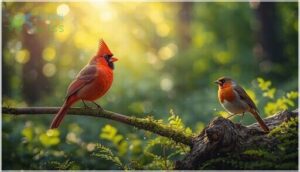
When you step into the woods, songbirds are often the first forest birds you’ll hear. Northern Cardinals and European Robins showcase striking avian diversity through:
- Vocal mimicry and song complexity that define forest acoustics
- Population sizes around 120 million for cardinals across North American birds
- Genetic diversity maintained through careful nest site selection
- Year-round presence in forest habitats, unlike many migrants
- Adaptation to nest predation through dense understory placement
Their distinctive calls make bird identification easier for anyone exploring the forest. They’re common in the Northeastern United States.
Parrots and Cockatoos (e.g., African Grey Parrot, Palm Cockatoo)

You’ll find African Grey Parrots and Palm Cockatoos in tropical forest habitats, where they showcase striking parrot intelligence and specialized bird diets.
These parrots face serious trade threats and habitat degradation, with African Grey populations declining sharply. Palm Cockatoo nesting depends on old-growth trees, and their exceptionally low reproduction rates—sometimes just one chick every few years—make recovery challenging when forests disappear.
The African Grey Parrot is considered IUCN endangered due to these threats.
Cranes and Turacos (e.g., Grey Crowned Crane, Great Blue Turaco)

You’ll encounter Grey Crowned Cranes in wetlands and grasslands bordering African forests, where their populations have plunged over 60% since 1985 due to habitat loss and illegal trade.
Great Blue Turacos inhabit West and Central African canopies, feeding mainly on forest fruits like Musanga and Syzygium.
Both avian species face conservation threats, with crane decline particularly severe in Rwanda, where fewer than 500 individuals remain.
Specialty Species (e.g., Resplendent Quetzal, Asian Paradise Flycatcher)

Moving into tropical forests, you’ll find even more striking specialty species that showcase nature’s artistry. The Resplendent Quetzal, with its vibrant plumage stretching nearly a meter in males, inhabits Central American cloud forests at elevations between 3,000–10,500 feet.
Asian Paradise Flycatchers, distinguished by elegant tail streamers that double their body length, demonstrate impressive aerial hunting skills while breeding across southern Asia, later migrating to lower tropical forests.
Forest Bird Habitats and Distribution

Forest birds don’t just live anywhere—they’ve carved out specific homes across the planet, from steamy rainforests to cold northern woodlands. Where you find these birds depends on the type of forest, the layer they prefer, and even which corner of the world you’re exploring.
Let’s look at the main habitats and regions where forest birds make their homes.
Tropical Rainforests
Tropical rainforests are home to roughly 72% of the world’s forest birds, despite covering only about 18% of Earth’s land. These forests showcase vertical stratification, where different birds occupy distinct layers from floor to canopy. You’ll find remarkable species richness here, with the Amazon Basin alone supporting over 1,300 bird species.
Climate change and deforestation impacts now threaten many species, with populations declining by 25–38% since 1980.
Temperate and Boreal Forests
You’ll discover that temperate and boreal forests support 20–50 bird species per plot, shaped by forest structure, management impacts, and climate change. In European forests, about 241 species depend on these habitats, while North American boreal forests host specialized songbird communities.
Bird diversity rises with structural complexity, and species richness responds strongly to management practices. Climate change now shifts migration timing, creating mismatches between forest birds and seasonal food availability, challenging bird conservation efforts.
Forest Floors, Canopies, and Edge Habitats
You’ll find that forest habitats are vertically layered, with distinct bird communities occupying the forest floor, understory, and forest canopy. Vertical stratification shapes where birds forage, nest, and thrive, while habitat structure and forest fragmentation influence richness across forest ecosystems and avian habitats.
- Forest floors host ground-nesting species and insectivores at 0.6–2.1 pairs per hectare
- Edge effects increase bird abundance within 30 m of boundaries, though predation risk rises
- Understory use peaks between 0.6–2.4 m, where most captures occur across forest types
Geographic Regions and Endemism
You’ll notice that avian endemism peaks in southern forest habitats, with Madagascar hosting 91% endemic forest birds. Tropical hotspots like the Amazon and Andes concentrate hundreds of range-restricted species, while island endemism drives severe losses—Hawaii lost 33 native forest birds.
North American forests and boreal forest regions show lower endemism than continental regions farther south, where latitudinal patterns favor irreplaceable lineages facing endangered species status.
Unique Features and Adaptations
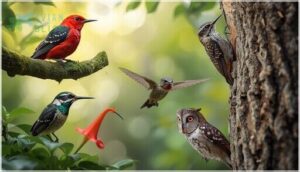
Forest birds have evolved striking traits that help them survive in their woodland homes. From bright feathers that catch your eye to beaks shaped for specific jobs, these adaptations make each species perfectly suited to its environment.
Let’s look at the key features that make forest birds so well-equipped for life among the trees.
Distinctive Plumage and Coloration
You’ll notice that colorful forest birds rely on two main strategies for their unique bird plumage: Carotenoid Pigments deliver yellows and reds, while Structural Coloration creates blues and iridescence. Hidden Layers beneath feathers increase brightness and saturation, making vibrant plumage even more striking.
Sexual Dichromatism means males often flash bolder colors than females, and Camouflage Survival helps ground-nesters blend into leaf litter, protecting them from predators.
Specialized Beaks and Feeding Tools
You’ll find that beak morphology directly shapes bird feeding habits, with each design acting as a specialized toolkit. Woodpeckers wield chisel-like bills that absorb impacts up to 1,400 g, while hummingbirds match bill length to flower corollas for nectar extraction. Crossbills pry conifer cones with crossed mandibles, and shorebirds use probing bills for soft substrates.
These feeding adaptations determine forest bird diet, separating insectivorous birds from seed-eating birds and nectar specialists through precise seed handling and foraging techniques.
Vocalizations and Communication
Just as beaks access food sources, vocal skills reveal complex avian communication networks in forests. Bird calls encode information across frequency ranges that match body size—large species use deep tones (under 0.5 kHz), while tiny birds reach 13.4 kHz.
You’ll observe song complexity, social context, and mimicry shaping forest bird behavior:
- Dawn choruses help species avoid acoustic interference
- Alarm calls trigger instant escape responses
- Multi-element songs convey territory and mating signals
Nesting Behaviors and Sites
Where birds nest matters as much as how they sing. About 28–35% of forest species rely on cavity nesting, using tree cavities or snags rather than building open cups.
You’ll find nesting spots distributed vertically—ground to canopy—with nest predation rising near edges. Habitat structure, especially large decayed trees, determines safe nest sites.
Vertical placement and edge effects shape bird nesting behavior across forest layers.
Ecological Roles of Forest Birds

Forest birds aren’t just pretty faces in the trees—they’re hardworking members of the ecosystem, keeping everything in balance. From spreading seeds to controlling pests, these feathered residents perform jobs that directly affect the health and survival of their forest homes.
Let’s look at the key roles birds play in maintaining vibrant, thriving forests.
Seed Dispersal and Forest Regeneration
When you explore forest regeneration, you’ll see that avian seed dispersal drives the whole process. Birds carry seeds across landscapes, boosting forest recovery rates by up to 38% in fragmented areas.
Dispersal functional redundancy ensures that even if some bird species decline, others keep seed distribution going. Bird loss effects can be severe, reducing tree diversity dramatically.
Management interventions like installing perches help attract seed-eating birds to degraded forest habitats.
Insect Control and Pest Management
Just as seed dispersal keeps forests growing, insect control keeps them healthy. You’ll see insectivorous birds dramatically reducing insect populations, with some systems showing a 38% drop in pest abundance. Forest proximity matters—insect regulation weakens as you move away from wooded areas. Economic benefits can reach $310 per hectare annually through avian pest control, making IPM integration and damage reduction essential forest management strategies.
- Bird exclusion experiments show that insect pests increase by roughly 40% when birds can’t access infested areas
- Coffee farms near forest patches receive double the insect control services compared to farms far from forests
- Insectivorous birds provide economic pest suppression worth over $1,400 per square kilometer in protected forest areas
- Studies document 50% reductions in coffee berry borer damage when birds actively hunt insect pests
- Distance from forest fragments directly affects both bird abundance and predation rates on insect pests
Pollination and Plant Diversity
While insects often receive most of the credit, bird pollinators play a disproportionately significant role in forest health. In the Galápagos, birds serviced 85% of plant species despite representing only 8% of pollinators. Their long-distance flights are crucial for maintaining genetic diversity in scattered plants. Additionally, forest structure is essential—complex canopies support more diverse bird communities, which in turn strengthen pollination networks and enhance plant reproduction across forest habitats.
| Pollinator Type | Plant Species Serviced | Key Contribution |
|---|---|---|
| Avian Pollinators | 66 species (53% exclusively) | Long-distance pollen transfer |
| Bird-Insect Teams | 40 species (32% shared) | Complementary pollination |
| Insects Only | 19 species (15%) | Local flower visitation |
| Mobile Nectarivores | Sparse flowering patches | Genetic diversity maintenance |
| Forest Specialists | Canopy to understory | Vertical stratification coverage |
Pollinator loss disrupts plant reproduction, and habitat fragmentation further weakens these vital networks. Maintaining diverse forest structures directly supports functional richness in bird communities, which sustains plant diversity and forest regeneration through effective seed dispersal and pollination.
Food Web Dynamics
When top predators vanish, the effects ripple down through every layer of the forest. Trophic cascades occur as mesopredators increase, elevating nest predation on smaller birds and disrupting their roles in insect control and seed dispersal. You’ll see these shifts play out across the food web:
- Insectivorous birds consume 400–500 million tons of arthropods yearly, keeping insect populations in check
- Frugivorous birds link plant reproduction to forest carbon storage through targeted seed dispersal
- Scavenging birds return nutrients to soil, completing the cycle
Predatory birds shape reproductive success across species, connecting every trophic level.
Conservation and Threats to Forest Birds

Forest birds face serious challenges that threaten their survival, from shrinking habitats to changing climates. Understanding these threats helps you see why conservation matters so much for these species.
Let’s look at the main issues affecting forest birds and what’s being done to protect them.
Habitat Loss and Deforestation
Forest habitats vanish at an alarming rate—the world loses nearly 11 million hectares of forest each year, directly threatening bird populations. Tropical deforestation and forest fragmentation have pushed dozens of species toward extinction, while habitat degradation claims breeding grounds for millions of birds.
In North America alone, forests have lost approximately 1 billion individual birds since 1970. Conservation strategies remain critical for protecting these endangered species.
North American forests have lost nearly 1 billion birds since 1970, making conservation strategies critical for endangered species
Climate Change Impacts
Rising global temperatures are reshaping forest bird communities in profound ways, threatening populations worldwide. For every 1.8°F increase in dry season warmth, you’ll see tropical forest bird survival plummet by 63% on average.
Climate-driven threats to bird populations include:
- Population declines: Two-thirds of North American species face extinction risk from warming
- Range shifts: Birds are moving northward at 1.5 km per year, seeking cooler habitats
- Breeding changes: Spring arrives three weeks earlier, causing food mismatches for chicks
- Morphology: Amazonian birds evolved lighter bodies and longer wings for heat adaptation
- Disease risks: Warming expands parasites and pathogens into previously safe zones
These effects of climate on birds demand urgent forest conservation and habitat loss prevention.
Migration Challenges
When you think about bird migration, you might picture a smooth journey south, but the reality is far tougher. Migrating forest birds face stopover degradation as forests vanish, forcing 28% fewer birds to complete their journeys since 1970.
Geomagnetic disruption throws off their internal compass, while artificial lighting near cities causes up to 988 million building collisions annually.
Energetic stress peaks when refueling forests disappear, and disease transmission along migration patterns adds another deadly risk during spring or fall migrations.
Conservation Efforts and Birdwatching Initiatives
You can join citizen science platforms like eBird to track forest birds and support conservation efforts. Birding tourism generates $71.5 billion annually, funding habitat preservation. Your birdwatching experiences directly contribute to avian conservation and forest conservation efforts worldwide.
Protected areas now cover key biodiversity sites, while community monitoring through REDD+ projects reduces deforestation costs to $2.50 per hectare.
Frequently Asked Questions (FAQs)
How do forest birds raise their young?
You’ll find that parental care varies widely—some forest birds share feeding duties equally, while others rely on cooperative breeding with helpers.
Nest predation shapes where they choose nesting spots, and incubation effort determines fledgling survival rates.
What sounds do different forest birds make?
Forest birds produce sounds spanning frequencies from 1,377 Hz to over 7,800 Hz, with song frequency and amplitude variation helping you identify species.
Vocal complexity, dawn chorus timing, and sound transmission patterns reveal unique bird behavior and forest bird behavior characteristics.
Which forest birds migrate the farthest distances?
The Arctic Tern holds the record among migratory birds, covering roughly 70,900 km annually between Greenland breeding grounds and Antarctic waters.
Long-distance songbirds like warblers travel 10,000–24,000 km between temperate forests and tropical wintering areas.
How long do common forest birds live?
Like candles flickering in different winds, forest birds burn through their years at varied rates. You’ll find songbirds averaging just 2-6 years, while corvids and woodpeckers stretch to 7-12, shaped by habitat influence and predation effects.
What time of day are forest birds most active?
Most songbirds are active during dawn chorus peaks, roughly 30–60 minutes before sunrise, when avian behavior intensifies.
Crepuscular foraging occurs at dusk for parrots, while nocturnal bird calls mark predatory birds hunting overnight.
Conclusion
You’ve now got the blueprint for understanding different types of birds in forests, from canopy-dwelling parrots to ground-foraging songbirds. Each species you encounter plays an important part in maintaining forest health, whether dispersing seeds, controlling insects, or pollinating plants.
These ecosystems depend on birds as much as birds depend on them. When you protect forests, you’re safeguarding thousands of species and the intricate relationships that keep our planet thriving. That’s worth remembering on your next forest walk.
- https://www.nps.gov/teachers/classrooms/wildlife-of-the-tropical-rainforests.htm
- https://worldrainforests.com/03birds.htm
- https://data.globalforestwatch.org/documents/4eea031c5a2e4a7cbebbd2e8b7447fa0
- https://www.neonscience.org/impact/observatory-blog/studying-relationships-between-forest-structure-and-bird-biodiversity
- http://globalchange.msu.edu/news/2020-03-17-bird-behavior.html