This site is supported by our readers. We may earn a commission, at no cost to you, if you purchase through links.
Most people think eating healthy means choosing organic kale over conventional, but the real nutritional revolution happens when you expand beyond the same five staples dominating your plate. Right now, three crops—wheat, rice, and corn—supply 60% of the world’s calories, a dangerous dependence that leaves both your body and global food systems vulnerable to collapse.
The importance of a diverse seed diet extends far beyond personal wellness, connecting your dinner table to agricultural resilience, climate adaptation, and the survival of thousands of heirloom varieties that once sustained entire civilizations.
When you deliberately rotate through legumes, ancient grains, oilseeds, and pseudocereals, you’re not just upgrading your nutrient intake—you’re participating in a quiet rebellion against industrial monoculture, accessing phytochemicals and minerals that conventional agriculture has bred out of existence, and strengthening the genetic safety net humanity will need as climate patterns shift.
Table Of Contents
Key Takeaways
- Rotating through legumes, ancient grains, oilseeds, and pseudocereals gives you access to phytochemicals and minerals that industrial monoculture has bred out, while your microbiome thrives on the fermentable fibers and polyphenols that boost butyrate production and fortify your immune response.
- Three crops—wheat, rice, and corn—supply 60% of global calories, creating dangerous dependence that threatens both personal nutrition and agricultural resilience, but deliberately choosing diverse seed varieties disrupts this vulnerability while preserving thousands of heirloom varieties refined over generations.
- Seed diversity acts as living crop insurance because mixed varieties exhibit complementary drought tolerance and pest resistance, stabilizing harvests when climate shocks hit while naturally boosting beneficial insect populations that reduce chemical dependency.
- Your everyday choices matter—selecting heirloom seeds, participating in community seed exchanges, and advocating for farmer-friendly seed legislation directly strengthens food sovereignty and preserves the cultural heritage embedded in regional varieties adapted to local conditions.
What is a Diverse Seed Diet?
A diverse seed diet means more than just sprinkling chia seeds on your yogurt. It’s about intentionally eating a wide variety of seeds—from ancient grains to modern hybrids—to boost your nutrition and support resilient food systems.
Let’s break down what this really means, which seeds count, and how we got here.
Definition and Key Concepts
A diverse seed diet isn’t just about adding flax to your smoothie—it’s about embracing seed varieties from multiple plant families, each carrying unique genetic diversity, nutrient profiles, and resilience traits. This approach strengthens food security while supporting agricultural systems built on crop diversity rather than monoculture.
Consider what seed diversity offers you:
- Protection through food biodiversity when climate threatens single crops
- Access to genetic variation developed over thousands of years
- Nutrient-dense options that industrial agriculture often overlooks
- A vote for ecological balance with every seed you choose
Embracing seed diversity also involves exploring language related concepts to better understand the nuances of crop naming and classification.
Types of Seeds in Diverse Diets
You can build genetic diversity into your meals through four main seed categories. Timing your seed offerings to align with peak migration periods ensures these travelers get the energy boost they need most.
Legumes—beans, lentils, chickpeas—deliver protein and fiber. Whole grains like quinoa, barley, and millet provide B vitamins and minerals. Pairing these nutrient-rich foods with practices that support local ecosystems creates a more sustainable approach to everyday eating.
Nut seeds such as sunflower and pumpkin offer healthy fats and vitamin E. Oilseeds including flax and chia supply omega-3s, while pseudocereals like amaranth add unique amino acid profiles.
Historical Context of Seed Diversity
For thousands of years, farmers cultivated seed varieties that thrived in their local climates, building agricultural heritage through seed trade and crop domestication networks. Ancient farming practices prioritized genetic diversity, with communities stewarding hundreds of heirloom seeds through careful seed evolution. That abundance shifted dramatically in the 1900s: Modern industrial agriculture replaced this diversity with monocultures, but protecting biodiversity through sustainable practices shows how individual actions can restore ecological balance.
- Industrial agriculture standardized crops, favoring uniform varieties over locally adapted ones
- Seed company consolidation eroded biodiversity conservation efforts
- Patenting restrictions limited farmers’ traditional rights to save and exchange seeds.
The importance of maintaining diverse seed stocks is also related to methodological rigor in scientific research on crop resilience.
Nutritional Benefits of Seed Diversity
When you eat a wider variety of seeds, you’re not just adding texture to your meals—you’re fundamentally upgrading your nutritional foundation. Different seeds carry different strengths, and rotating through multiple types gives your body access to a richer palette of nutrients than any single seed can provide. This same principle applies in nature—diverse habitats support bird migration and survival by offering varied food sources across seasons.
Here’s how seed diversity translates directly into measurable health benefits. Different seed types provide varied nutrients—choosing the best bird seeds for wild birds ensures your backyard visitors get complete nutrition for vibrant plumage and strong immunity.
Broader Spectrum of Vitamins and Minerals
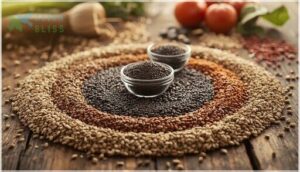
When you rotate different seeds into your meals, you’re fundamentally stacking your vitamin and mineral intake—think higher B vitamins, varied iron and zinc profiles, and fat-soluble vitamins like E and K that differ by seed type.
This dietary diversity creates micronutrient richness that guards against deficiencies, delivering nutritional security through naturally nutrient-dense foods with unique vitamin variance and mineral balance across species.
Enhanced Gut Microbiome and Immunity

Your immune response thrives when you feed your microbiome a variety of seeds, each packed with fermentable fibers and polyphenols that shift gut bacteria toward anti-inflammatory patterns and boost short-chain fatty acid production, particularly butyrate. This microbiome balance fortifies your intestinal barrier, bolstering food security against pathogens while addressing micronutrient deficiencies through improved nutrient absorption:
- Enhanced tight junction proteins fortify gut health
- Increased butyrate fosters regulatory T cell development
- Polyphenol benefits include cross-feeding beneficial microbes
- Reduced pro-inflammatory cytokines improve immune response
- Greater fiber intake promotes biodiversity conservation within your gut ecosystem
Protection Against Micronutrient Deficiencies
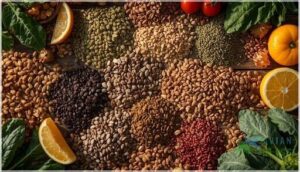
Dietary diversification with varied seeds strengthens your micronutrient balance, delivering complementary iron, zinc, and vitamin A precursors that buffer you against hidden hunger when one crop underperforms.
Seed fortification within diverse portfolios measurably boosts nutrient content, while mixed-seed meals improve mineral absorption through synergistic pairings—vitamin C enhancing iron uptake, for instance—securing nutritional security and genetic diversity that safeguard food security across unpredictable seasons.
Seed Diversity and Agricultural Resilience
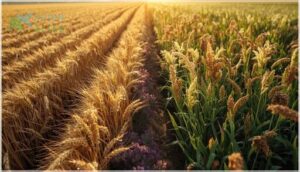
When you plant the same crop year after year, you’re basically rolling the dice on a single genetic hand. Agricultural resilience isn’t just about what grows above ground—it’s about building a living safety net that can bend without breaking when climate, pests, or disease pressures hit.
Seed diversity creates that flexibility, turning farms into adaptable ecosystems rather than vulnerable monocultures.
Resistance to Pests and Diseases
When you grow different seed varieties in the same space, you’re not just planting—you’re building a living defense system. Crop diversity disrupts the predictable patterns that specialist pests rely on, while simultaneously attracting beneficial insects that keep harmful populations in check. Here’s how genetic diversity strengthens your protection:
- Polygenic defense from multiple seed types offers broader, more durable disease resistance than single varieties
- Diverse seed mixtures naturally boost populations of pest predators, reducing your need for chemical inputs
- Mixed plantings interrupt pest life cycles, making it harder for infestations to gain momentum
- Contrasting resistance profiles across varieties create spontaneous backup when one crop faces pressure
This ecological balance transforms pest management from a constant battle into a self-regulating system, where crop protection emerges from biodiversity itself rather than synthetic interventions.
Climate Adaptation and Drought Tolerance
Climate change demands seeds built for survival, and that’s where drought tolerance becomes your insurance policy. Diverse seed collections harbor naturally drought-resilient varieties with deep root systems and efficient water use—traits refined over generations in arid regions.
When you plant multiple seed types, you’re hedging against irregular rainfall, because varied germination rates and seedling vigor mean something thrives even when conditions shift unexpectedly.
Soil Health and Ecosystem Services
Your soil is a living factory, and seed diversity powers it. Diverse root systems add organic matter, boost aggregate stability, and drive carbon sequestration—cutting atmospheric CO2 while improving water regulation and infiltration.
That’s agroecology in action: soil microbiology thrives, beneficial microbes cycle nutrients, and ecosystem resilience builds naturally.
Agricultural biodiversity strengthens ecosystem services, from biodiversity conservation to climate mitigation, all anchored in vigorous soil health.
Seed Diversity’s Role in Food Security
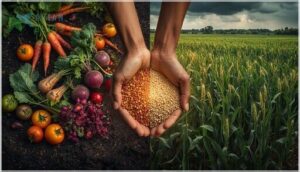
Food security isn’t just about producing enough calories—it’s about building systems that can withstand shocks, adapt to change, and nourish communities for generations.
Food security means building resilient systems that withstand shocks, adapt to change, and nourish communities across generations
When you narrow the genetic base of our crops, you’re fundamentally betting everything on a handful of varieties, and that’s a gamble we can’t afford to lose.
Seed diversity acts as our safety net, our strategy for resilience, and our connection to the foods that define who we’re.
Safeguarding Against Crop Failure
When a single disease or drought strikes, diverse seed portfolios act as your crop insurance—protecting harvests by spreading risk across varieties with different strengths. Here’s how seed diversity builds farm resilience:
- Mixed varieties exhibit complementary drought tolerance and pest resistance, stabilizing production when threats emerge
- Seed banking preserves germplasm reservoirs for rapid recovery during stress events
- Genetic diversity facilitates climate adaptation through staggered maturation timelines and microclimate flexibility
This risk management strategy safeguards against complete failure while supporting agricultural resilience.
Supporting Sustainable Food Systems
Beyond protecting individual harvests, seed diversity forms the backbone of sustainable food systems that nourish entire communities. When you support diverse seed portfolios through crop rotation and agroecology, you’re strengthening food sovereignty—your community’s right to control its own food supply.
Genetic diversity shortens supply chains, reduces chemical dependence, and builds agricultural resilience that keeps local food flowing even when global markets falter.
Preserving Cultural and Culinary Heritage
Every seed variety carries a story—recipes passed down through generations, farming techniques refined over centuries, and flavors that define a region’s identity.
When you grow and eat heirloom varieties, you’re participating in cultural heritage preservation that honors indigenous food cultures and traditional food systems.
Seed stewardship protects culinary traditions while keeping heritage recipes alive, creating a living bridge between food anthropology and your plate through cultural exchange.
How to Support and Preserve Seed Diversity
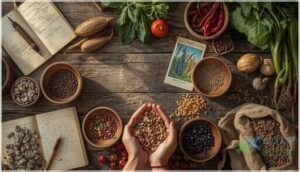
You don’t need to be a farmer or scientist to play a role in preserving seed diversity—your everyday choices matter more than you might think. From what you plant in your garden to how you shop at the market, small actions can ripple into meaningful change for our food system.
Here are three practical ways you can support and protect the seeds that sustain us all.
Choosing Heirloom and Heritage Seeds
Your choices at the market can become quiet acts of rebellion against industrial monoculture. When selecting heirloom seeds and heritage varieties, you’re preserving agricultural heritage while strengthening crop diversity. Consider these priorities:
- Flavor and regional adaptation – Choose varieties historically grown for at least 50 years in your area
- Verified seed authenticity – Source from trusted seed banks and heirloom-focused companies
- Cultural significance – Support landraces adapted to local conditions
Participating in Seed Saving and Exchanges
Once you’ve chosen your heirloom seeds, the next step is joining the growing network of seed stewardship. Community exchanges transform seed banking from a solitary act into collective resilience. Volunteer coordination at local seed banks connects you with others who share your values, while exchange networks let you trade locally adapted varieties without spending a dime.
| Activity Type | What You’ll Do | Why It Matters |
|---|---|---|
| Community seed banks | Collect, catalog, maintain public inventories | Preserves agricultural heritage for future generations |
| Seed swaps and exchanges | Trade varieties with other gardeners | Builds genetic diversity through shared stewardship |
| Documentation practices | Record variety names, sources, planting notes | Tracks provenance and adaptation over time |
| Online platforms | Connect with networks, learn best practices | Expands access to rare heirloom seeds nationwide |
Don’t overlook legal considerations—always check local regulations on plant material movement, especially when crossing borders, to ensure your seed-saving efforts remain compliant and biosafe.
Advocating for Policy and Community Initiatives
Your voice carries weight when you speak up for seed diversity. Strong policy frameworks protect farmers’ rights to save and exchange seeds, while community engagement turns local action into lasting change. Push for these three essentials:
- Seed legislation that recognizes farmers’ rights without punitive restrictions
- Funding mechanisms supporting community seed banks and local enterprises
- Stakeholder collaboration among farmers, NGOs, researchers, and policymakers
Together, these strategies strengthen food security, sustainable agriculture, and agricultural resilience while advancing community development goals.
Frequently Asked Questions (FAQs)
How does seed diversity affect global food prices?
Seed diversity buffers against price volatility by reducing crop failure risk. When you diversify seed portfolios, you stabilize yields across climate shocks, limiting market spikes and strengthening food security through resilient agricultural systems.
What threatens seed diversity in modern agriculture today?
Your entire food supply could vanish overnight. Monoculture risks, seed commodification, intellectual property restrictions, climate disruptions, and biological threats from pests and disease—especially under drought conditions—endanger agricultural systems and seed diversity globally.
Are commercial seeds less nutritious than heirloom varieties?
It’s complicated. Heirloom seeds often bring broader phytochemical profiles and genetic diversity, but nutrient content depends heavily on soil quality, growing conditions, and handling—not just whether seeds are commercial or heritage varieties.
How do indigenous communities preserve traditional seed knowledge?
Through oral traditions and intergenerational learning, Indigenous peoples pass down seed stewardship practices via storytelling, community exchange, and ritual ceremonies.
These practices safeguard agricultural heritage while strengthening cultural preservation and traditional seed knowledge for future generations.
Conclusion
What if the most powerful choice you make this week isn’t choosing organic, but choosing different?
The diverse seed diet importance reaches beyond your plate into climate resilience, genetic preservation, and micronutrient security that monoculture can’t deliver.
Start with one unfamiliar seed variety this month—amaranth, teff, hemp, fava beans—and you’ll join a growing movement reclaiming agricultural biodiversity one meal at a time. Your fork is your vote for a more resilient food future.
- https://pubmed.ncbi.nlm.nih.gov/29795809/
- https://food.berkeley.edu/wp-content/uploads/2020/07/2013_Kremen-and-Miles_Ecosystem-Services-in-Biologically-Diversified-versus-Conventional-Farming-Systems-Benefits-Externalities-and-Trade-Offs.pdf
- https://www.rafiusa.org/protecting-the-food-ark/
- https://doi.org/10.4060/cc3017en
- https://www.weforum.org/agenda/2018/10/once-neglected-these-traditional-crops-are-our-new-rising-stars/