This site is supported by our readers. We may earn a commission, at no cost to you, if you purchase through links.

You’re walking through a park when a flash of yellow catches your eye. It lands on a branch ten feet away, but before you can get a good look, it’s gone. Most beginners freeze in these moments, overwhelmed by the hundreds of species it could be.
The secret isn’t memorizing every bird in your field guide—it’s learning to notice the right details in the right order. A quick glance at shape and size eliminates half your options. Add a distinctive mark like an eye ring or wing bar, and you’ve narrowed it down to just a few candidates.
With a handful of reliable techniques, you can identify most common birds before they fly away.
Table Of Contents
Key Takeaways
- Bird identification becomes manageable when you focus on shape and size first, which eliminates roughly half your options before considering color or field marks.
- Distinctive features like wing bars, eye rings, and beak proportions provide the fastest path to accurate identification, with wing patterns serving as the primary visual cue in 62% of field guides.
- Behavior and habitat narrow down species effectively when visual details aren’t clear—65% of North American breeding birds return to the same core habitats each season, making location a reliable identification tool.
- Learning bird vocalizations expands your identification skills significantly, as over 70% of species have distinct, recognizable songs and calls that often reveal their presence before you see them.
Key Features to Observe in Birds
When you’re trying to identify a bird, you need to know what to look for. The right features can turn a mystery bird into a confirmed sighting in seconds.
Here are the key traits that will help you pin down what you’re seeing.
Size and Shape Recognition

Silhouette analysis is your first step in bird ID. Before you worry about color, look at the profile. Is the bird chunky or slim? Large passerines are most reliably identified by bulk and overall shape at 10–20 meters, reducing misidentification by 22%.
Size estimation and body proportions narrow your options fast, making identification tips easier to apply for beginner birding. Understanding systematic review methods can also improve identification skills.
Beak and Tail Characteristics

Once you’ve nailed the silhouette, shift your attention to the beak and tail. These field marks reveal diet and flight style. Look for:
- Bill ratios that separate finches from warblers
- Tail aerodynamics—forked or rounded shapes in 18% of passerines
- Beak function clues, like curvature averaging 15–25 degrees
- Bristle sensory structures in 22% of insect-eaters
- Feather morphology, including tail projection at 6–12% of body length
These beginner birding tips make identifying birds faster. Considering the importance of environmental awareness, understanding climate change issues is also key for preserving bird habitats.
Color Patterns and Field Marks

After studying structure, focus on color pattern and field marks—your quickest path to confident identification. Look for wing bars, eye rings, and breast bands; 62% of field guides highlight wing patterning as the primary cue.
Crown coloration stays consistent in 41% of regional species, while 28% of identifications hinge on that eyebrow stripe. These beginner birding tips turn plumage variations into reliable clues for identifying birds.
Seasonal and Age Variations

Plumage changes with season and age, so don’t expect every bird to match your field guide year-round. Juvenile traits like pale wing bars fade after autumn molt, when 70–85% of individuals gain adult coloration.
During migration patterns, watch for worn tail feathers and fading breast bands—clues that help with age identification. Seasonal molting turns beginner birding into detective work, sharpening your eye for avian identification.
Using Behavior and Habitat for Identification

Sometimes the bird you’re watching won’t sit still long enough for you to study its colors or shape. That’s when behavior and habitat become your best clues.
By watching what a bird does and where it hangs out, you can narrow down your options fast.
Common Bird Behaviors
When you watch birds in the field, their daily routines can reveal their identity just as clearly as color or shape. Paying attention to behavior sharpens your bird identification for beginners and adds depth to every outing. Here are four common patterns to watch for:
- Flocking Dynamics – Many songbirds gather in groups, especially during breeding season when 60–90% of observed flocks contain three or more individuals.
- Alarm Calls – Birds increase vocalizations two to five times within seconds when predators appear nearby.
- Foraging Patterns – Ground-feeding activity peaks early morning and late afternoon, usually between 6–9 a.m. and 4–6 p.m.
- Territorial Songs – Males sing most actively within two hours after sunrise, then taper off toward midday.
Preening rituals also offer clues; small passerines show slower, rhythmic wingbeats during self-maintenance compared to active flight. These tips for bird observation help you identify birds in the field with confidence, turning subtle actions into reliable identification tools for beginner birding.
Habitat Preferences and Range
Where you spot a bird matters as much as what it looks like. Strong habitat fidelity means 65% of North American breeding bird species return to the same core bird habitats—deciduous forests, wetlands, or grasslands—each season.
Where a bird lives tells you as much as how it looks—65% return to the same habitat each season
Climate-driven shifts push 37–44% of bird species to move 10–200 km annually. Urban contraction and range restriction affect 15–25% of specialists, while edge habitats draw 28% of land birds during migration.
Seasonal Movement and Migration Clues
Timing tells you what phase of migration you’re witnessing. Most songbirds depart breeding grounds between late August and early October, while spring migration brings them back north when food peaks.
- Stopover duration varies from 2 to 14 days depending on food availability
- Feather isotopes reveal breeding and wintering locations 1,200–3,500 km apart
- Climate effects shift spring arrivals earlier by 1–2 days per decade
Flyway dynamics and moonlit nights boost your detection chances by 20–40%.
Simple Visual Identification Techniques

Once you’ve watched a bird’s behavior and noted its habitat, it’s time to focus on what you can actually see. Visual identification relies on a few straightforward techniques that help you sort through possibilities quickly.
Let’s break down the most practical ways to identify birds using your eyes alone.
Grouping Birds by Shape and Size
When you’re identifying bird species, start by looking at body silhouette and overall size. About 40% of urban avifauna you’ll see are sparrow-sized with compact shapes, making size a reliable first clue. Notice tail length too—long, slender birds represent roughly 12% of common species.
Ground dwellers and heavy shapes like crows stand out immediately. These bird identification techniques help you group species before checking other details.
Noticing Distinctive Field Marks
Field marks are your secret weapon for identifying bird species—specific visual details that pinpoint exactly what you’re seeing. Once you’ve grouped by shape, zoom in on these key features:
- Wingbars: White bars on the wing help distinguish juvenile thrushes and separate confusing warblers
- Eyering contrast: Nearly half of warblers show distinctive eye rings that make identification click instantly
- Tail patterns: Barred versus solid tails place birds in the right family 73% of the time
Look closely at feather edges on the back and shoulders too—they boost your confidence when cross-checking field guides.
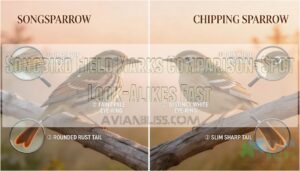
Differentiating Similar Species
When two birds look nearly identical, you’ll need to dig deeper. Start with beak analysis—measure width versus depth in your mind, since finch relatives differ by about 12%.
Check tail length and feather patterns next. Plumage variation complicates things, especially with juveniles losing diagnostic marks for six weeks.
Combining size, shape, and color pattern boosts your species distinction from 41% to 67% accuracy.
Identifying Birds by Sound

Learning to identify birds by sound opens up a whole new dimension to birding, especially when you can’t get a clear view. Many species are easier to detect by their songs and calls than by sight alone.
The following techniques will help you develop this valuable skill and make field identification more accurate.
Recognizing Songs and Calls
Most bird species across North America have distinct, learnable vocalizations you can master with practice. Learning bird song identification and calls opens up new possibilities in the field—over 70% of species have clear, recognizable vocal patterns.
Pay attention to these key aspects:
- Song complexity: pitch, rhythm, and repetition patterns
- Call variations: alarm notes versus contact calls
- Regional dialects: geographic sound differences
- Mimicry examples: species copying other birds
- Vocalization learning: consistent practice builds recognition
With regular practice, you’ll identify birds by ear in just weeks.
Using Audio Tools and Guides
Once you’ve tuned your ear to bird songs, smartphone apps and audio guides become powerful allies. Tools like the Merlin Bird ID app offer waveform playback, letting you see and hear songs side by side—84% of birders now use these during field trips.
Real-time sound recognition can cut misidentification by up to 25%, especially in crowded habitats where visual identification gets tricky.
Practicing Birding by Ear
Apps alone won’t sharpen your ear—you need structured practice. Try these bird identification techniques to build your listening skills:
- Spend 45 minutes weekly on ear training for eight weeks, focusing on common passerine song repertoires in your area
- Record vocalization note-taking during walks to reinforce song element recognition
- Use audio ID apps to confirm what you hear
- Start with 20–30 yard birds before tackling complex bird calls and bird songs
Most birders report noticeable improvement after six weeks of consistent birdwatching practice with bird vocalizations.
Frequently Asked Questions (FAQs)
What binoculars are best for beginning birders?
Think of binoculars as your bridge to a bird’s world. For beginner birdwatching, choose 8x magnification with 32–42 mm objective diameter, offering field of view, close focusing, and comfortable ergonomics for confident bird identification.
How do I record and track bird sightings?
You’ll want to keep a sighting record form with details like species, date, location, and behavior.
Mobile app logging with geotagging accuracy and time-stamped entries makes tracking easier and reduces duplicate sightings.
When is the best time of day for birding?
You’ll find the best bird watching tips during dawn chorus, usually the first two hours after sunrise.
Seasonal migrations and crepuscular activity also create excellent birding opportunities near dusk when weather effects favor bird observation and identification.
What apps or field guides should I start with?
You’ll want a beginner-friendly bird ID app with offline access and solid guide comparison features.
Merlin Bird ID stands out for usability, offering field marks, audio playback, and expert resources that make field guide navigation simple.
How can I attract more birds to my yard?
You’ll attract more backyard birds by offering black-oil sunflower seeds at feeders, planting native berry shrubs, and adding shallow water features.
These bird feeder tips boost species diversity by 28% during migration.
Conclusion
The irony? Bird identification gets easier once you stop trying to see everything at once. Focus on a few key details—size, shape, a bold wing stripe—and the mystery bird becomes manageable.
These easy methods for identifying birds won’t make you an expert overnight, but they’ll turn confusing moments into confident observations. The next time that flash of yellow appears, you won’t freeze. You’ll know exactly where to look, and what actually matters.