This site is supported by our readers. We may earn a commission, at no cost to you, if you purchase through links.
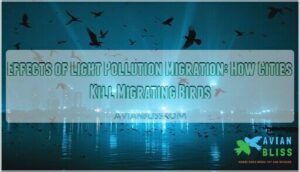 The effects of light pollution migration create deadly traps for wildlife. When you flip on city lights, you’re disrupting millions of birds that mistake artificial illumination for natural navigation cues. Seventy-five percent of nocturnal migrants rely on darkness, yet streetlights and buildings cause fatal collisions annually.
Light pollution triggers sensory overload, making disoriented birds circle endlessly around lit structures. Sea turtles face similar confusion from coastal lighting, while insects swarm streetlights instead of pollinating plants.
This artificial lighting doesn’t just kill individual animals – it crashes entire ecosystems by reducing pollination by 62% and creating trophic cascades that restructure food webs throughout urban corridors.
Table Of Contents
Key Takeaways
- Your city lights create deadly traps – When you flip on artificial lighting at night, you’re disrupting 75% of nocturnal migrants that rely on darkness for navigation, causing millions of fatal building collisions annually.
- You’re crashing entire ecosystems – Your streetlights don’t just kill individual birds; they reduce pollination by 62% as insects swarm lights instead of plants, creating trophic cascades that restructure urban food webs.
- You can save millions of lives with simple changes – You’ll reduce bird deaths by up to 80% when you participate in "Lights Out" programs, use shielded downward lighting, and turn off unnecessary lights during peak migration seasons.
- Your timing matters most during cloudy weather – You’ll witness the deadliest impacts when overcast skies block natural starlight, forcing disoriented birds to fly lower where your building lights become especially lethal during spring and fall migrations.
How Light Pollution Disrupts Animal Migration
You’re probably surprised to learn that your city’s bright lights are trapping and killing millions of migrating birds each year.
Your bright streetlights are creating death traps for millions of migrating birds overhead
When artificial light at night disrupts natural darkness, it confuses birds’ internal navigation systems and draws them into deadly collisions with buildings.
Artificial Light at Night (ALAN) and Wildlife
Artificial light at night disrupts wildlife behavior across ecosystems, creating a cascade of ecological impacts you mightn’t expect. ALAN affects migratory birds’ internal clocks, altering their natural rhythms and navigation systems.
Light pollution effects extend beyond birds to insects, mammals, and marine life, disrupting ecosystem balance. Wildlife research gaps remain significant, highlighting the need for thorough light mitigation strategies to protect vulnerable species.
Disorientation in Migratory Birds
Imagine thousands of migrating birds suddenly losing their internal compass—that’s exactly what happens when artificial light at night creates navigation impairment. Light pollution effects trigger sensory overload in migratory birds, causing altered behavior as they mistake city lights for natural cues.
Your city’s bright lights are trapping and killing millions of migrating birds each year
This fatal attraction leads to increased vulnerability, with birds circling buildings endlessly instead of continuing their journeys.
Impacts on Nocturnal Migrants and Insects
Seventy-five percent of nocturnal migrants rely on darkness for navigation, yet artificial light creates deadly traps. Nocturnal disorientation affects millions of songbirds annually, while insect attraction to streetlights reduces food sources by thirty percent.
This ecosystem ripple disrupts migration timing, causing energy depletion that weakens birds before they reach breeding grounds. Light pollution impacts extend beyond individual species survival.
Circadian Rhythm Disruption
You mightn’t realize that artificial light disrupts your body’s internal clock, and birds face the same challenge during migration. Light pollution suppresses melatonin production, throwing off their sleep cycle and causing hormonal imbalance.
These physiological effects impact breeding behavior and timing, leaving migratory species vulnerable to environmental threats as their natural nocturnal migration benefits become compromised.
Fatal Collisions and Mass-Mortality Events
When migrating birds encounter city lights, they face a deadly trap that kills millions each year. You’ll witness one of nature’s most tragic spectacles as disoriented flocks collide with lit buildings during peak migration periods.
Bird Collisions With Buildings
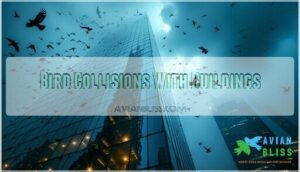
When you walk through downtown areas at night, towering glass buildings become death traps for migrating birds. These structures create collision hotspots where artificial light and building reflection confuse birds traveling by natural cues.
Urban brightness makes glass transparency invisible to birds, causing millions of fatal bird collisions annually. Bird-friendly design can reduce these devastating impacts substantially.
Effects During Peak Migration Periods
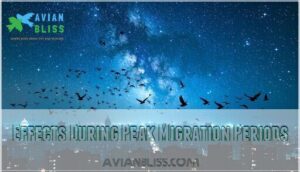
During Peak Migration Periods, you’ll witness nature’s deadliest timing coincidence. Spring and fall migrations create extreme collision risks when millions of birds travel simultaneously through urban corridors saturated with artificial light.
Urban lights turn spring migration into a deadly maze for millions of birds
Peak Vulnerability intensifies as:
- Migration Timing concentrates 80% of North American species into narrow windows
- Energy Depletion from altered routes leaves birds exhausted and disoriented
- Collision Hotspots in cities like Chicago report thousands of deaths nightly
- Light Pollution reaches maximum impact during these critical periods
- Lights Out programs become essential for species survival
Artificial light disrupts bird behavior and navigation.
Cloudy Weather and Increased Risks
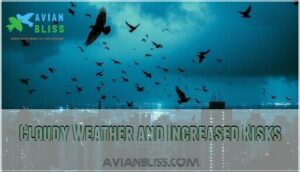
When cloudy weather rolls in, migrating birds face deadly navigation challenges. Cloud cover blocks starlight that birds rely on for direction, making artificial light sources more attractive and dangerous.
Reduced visibility forces birds to fly lower, increasing fatal encounters with illuminated buildings. Light pollution becomes especially lethal during overcast conditions when disoriented birds can’t distinguish natural navigation cues from artificial ones.
Mass Bird Loss in Urban Areas
Cities create deadly traps for migrating birds through concentrated light pollution and towering buildings. Urban areas experience devastating mass bird loss during peak migration seasons, with mortality factors including light attraction and building collisions.
Every city light becomes a death trap for millions of migrating birds each year
These urban bird deaths contribute substantially to population decline, as artificial lighting disorients millions of migrating birds annually in metropolitan areas. Promoting bird-friendly city designs can help mitigate this issue.
Species-Specific Effects of Light Pollution
While light pollution affects all wildlife, you’ll find that different species face unique challenges during migration.
Some birds crash into buildings, sea turtles get confused by coastal lights, and insects swarm around streetlights instead of finding mates.
Nocturnal Migratory Birds
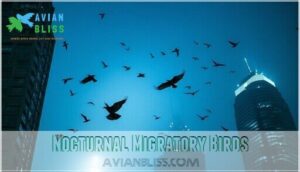
Nocturnal migrants face heightened Night Flight Risks when artificial lights disrupt their Avian Navigation systems. These birds rely on starlight and Earth’s magnetic field for guidance, but city lights create Sensory Disruption that confuses their natural compass. Many species depend on Earth’s magnetic field to navigate during their journeys.
Light pollution effects alter migratory bird behavior, causing nocturnal migrants to circle buildings endlessly. These nighttime migrations become deadly traps, demanding immediate conservation strategies to prevent severe ecological consequences.
Seabirds and Sea Turtles

Seabirds face deadly consequences when artificial lights disrupt their natural behaviors. Burrow-nesting seabirds like petrels and shearwaters become fatally attracted to coastal lighting, leading to devastating collisions with human structures.
Sea turtle hatchlings experience similar disorientation, mistaking bright city lights for moonlight reflecting on ocean waves. This light attraction pulls them away from marine ecosystems they desperately need to survive, creating widespread ecological disruption across seabird nesting colonies.
Insect Populations and Ecosystem Impacts
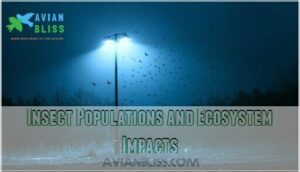
Light pollution wreaks havoc on nocturnal insects, creating a deadly attraction that ripples through entire ecosystems. When you light up the night, you’re basically setting ecological traps that devastate biodiversity and disrupt food webs.
- Pollinator decline: Moth populations drop 50% near streetlights, reducing plant pollination by 62%
- Trophic cascades: Predation increases 2.5x under artificial lighting, restructuring food webs
- Ecosystem services: Insect biomass has fallen 45% since the 1970s, compromising pest control
- Biodiversity loss: Light pollution impacts expand 2% annually, threatening nocturnal activity patterns
Mistimed Migration and Breeding Rituals
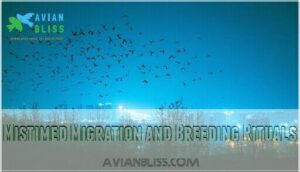
When you think of nature’s perfect timing, migrating birds have mastered their schedules for millions of years. Yet artificial light disrupts these finely-tuned breeding cycle shifts, confusing birds about seasonal cues.
Light pollution tricks them into early migration, causing mating seasonality problems and altered hibernation patterns. This timing mismatch reduces reproductive success at stopover locations, creating ecosystem imbalance that threatens avian needs and breeding rituals.
Conservation Solutions and Mitigation Strategies
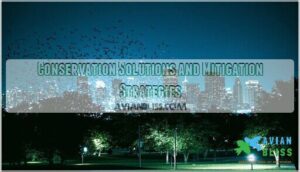
You
Lights Out Programs and Global Campaigns
Cities worldwide are fighting back against Light Pollution through coordinated Lights Out programs. These campaigns demonstrate outstanding Program Effectiveness and Community Engagement:
- Over 40 major U.S. cities participate in official programs, reducing collisions by up to 80%
- More than 30,000 individuals have pledged support since 2015
- 100+ municipalities globally use automated systems and regular audits
- Major corporations like Google implement campus-wide blackout protocols during peak migration
Global Collaboration through Policy Advocacy drives these Funding Initiatives forward.
Bird-Conscious Lighting Practices
You can implement BirdConscious Lighting Practices using dimming technologies and motion sensors that activate only when needed. Timer implementation reduces unnecessary nighttime illumination during peak bird migration seasons. Spectral tuning eliminates blue-rich wavelengths that disorient migrating birds most. Shielded fixtures prevent light from scattering upward into flight paths.
These practical approaches substantially reduce light pollution while maintaining human safety and security needs. Switching to bird-safe lighting options can further minimize the impact on migrating birds.
Shielded and Downward-Focused Lighting
Properly shielded outdoor lighting directs illumination downward, preventing artificial lighting from escaping upward into the night sky. You’ll reduce glare and improve visibility while achieving dark sky compliance through retrofit options that cut light spill by 40%. These lighting practices offer energy savings by focusing light where it’s needed, protecting migrating birds from disorienting light pollution.
National parks also implement habitat restoration projects to aid bird populations.
Citizen Science and Community Involvement
You can join citizen science initiatives to monitor light pollution impacts on migratory birds through data collection and bird counts. These monitoring programs help researchers track bird migration paths while engaging communities in habitat restoration projects. Strengthen your efforts with citizen science birding equipment.
Your neighborhood lights are pulling migrating birds into deadly traps overhead
Your advocacy efforts and public education activities raise awareness about light pollution’s deadly effects, creating grassroots support for bird-friendly lighting policies in your neighborhood.
Future Directions in Light Pollution Management
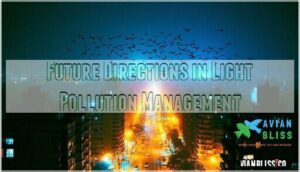
You’re witnessing a critical turning point where science meets policy to save millions of migrating birds from urban death traps. International organizations are now developing thorough guidelines that combine innovative research with practical solutions, transforming how cities approach lighting during migration seasons.
International Guidelines and Management Principles
Global cooperation through international frameworks has established thorough Light Pollution Reduction strategies. The International Dark Sky Association promotes standardized metrics for policy enforcement, while organizations develop management principles prioritizing habitat protection. The organization advocates for responsible lighting installations to combat light pollution.
- Five Principles for Responsible Outdoor Lighting guide municipalities worldwide
- Color temperature limits below 3000K minimize wildlife disruption
- Upward Light Output Ratio restrictions prevent skyglow in protected areas
- Adaptive management systems enable responsive lighting controls
- Light pollution guidelines integrate with urban planning frameworks
Species-Specific Measures and Research Needs
Despite making progress on international guidelines, researchers face significant knowledge gaps in species-specific responses to light pollution. Less than 15% of migratory species have systematic studies examining nocturnal attraction patterns. Landbird mitigation requires targeted approaches since closely related taxa show different responses—some shift routes while others rest near lit areas.
Bat conservation strategies need improvement as urban-adapted species display varying vulnerability compared to rural populations. Marine turtle guidance benefits from improved enforcement, while shorebird strategies remain underdeveloped. Effective monitoring often requires specialized birding equipment.
Citizen science platforms increasingly provide vital collision data, helping identify species-specific measures for effective mitigation strategies.
Urban Planning for Dark Skies
Cities can transform their nighttime landscapes through strategic Dark Sky Zoning and thorough Lighting Ordinances that protect migrating wildlife. You’ll need community engagement to retrofit buildings with bird-friendly fixtures and implement green infrastructure that reduces artificial light pollution in urban areas. Native plants offer shelter for migrating birds, improving their chances of survival.
- Thousands of exhausted songbirds crash into your city’s gleaming towers each migration season
- Your neighborhood’s bright streetlights trap nocturnal insects, starving the birds that depend on them
- Every unnecessary nighttime light you leave on contributes to the silent massacre overhead
Conservation Value and Policy Initiatives
While governments develop international cooperation frameworks for bird conservation efforts, you’ll find that effective policy implementation requires mitigation funding from multiple sources. Public awareness campaigns help communities understand how artificial lights affect migratory birds during critical habitat preservation periods. These coordinated strategies can reduce light pollution by up to forty percent when properly executed across urban corridors.
Frequently Asked Questions (FAQs)
How does light pollution affect daytime migration patterns?
Like a compass needle spinning wildly, artificial light disrupts birds’ internal navigation systems. While most migration occurs at night, daytime light pollution still affects you by altering birds’ circadian rhythms and energy reserves needed for successful journeys.
What role does moon phases play during migration?
You’ll find moon phases naturally guide birds during migration, with darker new moon periods providing clearer star visibility for navigation, while brighter full moons can improve nighttime travel conditions.
How do weather patterns interact with artificial lighting?
Weather patterns create a deadly combination with artificial lighting. During cloudy, foggy, or rainy nights, you’ll find birds flying at lower altitudes where building lights become lethal traps, dramatically increasing collision risks.
What are the economic costs of migration disruption?
You’ll face mounting costs from disrupted agriculture, tourism losses, and increased conservation spending. Migration timing mismatches reduce crop pollination, hurt birdwatching economies, and require expensive habitat restoration efforts.
Conclusion
Tomorrow’s wildlife faces an uncertain future, but your actions can change that. The devastating effects of light pollution migration demand immediate attention as cities expand worldwide.
You can’t ignore the science: artificial lighting kills billions of birds annually while disrupting entire ecosystems.
Simple solutions exist—shielded lights, "Lights Out" programs, and community involvement—but they need your support. Every darkened window during migration season saves lives and preserves the natural world for future generations.