This site is supported by our readers. We may earn a commission, at no cost to you, if you purchase through links.
Birds hide illness better than almost any other pet — it’s a survival instinct hardwired from generations of wild ancestors who couldn’t afford to look vulnerable.
By the time your parrot stops talking, your canary sits fluffed on the cage floor, or your cockatiel loses its balance, the situation may already be critical.
That’s what makes accessing emergency avian veterinarian services so different from a routine vet visit — every minute carries real weight. Knowing which warning signs demand immediate action, where to find qualified help at 2 a.m., and what that care will cost gives you the best possible chance of bringing your bird home.
Table Of Contents
- Key Takeaways
- Signs Your Bird Needs Emergency Care
- How to Find Emergency Avian Vets Fast
- What to Expect During Emergency Visits
- Typical Costs for Avian Emergency Services
- Essential Qualities of an Emergency Avian Veterinarian
- Frequently Asked Questions (FAQs)
- How much is an emergency vet visit for a bird?
- Do avian emergency clinics treat birds?
- Who is the best avian vet in Chicago?
- Do avians need a veterinarian?
- Who is a good avian vet?
- Where can I get a bird veterinary service?
- Where can I find an avian veterinarian?
- Can I transport my bird safely during emergencies?
- How do I prepare a bird first aid kit?
- What are common avian emergency medications used?
- Conclusion
Key Takeaways
- Birds are wired to hide illness, so by the time you notice something’s off, it’s often already a medical crisis — act fast, don’t wait for things to get worse.
- Warning signs like fluffed feathers, loss of appetite, blood in droppings, or sudden collapse all mean one thing: call an emergency avian vet right now, not tomorrow.
- Emergency avian care isn’t cheap — expect $100–$250 just to walk in the door, with diagnostics, hospitalization, and procedures pushing totals well into the thousands of dollars.
- Your best move is to find a qualified avian vet before you need one, since not every emergency clinic treats birds and scrambling during a crisis costs precious time.
Signs Your Bird Needs Emergency Care
Birds are masters at hiding when something’s wrong, so by the time you notice a change, it’s already urgent.
That’s why knowing early warning signs your bird needs a vet can genuinely make the difference between a close call and something far worse.
Knowing the warning signs can be the difference between a full recovery and losing your bird.
Here’s what to watch for.
Sudden Weakness or Collapsing

Sudden collapse is a five-alarm emergency in birds. If your bird falls off its perch, stumbles, or can’t stand, don’t wait. This signals a veterinary emergency requiring immediate avian veterinary services.
Watch for these collapse warning signs:
- Loss of balance or stumbling (Neurological Signs)
- Drooped wings or floor-sitting (Metabolic Causes)
- Open-mouth breathing before collapse (Respiratory Failure)
- Injury after impact (Trauma Response)
- Unresponsiveness requiring Emergency Handling
It’s critical to recognize that common avian emergency symptoms may involve a range of conditions needing rapid intervention.
Contact an emergency exotic avian vet now.
Fluffed Feathers and Lethargy

Not every emergency looks dramatic. Sometimes, it’s quieter — your bird sitting fluffed up for hours, barely moving, uninterested in you or its food.
A bird sitting fluffed and still for hours may already be seriously sick
These bird health signs are easy to dismiss, but feather puffing paired with lethargy often means your bird is already seriously sick. Don’t wait it out. Contact an emergency exotic avian vet right away.
For more information about recognizing symptoms of illness in birds, consult trusted avian health resources.
Abnormal Droppings or Blood

Your bird’s droppings tell a story. Healthy ones have a dark coil, white urates, and a little clear fluid.
Blood anywhere — red or black and tarry — is never normal. That’s an emergency triage sign that needs an avian veterinarian immediately.
Fecal abnormalities like dropping color changes lasting over 24 hours also warrant urgent avian veterinary care. Don’t wait.
Loss of Appetite or Voice

Just as abnormal droppings raise concern, Appetite Disorders and Voice Changes deserve the same urgency. If your bird stops eating for even 12 to 24 hours, contact an Emergency Exotic Vet immediately — small birds decline fast.
A sudden voice loss points to serious Respiratory Issues affecting the syrinx. These Emergency Symptoms in Avian Medicine aren’t “wait and see” moments. Avian Emergency Services exist for exactly this.
Severe Bleeding or Egg Binding

Two emergencies that can’t wait even an hour are Avian Blood Loss and egg binding. Both spiral fast.
Spotting trouble early makes all the difference, so knowing the signs of bird respiratory infection can help you act before things get critical.
Watch for:
- Blood pooling on feathers or cage floor — classic Bird Trauma Care territory
- A hen straining at the cage bottom, unable to perch — key Egg Binding Causes sign
- Pale skin, rapid breathing, or collapse
Call an Emergency Exotic Vet immediately. Avian Medicine saves lives when minutes matter.
How to Find Emergency Avian Vets Fast

When your bird is in crisis, every minute counts. Knowing where to look ahead of time makes all the difference between a frantic search and a fast answer.
Here are the best ways to find emergency avian care quickly.
Using Online Directories and Vet Networks
Finding the right help fast starts with knowing where to look. As a bird owner, you don’t have time to guess. Start with the Association of Avian Veterinarians’ FindaVet tool — it connects you directly to avian specialists in your area.
| Resource | What It Helps You Find |
|---|---|
| AAV FindaVet | Avian Veterinarian members near you |
| ABVP Directory | Board-certified Avian Specialists |
| Clinic Profiles | Emergency Veterinary Services and hours |
| Vet Network Filters | Species-specific search by location |
| Online Reviews | Real bird owner experiences |
Use clinic profiles to confirm emergency triage availability before you ever need it.
Locating 24/7 Avian Emergency Hospitals
When minutes matter, knowing where to go in advance can save your bird’s life. Search specifically for 24-hour emergency clinics that list exotic or avian species — not every Emergency Veterinary Services center treats birds.
Here’s how to narrow it down fast:
- Check for Avian Hospital Accreditation like AAHA certification
- Confirm Veterinary Staff Training in exotic species
- Look for Avian Care Facilities within a 60-mile radius
- Call ahead to verify Emergency Response Time and exotic pet readiness
Finding Mobile Avian Vet Services
Sometimes, a mobile bird vet can come to you — and that matters when your bird is too fragile to travel. Use vet directories like the Association of Avian Veterinarians to search with the right keywords.
| Feature | What to Check | Why It Matters |
|---|---|---|
| Expertise Verification | ABVP credentials listed | Confirms avian training |
| Service Limitations | Days/hours available | Avoids gaps in emergency care |
| Backup Planning | Partner hospital listed | Ensures exotic pet emergency services coverage |
What to Expect During Emergency Visits
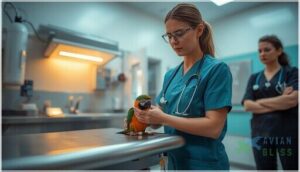
Walking into an emergency avian clinic for the first time can feel overwhelming, especially when you’re worried about your bird.
Knowing what happens next can make a real difference in how you handle those first few minutes. Here’s what you can usually expect once you arrive.
Emergency Triage and Stabilization
When your bird arrives at one of our 24-hour emergency clinics, the team moves fast.
Airway management comes first — staff check for open-mouth breathing or tail bobbing, then place your bird in a warm oxygen incubator to stabilize it.
Emergency protocols guide every step of bird resuscitation and avian trauma care, from fluid support to pain relief, giving your bird the best chance during a pet emergency.
Diagnostic Tests and Imaging for Birds
Once your bird is stable, the real detective work begins. Your avian veterinarian will run targeted tests to find out exactly what’s going on inside — because guessing isn’t an option in exotic pet emergency services.
Here’s what diagnostic imaging and testing usually include:
- Avian bloodwork — a complete blood count and biochemistry panel to check organ function
- Bird radiology — X-rays revealing lung, heart, or GI issues in seconds
- Emergency ultrasound — soft tissue scans guiding fluid taps or spotting swollen organs
- Fecal and crop testing — identifying bacterial imbalance or parasites fast
- Avian endoscopy — tiny scopes for direct internal viewing and biopsies
These veterinary services for birds combine avian medicine with diagnostic imaging to protect your bird’s health and wellness quickly.
Hospitalization and Critical Care Options
Once tests confirm what’s wrong, your avian veterinarian may recommend bird hospitalization for hands-on monitoring.
The avian ICU keeps your pet in a heated enclosure — around 85 to 92°F — with oxygen support to ease breathing. Emergency stabilization, intensive therapy, and assisted feeding all happen here.
These veterinary services for birds are designed to hold your pet steady while treatment takes effect.
Referral to Avian Specialty Clinics
When your bird’s condition goes beyond what emergency care can handle, your avian veterinarian may recommend an Avian Specialist Referral to a dedicated Avian and Exotics Pet Vet Clinic. These Specialty Clinic Services exist for exactly this kind of moment.
Veterinary Collaboration keeps your bird’s full history moving with them, so nothing gets missed. Expect the specialist to review:
- Prior exam notes and lab results
- Imaging like CT or MRI scans
- Avian Case Management and surgical options
- A written report sent back to your primary vet
Typical Costs for Avian Emergency Services

Emergency avian care can be more expensive than most people expect, and knowing what you’re walking into helps you stay calm when it matters most.
Costs can vary quite a bit depending on what your bird needs. Here’s a breakdown of what you might see on that bill.
Emergency Exam Price Range
Knowing your numbers ahead of time makes a real difference when stress is high.
Emergency exam fee structures at avian emergency clinics usually range from $100 to $250 — and 24-hour emergency clinics often charge more after 5 PM.
Here’s a quick look at what avian cost factors shape your initial veterinary expense:
| Situation | Estimated Exam Fee | Notes |
|---|---|---|
| Daytime urgent care | $100–$185 | Standard emergency price ranges |
| After-hours avian emergency | $185–$200 | Higher due to staffing |
| After-hours surcharge (added fee) | +$120 | Billed separately in some clinics |
| Urban specialty avian veterinarian | $200+ | Higher operating costs |
| Rural or general practice | $100–$150 | Smaller emergency markup |
Billing processes vary, so calling ahead helps you plan your pet emergency fund wisely.
Additional Fees for Diagnostics and Procedures
The exam fee is just the starting point. In avian medicine, diagnostics and procedures stack up fast — and that’s not a flaw in medical billing, it’s just how thorough emergency care works.
Common additional costs to expect:
- Lab test fees – Bloodwork runs $80–$200
- Diagnostic costs for imaging – X-rays range $150–$250
- Procedure pricing for fluids or injections – roughly $100–$200
- Emergency surcharges for STAT labs – around $25 extra
- Avian veterinarian culture or PCR panels – $50–$250
Hospitalization and Intensive Care Charges
Hospitalization is where medical costs can really climb. Once your bird is admitted, daily charges depend on how much support they need.
| Care Level | Daily Rate | What’s Included |
|---|---|---|
| Standard Ward | $500–$1,500 | Fluids, meds, monitoring |
| ICU Costs | $1,000–$3,500 | Oxygen chamber, specialized support |
| Total Stay (avg.) | $1,000–$10,000 | 1–3 days combined |
Your avian veterinarian will guide you through each step.
Insurance and Payment Solutions
Planning ahead makes a real difference when your bird needs urgent care. Avian insurance through providers like Nationwide can reimburse 50 to 90 percent of emergency costs.
For pet owners facing sudden veterinary billing, payment plans through CareCredit or Scratchpay offer fast approval. Veterinary clinics and hospitals also recommend building an emergency fund so you can say yes to care without hesitation.
Essential Qualities of an Emergency Avian Veterinarian
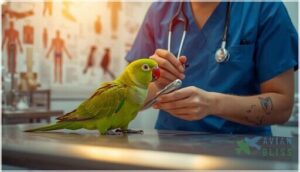
Not every vet who sees dogs and cats is equipped to treat a bird in crisis.
Birds are different in ways that matter a lot when every second counts. Here’s what to look for in an emergency avian veterinarian.
Specialized Avian Medical Training
Not every vet is trained to treat your bird. Avian medicine is its own specialty, built through years of veterinary education, clinical rotations, and hands-on work in exotic pet care.
Many practitioners pursue continuing education through the Association of Avian Veterinarians, covering avian nutrition, avian medicine and surgery, and bird surgery techniques. That depth of training makes a real difference in a crisis.
Experience With Exotic and Pet Birds
Training alone doesn’t make a great bird vet — real-world experience does. A skilled avian and exotic pet medicine specialist has treated everything from budgies to macaws, learning how bird behavior shifts when something’s wrong.
That depth of species handling shapes their veterinary expertise in ways a textbook can’t. When your bird’s health and wellness is on the line, that experience matters enormously.
Access to Avian-Specific Facilities
The right avian veterinarian doesn’t just know birds — they work somewhere equipped to help them. Look for clinics offering dedicated Avian ICU Units, oxygen cages, and digital imaging built for small patients.
Proper Avian Hospitalization means your bird gets Bird Surgery, nebulization, and continuous monitoring under one roof. That level of Avian and Exotic Pet Care is what true Emergency Care looks like.
Skilled Staff for Safe Bird Handling
Handling a frightened bird is its own kind of skill. Emergency clinics use Bird Handling Techniques and Avian Restraint Methods that protect your bird at every step — and skilled Staff Training Programs make that possible.
Look for teams that follow:
- Low Stress Procedures like dimmed lights and minimal restraint
- Emergency Response Protocols for rapid stabilization
- Species-specific Avian Medicine approaches for safe, effective Avian and Exotic Pet Care
Frequently Asked Questions (FAQs)
How much is an emergency vet visit for a bird?
When push comes to shove, an emergency vet visit for a bird usually runs $100 to $250 just for the exam, before diagnostics or treatment add to your bill.
Do avian emergency clinics treat birds?
Yes, avian emergency clinics absolutely treat birds. These facilities specialize in Avian Medicine and Exotic Pet Services, offering 24-hour emergency clinics for Critical Bird Conditions like Bird Trauma, respiratory distress, and more — giving every bird owner access to real Emergency Care.
Who is the best avian vet in Chicago?
There’s no single “best” bird vet in Chicago — it depends on your needs.
For avian medicine and specialist expertise, Midwest Bird and Exotic Animal Hospital and Chicago Exotics Animal Hospital earn strong owner recommendations consistently.
Do avians need a veterinarian?
Absolutely — birds need veterinarians just as much as any pet.
Avian Health Checks, Avian Nutrition Advice, and routine Bird Medical Needs all fall under a Bird Vet’s care, keeping Bird Health and Wellness on track year-round.
Who is a good avian vet?
A good avian vet holds a Doctor of Veterinary Medicine degree, board certification in avian medicine, and real bird care experience across species.
The Association of Avian Veterinarians can help you find one.
Where can I get a bird veterinary service?
You have several options. Local Clinics, Avian Directories, and Vet Referrals can connect you quickly to trusted Avian Veterinarians.
Mobile Vets also come to you — ideal when your bird can’t travel safely.
Where can I find an avian veterinarian?
Finding an avian veterinarian is easier than you’d think. Search Avian Vet Directories, tap into Bird Care Networks, or check Local Bird Clinics like Vet 4 Pets Beaumont Ypsilanti for a reliable Avian Specialist near you.
Can I transport my bird safely during emergencies?
Yes, you can. Use a hard-sided carrier lined with a towel, keep it warm, cover it to reduce stress, and drive smoothly.
These simple Bird Carrier Safety and Safe Transport Tips make Emergency Travel far less risky.
How do I prepare a bird first aid kit?
You don’t need a whole pharmacy — just a sturdy box.
Stock it with gauze, styptic powder, saline, a soft towel, and emergency contacts.
That’s your avian first aid kit, ready when it matters.
What are common avian emergency medications used?
In avian medicine, emergency care often involves fluid therapy, emergency antibiotics, avian analgesics like butorphanol, and respiratory drugs such as oxygen and doxapram — all supporting bird health until your veterinarian stabilizes the situation.
Conclusion
Your bird can’t tell you when something’s wrong — but now you know how to read the signs yourself. Having a trusted emergency avian veterinarian services provider already identified before a crisis hits isn’t just smart preparation; it’s one of the most caring things you can do for a creature that depends entirely on you.
Keep the number saved. Know the warning signs. When the moment comes, that small act of readiness can make all the difference.
- https://www.theexoticvet.com/emergency
- https://www.alliedervet.com/blog/what-happens-at-an-emergency-vet-clinic-a-step-by-step-guide-for-pet-parents/
- https://houstonaecne.com/triage-veterinary-er/
- https://bluepearlvet.com/pet-blog/avian-exotic-pet-emergencies/
- https://www.carecredit.com/well-u/pet-care/emergency-vet-visit-cost-and-veterinary-financing/