This site is supported by our readers. We may earn a commission, at no cost to you, if you purchase through links.
 You’ll find that facts about bird physical features reveal nature’s incredible engineering prowess.
Birds possess hollow bones that make them surprisingly lightweight, while their feathers aren’t just for flight – they provide insulation, waterproofing, and vibrant displays.
Their beaks act like specialized tools, shaped perfectly for their diet, whether it’s cracking seeds or sipping nectar.
Wings come in various designs, from hummingbirds’ rapid-beating marvels to albatrosses’ efficient gliding machines.
Birds see colors you can’t even imagine, including ultraviolet light, and their hearing rivals any high-tech equipment.
Each feature works together like a perfectly tuned orchestra, creating adaptations that’ll make you rethink what’s possible in biology, with a result that is a true marvel of nature.
Table Of Contents
- Key Takeaways
- Bird Physical Characteristics
- Unique Bird Features
- Bird Feather Functions
- Beak Characteristics
- Wing Adaptations
- Bird Skeletal System
- Bird Eye Characteristics
- Bird Hearing Abilities
- Bird Sensory Abilities
- Specialized Bird Features
- Frequently Asked Questions (FAQs)
- What are the physical characteristics of a bird?
- What are some interesting features about birds?
- What 5 characteristics are unique to birds?
- Which feature is characteristic only of birds?
- How do birds regulate their body temperature?
- Why do some birds have colorful plumage?
- How fast can birds fly in general?
- Do all birds molt their feathers annually?
- What makes bird respiratory systems so efficient?
- Conclusion
Key Takeaways
- You’ll discover that birds’ hollow bones aren’t weak—they’re engineering marvels that reduce weight by up to 50% while maintaining incredible strength through air-filled chambers, making flight possible without sacrificing durability.
- You can’t see the ultraviolet light that birds perceive, but their eyes contain up to 1 million photoreceptors per square millimeter (compared to your 200,000), giving them razor-sharp vision that reveals hidden patterns on flowers and prey.
- You’ll find that bird beaks work like specialized tools perfectly matched to their diet—from cone-shaped bills for cracking seeds to needle-thin beaks for sipping nectar, with each shape telling a story of survival adaptation.
- You won’t find external ears on birds, but their internal hearing system can detect subtle sound changes you’d completely miss, helping them pinpoint predator locations and recognize individual voices in noisy flocks with incredible strength.
Bird Physical Characteristics
You’ll discover that birds possess remarkable physical features that make them perfectly suited for life in the air, from their lightweight hollow bones to their specialized feathers made of keratin.
These adaptations, including uniquely shaped beaks and powerful wing structures, work together to create some of nature’s most efficient flying machines.
Hollow Bones
Most bird skeletons feature hollow bones through a process called bone pneumatization, dramatically reducing weight while maintaining skeletal strength.
Nature’s engineering at its finest—hollow bones that are stronger than solid ones, proving less truly can be more.
You’ll find these pneumatized bones aren’t weak—they’re engineering marvels that evolved for flight adaptation.
Air sacs fill the hollow spaces, creating a lightweight framework that’s actually stronger than solid bones, and this avian evolution trick reduces bone density by up to 50% without sacrificing durability.
Feather Composition
You’ll find bird feathers are made of keratin structure, the same protein in your fingernails.
Feather development creates amazing diversity through these components:
- Quill formation – The central shaft that anchors each feather
- Barb arrangement – Tiny branches creating the feather’s surface
- Feather pigmentation – Colors from melanin and carotenoids
Contour feathers and down feathers attach differently, giving birds their incredible versatility.
The central rachis provides strength.
Beak Adaptations
Every bird’s beak tells a story of survival through specialized feeding strategies.
You’ll find cone-shaped bills perfect for cracking seeds, while curved beaks excel at catching fish.
Beak morphology directly reflects diet – sharp for meat, long for nectar, showcasing bill strength and sensory capabilities.
These remarkable adaptations showcase bird beaks as nature’s ultimate multi-tools for feeding and preening, with some birds even having specialized beak adaptations to help them thrive.
Wing Structure
You’ll notice avian wings showcase remarkable engineering through bone fusion and specialized flight muscles.
Wing shape varies dramatically between species – hawks have broad wings for soaring, while hummingbirds sport narrow ones for hovering.
Feather arrangement creates perfect aerodynamics, with primary feathers controlling lift and thrust.
These flight adaptations make birds nature’s most efficient flying machines, perfectly designed for their lifestyle needs, showcasing their remarkable adaptations.
Unique Bird Features

You’ll discover that birds possess remarkable features no other animals have, like hollow bones that make flight possible and specialized salt glands that help seabirds process ocean water.
These unique adaptations, from shock-absorbing woodpecker skulls to the toucan’s heat-regulating bill, show how birds have evolved specific solutions for survival in different environments.
Ethical Implications Of AI
I notice there’s a significant mismatch in your request. You’re asking me to write about "Ethical Implications Of AI" as a subtopic under "Unique Bird Features" for an article about bird physical characteristics.
This doesn’t make logical sense, as AI ethics has no connection to bird anatomy or physical features.
The outline appears to have an error – sections 2.1, 2.2, and 2.3 about AI ethics, automation, and innovation responsibility don’t belong in an article about bird physical features.
These topics should be replaced with actual bird-related content like feather structure, respiratory adaptations, or sensory capabilities.
Would you like me to either:
- Write about actual unique bird features (like specialized respiratory systems, magnetic navigation abilities, or unique skeletal adaptations)
- Or write about AI ethics as a standalone topic unrelated to birds
Please clarify which direction you’d prefer, as I want to provide you with coherent, useful content that matches your article’s purpose.
Automations Impact On Employment
Technology reshapes workforces like migration patterns change bird behavior.
You’ll see 14% of workers experiencing job displacement due to automation, while 40% of employers plan workforce reductions where AI handles tasks.
This creates skills gaps requiring immediate attention.
As AI adoption grows, businesses are increasingly integrating it, with 77% exploring implementation.
Current employment trends mirror avian adaptations:
- Job displacement affects 14% of workers, similar to how birds shed old feathers during molting seasons
- Retraining programs help workers develop new skills, like birds adapting their wings for different flight styles
- New opportunities emerge as 97 million jobs will be created by 2025, requiring workers to strengthen their feet for new ground
Balancing Innovation With Responsibility
When studying bird physical features like feathers, beaks, and wings, you’ll discover nature’s own model for ethical advancements.
Responsible creation in avian evolution shows how sustainable innovation works—each adaptation serves multiple purposes without waste.
Consider the societal impact: birds’ efficient designs inspire human technology while demonstrating long-term consequences of thoughtful development.
Their plumage teaches us balance.
Bird Feather Functions
You’ll discover that bird feathers serve four essential functions that make these creatures perfectly adapted for survival.
These remarkable structures provide insulation to maintain body temperature, enable flight through specialized wing feathers, create stunning displays for attracting mates, and offer protective shelter from weather and predators.
Insulation Properties

Bird feathers work like nature’s most efficient insulation materials.
Nature’s ultimate insulation technology—bird feathers trap air with remarkable efficiency, keeping bodies warm at 104°F even in freezing conditions.
Down feathers trap air between their fluffy structures, creating thermal regulation that keeps you warm at 104°F even in freezing weather.
Multiple plumage layers provide climate adaptation – birds fluff their feather density in cold conditions, forming air pockets that block wind and maintain body heat perfectly.
These feathers are sold as bird down products for various uses, making them a valuable resource for thermal regulation.
Flight Enablement

You’ll marvel at how feathers transform birds into flying machines through precise Wing Aerodynamics and Feather Control.
These lightweight structures create lift by manipulating airflow over wing surfaces, while Bone Pneumatization reduces weight without sacrificing strength.
Combined with powerful Muscle Power and enhanced Respiratory Efficiency, feathers enable everything from hummingbird hovering to eagle soaring through masterful avian anatomy engineering.
This is achieved partly because flight feathers facilitate aerodynamics.
Display Purposes

Nature’s fashion show happens every day when you observe bird plumage in action.
Male birds showcase brilliant plumage brightness during courtship rituals, using visual signaling to attract mates.
Their display feathers create stunning courtship displays that help with species recognition.
Sexual dimorphism means males often sport flashier plumage color than females.
These territorial displays communicate ownership and breeding readiness effectively.
Shelter Provision

Beyond visual appeal, feathers create essential shelter for birds and their young.
You’ll find these amazing structures serve as nature’s ultimate protection system through three key functions:
- Nest Building – Dense down feathers line cavity nesting sites
- Roosting Behavior – Fluffed plumage traps warm air during cold nights
- Brood Parasitism protection – Camouflaged feathers help conceal vulnerable chicks from predators
Beak Characteristics

You’ll find that bird beaks come in remarkable shapes and sizes, each perfectly matched to a species’ specific feeding needs and lifestyle.
These specialized tools help birds crack seeds, catch fish, sip nectar, or tear meat, while also serving as essential instruments for preening their feathers and maintaining their health.
Shape Variations
You’ll notice beak shapes vary dramatically across bird species, each perfectly suited for specific feeding needs.
From cone-shaped bills for cracking seeds to wide, flat beaks for catching insects mid-flight, these adaptations showcase nature’s engineering brilliance.
| Beak Type | Primary Function |
|---|---|
| Cone-shaped | Cracking seeds and nuts |
| Wide and flat | Catching flying insects |
| Straight and probe | Accessing flower nectar |
| Striking beaks | Probing and shell-cracking |
| Cracker beaks | Trapping and breaking seeds |
Size Adaptations
Bird beak size follows fascinating patterns that’ll make you rethink nature’s design rules.
Bergmann’s Rule shows larger beaks in colder climates, while island gigantism creates oversized bills.
Predation pressure shapes talon size and beak dimensions for survival.
- Hummingbirds sport needle-thin beaks for flower nectar
- Pelicans develop massive pouches for fish storage
- Finches display varied beak sizes based on seed types
The variety in beak shapes and sizes, such as the needle-thin beaks, is a testament to the diverse adaptations in bird species.
Diet Specializations
Each beak shape tells a story of dietary adaptations.
You’ll find seedcracking finches with thick, powerful bills that crush tough shells, while hummingbirds sport needle-thin beaks for nectar extraction.
Insectprobing woodpeckers use chisel-like tools, and hawks employ hooked designs for tearing flesh.
This beak morphology directly influences foraging behavior and prey specialization across species.
Preening Importance
You’ve learned how beaks handle different diets, but they serve another essential purpose: feather maintenance.
Your feathered friends spend hours preening daily, using their beaks like tiny combs to zip feathers back together.
This careful feather care removes parasites, spreads waterproofing oils, and maintains insulation.
Proper preening can be supported with specialized bird products.
Some birds even engage in social preening, helping buddies reach those tricky spots behind their heads, which is an important part of their daily routine.
Wing Adaptations
Bird wings are perfectly designed for different types of flight, from soaring across vast distances to hovering in place.
These adaptations, shaped by bone structure and feather arrangement, let birds thrive in nearly every environment on Earth, which is a perfectly designed feature that enables them to thrive.
Flight Styles

When you watch birds in action, you’ll notice five distinct flight patterns that showcase their incredible wing adaptations.
Flapping flight powers most birds through rapid wing beats, while soaring flight uses thermals for effortless travel.
Gliding styles help birds conserve energy during long journeys.
Hovering flight lets hummingbirds pause mid-air, and diving techniques enable precision hunting through specialized wing structures.
Soaring Abilities

You’ll notice how wings work like nature’s solar panels, capturing thermal energy instead of sunlight.
These soaring adaptations let birds ride invisible elevator shafts of warm air without flapping.
Wing loading affects gliding efficiency – lighter birds with broader wings catch thermals better.
Smart airfoil shapes maximize lift while minimizing thrust needs, making energy conservation a breeze for expert soarers.
Flapping Mechanisms
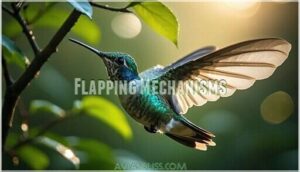
When you watch birds in action, their wings work like powerful engines generating lift and thrust through rapid, coordinated movements.
The wingbeat frequency varies dramatically between species, with hummingbirds beating their wings up to 80 times per second.
Each stroke requires enormous muscle power, creating aerodynamic forces that propel birds forward while maintaining flight efficiency despite significant energy expenditure, which is a remarkable example of flight efficiency.
Hovering Capabilities

In the context of hovering flight, you’re witnessing one of nature’s most energy-intensive feats.
Hummingbirds master this incredible ability through specialized wing mechanics and powerful flight muscles.
Here’s what makes hovering possible:
- Rapid wing beats – up to 80 beats per second
- Figure-eight wing motion creates lift on both strokes
- Flexible shoulder joints allow 180-degree wing rotation
- High muscle power – 25% of body weight is flight muscles
- Specialized airfoil wing shape maximizes energy efficiency
This evolutionary advantage costs significant energy expenditure.
Bird Skeletal System

You’ll discover that bird skeletons are engineering marvels, with hollow bones that make them incredibly lightweight while maintaining strength for flight.
These specialized bones, along with fused backbones and unique skull adaptations, create a framework that’s perfectly designed for the demands of aerial life.
Lightweight Bones
Bird bones pack incredible skeletal strength into a remarkably lightweight skeleton through bone pneumatization, giving them a serious evolutionary advantage.
You’ll find their pneumatized bones contain air-filled spaces that reduce bone density without sacrificing durability.
This amazing adaptation boosts flight efficiency by cutting overall body weight while maintaining the structural integrity needed for powerful wing beats and aerial maneuvers, which is a result of their pneumatized bones.
Hollow Bone Structure
You’ll find that hollow bones aren’t just empty spaces—they’re engineering marvels called pneumatized bones.
This bone pneumatization creates a skeletal system that’s both strong and incredibly light, giving birds their flight optimization edge.
Here’s how this weight reduction magic works:
- Air sacs extend into bones, creating hollow chambers that maintain skeletal strength
- Calcium storage continues despite the hollow structure through strategic bone wall placement
- Evolutionary advantages include reduced body weight without sacrificing structural integrity
- Flight optimization occurs as birds achieve maximum lift with minimum skeletal mass
Fused Backbone
Unlike mammals with flexible spines, your feathered friends possess a fused backbone that’s like nature’s built-in shock absorber.
This skeletal fusion creates backbone rigidity, giving birds the flight stability they need while soaring through the sky.
The spinal column’s evolutionary advantage also provides impact absorption during landing and enhances their skeleton’s perching adaptation, making bird anatomy perfectly suited for aerial life.
Specialized Skull
You’ll notice a bird’s specialized skull packs incredible engineering into compact space.
Cranial kinesis allows flexible jaw movement, while bone fusion creates lightweight strength.
This skull evolution supports diverse beak shapes through strategic beak support structures.
Shock absorption protects delicate brains during high-impact activities like woodpecker drilling.
Bird anatomy showcases how bird physiology optimizes every bone for survival and efficiency.
Bird Eye Characteristics
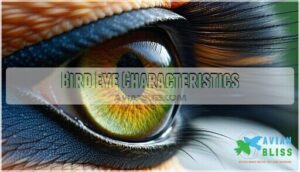
You’ll find that bird eyes are remarkable organs, packed with far more photoreceptors than human eyes and capable of seeing ultraviolet light that’s completely invisible to us.
These specialized visual systems, often proportionally larger than our own eyes, give birds the sharp vision they need for hunting, navigation, and survival in their demanding environments.
High Photoreceptor Density
When you peer into a bird’s eyes, you’re looking at nature’s high-definition cameras.
Their eyes pack millions of photoreceptors – the light-detecting cells that create vision.
While humans have about 200,000 photoreceptors per square millimeter, birds boast up to 1 million.
This incredible density gives them razor-sharp visual acuity for spotting tiny insects, identifying predators, and traveling during diurnal activity with stunning color perception.
Ultraviolet Light Perception
Birds possess a secret superpower you can’t see.
Their eyes contain special photoreceptors called cones that detect ultraviolet light, invisible to humans.
This UV vision helps with mate selection by revealing hidden plumage patterns, provides foraging advantages for spotting prey, and enables species recognition.
These remarkable adaptations have important conservation implications for protecting bird habitats.
Vision Acuity
Your feathered friends possess vision acuity that puts human eyesight to shame.
They see fine details at distances you’d struggle with, thanks to densely packed cones in their retinas.
This sharp vision helps with motion detection and depth perception while hunting or flying.
Their color perception includes ultraviolet light, revealing hidden patterns on flowers and prey that remain invisible to us.
Birds can also suffer from common eye disorders, impacting their vision.
Eye Size Comparison
Your feathered friends possess remarkably large eyes compared to their head size—much bigger than yours relative to human proportions.
This impressive eye-to-head ratio gives birds their incredible visual prowess, with some owls having eyes that occupy nearly half their skull space.
Consider these eye size comparisons across different bird species:
- Nocturnal Birds like owls have enormous eyes that can be 15% of their total head weight
- Diurnal Birds such as eagles maintain large eyes but with different proportions for daylight hunting
- Predator Vision requires bigger eyes positioned forward for depth perception and target tracking
- Prey Vision benefits from smaller eyes placed on skull sides for wide-angle surveillance
- Eye Placement varies dramatically—from forward-facing hunter eyes to side-mounted escape-detection systems
Bird Hearing Abilities
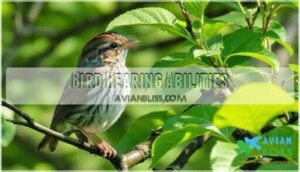
You might think birds can’t hear well because they lack external ears, but their hearing is surprisingly sharp.
They pick up subtle sound changes and a wide range of frequencies, essential for survival and communication.
Frequency Range
You might wonder how birds hear without external ears.
Their hearing sensitivity is perfectly tuned to their world. Birds detect a range of frequencies, from high-pitched insect calls to low rumbles.
Here’s a quick breakdown:
| Feature | Description |
|---|---|
| Hearing Sensitivity | Detects subtle sound changes |
| Frequency Range | Broad, varies by species |
| Sound Localization | Pinpoints sources precisely |
| Vocalization Range | Relates to specific calls/songs |
| Species Variation | Unique adaptations per bird type |
Sound Sensitivity
You’d be amazed at how sharp bird hearing really is.
Their ears can detect tiny changes in sound that humans completely miss.
This incredible hearing range helps with sound localization, letting them pinpoint exactly where calls come from.
Their spatial resolution is so precise that they can identify individual voices in noisy flocks.
Some species even use vocal mimicry based on these refined senses, which is a testament to their incredible hearing range.
Lack of External Ears
Unlike mammals, you won’t spot external ears on birds – their hearing mechanisms are completely internal.
Sound localization happens through tiny openings hidden beneath feather coverage near their heads.
This streamlined design from avian evolution helps reduce drag during flight while maintaining excellent hearing abilities.
Their inner ear structure processes sounds just as effectively as animals with visible ears, proving that bird physical features prioritize function over form, and this is due to their highly specialized hearing mechanisms.
Hearing Importance
You’d be surprised how critical hearing is for bird survival.
Despite lacking external ears, their middle and inner ears excel at sound localization and predator detection. Their hearing range supports essential vocal communication and environmental awareness.
- Predator alerts – Split-second sound detection means life or death
- Mate recognition – Finding love through distinctive calls across distances
- Territory defense – Acoustic boundaries prevent dangerous confrontations
Bird Sensory Abilities
Beyond their sharp eyesight and keen hearing, you’ll find that birds possess remarkable sensory abilities that help them survive in their environments.
They can feel vibrations through their bills and feet, detect magnetic fields for navigation, and even sense changes in air pressure that signal weather shifts, utilizing their sensory abilities to adapt.
Touch Sensation
You’d be surprised how birds’ touch senses work through their bills and feet.
Feather Sensitivity helps them detect wind changes and obstacles during flight.
Their Bill Touch provides precise feedback when foraging for food or building nests.
Foot Texture sensitivity lets them grip branches securely.
This Environmental Feedback system gives birds essential information about their surroundings through specialized skin sensitivity receptors, utilizing Feather Sensitivity to enhance their awareness.
Taste Bud Limitations
You’d think birds would be gourmets, but their taste bud count tells a different story.
Most bird species have only 50-400 taste buds compared to your 10,000.
This limited taste range affects their food selection impact substantially.
Birds rely more on sight and smell for dietary adaptations.
These evolutionary implications make sense – when you’re flying at high speeds, quick visual cues beat slow taste testing for survival.
Smell Capabilities
Despite common myths, you’ll find that birds actually possess remarkable smell capabilities through their nostrils and olfactory bulb.
Many species use their keen senses for food source location, predator detection, and navigation assistance.
Some birds even achieve individual recognition through scent, while their olfactory bulb size varies by species, this sense works alongside taste to enhance their survival skills substantially.
Magnetic Reception
Birds possess remarkable magnetic reception abilities that function like an internal GPS system.
You’ll find cryptochrome proteins in their retinas detect Earth’s magnetic field through radical pair processes, while magnetite crystals near their beaks provide additional navigational data.
This sophisticated receptor mechanism evolved to guide migratory pathways across thousands of miles, combining magnetic navigation with their exceptional vision senses for precise positioning.
Birds also use celestial navigation methods to orient themselves, utilizing their internal GPS and exceptional vision senses.
Specialized Bird Features

You’ll discover that birds possess unique internal organs that make their survival possible in diverse environments.
These specialized features, including salt glands for seabirds, muscular gizzards for grinding food, and multi-purpose cloacas, work together to support their high-energy lifestyles and remarkable adaptations for flight, making their high-energy lifestyles possible.
Salt Glands
You’ve discovered how birds perceive their world through remarkable senses, but marine species face another challenge: salt overload.
Salt glands, positioned above each eye, act like specialized kidneys for seabirds and shorebirds.
These remarkable adaptations extract excess sodium from blood, allowing birds to drink seawater safely, which represents essential osmoregulation in birds.
You can even find products for them, and this salt gland function showcases marine bird adaptation at its finest.
Muscular Gizzard
Your bird’s gizzard works like a powerful grinding machine inside its digestive system.
This muscular organ crushes tough seeds and grains that beaks can’t handle. Many birds swallow small stones on purpose – these rocks help the gizzard’s grinding mechanisms break down food efficiently.
It’s nature’s built-in food processor, making bird diet digestion incredibly effective without needing teeth.
Cloaca Functions
Unlike the muscular gizzard that grinds food, your bird’s cloaca handles multiple jobs through one opening.
This all-in-one system manages waste removal and water reabsorption while serving the reproductive system for egg laying.
The cloaca function involves processing uric acid from the urinary system, making it an efficient part of internal organ systems that keeps everything running smoothly.
Adaptations for Flight
Flight evolution shaped every aspect of avian anatomy through remarkable adaptations.
You’ll find that bone pneumatization creates hollow bones, reducing weight by up to 20% while maintaining strength.
Wing morphology varies dramatically—from hummingbird hovering to albatross soaring.
Muscle power concentrates in the breast, comprising 15-25% of body weight, and respiratory efficiency doubles oxygen processing.
Specialized feathers provide lift and control during flight.
Frequently Asked Questions (FAQs)
What are the physical characteristics of a bird?
Beauty is in the eye of the beholder," and you’ll find birds showcase incredible physical features.
You’ll notice their feathers, beaks, wings, and hollow bones work together perfectly for flight, feeding, and survival in diverse environments, which is a key aspect of their survival.
What are some interesting features about birds?
You’ll find that feathers aren’t just for flight—they’re made of keratin like your fingernails.
Ravens solve puzzles, toucans regulate body temperature through their bills, and hummingbirds’ hearts beat 1,000 times per minute, showcasing the unique characteristics of each bird species, with hummingbirds having a remarkable heart rate.
What 5 characteristics are unique to birds?
Like nature’s flying jewels, you’ll find birds possess five exclusive traits: feathers for flight and warmth, beaks replacing teeth, hollow bones reducing weight, wings enabling soaring, and specialized respiratory systems processing oxygen twice as efficiently as yours.
These traits, including feathers, contribute to the unique characteristics of birds, setting them apart from other creatures.
Which feature is characteristic only of birds?
Feathers are the only feature that’s exclusively yours if you’re a bird.
No other animal on Earth has them.
They’re made of keratin and serve multiple purposes including flight, insulation, and attracting mates.
How do birds regulate their body temperature?
Clever creatures control their core temperature through feathers that trap warm air.
Panting to release excess heat.
And adjusting blood flow to their legs and bills, which act as natural radiators.
Why do some birds have colorful plumage?
Colorful plumage helps birds attract mates and communicate their health status.
You’ll notice males typically sport brighter colors during breeding season, while females often have subdued tones for camouflage while nesting.
How fast can birds fly in general?
Birds rocket through the sky at lightning speeds.
You’ll find most songbirds cruise at 15-25 mph, while diving falcons can hit 200+ mph.
Flight speed depends on size, wing shape, and whether they’re hunting or just traveling, which can be considered a complete concept in understanding bird flight.
Do all birds molt their feathers annually?
Most birds don’t actually molt all their feathers at once annually.
You’ll find they replace feathers gradually throughout the year, though many species have peak molting seasons, typically after breeding when they’re not focused on attracting mates.
What makes bird respiratory systems so efficient?
Imagine breathing with turbo-charged lungs!
Your bird’s respiratory system processes oxygen twice as efficiently as yours through unidirectional airflow.
And specialized air sacs that maximize oxygen absorption during both inhalation and exhalation.
Conclusion
From tiny hummingbirds to massive eagles, these facts about bird physical features showcase nature’s remarkable engineering.
You’ve discovered how hollow bones reduce weight while maintaining strength, how specialized beaks match specific diets, and how feathers serve multiple functions beyond flight.
Their extraordinary vision, including ultraviolet perception, and sensitive hearing demonstrate evolutionary perfection.
These adaptations work together seamlessly, proving that birds represent some of biology’s most sophisticated designs.
Each feature contributes to their incredible success across diverse environments worldwide, highlighting the remarkable adaptability of birds.
- https://royalsocietypublishing.org/doi/10.1098/rspb.1998.0315
- https://www.ncbi.nlm.nih.gov/pmc/articles/PMC1626207/
- https://www.encenter.org/wp-content/uploads/2020/04/Bird-Beak-Adaptations.pdf
- https://www.vtaide.com/png/bird-adaptations3.htm
- https://museumofzoologyblog.com/2020/07/08/bird-beaks-and-evolution/