This site is supported by our readers. We may earn a commission, at no cost to you, if you purchase through links.
A toucan’s bill might steal the spotlight, but that vibrant, oversized tool isn’t just for show—it’s a precision instrument that unlocks feeding opportunities other rainforest birds can’t access.
The feeding habits of toucans reveal a strategic forager that balances fruit-heavy meals with protein from insects, eggs, and even small lizards, shifting its diet as seasons change the availability of figs, palm berries, and tropical staples.
This dietary flexibility doesn’t just keep toucans nourished; it makes them essential architects of forest regeneration, scattering seeds across miles of canopy with every meal.
Understanding how these birds feed—from their dawn foraging peaks to their bill’s serrated grip on slippery rinds—reveals why habitat loss threatens not just the toucan, but the entire ecosystem that depends on their movements.
Table Of Contents
- Key Takeaways
- What Do Toucans Eat in The Wild?
- Feeding Behavior and Foraging Patterns
- The Role of The Toucan’s Bill in Feeding
- Toucans as Seed Dispersers in Rainforests
- Dietary Needs of Captive Toucans
- Iron Sensitivity and Health Risks
- Conservation Challenges Affecting Toucan Feeding
- Frequently Asked Questions (FAQs)
- Do toucans need to eat every 15 minutes?
- What are a toucan’s favorite foods?
- How much do toucans eat in a day?
- How much water do toucans drink daily?
- Do toucans feed their chicks differently than adults?
- Can toucans taste sweetness in their fruit?
- Do toucans compete with other birds for food?
- What time of day do toucans eat most?
- Conclusion
Key Takeaways
- Toucans function as essential seed dispersers in rainforest ecosystems, moving seeds an average of 144 meters per trip and enabling forest regeneration across fragmented habitats that smaller birds cannot connect.
- The toucan’s oversized bill operates as a precision feeding tool with lightweight honeycomb construction and serrated edges that allow access to fruits on thin branches other birds cannot reach, while specialized jaw mechanics enable them to toss and swallow food in single ballistic motions.
- Wild toucans maintain dietary flexibility by consuming primarily fruit (80+ percent during certain seasons) supplemented with insects, eggs, and small vertebrates, but captive toucans require strictly managed low-iron diets below 100 ppm to prevent fatal hemochromatosis since they cannot regulate iron absorption.
- Habitat loss directly threatens toucan survival by eliminating the fruiting trees that provide their primary food sources, forcing longer foraging distances between isolated forest patches and disrupting the seed-dispersal services that sustain tropical forest regeneration.
What Do Toucans Eat in The Wild?
If you’ve ever watched a toucan toss fruit into the air with that massive, colorful bill, you know these birds aren’t your typical seed-peckers. Wild toucans are primarily fruit lovers, but they’re far from strict vegetarians—they’ll happily snatch up insects, eggs, and even small lizards when the opportunity arises.
Their bills may look oversized and clumsy, but tropical bird species have evolved remarkably specialized beaks that perfectly match their preferred foods.
Understanding what toucans eat in their native rainforest habitat reveals how they’ve adapted to thrive in one of Earth’s most competitive ecosystems.
If you’re captivated by these vibrant birds, check out top bird-watching destinations for rare species to see where you might spot Toco Toucans in the wild.
Common Fruits in Toucan Diets
Toucans feast on a striking array of fresh fruits that power their rainforest wanderings. You’ll find them devouring figs, Cecropia fruits, and guavas—staples that provide essential fruit nutrition and enable seed dispersal across vast forest territories. Their toucan diet shifts with seasons: lipid-rich palm berries during rainy months, sugar-packed oranges and papayas when resources tighten. This fruit variety ensures dietary balance while supporting tropical forest regeneration. They also play a key ecological role as .
Their feeding patterns intersect with those of tanagers, honeycreepers, and other canopy specialists across different bird habitats in the Amazon, creating complex ecological networks that sustain rainforest biodiversity.
Animal Prey and Omnivorous Habits
Beyond frugivory, you’ll witness toucans employing bold foraging strategies to secure animal protein. These omnivores capture beetles, caterpillars, and lizards—even raiding nests for eggs and chicks. Prey capture supplements their toucan diet with essential amino acids and calcium that fruit alone can’t provide. This omnivore diet places them within multiple ecological roles, balancing bird dietary needs while influencing forest community structure through predation pressure. Strikingly, toucans’ reliance on shapes their movement patterns and ecological impact.
Seasonal and Regional Food Variations
You’ll notice fruit availability reshapes toucan diet throughout the year, driving seasonal shifts in what these birds consume. During the Pantanal’s dry season, Toco toucans concentrate over 80 percent of foraging on Genipa americana fruits, which sustains them when tropical fruits become scarce.
Regional diets also vary—Amazonian toucans access figs and palms year-round, while montane species at higher elevations exploit different fruit assemblages, demonstrating striking dietary adaptation across habitats.
Feeding Behavior and Foraging Patterns

Toucans don’t just passively wait for food to appear—they follow deliberate patterns that optimize their access to ripe fruit across the forest canopy.
Their daily routines and foraging techniques reveal how these birds adapt to the rhythms of the rainforest, moving strategically through their territory to exploit the best feeding sites.
As habitats shrink, understanding how birds adapt across different climates becomes crucial to protecting species facing environmental change.
Understanding these behaviors shows you how toucans balance energy expenditure with nutritional reward in one of the planet’s most competitive ecosystems.
Daily Foraging Routines
Ever wonder how a bird with a billboard for a beak plans its day? You’ll find that toucan feeding behavior follows a rhythm tied to the sun and survival. These tropical foragers operate on a schedule shaped by temperature, predation risk, and the scattered bounty of fruiting trees across tens of hectares:
- Morning feeding peaks – Activity surges after sunrise when fruit is abundant and forests are cool
- Midday rest periods – Heat drives them to shaded perches, conserving energy
- Late afternoon foraging – A second push before roosting completes the daily pattern
- Large home ranges – Toco toucans cover roughly 86 hectares, tracking bird diet resources
- Social coordination – Small groups travel single-file between treetops, balancing food searching with safety
This foraging pattern lets them exploit tropical fruits efficiently while dodging predators and heat stress.
Many different types of birds in forests have evolved similar feeding strategies to balance nutrition with safety in dense canopy environments.
Canopy Foraging Techniques
You’ll spot toucans hopping branch to branch in the canopy, using their zygodactyl feet—two toes forward, two back—to grip narrow perches while that oversized beak reaches fruits on flimsy outer twigs.
This aerial maneuver lets them pluck tropical forest prizes without risking a fall, accessing food other birds can’t reach while dodging understorey predators through interconnected crowns.
The Role of The Toucan’s Bill in Feeding
The toucan’s oversized bill isn’t just for show—it’s a precision tool shaped by millions of years of evolution to solve specific feeding challenges.
This exceptional structure lets toucans access food sources that other birds simply can’t reach, from fruits dangling on flimsy branches to prey hidden in tree crevices.
Understanding how the bill works reveals why toucans have become such successful foragers in the rainforest canopy.
Bill Adaptations for Food Acquisition

You might wonder how a bird with such an oversized, seemingly awkward bill copes to feed itself with precision—but the toucan’s beak is actually a finely tuned instrument that evolved specifically for reaching, grasping, and processing food in ways most other birds can’t.
The bill’s structure reflects millions of years of bill evolution shaped by dietary habits and feeding mechanisms:
- Lightweight honeycomb construction lets you extend far onto branches that won’t support your body weight
- Serrated edges along both mandibles grip slippery fruit rinds during food manipulation
- Precise jaw movement controls the angle and pressure needed for different foods
- Extended reach gives you access to canopy resources competitors can’t exploit
This beak adapts bird nutrition strategies for Neotropical forests where the best fruits hang at the thinnest tips.
Manipulating and Swallowing Food
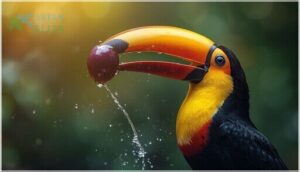
After seizing fruit at the bill tip, toucans toss it upward in a single ballistic motion that propels the food straight back to the throat—no chewing, no multiple stages.
This food transport mechanics relies on jaw kinematics: precise gape timing controls the launch and catch, while esophageal contractions complete the swallow.
High-speed studies reveal these swallowing techniques let toucans gulp oversized items rapidly during active feeding.
Toucans as Seed Dispersers in Rainforests

Toucans do far more than simply eat fruit—they actively shape the forests around them through seed dispersal.
When you watch a toucan swallow a berry whole and later deposit the seed kilometers away, you’re witnessing forest regeneration in action.
When you see a toucan swallow a berry and deposit its seed kilometers away, you’re watching forest regeneration unfold
Their feeding habits connect distant patches of forest, influence which tree species thrive, and determine how quickly cleared areas can recover.
Impact on Forest Regeneration
When large frugivores like toucans vanish from tropical forests, seed dispersal collapses and forest regeneration stalls. These birds carry large-seeded canopy trees beyond parent crowns—often more than 45 meters—reducing seed predation and density-dependent mortality that concentrate near adults.
Their long-distance dispersal creates recruitment patterns essential for biodiversity conservation, shaping rainforest ecosystems and maintaining ecosystem balance across broad spatial scales in regenerating forest ecology.
Preferred Tree Species for Feeding
Toucans don’t feed at random—they track fruit availability across forest canopy zones, zeroing in on specific tree species that anchor tropical ecology. Field observations reveal their strongest preferences in rainforest ecology:
- Virola surinamensis delivers large arillate seeds that toucans ferry across forest ecosystems
- Ficus species provide year-round figs, stabilizing toucan diet and nutrition
- Genipa americana dominates late dry-season foraging, accounting for over 80 percent of activity
- Cecropia pachystachya fuels wet-season feeding in pioneer stands
This selective foraging drives seed dispersal patterns throughout tropical forests.
Long-Distance Seed Dispersal
GPS-tracked toucans move seeds farther than most birds imagine—averaging 144 meters per dispersal event, with 56 percent exceeding 100 meters. This landscape ecology transforms tropical forest ecology through frugivore networks that extend kilometers daily.
Your morning-foraging birds carry Virola seeds during peak movement periods, creating ecological connectivity across fragmented habitats. These dispersal mechanisms shape seed dispersal patterns that smaller seed dispersers can’t replicate, anchoring wildlife ecology and behavior in avian ecology.
Dietary Needs of Captive Toucans
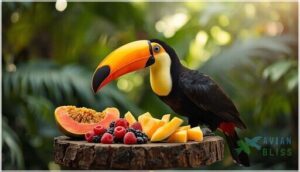
Keeping a toucan healthy in captivity requires a completely different approach than what these birds find in the wild, because you need to manage risks that don’t exist in tropical forests. The biggest challenge you’ll face is balancing their fruit-heavy diet with strict iron limits, which means understanding exactly what to feed and what to avoid.
Let’s break down the three essential components of a captive toucan’s nutrition.
Recommended Fruits and Vegetables
You want to break free from guesswork when feeding your toucan, so focus on dietary variety with these core items:
- Fresh fruit options like apples, bananas, grapes, blueberries, and melons form around 60 percent of daily intake
- Vegetable supplements including diced carrots, peppers, and squash add nutrients without excess iron
- Fruit salad ideas mixing papaya, mango, and berries prevent selective eating
Avoid citrus and tomatoes, which boost iron absorption.
Low-Iron Pelleted Diets
Beyond fresh produce, you need low-iron pelleted diets formulated specifically for softbills. These specialized pellets contain iron concentrations below 100 parts per million—often ranging from 50 to 85 ppm—which prevents hemochromatosis while maintaining nutrient balance.
Look for products with added tannins that bind iron in the gut, and keep vitamin C under 500 milligrams per kilogram to avoid boosting iron absorption during digestion.
Foods to Avoid for Toucan Health
Just as critical as choosing the right pellets is knowing what toxic food sources to eliminate. Avocado toxicity tops the list—persin causes heart and lung failure in toucans. Citrus fruits, tomatoes, chocolate, and alcohol are equally hazardous substances that disrupt avian nutrition.
You’ll also want to avoid iron-rich foods like beans and grapes, raw meat dangers from bacteria, and anything containing xylitol, which triggers fatal liver damage.
Iron Sensitivity and Health Risks

One of the biggest challenges you’ll face when keeping toucans is their unusual sensitivity to dietary iron, which sets them apart from most other birds. Unlike parrots or finches, toucans can’t efficiently regulate iron absorption in their intestines, so excess iron accumulates in their organs and causes serious illness.
Understanding this vulnerability is essential because it shapes every feeding decision you make, from choosing pellets to selecting which fruits belong in the daily bowl.
Iron Storage Disease (Hemochromatosis)
Excessive iron accumulation in liver cells defines this devastating condition, which you should recognize as hemochromatosis or iron storage disease—a frequent killer of captive toucans.
Hepatic damage occurs when hemosiderin deposits overwhelm parenchymal tissues, causing emaciation, breathing difficulties, and sudden death. Disease pathology reveals toxic iron levels exceeding 300 ppm in affected birds, making avian health dependent on understanding iron toxicity and nutrition.
Managing Iron Intake in Toucans
You’ll need to orchestrate dietary balance with precision to keep iron levels safely between 50 and 100 ppm, preventing hemochromatosis from silencing your toucan’s vitality.
Effective feeding strategies for iron regulation include:
- Select low-iron pellets containing less than 90 ppm as your foundation for nutrican management
- Dilute formulated diets with papaya, berries, and melons that naturally lower total iron concentration
- Avoid citrus fruits and tomatoes, which boost iron absorption through their high citric acid content
- Test water sources regularly because dissolved iron contributes markedly to your bird’s total intake
- Replace rusted cage components with stainless steel to eliminate incidental iron ingestion
Health monitoring through periodic blood work reveals iron storage disease before liver damage becomes irreversible, making toucan care and feeding a commitment to constant vigilance.
Conservation Challenges Affecting Toucan Feeding
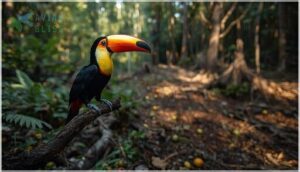
Protecting toucans means protecting the forests they depend on for food. When habitat destruction disrupts the availability of fruiting trees and prey, toucan populations face serious survival challenges.
Let’s explore how habitat loss affects their feeding options and what conservation strategies can help safeguard their diets.
Habitat Loss and Food Availability
Deforestation impacts toucan survival by destroying the canopy forests where fruit scarcity becomes critical. The conversion of over 1 million hectares annually in Brazil and Colombia removes fruiting trees these birds depend on.
Habitat fragmentation forces toucans to travel farther between isolated forest patches, while climate effects disrupt fruiting cycles, creating mismatches between peak fruit production and when toucans need food most for ecosystem disruption mitigation.
Conservation Strategies for Toucan Diets
Through habitat restoration and climate adaptation planning, you can help safeguard toucan diets against shrinking fruit resources. Conservation efforts that protect ecological balance include:
- Fruit tree planting targeting native species that toucans prefer, which reinforces sustainable foraging opportunities and wildlife nutrition
- Agroforestry practices like shade-grown coffee that maintain canopy corridors
- Reforestation protecting at least 40 percent forest cover to sustain seed-dispersal processes
Frequently Asked Questions (FAQs)
Do toucans need to eat every 15 minutes?
Ever wonder how often these vibrant birds actually fuel up? Toucans don’t require feeding every 15 minutes—their dietary rhythms follow natural hunger cycles with two main meals daily, optimizing nutrient absorption through their specialized avian diet.
What are a toucan’s favorite foods?
Toucans favor soft, sugar-rich fruits like figs, berries, and papaya, which make up most of their diet.
They supplement this fruit preference with insects and occasional small vertebrates for essential protein and nutrients.
How much do toucans eat in a day?
A large toucan usually consumes 15 to 20 percent of its body weight daily—roughly 90 to 140 grams for a 600-gram bird—split across multiple feeding bouts to meet energy requirements and nutrition needs.
How much water do toucans drink daily?
You’ll rarely see a toucan gulping from a water dish—they drink very little, pulling most of their hydration needs from juicy fruits that make up their diet, though clean water should always be available.
Do toucans feed their chicks differently than adults?
Yes, adult toucans regurgitate partially digested food for nestlings and provide frequent, high-protein meals including crickets and small mice—dramatically different from their own fruit-dominated diets—to fuel rapid chick growth and development.
Can toucans taste sweetness in their fruit?
You might wonder whether these fruit-loving birds detect sugar perception during fruit selection—and the answer is almost certainly yes.
Their avian taste receptors, though different from ours, enable sweetness detection that guides their dietary habits and foraging behavior.
Do toucans compete with other birds for food?
Picture fruit-laden branches bustling with hungry wings—you’ll find intense competition unfolding. Toucans aggressively dominate fruiting trees through size-based intimidation, displacing smaller birds while seasonal scarcity intensifies these battles, though resource partitioning through fruit-size preferences reduces some overlap.
What time of day do toucans eat most?
Toucans concentrate their feeding during crepuscular hours—dawn and dusk—when they’re most active.
You’ll spot them foraging intensely in early morning, resting through midday heat, then resuming late afternoon feeding bouts before roosting.
Conclusion
When you protect a toucan’s food source, you protect the forest it rebuilds. Their bills reach fruit others can’t access, their appetites scatter seeds across miles, and their survival now depends on whether rainforests remain intact enough to sustain both the forager and the ecosystem that forages back.
When you understand the feeding habits of toucans, you recognize how fragile that balance has become. Conservation isn’t optional—it’s reciprocal.
- https://digitalcommons.usf.edu/cgi/viewcontent.cgi?article=2126&context=ornitologia_neotropical
- https://toucan-teach.com/the-great-debate-toucan-nutrition/
- https://toucandinetocos.wordpress.com/toco-toucans-diet/
- https://www.scielo.br/j/bjb/a/JdHp88gsbCjbGZZNbptmG4r/?lang=en
- https://avibirds.com/what-do-toucans-eat/