This site is supported by our readers. We may earn a commission, at no cost to you, if you purchase through links.

I’ve spent twenty years watching birds, and I still grab the wrong field guide half the time—flipping through warbler plates when I’ve got a hawk overhead, or hauling my exhaustive Sibley tome on a quick backyard check when a pocket guide would’ve done the job.
Here’s the thing about field guides for backyard bird watching: the “best” one depends entirely on what’s landing at your feeder, what fits in your back pocket, and whether you’re the type who needs to know every subspecies variation or just wants to tell your goldfinches from your warblers.
The explosion of specialized guides over the past decade—raptors, waterfowl, warblers, even guides organized by the exact way birds appear in the wild rather than taxonomic order—means you’ve got options that would’ve made Roger Tory Peterson’s head spin. Choosing the right guide isn’t about finding the most exhaustive book (though we’ll cover those too); it’s about matching the tool to your specific backyard, your experience level, and honestly, how much weight you’re willing to carry when you dash outside in your pajamas because something interesting just hit the suet feeder.
Table Of Contents
- Key Takeaways
- Key Features of Backyard Bird Field Guides
- Factors to Consider When Choosing a Guide
- Top 10 Field Guides for Backyard Bird Watching
- 1. Sibley Guide To Birds Second Edition
- 2. Crossley Eastern Bird Identification Guide
- 3. Crossley Id Guide To Raptors Book
- 4. Hawks In Flight Identification Guide
- 5. Hawks at a Distance Guide
- 6. Crossley Waterfowl Identification Guide
- 7. Waterfowl Identification Guide Book
- 8. North American Waterfowl Identification Guide
- 9. North American Warbler Identification Guide
- 10. Peterson Field Guide To North American Warblers
- How to Use Field Guides Effectively
- Enhancing Your Backyard Bird Watching Experience
- Frequently Asked Questions (FAQs)
- Conclusion
Key Takeaways
- The “best” field guide depends entirely on your specific needs—what birds visit your yard, whether you prioritize portability or comprehensive coverage, and your experience level with identification techniques.
- Illustration quality, accurate range maps, and user-friendly layouts matter more than sheer page count, especially when you’re trying to identify a bird that won’t sit still at your feeder.
- Specialized guides for raptors, waterfowl, or warblers outperform general references when you’re tackling tricky species groups, though they’re better suited as car-seat companions than trail companions due to their weight.
- Effective field guide use combines visual observation (shape, plumage patterns, behavior) with range data and seasonal timing to transform quick glimpses into confident identifications you can log and track over time.
Key Features of Backyard Bird Field Guides
Not all field guides are created equal—trust me, I’ve lugged enough clunkers into the field to know! The best ones share a handful of essential features that transform frustrating page-flipping into smooth identification, whether you’re tracking a mystery warbler at your feeder or comparing confusing sparrows.
The best guides also include common bird recognition techniques like range maps and comparison charts that help you quickly narrow down your options in the field.
Let’s break down what separates the keepers from the shelf-sitters.
Illustration Quality and Detail

Sharp feather detail separates field guides you’ll actually use from those gathering dust. When you’re identifying a warbler flitting through the shadows, color accuracy matters—especially for subtle plumage patterns that distinguish similar species.
Look for guides with these visual strengths:
- Crisp bird silhouettes showing bill shape and posture
- High-resolution images capturing feather texture and seasonal variations
- Visual fidelity that reflects what you’ll see through binoculars
The Sibley Guide sets the benchmark for illustration quality, though several newer birdwatching field guides now rival its precision.
Range Maps and Species Coverage

Precise illustrations won’t help if your guide shows a cardinal wintering in Montana! Range maps reveal where species actually occur—seasonal variations, geographic barriers like the Rockies, and breeding versus migration zones. Look for field guides with quarterly map updates that reflect climate-driven range shifts, because species distribution changes fast.
| Map Feature | Why It Matters for Bird Identification |
|---|---|
| Seasonal layers | Distinguishes summer breeders from winter visitors in your yard |
| Geographic barriers | Shows why certain Sibley Guide species won’t cross mountain ranges |
| Update frequency | Tracks expanding or contracting ranges due to warming trends |
User-Friendliness and Layout

You’ll spot clear visual hierarchy in top-tier field guides—Sibley Guide uses bold sans-serif headings, generous margins, and two-column layouts that prevent eye fatigue during fast page navigation. Font readability matters when you’re squinting at text under a feeder’s shadow!
Color coding by species family and consistent layout design transform chaotic bird identification into smooth pattern recognition.
These birdwatching tips make field guide recommendations actually work in real conditions.
Size, Portability, and Durability

Great layouts won’t help if your guide disintegrates after three rainy mornings! Pocket-sized editions—usually 5 to 6 inches tall—slip into jacket pockets without weighing you down, averaging 6 to 12 ounces for comfortable one-handed use. Guide weight matters when you’re juggling binoculars and coffee simultaneously.
- PVC or polyurethane cover materials resist moisture and abrasion far better than standard paper bindings
- Laminated page edges prevent curling from dew, maintaining page durability through seasons of backyard observation
- Compact designs with spiral binding enable flat loading on your feeder bench while preserving spine integrity
Print Vs. Digital Guide Options

Your feeder-side options have never been more diverse! Print field guides deliver tactile, battery-free reliability—Sibley Guide owners swear by flipping pages mid-observation without screen glare disrupting warblers.
Digital field guides counter with instant updates, searchable databases, and built-in audio clips. Cost comparison favors digital initially, though quality print editions last decades.
User preferences split: traditionalists cherish annotated margins, tech-savvy birders sync notes across devices.
Factors to Consider When Choosing a Guide

You wouldn’t buy binoculars without thinking about magnification and weight, right? The same logic applies when you’re standing in front of a wall of field guides, trying to figure out which one won’t drive you crazy when a hawk soars overhead and you need an answer now.
Let’s break down the practical factors that’ll help you choose a guide that actually works for your backyard adventures.
Purpose: General Vs. Specialty Guides
Your birding goals will dictate whether you reach for a general or specialty field guide. If you’re just starting out, an extensive resource like the Sibley Guide gives you a broad species base—perfect for backyard birdwatching and learning Bird Identification Techniques.
But when you zero in on raptors or warblers, specialty guides offer laser-focused Identification Tips that general field guides simply can’t match!
Content Depth and Information Provided
Check that your field guide doesn’t just flash pretty pictures—you need Species Profiles packed with Visual Details like size measurements, plumage variants across seasons, and vocalization transcriptions. The best Informative Content for Bird Identification Techniques includes Behavioral Insights (feeding habits, flight patterns) and comparison plates.
The Crossley ID Guide excels here, offering multiple age groups and habitat notes that transform birdwatching from guessing game to confident Bird Species Research!
Age Appropriateness for Users
Who will turn these pages—your curious toddler, a wide-eyed tween, or maybe your nature-loving grandparent? Age Appropriateness transforms User Experience from frustration to joy!
- Toddler Engagement thrives with bold labels, visual icons, and minimal text for quick recognition
- Youth Education demands larger print, interactive elements, and simple Bird Identification Techniques for emerging readers
- Senior Accessibility requires high contrast, consistent layouts, and adjustable fonts for comfortable field use
Family Involvement flourishes when field guides match developmental stages, turning birdwatching into multi-generational Birding Community Engagement.
Extras: Audio, Photo Galleries, and Comparison Plates
Most modern guides don’t stop at static illustrations—they offer Audio Clips, Photo Galleries, and Comparison Plates that turn field identification from guesswork into certainty! Audio Clips let you study Bird Songs and Vocal Patterns at adjustable speeds, perfect for learning those tricky warblers.
Photo Galleries reveal seasonal plumage shifts and age variations you’ll actually encounter at your feeder.
Comparison Plates place lookalikes side by side, highlighting the subtle differences that separate a Song Sparrow from a Savannah Sparrow in seconds.
Top 10 Field Guides for Backyard Bird Watching
After years of squinting at field marks through binoculars, I can tell you that the right guide makes all the difference between triumphant identification and muttering “little brown job” for the hundredth time.
The right field guide transforms backyard birding from frustrating guesswork into confident identification
The guides below represent the benchmark—books I’ve worn out, water-stained, and dog-eared in backpacks from Minnesota feeders to Texas migration hotspots.
Here’s what actually works when you’re standing in your yard trying to sort out that confusing fall warbler.
1. Sibley Guide To Birds Second Edition

If you want the benchmark in North American bird identification, Sibley’s second edition is your go-to companion—period. This flexibound powerhouse packs in nearly 7,000 digitally remastered paintings, all 15 to 20 percent larger than the first edition, so you won’t miss those subtle field marks that separate a Sharp-shinned from a Cooper’s Hawk.
With 810 species, 350 regional populations, and updated range maps showing seasonal shifts, you’ll have everything you need right at your fingertips, even if the three-pound heft means it’s better suited for your porch than a long hike.
| Best For | Serious birders and nature enthusiasts who want the most comprehensive field guide available and don’t mind the weight for at-home reference or car-based birding trips. |
|---|---|
| Publisher | Knopf |
| Language | English |
| Page Count | 624 pages |
| Weight | 3 pounds |
| Publication Year | 2014 |
| Primary Focus | North American Birds |
| Additional Features |
|
- Nearly 7,000 paintings that are 15-20% larger than the first edition, making field marks easier to spot
- Covers 810 species and 350 regional populations with updated range maps showing seasonal movement
- Expanded text includes habitat details and voice descriptions for every species, plus 600 new paintings
- Weighs three pounds, making it too heavy to carry comfortably on long hikes or birding walks
- Small font size can be challenging for readers with vision difficulties
- Some users report the illustrations appear too dark or have inconsistent color reproduction
2. Crossley Eastern Bird Identification Guide

Richard Crossley’s Eastern guide flips the script entirely—instead of static portraits, you get lifelike scenes built from over 10,000 photographs showing birds exactly as they appear in the wild.
Each of the 640+ species spreads features 12 to 20 images at different distances, angles, and behaviors, so you’ll see that Robin hopping, perching, and flying away just like in your yard.
Sure, it’s heavy at 3.75 pounds and the busy plates take some getting used to, but this groundbreaking approach trains your eye faster than any traditional guide.
| Best For | Birders who want to level up their identification skills by learning what birds actually look like in real-world scenarios, not just perfect studio shots. |
|---|---|
| Publisher | Princeton University Press |
| Language | English |
| Page Count | 528 pages |
| Weight | 3.75 pounds |
| Publication Year | 2011 |
| Primary Focus | North American Birds |
| Additional Features |
|
- Revolutionary scene-based approach with 640 spreads showing 12-20 images per species at different distances, angles, and behaviors
- Trains your eye faster than traditional guides by mimicking how you actually see birds in the field
- Built from over 10,000 photographs showing birds in natural poses, flight, and various plumages
- Heavy at 3.75 pounds—not practical to carry around while birding
- The busy photographic montages can feel overwhelming at first and require some adjustment
- Works better as a study tool at home than a grab-and-go field reference
3. Crossley Id Guide To Raptors Book

If you’re serious about raptor ID, Crossley’s approach delivers again with 101 composite scenes showing all 34 North American diurnal raptors—yes, owls got the boot, but that’s a trade-off for depth.
You’ll study Red-tailed Hawks across multiple age classes, compare Osprey and Swainson’s Hawks side by side, and quiz yourself with mystery photographs that’ll humble even confident birders.
At 2.06 pounds and nearly 10 inches tall, it’s strictly for home study or your car, not your field vest.
| Best For | Birders who want to master raptor identification through real-world composite scenes and are willing to keep a hefty reference book in the car rather than carry it in the field. |
|---|---|
| Publisher | Princeton University Press |
| Language | English |
| Page Count | 288 pages |
| Weight | 2.06 pounds |
| Publication Year | 2013 |
| Primary Focus | Raptors |
| Additional Features |
|
- 101 composite scenes show all 34 North American diurnal raptors in various ages, poses, and lighting conditions for realistic practice
- Mystery photographs and comparison layouts test your skills and help you learn the tricky differences between similar species
- Written by two leading raptor experts with detailed accounts that work for both beginners and experienced birders
- Excludes owls entirely, so you’ll need a separate guide for nocturnal raptors
- At over 2 pounds and nearly 10 inches tall, it’s too bulky to carry comfortably in the field
- Lacks simple side-by-side progression images of individual species that some learners prefer
4. Hawks In Flight Identification Guide
When you’re standing beneath a kettle of migrating buteos, Pete Dunne’s Hawks in Flight becomes your gospel—339 color plates and 32 black-and-whites spread across 129 pages that nail light conditions, molt patterns, and those tricky aberrant plumages nobody warns you about.
You’ll compare species that constantly fool even veteran hawk counters, learning to read wing posture and tail bands from below. Sure, it’s 1 pound and nearly 10 inches tall, so leave it in your car at the hawk watch, but its flight-centric approach outshines perched-bird references when raptors won’t cooperate.
| Best For | Intermediate to advanced birders who spend time at hawk migration sites and need to identify raptors in flight from various angles and lighting conditions. |
|---|---|
| Publisher | Princeton University Press |
| Language | English |
| Page Count | 129 pages |
| Weight | 1 pound |
| Publication Year | 2005 |
| Primary Focus | Hawks in Flight |
| Additional Features |
|
- 339 color photos across 68 plates show hawks as you’ll actually see them—soaring overhead in different light and molt stages
- Direct comparisons between easily confused species help you sort out tricky IDs in real time
- Covers the 19 most common migratory raptors across North America, making it practical for most hawk-watching locations
- No perched hawk photos, so you’ll need another guide for stationary birds
- At nearly 10 inches tall and 1 pound, it’s too bulky to carry in the field comfortably
- Skips localized species like Short-tailed and Black Hawks, limiting coverage for certain regions
5. Hawks at a Distance Guide

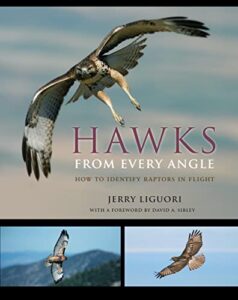
Sometimes those migrating hawks vanish into thermal hazes or fly so high they’re barely dots—and Jerry Liguori’s Hawks from Every Angle saves your sanity. Its 558 color photos and 896 black-and-white images drill you on silhouette, wing posture, and flight style when plumage details disappear, covering 29 species across every lighting mess you’ll encounter.
At 208 pages and 6×8.5 inches, it’s lighter than Dunne’s tome, though Kindle screens wash out the subtle contrast work that makes distance ID click.
| Best For | Birders who need to identify migrating raptors when they’re just distant specks in the sky and plumage details are useless. |
|---|---|
| Publisher | Princeton University Press |
| Language | English |
| Page Count | 208 pages |
| Weight | 1 pound |
| Publication Year | 2011 |
| Primary Focus | Distant Raptors |
| Additional Features |
|
- Massive image collection (558 color 896 B&W) drills you on silhouettes and flight styles across 29 species
- Covers real-world challenges like thermal hazes and bad lighting instead of perfect close-ups
- Compact 6×8.5″ size makes it easier to carry than bulkier field guides
- Kindle version struggles with photo quality on smaller screens, losing the subtle contrasts you need
- Still weighs a pound, which adds up if you’re hauling gear on long watches
- Focus on distant ID means it’s less helpful when hawks are close enough to see field marks
6. Crossley Waterfowl Identification Guide

When you’re sorting ducks from geese on a misty pond, Richard Crossley’s visual-heavy approach—512 pages of lifelike habitat scenes—lets you match real birds to real settings instead of wrestling with isolated plumage charts.
Each species gets multiple angles, seasonal variations, and behavioral poses (feeding, preening, flight) right on one page, so you’re not flipping back and forth while a Redhead drifts out of view.
At 3.6 pounds and nearly 10 inches tall, you’ll leave this 2017 masterpiece on your tailgate, not in your jacket.
| Best For | Birders and hunters who want to identify waterfowl by studying realistic habitat scenes at home or in the truck, rather than carrying a reference into the field. |
|---|---|
| Publisher | Crossley Books |
| Language | English |
| Page Count | 512 pages |
| Weight | 3.6 pounds |
| Publication Year | 2017 |
| Primary Focus | Waterfowl |
| Additional Features |
|
- Nearly 300 pages of lifelike scenes show waterfowl in multiple plumages, behaviors, and angles all on one page—no constant flipping required
- Visual-first approach makes identification faster and more intuitive by matching real birds to real settings instead of relying on technical descriptions
- Comprehensive coverage with 512 pages means you get detailed information on size, structure, behavior, and color variations for accurate IDs
- At 3.6 pounds and nearly 10 inches tall, it’s too heavy and bulky to carry comfortably in the field
- High price point may be a barrier for casual birders or those on a budget
- Kindle version doesn’t do justice to the detailed images and compositions that make the physical book valuable
7. Waterfowl Identification Guide Book

If you need authoritative coverage without Crossley’s scene-based format, Delta Waterfowl’s full-color guide delivers 47 species—ducks, geese, swans—through high-detail photos showing males, females, wing tops, wing bottoms, and even bills and feet for fast field ID.
The consistent layout lets you cross-reference plumage stages in seconds, and the durable binding withstands rain-soaked mornings at the pond.
A digital companion adds zoomable images and searchable indexes, perfect for confirming that eclipse-plumaged drake while your binoculars fog.
| Best For | Serious birders and waterfowl enthusiasts who want the most comprehensive reference on ducks, geese, and swans across North America, Europe, and Asia. |
|---|---|
| Publisher | Princeton University Press |
| Language | English |
| Page Count | 656 pages |
| Weight | 3.6 pounds |
| Publication Year | 2016 |
| Primary Focus | Waterfowl |
| Additional Features |
|
- Massive visual library with 72 color plates, 920 drawings, and 650 photos covering 84 species plus over 100 hybrids
- Deep technical detail on taxonomy, identification, age/sex determination, molt patterns, and geographic variations that goes beyond basic field guides
- Includes distribution maps, voice descriptions, and habitat information for complete species profiles
- Heavy and bulky at 3.6 pounds and 656 pages, making it impractical to carry in the field
- Limited geographic scope excludes waterfowl from Africa and South America
- Lacks the digital companion features and searchable tools mentioned in competing guides
8. North American Waterfowl Identification Guide
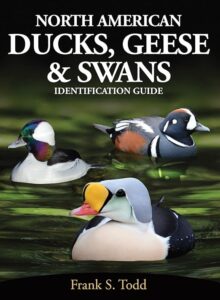
When you’re ready to move beyond regional titles and tackle 83 waterfowl species—ducks, geese, swans—across the continent, this Hancock House photographic guide delivers separate accounts for each species and subspecies, complete with range maps, molt timing, and population estimates.
At 208 pages it’s hefty (1.35 pounds!), but the richly detailed photos capture plumage phases, age classes, and behavioral postures that text alone can’t convey. Just note: captions stay brief, so you’ll lean on visuals to distinguish that eclipse drake from a first-winter hen.
| Best For | Birders who want a comprehensive photographic reference for identifying all 83 North American waterfowl species across multiple plumage stages and ages. |
|---|---|
| Publisher | Hancock House |
| Language | English |
| Page Count | 208 pages |
| Weight | 1.35 pounds |
| Publication Year | 2018 |
| Primary Focus | Waterfowl |
| Additional Features |
|
- Covers every duck, geese, and swan species continent-wide with individual accounts, range maps, and population data
- Rich photographic detail showing plumage variations, age classes, and behavioral postures that text descriptions can’t match
- Includes practical details like molt timing to help with seasonal identification challenges
- Brief captions mean you’re relying heavily on photos alone to make fine distinctions between similar species
- At 1.35 pounds and 208 pages, it’s too bulky to carry comfortably in the field
- Limited text descriptions may frustrate readers who prefer detailed written explanations alongside images
9. North American Warbler Identification Guide

If warblers feel like pocket-sized speed demons darting through the canopy, you’re not alone—these 4-to-6-inch insect hunters demand quick eyes and solid reference material.
The Warbler Guide (Princeton, 2013) packs over 1,000 photos and sonograms into 560 pages, teaching you to distinguish songs and subtle wing bars across all 56 North American species.
Yes, at 2.06 pounds it’s a car-seat companion, not a trail buddy, but those multiple viewing angles and call finders decode confusing fall plumages faster than you can say “Yellow-rumped.
| Best For | Serious birders and ornithology students who need a comprehensive warbler reference for home study and car-based birding trips. |
|---|---|
| Publisher | Princeton University Press |
| Language | English |
| Page Count | 560 pages |
| Weight | 2.06 pounds |
| Publication Year | 2013 |
| Primary Focus | Warblers |
| Additional Features |
|
- Over 1,000 photos show warblers from multiple angles, making fall plumage ID much easier
- Sonogram system teaches you to distinguish songs and calls across all 56 species
- Quick finders and detailed species accounts let you zero in on tricky field marks fast
- At 2.06 pounds and 560 pages, it’s too heavy to carry on trail hikes
- Sonograms can be hard to interpret if you’re new to reading sound visualizations
- The depth and specialized content might overwhelm beginners just starting out
10. Peterson Field Guide To North American Warblers

Peterson’s 1997 warbler bible shines with 32 arrow-marked color plates that spotlight every crown stripe, eye ring, and wing bar across 60 species—classic identification shorthand that still works brilliantly today.
At 672 pages and 1.66 pounds, you’ll carry serious detail: vocalizations, nesting quirks, and 141 photos showing seasonal plumage shifts.
The binding can separate with heavy use, and plates jump around rather than follow A-Z order, but those trade-offs buy you breeding and winter maps plus side-by-side comparisons that nail confusing look-alikes in seconds.
| Best For | Dedicated birders who need detailed warbler ID help in the field and don’t mind a well-worn reference that prioritizes visual comparison over alphabetical convenience. |
|---|---|
| Publisher | Mariner Books |
| Language | English |
| Page Count | 672 pages |
| Weight | 1.66 pounds |
| Publication Year | 1997 |
| Primary Focus | Warblers |
| Additional Features |
|
- Peterson’s arrow system pinpoints the exact field marks—crown stripes, wing bars, eye rings—that separate confusing species in seconds
- 141 color photos show seasonal plumage changes alongside breeding and winter range maps for all 60 species
- Compact 4.5 x 7.25-inch size fits in a daypack despite packing 672 pages of vocalizations, nesting behavior, and habitat notes
- Plates skip alphabetical order, forcing you to flip back and forth when comparing species quickly
- Binding tends to separate with regular field use, especially given the book’s age and heft
- Some photos carry a blue tint that can throw off color-based identification in tricky lighting
How to Use Field Guides Effectively

Look, owning a field guide is one thing—actually getting sharp IDs in the field is another beast entirely. The real magic happens when you stop flipping pages randomly and start using these books the way ornithologists do, combining visual cues with range data and behavior patterns.
Here’s how to transform your field guide from a pretty coffee table book into a legitimate identification powerhouse.
Identifying Birds by Shape, Plumage, and Song
You’ll crack the code faster when you train your eye on three fundamentals: shape, plumage, and song. Field guides pack these clues together, so here’s your strategy for sharp bird identification:
- Bird Silhouettes reveal size, beak shapes, and tail length—stocky sparrows versus slender warblers stand apart instantly
- Feather Patterns like wing bars and breast streaks separate lookalike species
- Song Variations help you distinguish warblers by cadence and call notes
- Wing Beats expose flight style differences
- Behavior Cues narrow candidates through perching posture and foraging habits
Observing birds in their habitats while applying the 4 keys to identification will greatly improve your ability to recognize different species.
Leveraging Range Maps and Seasonal Data
Once you’ve pinpointed shape and song, flip to the range maps—those color-coded gems show seasonal shifts and migration patterns across boundaries.
Check where your bird species should be right now: breeding grounds in summer, wintering zones in fall, or brief stopovers during spring passage.
Habitat associations and data visualization layers help you predict which backyard visitors will show up next month, turning field guides into your personal birdwatching calendar.
Comparing Similar Species Side by Side
Knowing where and when a bird appears only gets you halfway—now you need visual cues to split lookalikes. Flip to comparison plates, align species side by side, and run through these checks for rock-solid species differentiation:
- Crown patterns – plumed crest versus smooth head
- Wing bars – count them, measure thickness
- Bill color and depth – yellow versus gray, shallow versus substantial
- Tail markings – flecked white edges or solid dark tones
That beak analysis seals the deal every time.
Logging Sightings and Notes
Once you’ve nailed the ID, lock it in! Build your own bird journals with columns that capture the thrill and strengthen your birding skills.
Track sighting records down to the minute, jot note-taking shortcuts for plumage quirks, and master data management so you can map patterns across seasons—these logging tips transform casual wildlife observation into serious field science.
Logging your sightings with attention to essential bird log details helps you organize records for both personal growth and scientific contribution.
| Field | What to Record |
|---|---|
| Species | Common and scientific name |
| Time & Date | Exact timestamp, local zone |
| Location | GPS coords, habitat notes |
| Count & Behavior | Numbers seen, feeding or calling |
| Weather | Temperature, wind, cloud cover |
Enhancing Your Backyard Bird Watching Experience

You’ve got your field guide—now let’s talk about taking your backyard birding to the next level. The right equipment, a respectful approach, and a few strategic habitat tweaks can transform your yard into a genuine avian hotspot.
Here’s what you need to know to make every sighting count.
Essential Birdwatching Equipment
You’ll transform every backyard session when you pair quality binoculars—8×42 magnification gives you steady, crisp views—with a reliable field guide that fits your pocket.
Add birding apps for instant call identification, bird feeders to draw species close, and spotting scopes with tripod stands for distant observations.
Don’t forget camera lenses to capture wing bars and a compact notebook for logging those “wait, what was that?” moments!
Responsible Birdwatching Ethics
You’ll protect the very birds you’re here to observe when you follow a few simple ethical codes—stay on trails to minimize disturbance, limit playback audio that stresses shy species, and never touch nests or chicks.
Respect private property, share sightings responsibly without revealing exact nest locations, and embrace conservation methods that guarantee sustainable practices for wildlife conservation and long-term birding success!
Tips for Attracting Birds to Your Yard
Successfully attracting birds to your yard starts with layering native bird-friendly plants—tall trees, mid-height shrubs, and groundcover—to create a garden habitat that mimics nature.
Offer diverse bird seed options like sunflower and nyjer, add water feature ideas such as drip fountains, and follow yard layout tips positioning feeders 5–10 feet from cover so you can observe authentic bird behavior through your birdwatching field guide during every birding session!
Frequently Asked Questions (FAQs)
How often should I replace my field guide?
Field Guide updates aren’t ordained by birding gospel—swap yours when illustrations fade, range maps lie about where species actually hang out, or you miss regional birds your current guide ignores completely.
Can field guides identify juvenile or molting birds?
Many quality field guides include juvenile plumage plates, molt charts, and age-class labeling—essential aging techniques for spotting plumage variation.
Digital options often add zoomable details, making juvenile identification and tracking bird development easier during birdwatching outings.
Do field guides work for urban apartment birding?
City species like sparrows and pigeons perch right on your balcony railing, and compact field guides fit perfectly in small spaces—urban birding thrives when you match guide portability to apartment feeder setups.
Are there field guides for bird nests and eggs?
Specialized nest and egg field guides exist for North American and European regions, documenting nest shapes, materials, egg characteristics, and seasonal timing—helping you identify builders while practicing conservation ethics and responsible birdwatching.
Whats the best guide for rare or vagrant species?
Rare Birds of North America stands out for vagrant hunters—it delivers 275 color plates covering 262 species with regional occurrence patterns, seasonal timing, and plumage variations you’ll need when that unexpected rarity lands in your yard!
Conclusion
Your binoculars are the lens, but field guides for backyard bird watching are the compass—they point you toward understanding what you’re actually seeing out there. The right guide transforms fleeting glimpses into lasting knowledge, whether you’re parsing plumage details with Sibley or learning flight silhouettes with Crossley.
Don’t overthink it: grab one that matches your yard’s visitors, slip it in your pocket, and start identifying. The birds won’t wait.
- http://flockingaround.com/register
- https://sites.prh.com/complete-audubon-guides?utm_source=Audubon&utm_medium=website&utm_campaign=audubon-complete-guides-2023
- https://www.10000birds.com/review-of-the-crossley-id-guide-eastern-birds.htm
- https://www.allaboutbirds.org/news/book-review-the-crossley-id-guide-eastern-birds-by-richard-crossley/
- https://www.audubon.org/news/review-crossley-id-guide-eastern-birds