This site is supported by our readers. We may earn a commission, at no cost to you, if you purchase through links.
You’ve probably felt it—that split second when an aircraft lifts off the runway and gravity loses its grip. Flying, in its most fundamental sense, is humanity’s answer to one of nature’s oldest achievements: moving through air with purpose and control.
Birds mastered it 150 million years ago through evolutionary refinement. Insects figured it out even earlier, developing wing structures so efficient that modern drones can’t match their agility. We took a different route—steel, aluminum, and the precise mathematics of aerodynamics—but the result is the same: defying the earth’s pull.
Whether you’re watching a hawk ride thermal currents or sitting in row 23C at 35,000 feet, the principles remain surprisingly consistent. Understanding what flying actually means—from its linguistic roots to the physics that make a 900,000-pound 747 stay airborne—reveals why this act continues to captivate us.
Table Of Contents
- Key Takeaways
- What is Flying? Definitions and Origins
- Natural Flight in Animals and Insects
- Human Flight: Aircraft and Technology
- The Experience of Flying in Aviation
- Flying in Language and Everyday Use
- Frequently Asked Questions (FAQs)
- Should I avoid flying now?
- Why is flying so expensive?
- How to fly with pets or service animals?
- Are there play areas for children at airports?
- What are the options for flying with infants?
- How to handle seating arrangements with lap infants?
- What resources can help choose airplane seats?
- How do birds navigate during long migrations?
- What causes turbulence during a flight?
- Can humans develop personal flying devices safely?
- Conclusion
Key Takeaways
- Flying technology represents humanity’s engineered solution to natural flight, relying on aerodynamics and precise physics rather than evolutionary adaptation—yet both birds and aircraft manipulate the same four forces: lift, drag, thrust, and weight.
- The word “flying” traces back to Proto-Indo-European pleu- meaning “to flow,” revealing how ancient language captured the fluid motion of aerial movement long before humans achieved powered flight.
- Modern aviation balances sophisticated safety protocols with passenger comfort through systems like real-time air quality monitoring, adaptive seating technology, and layered emergency procedures that make air travel statistically safer than daily driving.
- Insects achieve flight through indirect muscle systems that oscillate their thorax up to 40 wingbeats per nerve impulse, creating unsteady aerodynamic forces like front-edge vortices that would stall conventional fixed wings.
What is Flying? Definitions and Origins
Flying means something different depending on whether you’re watching a hawk soar, boarding a jet, or tossing around phrases like “time flies.”
Birds like hawks use a mix of flapping and gliding techniques, which you can explore further in this guide to different bird species and their unique flight behaviors.
Before you can understand the mechanics and magic behind flight, you need to know what the word actually means—and where it came from.
Let’s start with the basics: the dictionary definition, the history of the term, and how “flying” works as different parts of speech.
Dictionary Meaning of Flying
You’ll find flying defined several ways in any dictionary—as a noun, it means traveling through the air in aircraft or the act of flight itself.
As an adjective, flying describes anything moving swiftly or capable of aerial motion, from insects to machines. The word also captures speed and urgency in phrases like “flying visit,” showing how aviation terminology has shaped everyday language beyond literal flight definitions.
For deeper insights into the word’s roots and meanings, see this explanation of its etymology and related terms.
Etymology and Word History
Understanding the word’s roots reveals how language mirrors human ambition. “Flying” traces back to Proto-Indo-European pleu-, meaning “to flow” or “to float”—the same root that gave us “flow” itself.
The word flying descends from an ancient root meaning to flow—revealing how language itself mirrors humanity’s soaring ambitions
Through Proto-Germanic fleuganą and Old English fleogan, the word evolved across centuries, absorbing influences from Norse invaders and Norman scribes. By the 1400s, Middle English variations like fleynge stabilized into the modern form you recognize today.
Insights into the evolutionary challenges of flight reveal how complex adaptations have shaped our understanding of this phenomenon.
Flying as a Verb, Noun, and Adjective
Beyond its historical roots, flying shifts across grammar like an aircraft changing altitude. As a verb, it captures ongoing motion—“the plane is flying to Denver”—while the noun form names the activity itself: “flying demands precision from every pilot.”
When modifying other words, it becomes an adjective describing rapid movement or airborne objects, from flying debris to wing-tested aircraft traversing complex aerodynamics through participle usage and linguistic analysis.
Natural Flight in Animals and Insects
Long before humans ever dreamed of taking to the skies, nature had already perfected the art of flight. Birds, insects, and even some mammals developed remarkable adaptations that allow them to soar, glide, and hover with precision that still inspires modern aviation.
From flightless penguins to soaring eagles, the diverse types of bird species showcase evolution’s creative solutions to survival across every habitat on Earth.
Here’s how different creatures conquered the air through millions of years of evolution.
How Birds Achieve Flight
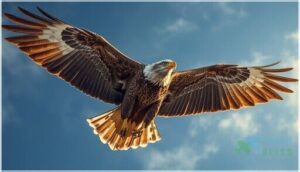
When birds take flight, they utilize aerodynamics through carefully orchestrated wing movements and specialized anatomy. You’re watching a masterclass in natural engineering every time a bird launches skyward.
Here’s how birds achieve flight through four essential systems:
- Wing Aerodynamics – Curved wings create lower pressure above and higher pressure below, generating lift that defies gravity
- Feather Structure – Interlocking barbules form smooth, continuous surfaces that channel airflow and prevent air leakage
- Flight Muscles – The powerful pectoralis drives the downstroke while the supracoracoideus raises wings through a specialized shoulder pulley system
- Airflow Dynamics – Birds adjust their angle of attack and stroke plane to balance lift, thrust, and drag throughout each wingbeat cycle
During bird migration, these systems work continuously for hours—sometimes days—powered by an efficient respiratory system that keeps oxygen flowing to flight muscles.
Insect Flight Mechanisms
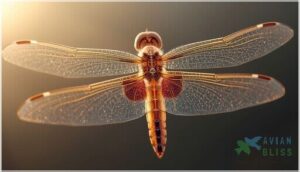
Unlike birds, most flying insects utilize indirect flight muscles attached to the thorax—not the wings—that deform the thoracic box to power each stroke. You’re witnessing a mechanical marvel: two antagonistic muscle groups create rapid oscillations, with some species achieving 15 to 40 wingbeats per nerve impulse through stretch activation.
| Muscle Structure | Flight Control | Sensory Systems |
|---|---|---|
| Dorsal longitudinal and dorso-ventral muscles work as antagonists | Direct steering muscles at wing hinges adjust stroke timing and rotation | Campaniform sensilla detect wing strain for instant aerodynamic feedback |
| Asynchronous fibers contract multiple times from single motor impulses | Axillary sclerites form mechanical fulcrums that rock wings during beats | Halteres act as gyroscopes sensing body rotations mid-flight |
| Stretch activation triggers self-sustaining oscillation in thorax | Insects tweak angle of attack through small apodeme levers | Reflex pathways connect sensors directly to motor neurons for rapid corrections.” |
Wing movement in entomology reveals unsteady aerodynamic forces at work—front-edge vortices spiral toward wingtips during downstrokes, generating lift that would stall fixed wings. Dragonflies showcase direct muscle control, attaching flight muscles to wing bases for agile maneuvers you’d never see in larger flyers.
Other Flying Animals (Bats, Mammals)
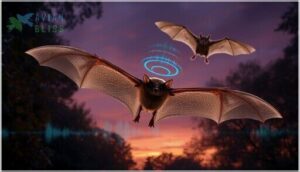
You’ll discover that bats take flight one step beyond gliding mammals like flying squirrels and colugos. Bat wing anatomy features thin patagia membranes stretched across elongated finger bones, enabling rapid three-dimensional maneuvers no insect can match.
Their echolocation systems transform nighttime navigation into an acoustic map, detecting prey mid-flight through echo patterns. Meanwhile, mammal gliding relies on parachute-like membranes for controlled descents—aerodynamic adaptations that bridge the gap between ground-bound and airborne life.
Human Flight: Aircraft and Technology
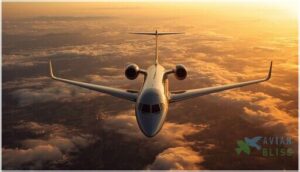
While nature gave birds and insects the gift of flight, humans had to engineer it from scratch. Today’s aircraft don’t just defy gravity—they’ve transformed how we move, work, and connect across the globe.
Understanding how machines take to the sky starts with three fundamentals: the physics that makes it possible, the different types of aircraft conquering our skies, and the pioneering innovations pushing aviation into its next era.
Principles of Aerodynamics and Lift
When you soar through the sky, four aerodynamic forces work in concert—lift pushes you upward as air moves faster over curved wings, creating lower pressure above than below.
Drag resists your forward motion while thrust from engines propels you ahead. Wing design and airflow dynamics determine how efficiently you climb, cruise, and conquer gravity. Understanding these flight mechanics unlocks aviation’s revolutionary power.
Types of Aircraft (Planes, Helicopters, Drones)
You’ll encounter three groundbreaking categories of aircraft design—each unleashing unique freedom in the skies. Fixed-wing planes like the Boeing 737 dominate commercial aviation, seating 130 to 220 passengers with ranges exceeding 3,000 nautical miles.
Helicopter systems, from single-rotor designs to tandem configurations like the CH-47 Chinook, provide vertical lift and hover capabilities that conventional aircraft can’t match. Drone technology ranges from nano quadcopters under 250 grams to industrial UAVs handling mapping missions—transforming how you access aerial perspectives through accessible aviation community innovations.
Advances in Aviation Technology
Aviation technology is rewriting the rules of flight—breaking barriers that once seemed unshakeable. Electric propulsion and sustainable fuels are pushing airlines toward that 5 percent carbon reduction target by 2030, while autonomous systems edge closer to certification through programs testing eVTOL aircraft in real communities.
- Sophisticated materials reduce weight and boost aerodynamics and physics efficiency
- Cybersecurity measures protect connected cockpits from digital threats
- Aeronautical engineering integrates AI into aircraft operation monitoring
- The aviation industry stands at a crossroads between tradition and transformation
The Experience of Flying in Aviation
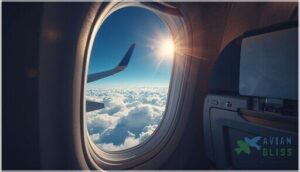
Stepping aboard a commercial aircraft marks the beginning of an air adventure that’s become surprisingly routine—yet the engineering and systems protecting you at 35,000 feet remain remarkable.
Modern air travel balances state-of-the-art safety protocols with passenger comfort, transforming what was once a luxury into an accessible experience for millions. Here’s what you need to know about the cabin environment, safety measures, and the practicalities of traveling through today’s aviation network.
Inside a Modern Aircraft Cabin
Step inside today’s aircraft cabin and you’ll find a sanctuary in the sky. Smart seats adapt to your body, while Starlink-powered inflight entertainment streams 4K content in real time.
Sustainable design uses lightweight composites to cut emissions without sacrificing comfort. Whether you’re exploring aircraft for sale or simply experiencing passenger-focused cabin technology, the aviation industry has transformed aircraft operation into something far more personal.
Passenger Safety and Comfort
Behind all that streaming entertainment and adaptive seating, your safety comes first. Seat Belt Safety starts the moment you buckle up—crews emphasize keeping that belt low and snug across your hips because Flight Turbulence strikes without warning.
Emergency Procedures cover oxygen masks that drop automatically and life vests tucked under your seat. Cabin Air Quality stays filtered and fresh, supporting Passenger Wellness even on long hauls.
Aviation News and Pilot Resources constantly improve these systems, while the Aviation Community Engagement and Flight Education networks guarantee Pilot Experiences translate into smarter protocols. You’re protected by layers of tested, proven safeguards.
Navigating Air Travel
Your journey from curb to cruising altitude demands smart Flight Planning and sharp Travel Documents. Airport Security lines screen passengers and bags under strict protocols—arrive at least two hours early for domestic flights, three for international routes. Boarding Procedures follow assigned zones printed on your pass.
Air Traffic systems coordinate thousands of aircraft daily, while Navigation and Piloting crews guide you safely through congested skies. Flying transforms into adventure when you master these checkpoints.
| Checkpoint | What You Need |
|---|---|
| Check-In | Passport, confirmation code, seat selection |
| Security Screening | Valid ID, liquids under 3.4 oz, electronics out |
| Gate Boarding | Boarding pass, zone number, on-time arrival |
| Connection | Minimum connection time, customs clearance if international |
Flying in Language and Everyday Use

Beyond the cockpit and clouds, “flying” has carved out its own space in the English language—showing up in everything from quick comebacks to old sayings your grandparents probably used.
The word shifts meaning depending on context, stretching from literal movement through the air to expressions that capture speed, freedom, or something slipping away before you can catch it.
Here’s how “flying” works its way into everyday conversation and why it carries more weight than you might think.
Common Idioms and Phrases
You’ll discover that “flying” takes off in language as a powerful tool for rebellion and transformation. When you “pass with flying colors,” you’ve conquered a challenge on your own terms—and time flies when you’re breaking new ground.
- Time flies captures that rush when every moment counts and you’re chasing freedom
- Flying by the seat of your pants means embracing risk-taking without a safety net or rigid plan
- When pigs fly challenges the impossible, daring you to prove skeptics wrong
- Flying high describes that unstoppable feeling after you’ve seized control and won
Usage Differences in English
You’ll notice Fly vs. Flight split roles in everyday grammar—fly drives action as a verb, while flight names the journey itself.
Transitive Uses let you fly a plane, but intransitive flying means you soar solo.
Regional Terms like aeroplane versus airplane mark your linguistic territory, though most rebels now choose plane and skip the dictionary debate entirely. Ad copy and airlines prefer flight for clarity.
Metaphorical and Figurative Uses
The sky becomes your canvas when flight transforms into metaphor—liberation phrases like “spread your wings” and “fly free” signal minds breaking constraints, while success symbols such as “soaring to new heights” celebrate victory.
Risk allegories warn against “flying too close to the sun,” and fantasy elements like “when pigs fly” dismiss impossibility.
These liberated minds sail through language, turning literal takeoff into conceptual leap.
Frequently Asked Questions (FAQs)
Should I avoid flying now?
That depends on your destination, health, and timing.
Commercial aviation remains statistically safe—you’d need to fly daily for 15,000 years to encounter a fatal accident—but operational disruptions and health concerns deserve your attention right now.
Why is flying so expensive?
Fuel costs drive up ticket prices—jet fuel alone hits nearly 30 percent of operating expenses.
Add labor, taxes, and surcharges, and you’re paying for a complex machine that demands massive overhead before wheels ever leave the runway.
How to fly with pets or service animals?
Breaking free from the leash means traversing airline pet policies—reserve early, carry vet documents, and verify your carrier fits under the seat for smooth in-cabin pets travel with service animal rules clarity.
Are there play areas for children at airports?
Yes—major airports offer kids zones with soft climbing structures, aviation-themed playgrounds, and observation areas.
You’ll find family facilities like LAX Beach or Dulles’ NASA space near gates, helping children burn energy before flight boarding begins.
What are the options for flying with infants?
Imagine tucking a seedling into fertile ground—traveling with infant begins with choosing lap travel, purchasing a dedicated seat with an FAA-approved restraint, or requesting a bassinet on long-haul flights for safe, comfortable journeys.
How to handle seating arrangements with lap infants?
When selecting seats with a lap infant, book early and request bulkhead rows for bassinet options—families benefit from adjacent seating guarantees under new airline policies, ensuring infant safety throughout your flight.
What resources can help choose airplane seats?
Choosing the right spot on a flight transforms your journey—seat maps from airline tools reveal layouts at booking, while travel apps like TripIt Pro and flight alerts from platforms like FlightSeatmap help you snag upgrades.
How do birds navigate during long migrations?
Migratory birds navigate using an internal magnetic compass, star patterns, sun position, and visual landmarks—combining innate directional programs with learned routes through multisensory integration that keeps them on course across continents.
What causes turbulence during a flight?
The smoothest sky hides the roughest ride—turbulence strikes when pressure changes collide with jet stream effects, mountain waves, convective storms, or wake vortices from other aircraft cutting through unstable air masses.
Can humans develop personal flying devices safely?
Personal Aircraft Design with electric propulsion, distributed motors, and emergency parachutes can reduce accidents, but Flight Safety Measures demand strict Regulatory Frameworks, Flight Training, and Accident Prevention rules to protect both pilots and people below.
Conclusion
The next time you board an aircraft or watch a sparrow navigate updrafts, you’ll carry something most passengers lack—a working knowledge of what makes flying possible.
From the ancient wingspan of a dragonfly to the jet engines that compress air at impossible speeds, the mechanics haven’t changed: generate lift, overcome drag, maintain control.
You’ve moved beyond the surface now. That’s the difference between traveling and truly understanding flight.
- https://podcasts.apple.com/us/podcast/i-learned-about-flying-from-that/id1544875746
- https://www.barrons.com/news/french-olympic-ice-dance-champions-laud-greatest-gift-28a19744
- https://www.latimes.com/entertainment-arts/music/story/2026-02-11/wasserman-artists-staff-want-him-out-after-epstein-files-chaos
- https://www.marketwatch.com/story/a-budget-airline-cancelled-my-flight-and-gave-me-a-25-voucher-and-a-hotel-room-is-this-normal-506b2626
- https://docs.google.com/forms/d/1GAQr3Kn1cURCVHUA82hAga1Wv8DCH0IuqDLRUrOpN7M/viewform?ts=63f4f653&entry.1515682415=https://www.merriam-webster.com/dictionary%2Ffly