This site is supported by our readers. We may earn a commission, at no cost to you, if you purchase through links.
Your binoculars capture only 50 to 60 percent of available light if the lenses remain uncoated—a staggering loss that dims your view and muddies fine detail. Each uncoated air-glass boundary reflects roughly 4 percent of incoming light, and a typical binocular design includes ten or more of these surfaces.
Anti-reflective coatings change the equation by depositing ultra-thin films that cancel reflections through destructive interference, pushing transmission rates above 90 percent in premium models. The difference isn’t subtle: how binocular lens coatings affect image quality determines whether you see crisp, high-contrast images or washed-out views plagued by glare and ghost reflections.
Understanding coating types—from basic single-layer treatments to complex dielectric stacks—gives you the insight to evaluate performance claims and choose optics that deliver the brightness, color fidelity, and sharpness your eyes deserve.
Table Of Contents
- Key Takeaways
- How Lens Coatings Reduce Light Loss
- Types of Binocular Lens Coatings Explained
- Impact on Brightness and Contrast
- Color Fidelity and Coating Choices
- Coating Quality and Binocular Performance
- Frequently Asked Questions (FAQs)
- Does anti-reflective coating affect vision?
- What does lens coating damage look like?
- Are lens coatings necessary?
- How to make binoculars less blurry?
- How do lens coatings affect binocular durability?
- Can lens coatings be reapplied or repaired?
- Do coatings degrade over time with use?
- How to clean coated lenses without damage?
- Are waterproof coatings different from optical coatings?
- Conclusion
Key Takeaways
- Uncoated binocular lenses lose 40-50% of incoming light through reflection at multiple air-glass boundaries, while fully multi-coated optics boost transmission above 90% by depositing quarter-wave anti-reflective films that use destructive interference to cancel reflections at each surface.
- The coating hierarchy spans four distinct levels—coated, fully coated, multi-coated, and fully multi-coated—with each step reducing per-surface reflection from 4% down to 0.25-0.5%, directly translating to measurable gains in brightness, contrast, and detail resolution in low-light conditions.
- Roof prism binoculars require phase correction coatings and dielectric mirrors to match porro prism performance, since the split light path creates polarization shifts that cut contrast nearly in half without specialized multi-layer treatments achieving 99%+ reflectivity.
- Neutral broadband coatings preserve true color fidelity across 400-700nm for accurate field identification, while tinted ruby or blue-filtering options sacrifice 15-20% transmission and distort natural hues to boost perceived contrast in specific applications like hunting.
How Lens Coatings Reduce Light Loss
When light hits a glass surface, a percentage bounces back instead of passing through—and that reflected light never reaches your eye.
That’s why choosing the right magnification for birding matters less than finding optics with coatings designed to minimize reflection and maximize light transmission.
Binocular lenses interact with light at multiple surfaces, compounding these losses and degrading the image you see. Understanding how anti-reflective layers work, and the measurable differences between coating types, starts with examining what happens in uncoated optics.
Understanding Light Reflection in Uncoated Lenses
Reflection theory reveals a harsh truth: every air-glass boundary bleeds light. An uncoated surface with refractive index around 1.5 reflects roughly 4 percent of incoming light, slashing light transmission to about 96 percent per surface.
Every uncoated air-glass boundary reflects roughly 4 percent of incoming light, bleeding optical efficiency at each surface
Here’s what light loss looks like in practice:
- A simple two-surface window transmits only 92 percent of light
- Ten uncoated surfaces compound reflective loss to nearly 50 percent
- Standard binoculars with 10-16 interfaces lose almost half their light gathering capability
- Reflection increases sharply at steeper angles from straight-on incidence
- Surface quality and refractive index determine optical efficiency before antireflection coatings enter the picture
For more insight into how light transmission efficiency improves with anti-reflective coatings, modern lens treatments are essential for maximizing performance.
Anti-Reflective Coating Basics
Antireflection coatings fight that loss by depositing thin films with optical thickness equal to one quarter of the target wavelength, creating destructive interference that cancels reflections.
Magnesium fluoride, with a reflective index near 1.38, bridges the gap between air and glass, dropping surface reflection from 4 percent to roughly 1 to 1.5 percent.
These coating materials manipulate light interactions at each boundary, dramatically boosting light transmission across your binocular’s lens surfaces.
Understanding the role of optical interfaces and coatings can further illustrate how these advancements improve image clarity and efficiency.
Light Transmission Rates Across Coating Types
Now that you understand how quarter-wave films fight reflections, let’s examine actual transmission rates across coating types to see lens optimization in action.
- Uncoated glass surfaces lose roughly 4 to 5 percent of light at each boundary, so coating efficiency becomes critical for optical performance.
- Single-layer coatings cut reflection to about 1 percent per surface, raising binocular lens coatings’ light transmission from 60 to roughly 80 percent.
- Multi-coated optics with multiple antireflective layers drop reflection to 0.25 to 0.5 percent, pushing transmission above 90 percent through enhanced reflectivity control.
- Fully multicoated designs apply these sophisticated coating types and applications to all air-glass interfaces, maximizing spectral balance and brightness.
- Broadband multicoatings maintain consistent transmission rates across red through blue wavelengths, preserving natural color while delivering peak performance.
Types of Binocular Lens Coatings Explained
Not all lens coatings are created equal, and understanding the differences helps you make smarter purchasing decisions.
High-quality coatings reduce glare and boost contrast, especially critical when choosing lenses for bird photography where clarity at distance matters most.
Manufacturers use specific terminology to describe coating coverage and complexity, from basic single-layer treatments to sophisticated multi-layer systems. Let’s break down the four primary coating categories you’ll encounter when shopping for binoculars.
Single-Layer Coated Vs. Fully Coated
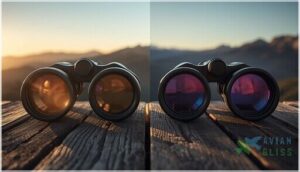
You’ll encounter two main binocular lens coatings distinctions at the entry level. Single-layer coated designs apply a thin anti-reflective film to just a few key lens surfaces you can see, leaving internal elements bare. Fully coated models treat every air-to-glass interface across the optical path with at least one coating layer, boosting light transmission from around 60 percent to 80–90 percent and delivering noticeably brighter, clearer images.
| Coating Type | Surface Coverage | Typical Light Transmission |
|---|---|---|
| Coated | Partial (key surfaces only) | ~60% |
| Fully Coated | Complete (all air-to-glass) | 80–90% |
| Uncoated | None | ~50% or less |
Multi-Coated and Fully Multi-Coated Options
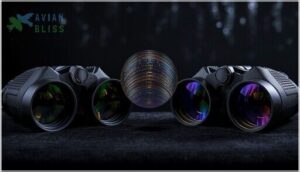
Multiple interference layers distinguish multi-coated from basic fully coated optics. Multi-coated binoculars stack several anti-reflective films on select surfaces—usually the outer objective and eyepiece lenses—while fully multi-coated models extend those stacks to every air-to-glass boundary. That difference in coating coverage translates directly into optical clarity and light transmission.
- Multi-coated: Multiple layers on key surfaces; internal elements may carry single coatings; transmission around 85–92 percent.
- Fully multi-coated: Multiple layers on all surfaces; reflection drops to 0.25–0.5 percent per boundary; overall transmission reaches 90–95 percent.
- Fully broadband multi-coated: Extends multilayer stacks across the entire visible spectrum; preserves color fidelity and micro-contrast.
- Coating materials: Sophisticated dielectric and magnesium fluoride stacks increase lens durability and maintain image quality over time.
When you compare multi-coated and fully multi-coated binoculars side by side, you’ll notice the fully multi-coated pair shows dimmer greenish or purplish reflections on the objectives—a sign that more photons are reaching your eyes instead of bouncing back. In low light, that extra few percent of transmission sharpens detail and deepens contrast, especially in shadow zones where every photon counts.
If you’re deciding between roof and porro designs, understanding prism differences helps explain why coating quality matters even more in compact roof-prism models.
Phase Correction Coatings for Roof Prisms
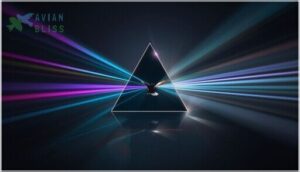
Roof prism design splits incoming light into two paths that travel different distances along internal reflective surfaces, creating a polarization-dependent phase shift that cuts image contrast nearly in half.
Phase correction coatings fix this interference problem by depositing dozens of dielectric layers—often magnesium fluoride and higher-index oxides—onto the roof surface, restoring coherent wavefronts and delivering sharp, high-contrast images comparable to Porro prisms.
Dielectric Mirror Coatings
Dielectric coatings stack dozens of ultra-thin oxide layers—alternating high-index materials like titania and low-index materials like silica—on prism faces to achieve mirror reflectivity above 99 percent across the visible spectrum.
These non-metallic dielectric materials reflect light through interference effects rather than metal conductivity, delivering better light transmission, prism efficiency, and coating durability compared to silver or aluminum mirrors that degrade over time.
Impact on Brightness and Contrast
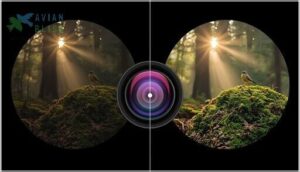
When you’re evaluating binoculars, brightness and contrast aren’t just marketing buzzwords—they’re measurable optical properties that lens coatings directly influence. High-quality lens coatings don’t simply make your view a bit sharper; they fundamentally change how light behaves inside the optical system, boosting performance in dim conditions and revealing detail you’d otherwise miss.
Let’s examine three specific ways coatings improve these critical image quality parameters.
How Coatings Improve Low-Light Performance
Low light enhancement separates premium optics from basic models when dusk settles in. Fully multicoated binocular lens coatings push light transmission above 90 percent by cutting reflection at each glass surface to under one percent, so you see noticeably brighter views at dawn and dusk.
That extra optical efficiency means more detail in shadows and better lowlight performance when every photon counts for image quality enhancement.
Micro-Contrast Enhancement
Micro-contrast separates fine details you didn’t know were there. Multi-layer lens coatings suppress veiling glare below one percent per surface, so local edge separation between bark texture and shadow stays crisp at medium spatial frequencies.
Phase correction coatings restore contrast in roof prisms, making micro details stand out instead of blending into flat tones. Better coatings deliver sharper light transmission and contrast enhancement across every surface for real image quality enhancement.
Eliminating Ghost Images and Flare
Ghost images appear when internal reflection sends light along unintended paths, creating faint duplicates near bright objects.
Anti-reflective optical coatings drop per-surface reflection from 4 percent to under 1 percent, cutting stray light that forms ghosts and flare.
Prism coatings with dielectric mirrors keep light transmission above 99 percent while blocking unwanted reflections.
These lens coatings deliver glare reduction and contrast enhancement, keeping your view clean even near streetlights or low sun.
Color Fidelity and Coating Choices
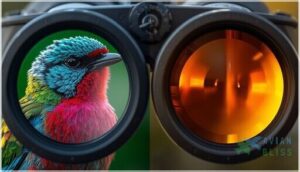
Not all lens coatings treat color the same way. Some manufacturers apply tinted coatings that filter specific wavelengths, while others prioritize neutral transmission to preserve what you actually see in the field.
Your choice between these approaches directly affects whether you’re viewing accurate colors or a modified version of reality.
Neutral Coatings Vs. Tinted Options
You’ll choose between two fundamental coating philosophies that define optical quality: neutral systems that preserve true color accuracy, and tinted options that manipulate the spectrum for specific effects. Neutral multicoated lenses transmit red, green, and blue light evenly, maintaining visual comfort and image sharpness across all conditions.
Here’s what each approach delivers:
- Neutral coatings reach 90-95% light transmission while keeping grass, sky, and animal fur looking exactly as your naked eye sees them.
- Tinted coatings cut specific wavelengths, trading color accuracy for perceived contrast boosts or glare reduction in bright environments.
- Dielectric mirror coatings on roof prisms achieve over 99% reflectivity per bounce, supporting neutral rendering without sacrificing brightness.
- Simple coated systems with aggressive tints may only manage 70-76% transmission, visibly dimming your field of view.
- High-quality neutral systems minimize stray reflections through precise coating thickness and lens materials, sharpening detail without false color enhancement.
Birdwatchers and wildlife observers usually demand neutral options because plumage identification depends on matching field guide colors exactly.
Ruby and Blue Light Filtering Effects
While neutral systems preserve accuracy, ruby coatings and blue light filtering twist the spectrum to suit niche uses. Ruby tints block red wavelengths—sometimes dropping transmission from 88% to 75% in the 400–500 nm band—creating a blue-green cast that helps hunters spot game against foliage. Blue spectrum cuts reduce haze and boost perceived contrast, but push scenes toward yellow. Both sacrifice true color for task-specific gains.
| Coating Type | Color Shift Effects | Light Transmission Impact |
|---|---|---|
| Ruby Coatings | Blue-green cast, faded reds | 70–76% overall (dims view) |
| Blue Light Filtering | Yellow tint, warmer look | 75% in 400–500 nm band |
| Neutral Multi-Coat | No shift, true colors | 90–95% across spectrum |
| Heavy Ruby Tints | Washed-out, muted tones | Cuts red spectrum aggressively |
Choosing True-Color Coatings for Birdwatching
For birdwatching, you need binoculars that show plumage as your naked eye would—no yellow warmth, no blue tint. Fully multi-coated optics delivering 90–95% light transmission across 400–700 nm keep greens, browns, and buffs accurate. If you’re comparing models, this guide to binoculars for bird watching breaks down how ED glass and dielectric coatings affect color fidelity in real field conditions.
Dielectric-coated roof prisms maintain color balance better than basic aluminum mirrors, so subtle face patterns and wing bars stay sharp without artificial contrast tweaks distorting what you’re identifying.
Coating Quality and Binocular Performance
The materials and application methods used in lens coatings directly determine how well your binoculars perform in the field. Not all coatings deliver the same optical benefits, and understanding what separates adequate from outstanding can save you from buying equipment that underdelivers.
Here’s what you need to know about coating quality and how it translates to real-world image sharpness and value.
Common Coating Materials Like Magnesium Fluoride
Magnesium fluoride stands as the workhorse of binocular lens coatings because its refractive index of about 1.38 sits close to the ideal low value needed for anti-reflective thin films.
A quarter-wave layer roughly 0.145 micrometers thick on crown glass cuts surface reflection from 4 percent down to 1 percent in green wavelengths, making your coated or multi-coated optics noticeably brighter than bare glass.
How Coating Quality Affects Sharpness
High-end binocular lens coatings deliver sharper images by controlling phase correction in roof prisms, preserving micro contrast across fine details, and blocking stray light that softens edges.
Fully multi-coated optics with uniform dielectric layers maintain edge clarity from center to field boundary, while poor coating uniformity introduces focus shifts and veiling glare that rob your view of that crisp, etched sharpness premium glass provides.
Balancing Cost and Optical Value
You’ll see the biggest jump in optical performance moving from basic coated glass to a well-built, fully multi-coated midrange model—real-world light transmission climbs from around 80 to over 90 percent.
Premium features like dielectric mirror coatings push that figure only a few points higher, delivering subtle gains in micro-contrast that rarely justify cost efficiency tradeoffs for typical daytime use.
Frequently Asked Questions (FAQs)
Does anti-reflective coating affect vision?
Anti-reflective coatings dramatically improve visual acuity by reducing light scattering and boosting image sharpness.
You’ll notice better optical performance, less eye strain, and enhanced color perception—especially when viewing fine details in challenging conditions.
What does lens coating damage look like?
Damaged binocular lens coatings reveal fine scratches, peeling flaking zones, or crazing patterns that scatter light transmission.
These defects degrade visual clarity and optical performance, appearing as swirls, patchy colors, or hazy areas under reflected light.
Are lens coatings necessary?
Lens coatings are functionally necessary for serious binocular use. Without them, you’ll lose 35 to 50 percent of incoming light across multiple glass surfaces, creating dim, low-contrast images that fail in low-light conditions.
How to make binoculars less blurry?
Focus your central wheel properly, set the diopter for both eyes, twist eyecups to match your glasses.
Then clean any smudges—if blur persists, check lens alignment and coating quality for light transmission issues.
How do lens coatings affect binocular durability?
Protective layers with scratch resistance and hydrophobic coatings defend glass surfaces from abrasion, moisture, and contaminants.
Chemical durability and environmental resistance guarantee lens coating technologies maintain optical component quality, reducing maintenance needs over years of field use.
Can lens coatings be reapplied or repaired?
Recoating processes require stripping old layers and vacuum-chamber application—costly and risky for precision optics.
Factory service centers usually replace damaged elements rather than attempting coating restoration.
For inexpensive binoculars, replacement proves more economical than lens refurbishment.
Do coatings degrade over time with use?
Yes, coatings degrade gradually through cleaning wear, environmental exposure, and thermal cycling.
Modern multi-layer dielectric systems resist aging better than older magnesium fluoride, but visible signs like patchy reflections signal reduced light transmission over decades.
How to clean coated lenses without damage?
You’ll protect light transmission and optical coatings by following a strict order: blow away dust with a manual air blower, brush gently, then apply lens-safe solution to a microfiber cloth—never directly onto coated glass—before using gentle wipe techniques in circular motions.
Are waterproof coatings different from optical coatings?
Confusing waterproof with optical coatings is like mixing up your binocular’s raincoat with its eyeglasses.
Waterproof features seal the housing with O-rings, while optical coatings manipulate light transmission for enhanced image quality.
Conclusion
Think of coatings as the gatekeepers between your eye and the world—passive films that either squander photons or shepherd them through with precision. How binocular lens coatings affect image quality isn’t marketing theater; it’s measurable physics determining whether you catch subtle plumage detail at dawn or settle for muddy silhouettes.
Match coating architecture to your demands: fully multi-coated glass for serious observation, budget options when performance can yield to price. Your optics deserve intentional choices, not guesswork.
- https://www.bestbinocularsreviews.com/blog/optical-coatings-in-binoculars-an-analysis-of-performance-evolution-and-differentiation-07/
- https://shoptimeandoptics.com/pages/binocular-basics
- https://accurateoptics.wordpress.com/2024/06/12/what-are-the-differences-between-silver-coated-and-dielectric-coated-roof-prisms/
- https://imaging.nikon.com/sport-optics/guide/binoculars/technologies/technologies_07/
- https://optics4birding.com/pages/learn-about-optic-components-image-quality