This site is supported by our readers. We may earn a commission, at no cost to you, if you purchase through links.
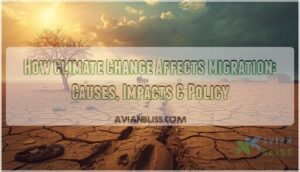
By 2050, the World Bank estimates that over 216 million people could be displaced within their own countries by climate change alone—not war, not political instability, but rising temperatures, failing harvests, and disappearing coastlines. That number doesn’t capture the full picture. It doesn’t account for the Malian pastoralists who’ve already abandoned centuries-old northern corridors, or the Central American farmers who’ve quietly traded seasonal harvests for dangerous irregular migration routes north.
Understanding how climate change affects migration means tracing these decisions back to their roots—droughts that don’t end, floods that arrive without warning, and cities straining under the weight of people who had nowhere else to go.
Table Of Contents
- Key Takeaways
- How Climate Change Alters Migration Patterns
- Environmental Drivers of Climate Migration
- Socioeconomic Impacts of Climate-Driven Migration
- Regional Hotspots and Migration Trends
- Policy Responses and Adaptation Strategies
- Frequently Asked Questions (FAQs)
- How does climate change affect migration?
- How does the environment influence migration?
- How does climate change connect to immigration?
- How many people have migrated because of climate change?
- How does climate migration differ from economic migration?
- What legal protections exist for climate migrants?
- Can climate migrants claim refugee status internationally?
- Which countries accept the most climate migrants?
- How do governments prepare for climate migration?
- How does climate migration affect mental health?
- Conclusion
Key Takeaways
- By 2050, over 216 million people could be displaced within their own countries by climate change alone, driven by droughts, rising seas, and failing harvests rather than conflict or political instability.
- Climate migration isn’t always sudden — slow-onset changes like desertification, sea level rise, and chronic drought quietly push families out season by season until returning home no longer makes sense.
- Current international law leaves climate migrants in a legal gray zone, since the 1951 Refugee Convention doesn’t recognize environmental displacement as grounds for protection.
- The communities hit hardest — including women, Indigenous groups, and low-income urban settlers — consistently receive the least protection, making climate justice an urgent gap in global policy.
How Climate Change Alters Migration Patterns

Climate change isn’t just shifting temperatures — it’s quietly reshaping where people go, how long they stay, and whether they can return.
For birds, the stakes are just as high — seagull migration patterns are shifting as the coastlines and climates they depend on continue to change.
The patterns that once guided migration decisions, from seasonal farmwork to long-term settlement, are being disrupted in ways that ripple across communities worldwide.
Here’s a closer look at how those shifts are playing out.
Shifts in Traditional Migration Routes
Across the Sahel, climate displacement isn’t just pushing people out — it’s redirecting entire routes people have followed for generations.
Pastoralists in Mali are bypassing northern corridors, while Central American farmers are swapping seasonal farm circuits for northbound irregular paths. These shifts in human migration and climate change impacts aren’t random.
Environmental refugees don’t choose new routes freely — collapsing resources and blocked passages leave little choice. Challenges such as climate migration in Mesoamerica illustrate how climate change can fundamentally reshape migration patterns.
Changes in Seasonal and Permanent Migration
When seasonal moves stop working, families face a harder choice. Climate refugees aren’t just shifting routes — they’re rethinking whether returning home makes sense at all. Repeated crop failures push seasonal shifts into permanent relocation.
In rural India, extreme heat makes long-term migration more likely than short seasonal trips. These evolving migration patterns reflect something deeper: adaptive strategies reshaping human migration one household at a time.
In regions like Central America, the complex effects of climate extremes and food insecurity also drive lasting migration decisions.
Influence on Urban Vs. Rural Migration
Where you land on the rural-to-urban spectrum increasingly depends on where climate change hits hardest. Rural exodus is reshaping human migration patterns as farming families lose reliable seasons and move toward cities seeking stability.
- Climate refugees often settle in informal urban settlements on flood-prone edges
- Urbanization trends accelerate when repeated droughts hollow out rural livelihoods
- Urban planning struggles to absorb sudden waves of climate migration
- Wealthier city residents move out while low-income migrants move in
Environmental Drivers of Climate Migration

When we talk about climate migration, it’s easy to focus on the people moving — but what’s actually pushing them out in the first place?
Behind every move is a mix of droughts, floods, and shifting seasons — the same forces explored in this look at how weather disrupts migration patterns.
The environmental forces behind displacement range from sudden, violent shocks to changes so gradual you almost don’t notice them until it’s too late.
Here’s a closer look at the key drivers forcing people to leave the only homes they’ve ever known.
Extreme Weather Events and Sudden Displacement
When a hurricane hits, you don’t get weeks to decide — you get hours. Rapid-onset events like floods and storms triggered 26.4 million internal displacement cases in 2023 alone.
These extreme weather events don’t just uproot families; they erase livelihoods overnight, sparking a humanitarian crisis that ripples far beyond the disaster zone.
| Disaster Trigger | Internal Movement Scale | Primary Livelihood Loss |
|---|---|---|
| Floods & Storms | Tens of millions annually | Crops, housing, tools |
| Tropical Cyclones | Hundreds of thousands per event | Fishing, coastal trade |
| Intense Rainfall | Localized but concentrated | Small businesses, livestock |
Slow-Onset Changes: Drought, Sea Level Rise, Desertification
Unlike a hurricane, drought doesn’t announce itself — it just quietly drains your options, season by season. Desertification, sea level rise, and chronic droughts are pushing climate refugees from their homes through slow, grinding environmental displacement rather than dramatic crisis. Coastal erosion swallows fishing grounds. Water scarcity dries up wells. Land degradation empties villages.
- Droughts kill harvests across consecutive seasons, making rural income impossible
- Desertification shrinks grazing land, forcing herders toward overcrowded towns
- Sea levels creep inland, turning farmland salty and unworkable
- Coastal erosion displaces younger adults to cities first
- Climate migration from these zones is rarely sudden — it’s a slow surrender
Resource Scarcity and Competition
When resources vanish, competition fills the void. Droughts and environmental degradation shrink water access and fertile land, turning neighbors into rivals.
Around Lake Chad, resource scarcity has fueled water wars and land grabs as fishers and farmers fight over what’s left. Food shortages follow close behind.
Without strong resource management and a commitment to environmental sustainability, climate change will keep rewriting competition dynamics — and displacing millions more.
Socioeconomic Impacts of Climate-Driven Migration
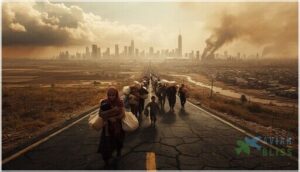
When people are forced to leave their homes because of climate change, the consequences don’t stop at the border crossing or the city limits. The ripple effects touch economies, communities, and the most vulnerable people in ways that are hard to untangle.
Here’s a closer look at what those impacts actually look like.
Economic Hardship and Livelihood Loss
When a single bad season can wipe out everything a family has built, climate migration stops being a choice and starts being survival. Rural job losses, fisheries decline, and food insecurity push millions into debt traps that only deepen over time.
- A 1% drop in agricultural productivity can nearly double emigration rates
- Coastal fishers lose gear, income, and options after stronger storms
- Families spend over half their income on food after crop failures
- Selling livestock or land erodes labor capacity permanently
- Social disruption breaks community safety nets, leaving everyone more exposed
Urban Overcrowding and Infrastructure Strain
When climate migration reshapes a city faster than its planners can respond, the cracks show everywhere. Informal settlements expand onto floodplains, housing crises deepen, and infrastructure strain becomes a daily reality.
In South Africa’s Gauteng region, 23% of households report frequent water interruptions — a telling sign of what urban overcrowding does to city governance and environmental degradation when migration patterns outpace infrastructure investment.
Vulnerable Populations and Inequality
Not everyone faces climate change on equal footing. Women, children, disabled people, and Indigenous communities carry the heaviest burdens in migration and displacement, yet receive the least protection. Climate refugees experiencing social exclusion rarely access basic human rights or fair vulnerability assessments.
Those who bear the heaviest burden of climate displacement receive the least protection
Climate justice demands we close these gaps — because gender inequality, disability rights, and child migration can’t be afterthoughts when lives are already on the move.
Regional Hotspots and Migration Trends
Climate change doesn’t hit every region the same way — some places are already living the climate crisis that others only read about.
Where you’re in the world shapes whether climate migration means crossing a border, moving to higher ground, or watching your coastal home disappear.
Here are three regions where these trends are playing out most visibly right now.
Climate Migration in Central America and The Caribbean
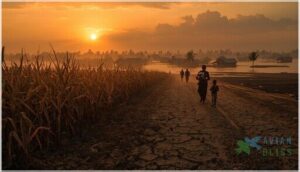
Few regions show the human cost of environmental change quite like Central America and the Caribbean. Dry Corridor farmers in Honduras, El Salvador, and Guatemala have watched repeated droughts hollow out harvests since 2014, pushing over 2.5 million into food insecurity. Caribbean storms like Hurricanes Maria and Dorian accelerated displacement dramatically.
Key pressures driving climate migration include:
- Sea level rise threatening coastal communities
- Natural disasters destroying homes and infrastructure
- Urban influx straining cities like Tegucigalpa
- Crop failures nudging families North permanently
Displacement in South Asia and Pacific Islands
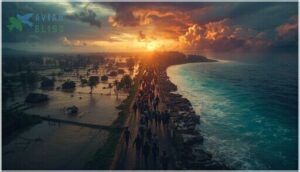
South Asia tells a similar story, just at a much larger scale. By 2050, up to 62 million people could be displaced by floods, cyclones, and coastal erosion across Bangladesh, India, and Pakistan.
Meanwhile, Pacific Island nations like Tuvalu and Kiribati face near-total loss to sea level rise — driving Pacific migration and sparking serious conversations about island relocation for climate refugees with nowhere left to go.
Africa’s Seasonal and Disaster-Induced Migration
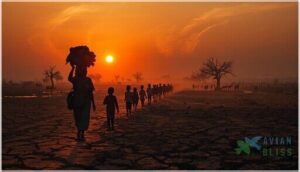
Africa’s story hits differently. Climate change has quietly unraveled centuries of Sahelian Routes, forcing herder mobility patterns south as rains grow shorter and less reliable. At the end of 2023, about 35 million people were internally displaced across the continent — flood displacements alone have increased sixfold since 2009.
Three realities define this crisis:
- Families losing their entire livelihood when droughts wipe out livestock overnight
- Environmental degradation pushing communities into cities with no safety net
- Climate migration turning survival strategies into permanent displacement
Policy Responses and Adaptation Strategies
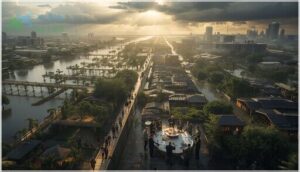
Knowing the problem is one thing—figuring out what to do about it’s another. Policies around climate migration are still catching up to the reality millions of people already face, but real solutions are starting to take shape.
Here’s a closer look at the key approaches guiding that response.
Gaps in International Protection for Climate Migrants
One of the starkest gaps in today’s migration policy is this: climate migrants don’t legally exist. The 1951 Refugee Convention‘s legal framework covers persecution, not rising seas or drought. That means climate refugees fall into a gray zone, with no guaranteed refugee protection or enforceable human rights and refugees safeguards.
| Challenge | Impact |
|---|---|
| No legal definition for climate migrants | Denied asylum claims |
| Non-binding international cooperation tools | Inconsistent state responses |
Planned Relocation and Community Adaptation
When legal frameworks fail you, communities often step up. Planned relocation, done right, isn’t just about moving people — it’s about rebuilding belonging. Fiji’s Vunidogoloa village moved together, keeping every family intact. That’s climate adaptation in action.
Five things that make relocation work:
- Early community engagement in every decision
- Securing land for farming, not just housing
- Infrastructure ready on day one
- Protecting social cohesion by keeping neighbors together
- Long-term adaptive governance support post-move
Role of International Cooperation and Governance
Behind every policy framework is a question of climate justice: who carries the burden, and who gets protection? Global governance tools like the Paris Agreement and Global Compact for Migration are trying to close that gap.
| Framework | Focus | Key Action |
|---|---|---|
| Paris Agreement | Climate Adaptation Strategies | Displacement task force |
| Global Compact | International Law & Human Rights | Safe mobility pathways |
| Nansen Agenda | Climate Refugees | Cross-border protections |
Frequently Asked Questions (FAQs)
How does climate change affect migration?
Climate change reshapes migration patterns by making once-stable homes unlivable. Environmental displacement, driven by floods, drought, and rising seas, forces human mobility on a massive scale — turning climate adaptation into survival.
How does the environment influence migration?
Your environment shapes where you can live, work, and thrive. When ecological disasters strike or environmental degradation erodes livelihoods, human mobility becomes less a choice and more a survival strategy driving migration patterns worldwide.
How does climate change connect to immigration?
Rising temperatures, extreme weather, and resource scarcity reshape human mobility worldwide, turning climate migrants into one of the fastest-growing populations.
Environmental displacement now drives migration patterns that no policy framework fully tackles yet.
How many people have migrated because of climate change?
Globally, disaster displacement triggered 6 million new internal movements in 2023 alone. Today, over 123 million people are forcibly displaced worldwide, with climate migrants representing a fast-growing share of that staggering total.
How does climate migration differ from economic migration?
Think of it like being pushed out of your home versus choosing to leave. Climate migration stems from environmental push factors — floods, drought, failed crops — while economic migration is driven by the pursuit of better wages or work opportunities.
What legal protections exist for climate migrants?
Legal protections for climate migrants remain limited. The 1951 Refugee Convention doesn’t recognize climate change as grounds for refugee status, leaving most climate migrants without formal protection under international law.
Can climate migrants claim refugee status internationally?
Under current refugee law, climate migrants can’t claim formal refugee status internationally. The 1951 Convention doesn’t recognize climate displacement, leaving millions in a legal gray zone without guaranteed international protection or climate asylum rights.
Which countries accept the most climate migrants?
The United States, Germany, Canada, France, and the United Kingdom accept the most climate migrants. The U.S. alone received more asylum applications in 2023 than all European OECD countries combined.
How do governments prepare for climate migration?
Governments prepare for climate migration through national adaptation plans, planned relocation frameworks, better data collection, and international cooperation — mapping climate risks and building policies that protect displaced communities before disaster strikes.
How does climate migration affect mental health?
Climate migration takes a serious psychological toll. Displacement, loss, and uncertainty drive anxiety, depression, and PTSD among climate migrants, with some displaced groups showing PTSD rates above 30 percent — a profound emotional distress that rarely gets enough attention.
Conclusion
Climate migration isn’t just a distant forecast—it’s already reshaping where millions call home. Understanding how climate change affects migration means recognizing that every drought, flood, and disappearing shoreline quietly rewrites someone’s future.
The policies we build today are the bridges displaced communities will cross tomorrow. You can’t outrun a rising tide with outdated frameworks, and the window for meaningful action won’t stay open forever.
The question isn’t whether to act—it’s whether we’ll act in time.
- https://www.scientificamerican.com/article/disasters-displaced-more-than-26-million-people-in-2023/
- https://pmc.ncbi.nlm.nih.gov/articles/PMC8208600/
- https://www.newscientist.com/article/2080502-sea-level-rise-may-displace-13-million-people-in-the-us-by-2100/
- https://www.migrationpolicy.org/article/climate-migration-101-explainer
- https://www.elibrary.imf.org/view/journals/001/2024/058/article-A001-en.xml