This site is supported by our readers. We may earn a commission, at no cost to you, if you purchase through links.
A warbler lands on your feeder for three seconds, then vanishes. Blink and you miss it—which, if you’ve ever tried catching birds on a regular camera, describes roughly 90% of your attempts.
They use passive infrared sensors to detect the heat signature of an approaching bird, then trigger the shutter in milliseconds—fast enough to catch a hummingbird mid-hover. Understanding how motion-activated bird cameras work helps you pick the right one and set it up where it’ll actually perform.
Table Of Contents
- Key Takeaways
- How Motion-Activated Bird Cameras Work
- Key Features of Motion-Activated Bird Cameras
- How Bird Cameras Transmit and Store Data
- Top 4 Motion-Activated Bird Cameras to Consider
- Frequently Asked Questions (FAQs)
- What triggers a trail camera to take a picture?
- Do motion detection cameras record all the time?
- Can motion sensors be fooled?
- Do bird cameras need Wi-Fi?
- How long do bird camera batteries typically last?
- Can bird cameras work in extreme cold temperatures?
- How do I attract more birds to my camera?
- Are bird cameras safe for birds health?
- Can multiple users access the same camera feed?
- Conclusion
Key Takeaways
- Motion-activated bird cameras use passive infrared sensors to detect a bird’s body heat, triggering the shutter in milliseconds — fast enough to freeze a hummingbird mid-hover.
- Trigger speed is a make-or-break spec: under 0.3 seconds catches the landing, but anything slower than 0.5 seconds and you’re just photographing an empty feeder.
- Built-in AI technology can identify thousands of bird species right on the device, so you don’t have to spend hours flipping through a field guide after every session.
- You don’t need Wi-Fi to get started — basic trail cameras save footage to an SD card, while smart feeders add live streaming, app alerts, and cloud backup when connectivity is available.
How Motion-Activated Bird Cameras Work
Ever wonder what’s actually happening inside that little camera box when a bird swoops in? These cameras are smarter than they look, using a handful of clever technologies working together behind the scenes.
From motion sensors to AI recognition, how bird cameras actually work is surprisingly fascinating once you peek under the hood.
Here’s a breakdown of the key mechanisms that make it all click.
Passive Infrared (PIR) Sensors and Heat Detection
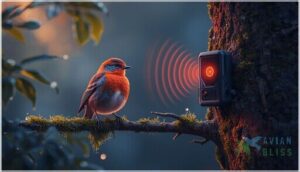
At the heart of every motion activated camera is a passive infrared sensor — basically a tiny heat detector. Birds are warm-blooded, so they naturally stand out against cooler backgrounds. When a bird hops into frame, its body heat triggers the sensor’s infrared sensing zone, crossing a thermal threshold and waking the camera up.
Proper sensor calibration keeps false triggers from wind or sunlight shimmer to a minimum. For additional techniques, strategic camera placement and calibration can substantially reduce false alarms.
Trigger Speed and Motion Detection Accuracy
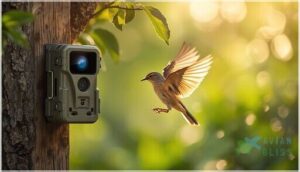
Once the PIR sensor catches that heat signature, trigger speed takes over — and it matters more than you’d think.
Motion activated bird cameras with speeds under 0.3 seconds catch birds mid-landing; anything above 0.5 seconds and you’re photographing an empty feeder. Adjusting motion sensor sensitivity helps cut down false triggers from swaying branches, keeping your detection zones focused on what actually matters.
At under 0.3 seconds, a bird camera captures the landing; above 0.5, it captures nothing
Understanding the significance of fast trigger speed for wildlife cameras can help you capture sharper, more reliable shots.
Daytime and Nighttime Recording Capabilities
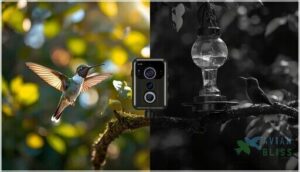
Fast trigger speed gets the shot — but what you actually see depends on your camera’s recording chops. During the day, motion activated cameras deliver high-quality video up to 4K, with 60fps smoothing out wingbeats beautifully.
At night, infrared LEDs handle complete darkness, while starlight sensors keep color night vision running at dusk. Automatic switching manages the shift seamlessly, so low light capture never misses a beat.
AI-Powered Bird Species Identification
Once your camera captures the shot, AI recognition takes over — and it’s honestly impressive. Tiny neural networks run image analysis right on the device, identifying birds in milliseconds.
Species databases cover over 6,000 birds, so whether it’s a familiar sparrow or a surprise visitor, bird classification happens fast. That’s AI-powered bird identification working quietly in the background, making motion-activated bird camera technology genuinely useful.
Key Features of Motion-Activated Bird Cameras
Not all bird cameras are built the same, and the right features can make a huge difference in what you actually capture.
Knowing which specs actually matter—like sensor size, burst speed, and autofocus tracking—helps you shop smarter, and this guide to top bird cameras for backyard watching breaks it all down clearly.
Before you buy, it helps to know what to look for so you’re not stuck with a camera that misses half the action. Here are the key features worth paying attention to.
Field of View and Placement Angle
Think of field of view like a window — too narrow and you miss half the action. Most motion activated cameras offer 120 to 170 degrees of field coverage, but around 135 degrees hits the sweet spot for bird tracking without distortion.
For frame optimization, mount your bird camera 1 to 3 feet from the feeder, angled slightly downward. That keeps your wildlife watching sharp and centered.
Weather-Resistant and Outdoor-Ready Design
Out in the wild, your camera takes a beating — rain, frost, blazing sun, and everything in between. That’s why weatherproof design isn’t optional; it’s survival gear for your setup.
Most quality outdoor camera systems use IP65 or IP66-rated weatherproof housing, rubber weather seals, and UV-resistant materials for serious outdoor durability.
- Waterproof materials block dust and resist low-pressure water jets
- Rubber gaskets and weather seals protect lens covers and card doors
- Thermal insulation liners keep electronics stable in freezing temps
- UV-stable plastics prevent cracking after months of sun exposure
- Moisture control via desiccant packs fights internal condensation
Power Source Options: Battery, Solar, and Wired
Behind every great bird shot is a power source you can actually count on. Here’s how your three main options stack up:
| Power Type | What to Expect |
|---|---|
| Battery Life | Weeks to months; 5200 mAh lasts ~3 months |
| Solar Panels | Solar Power tops up battery; near-indefinite runtime |
| Wired Systems | Constant 12V DC; ideal for busy feeders |
| Power Consumption | ~2W average; ~48Wh daily |
| Energy Efficiency | Solar Powered setups win long-term |
The information provided helps in understanding the different power options available for bird shots, including their expected performance and efficiency.
How Bird Cameras Transmit and Store Data
Once a bird triggers your camera setup, something pretty cool happens behind the scenes — the footage has to go somewhere fast.
Depending on your setup, that data travels through Wi-Fi, lands on an SD card, or heads straight to the cloud.
Here’s a look at the three main ways bird cameras handle all of that.
Wi-Fi Connectivity and Live Streaming
Most bird cameras use 2.4 GHz WiFi connectivity because it punches through walls and travels farther across your yard. That’s great news for Wi-Fi Range.
Open your app, and you’re watching live streaming footage in 1080p HD — feather detail and all. Signal Strength matters here, so check your bars where the camera sits. Weak signal means choppy Video Quality, but a mesh extender usually fixes that fast.
Local SD Card Vs. Cloud Storage
Your storage choices basically come down to two options: SD cards or cloud storage. Local SD cards are a one-time cost, hold up to 256 GB, and work without WiFi connectivity — solid for remote setups.
Cloud benefits include access anywhere and better data security if your camera gets stolen. Hybrid models give you both. Storage costs favor SD long-term, but cloud wins on convenience.
Mobile App Integration and Real-Time Notifications
Your phone becomes the command center the moment you connect a camera to its mobile app. You get real-time notifications with notification filters that separate bird activity from random motion, plus species tracking alerts naming exactly who dropped by.
Adjust push settings, tweak motion detection sensitivity, and tap into live streaming anytime. Some apps even sync with smart home devices — seriously convenient WiFi connectivity in one place.
Top 4 Motion-Activated Bird Cameras to Consider
With so many options out there, picking the right camera can feel like spotting a rare warbler — exciting but a little overwhelming.
The good news is that a handful of models consistently stand out for backyard birders and serious watchers alike. Here are four worth putting on your radar.
1. Netvue Smart Bird Feeder Camera
If you’re serious about backyard birding, the Netvue Birdfy is worth a close look. It shoots 1080p HD video, runs on solar power with a backup battery, and connects to your 2.4 GHz Wi-Fi so you can watch live from anywhere.
The built-in AI identifies over 6,000 species automatically — no guessing required. Its 135-degree wide-angle lens catches the whole feeding tray, and the IP65 weatherproof rating means rain won’t shut your setup down.
| Best For | Bird lovers and backyard enthusiasts who want a hands-off way to watch, identify, and learn about the birds visiting their feeder. |
|---|---|
| Resolution | 1080P |
| Motion Detection | Yes |
| Night Vision | Not specified |
| Connectivity | WiFi 2.4GHz |
| Waterproofing | Not weatherproof |
| Power Source | Solar + battery |
| Additional Features |
|
- AI identifies over 6,000 bird species automatically, so you don’t have to do any guesswork
- Solar-powered with a backup battery means it keeps running without you thinking about it
- Live 1080p video and instant notifications let you catch every visit, even when you’re away from home
- Only works on 2.4GHz Wi-Fi, so if your router pushes 5GHz, you may run into connection headaches
- The solar panel struggles in shady yards, which could leave the battery draining faster than expected
- Some of the best features are locked behind a paid subscription, so the upfront cost isn’t the whole story
2. KJK Trail Camera With Night Vision
Not every birder needs app connectivity and AI species ID — sometimes you just want a rugged camera that quietly does its job. The KJK Trail Camera is built for that.
It shoots 36MP stills and 2.7K video, and its 0.1-second trigger catches birds the moment they land. The 130-degree wide-angle lens covers your whole feeder setup, and the 22 infrared LEDs give you solid night vision out to 75 feet — all in an IP66 weatherproof body that laughs at rain.
| Best For | Birders and wildlife watchers who want a dependable, no-fuss trail camera without needing Wi-Fi or app setup. |
|---|---|
| Resolution | 2.7K |
| Motion Detection | Yes |
| Night Vision | 850nm LEDs, 75ft |
| Connectivity | No WiFi |
| Waterproofing | IP66 |
| Power Source | Batteries |
| Additional Features |
|
- 36MP stills and 2.7K video capture sharp, detailed shots of birds and wildlife
- 0.1-second trigger and 130° wide-angle lens means you rarely miss a moment at the feeder
- IP66 weatherproof build handles rain, dust, and tough outdoor conditions without complaint
- No Wi-Fi or app — you have to physically visit the camera to review footage
- IR night video can look a bit grainy, so low-light quality isn’t top-tier
- The SD card slot is awkwardly placed, and the included batteries tend to drain faster than you’d hope
3. GardePro WiFi Trail Camera
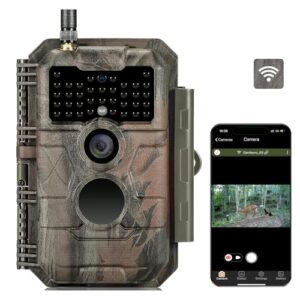
Want Wi-Fi without the complicated setup? The GardePro E6 hits a sweet spot. It shoots 48MP photos and 1296P HD video through a 110-degree wide-angle lens, so you’re catching the full feeder scene.
The no-glow 940nm infrared keeps nighttime birds completely unbothered. Connect via Bluetooth first, then flip to Wi-Fi for live view and quick file transfers — all within about 45 feet. Accommodates up to 512GB SD cards, so you won’t miss a moment.
| Best For | Bird watchers and wildlife enthusiasts who want easy Wi-Fi connectivity and sharp day-and-night footage without dealing with complex tech setups. |
|---|---|
| Resolution | 1296P HD |
| Motion Detection | Yes |
| Night Vision | 940nm IR |
| Connectivity | WiFi & Bluetooth |
| Waterproofing | Not specified |
| Power Source | 8xAA batteries |
| Additional Features |
|
- 48MP photos and 1296P HD video capture crisp, detailed shots day or night
- No-glow infrared keeps animals calm and unaware of the camera
- Supports up to 512GB SD cards so you never have to worry about running out of space
- Wi-Fi range tops out at 45 feet, so placement close to your home or base matters
- App connectivity can be sluggish, which gets frustrating when you want quick access
- No cellular option means you have to be nearby to pull footage or check live view
4. Harymor Smart Bird Feeder Camera
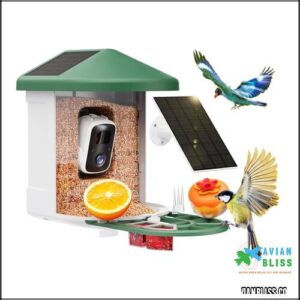
If the GardePro is the practical trail workhorse, the Harymor Smart Bird Feeder Camera (Model Q8) is more like your backyard’s personal wildlife studio. It streams 2K HD video through a 120° wide-angle lens, packs 3× digital zoom for feather-close detail, and runs on a 5200mAh solar-powered battery — so it keeps rolling even on cloudy days.
The IP65-rated housing laughs at rain. Pair it with the Vicohome app, and its AI identifies 10,000+ species with real-time alerts straight to your phone.
| Best For | Backyard bird lovers who want a hands-off, high-tech setup they can check from the couch — or share with the kids. |
|---|---|
| Resolution | 2K |
| Motion Detection | Yes |
| Night Vision | Not specified |
| Connectivity | WiFi |
| Waterproofing | Not specified |
| Power Source | Battery |
| Additional Features |
|
- 2K video with a wide-angle lens means you catch every visit, not just the ones you happened to be watching for.
- Solar-powered with a solid battery backup, so you’re not constantly swapping out batteries.
- AI that knows over 10,000 species is genuinely impressive — great for learning as you go.
- The full experience sits behind a subscription (~$4/month), which adds up over time.
- Only works on 2.4GHz Wi-Fi, so if your router’s finicky about that band, expect some headaches.
- AI ID isn’t perfect — you might get a wrong call now and then, especially with less common species.
Frequently Asked Questions (FAQs)
What triggers a trail camera to take a picture?
A trail camera fires when its PIR sensor detects a sudden heat change — like a warm bird passing a cooler background.
That temperature shift crosses a built-in threshold and boom, the shutter triggers.
Do motion detection cameras record all the time?
Not exactly. Most motion detection cameras take a little nap between visits — only waking up to record when a bird triggers the sensor, which saves battery life and storage space.
Can motion sensors be fooled?
Yes, motion sensors can be fooled. Wind-blown branches, sudden sunlight shifts, and insects near the lens all trigger false alerts.
On the flip side, birds moving directly toward the sensor may go undetected.
Do bird cameras need Wi-Fi?
Not always. Basic trail-style cameras record straight to an SD card — no Wi-Fi needed. Smart feeder cameras do require Wi-Fi for live streaming, phone alerts, and cloud backup.
How long do bird camera batteries typically last?
Battery life varies a lot. Budget cameras might last 7 days, while models like Birdfy claim up to 3 months. Lithium batteries and solar panels can stretch that even further.
Can bird cameras work in extreme cold temperatures?
Winter and bird cameras — a match made in, well, frozen frustration.
Most handle down to 14°F just fine, but premium models like Reconyx push to -40°F.
Use lithium batteries, and you’ll be golden.
How do I attract more birds to my camera?
Start with the right food. Black-oil sunflower seeds attract the widest variety of birds, while nyjer seed brings in finches fast.
Add a shallow birdbath nearby — moving water is basically a dinner bell for birds.
Are bird cameras safe for birds health?
Yes, bird cameras are generally safe for birds. The infrared light is diffuse, not a direct beam, so it won’t harm their eyes.
Motion detection is silent, causing little to no stress.
Can multiple users access the same camera feed?
Most bird cameras support multiple users at once. Apps like Birdfy let you invite 20+ friends to view the same feed from their own accounts — no password sharing needed.
Conclusion
Studies show motion-activated cameras capture up to 10 times more bird species than manual photography—because most birds don’t wait around for you to press a button.
Once you understand how motion activated bird cameras work, picking the right setup stops feeling overwhelming and starts feeling exciting. Match the sensor sensitivity to your target species, choose a power source that fits your setup, and let the camera do the patient waiting you never could.
- https://www.gearcheckers.com/en/trail-cameras/how-does-trail-camera-work/
- https://www.feathersnapcam.com/blog/post/how-smart-bird-feeder-cams-work
- https://soliom.net/blogs/tips/how-does-outdoor-motion-activated-cameras-work
- https://support.birdfy.com/help/birdfy-app/Introduction-BirdfyApp/
- https://hiicam.com/understanding-pir-imaging-in-hunting-cameras-how-it-works/