This site is supported by our readers. We may earn a commission, at no cost to you, if you purchase through links.
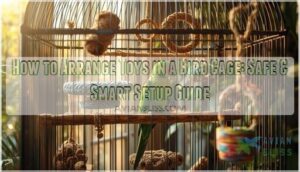
Most bird owners focus on which toys to buy, but where those toys go matters just as much. A cage packed with colorful distractions but no real logic behind the layout can stress a bird out rather than stimulate it.
Birds navigate their space instinctively—they forage low, climb high, and retreat to quiet corners when they need a break. When you arrange toys in a bird cage with those instincts in mind, you stop guessing and start giving your bird an environment that genuinely works.
The difference in engagement, confidence, and calm is noticeable within days.
Table Of Contents
Key Takeaways
- Where you place toys matters as much as which toys you choose, so map your cage into clear zones for play, rest, and feeding before hanging anything.
- Use vertical space on purpose — foraging toys go high, climbing structures in the middle, and calm visual toys lower down to match your bird’s natural instincts.
- Keep one-third of the cage open at all times, because a crowded cage creates stress instead of enrichment.
- Rotate about a third of the toys weekly and replace anything frayed, cracked, or loose right away to keep your bird both mentally sharp and physically safe.
Steps to Arrange Toys in a Bird Cage
Arranging toys in your bird’s cage isn’t just about filling space — it’s about creating a setup that keeps your bird safe, active, and mentally sharp. A few simple steps can make a big difference in how comfortable and engaged your bird feels every day.
Think of it as interior design for your bird — and this guide to setting up the inside of a bird cage walks you through exactly what to include and where.
Here’s how to get it right, from start to finish.
Assessing Your Bird’s Needs and Preferences
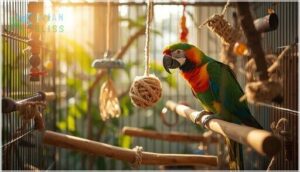
Every bird has its own personality, and understanding yours is the first step to a cage setup that truly works. Before buying a single toy, take time to observe your bird’s behavior. Notice what grabs its attention and what it ignores.
- Watch daily activity patterns for clues about preferences
- Research your species’ natural habitat and instincts
- Note whether your bird favors climbing, chewing, or foraging
- Consider age, health, and temperament as environmental factors
- Log owner observations weekly to track what keeps engagement high
Planning Cage Zones for Play, Rest, and Feeding
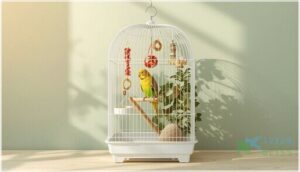
Once you know what makes your bird tick, you can start putting that knowledge to work by carving the cage into clear zones for play, rest, and feeding. Smart cage layout means your bird always knows where to go. Think of it like arranging a small apartment — every corner has a purpose.
| Zone | Purpose | Placement |
|---|---|---|
| Play | Toy distribution and activity | Top third of cage |
| Rest | Privacy and comfort | Back corner, lower perch |
| Feeding | Food and water access | Mid-level, near front |
This zone creation keeps bird behavior predictable and reduces stress, making your overall cage organization much easier to manage.
Positioning Toys at Various Heights
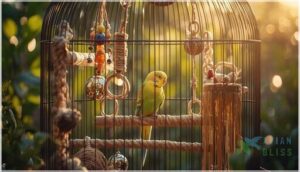
With your cage zones mapped out, the next step is thinking vertically — because where you hang each toy matters just as much as which toys you choose. Height variation in toy placement transforms your bird cage setup into a vibrant environment. Use vertical space intentionally — top for play, middle for climbing structures, lower levels for calmer visual stimulation.
- Place foraging toys up high to spark natural curiosity
- Hang climbing structures mid-cage so your bird builds confidence daily
- Position visual stimulation toys at eye level for maximum engagement
- Use toy rotation at different heights to keep things feeling fresh
- Let cage organization reflect your bird’s natural instinct to explore every level
Ensuring Clear Movement Paths
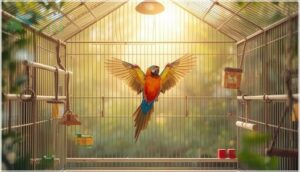
All those carefully placed toys won’t do your bird much good if there’s no room left to actually move around. Think of your bird cage toy placement like a flight path optimization plan — keep the central area open as an unobstructed landing zone.
Your bird needs wing span clearance to hop, glide, and stretch freely. Smart space optimization and clear pathways make every cage arrangement safer and more enjoyable.
Securing Toys Safely to Prevent Accidents
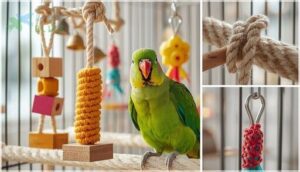
A loose toy clip or frayed knot might seem like a small thing, but for your bird, it can turn an afternoon of play into a dangerous situation fast. Good fall prevention starts with tight, secure connections.
A quick daily scan for wear—guided by safe bird toy and accessory tips—can catch small risks before they become serious ones.
Check your toy anchor systems weekly and match toy tethering hardware to your cage bar spacing. Accident proofing your cage setup means your bird plays safely every time.
Best Practices for Toy Placement
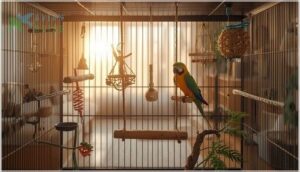
Once the basics are in place, how you position each toy makes a real difference in your bird’s daily life. Small decisions — like where a swing hangs or how much open space you leave — add up fast.
Here are the best practices to keep in mind as you set things up.
Avoiding Overcrowding and Ensuring Free Space
Too many toys crammed into one cage isn’t enrichment — it’s chaos, and your bird feels every bit of it. Cage size should guide your toy density from the start. Leave clear pathways so your bird can move without bumping into things. A good rule: one-third of the space stays open.
Prioritize multifunctional accessories and use vertical space wisely to optimize bird comfort without sacrificing freedom.
Grouping Similar Toys for Mental Stimulation
Think of your bird’s cage as a classroom — every corner should teach something different. Grouping bird toys by function creates Stimulation Zones that support Cognitive Development naturally.
Treat your bird’s cage like a classroom where every corner teaches something new
- Cluster foraging toys for species-specific problem-solving
- Group puzzle toys using Material Variety — wood, acrylic, sisal
- Arrange shredding toys in one dedicated section
- Use Toy Clustering near perches for easy access
- Tailor zones to your bird’s natural behaviors
Smart cage setup makes avian enrichment straightforward.
Rotating Toys to Prevent Boredom
Even the best bird toys lose their magic if they stay in the cage too long. Using smart Toy Rotation Schedules keeps Novelty Stimulation high and boredom low. Swap one-third of your bird toys weekly — daily for high-energy species like conures.
Bird Behavior Analysis guides your Rotation Frequency: watch for feather plucking or restlessness. Gradual Toy Introduction Strategies prevent stress, supporting real avian enrichment and mental stimulation.
Placing Toys Near Perches for Easy Access
Your bird’s perch is home base, so placing toys within easy reach turns every rest stop into a chance to play. Smart Perch Toy Placement creates Easy Access Zones your bird will actually use.
Follow these four tips for a better cage setup:
- Position bird toys within one beak-length of perches
- Create Toy Height Variations so your bird explores naturally
- Keep Cage Navigation Paths clear for confident movement
- Match Bird Climbing Structures to your bird’s behavior
Done right, your bird won’t have to think twice.
Using Vertical Space for Hanging and Climbing Toys
Most bird owners never look up — and that’s exactly where the best opportunities for enrichment are hiding. Your bird cage has vertical real estate that most setups completely waste. Use Toy Suspension hooks and Hanging Swings along the top third, and add Climbing Structures along the sides for natural movement.
| Vertical Zone | Toy Type | Purpose |
|---|---|---|
| Top third | Hanging Swings, bells | Active play |
| Middle section | Vertical Toys, ladders | Climbing Structures |
| Lower area | Foraging toys | Calm exploration |
Smart Space Optimization in your cage setup and design keeps your bird moving — and happy.
Top 5 Bird Cage Toys for Enrichment
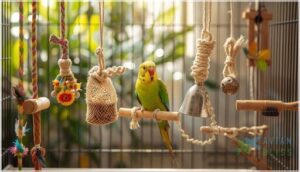
Not all bird toys are created equal, and the right ones can make a real difference in how happy and healthy your bird stays. Some toys check multiple boxes at once — foraging, climbing, chewing, and relaxing — all in one cage setup.
Here are five enrichment toys worth adding to your bird’s space.
1. FlidRunest Bird Foraging Mat Toy
The FlidRunest Bird Foraging Mat pulls double duty as a climbing surface, resting spot, and feeding station all in one. Made from artificial grass and natural hemp rope, it measures 9.4 x 9.4 x 17.3 inches — roomy enough for parakeets, cockatiels, and sun conures to explore freely.
You can hang it at mid-cage height to encourage natural foraging behavior. Just monitor it closely, since the grass fibers can loosen over time and pose a choking risk if swallowed.
| Best For | Bird owners with small parrots like parakeets, cockatiels, or sun conures who want to add more enrichment and activity to their cage setup. |
|---|---|
| Material | Artificial Grass, Hemp |
| Bird Compatibility | Parakeets, Cockatiels, Conures |
| Installation | Hooks, adjustable height |
| Entertainment Value | Foraging and climbing |
| Ease of Cleaning | Difficult to clean |
| Weight | 0.13 kg |
| Additional Features |
|
- Keeps birds busy with foraging, climbing, and chewing all in one spot
- Easy to hang and adjust to the right height in the cage
- Works as a feeding station too — just tuck treats into the grass
- The fake grass can loosen over time and become a choking hazard
- Hard to clean, so it may need replacing more often than you’d like
- Too bulky for smaller cages and not sturdy enough for larger birds
2. Natural Wood Bird Playground Toy
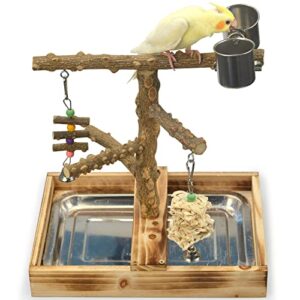
If you want something that does a little more heavy lifting, the Natural Wood Bird Playground Toy is worth a close look. It measures 13.5 x 9.5 x 13.5 inches and comes with stainless steel cups, a copper bell, corn husks, and a bird stand — all packed into a compact activity center.
It’s built for parakeets, cockatiels, and conures, and the removable tray makes cleanup straightforward. Just check the screws regularly, since they can loosen with active birds over time.
| Best For | Small to medium bird owners who want an all-in-one activity center that’s easy to clean and move around the house. |
|---|---|
| Material | Natural Wood, Stainless Steel |
| Bird Compatibility | Parakeet, Parrot, Cockatiel, Budgie |
| Installation | Easy assemble/disassemble |
| Entertainment Value | Activity center with toys |
| Ease of Cleaning | Removable tray |
| Weight | 2 lb |
| Additional Features |
|
- Comes with everything included — stainless steel cups, copper bell, corn husks, and a bird stand right out of the box
- Removable tray makes cleanup quick and painless
- Lightweight and easy to take apart, so you can move it from room to room without any hassle
- The wood is pretty soft, so determined chewers can shred it fast
- Screws tend to loosen over time, which can make the whole thing feel wobbly
- The metal food and water containers have sharp edges that may need some attention before use
3. Bird Cage Fruit And Vegetable Feeder
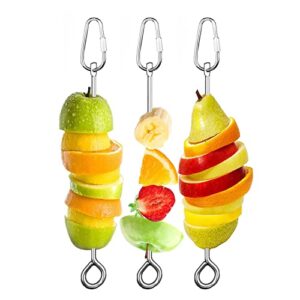
Feeding time can double as enrichment — and that’s exactly what the Suplklz Bird Cage Fruit and Vegetable Feeder does well. The 9-inch stainless steel skewer holds carrots, kale, bell peppers, and more, giving your bird a reason to work for its food.
It’s made from safe 304 stainless steel, hangs anywhere in the cage, and comes in a 3-pack. Just note that the clip can be fragile, so check it often.
| Best For | Bird owners who want to turn mealtime into a fun foraging activity for parakeets, budgies, macaws, and similar species. |
|---|---|
| Material | Stainless Steel |
| Bird Compatibility | Parakeets, Budgies, Macaws |
| Installation | Hangs on cage bars |
| Entertainment Value | Foraging behavior |
| Ease of Cleaning | Rinse before use |
| Weight | 0.06 kg |
| Additional Features |
|
- The 9-inch skewer holds a good amount of fruits and veggies — carrots, kale, bell peppers, you name it.
- Made from safe 304 stainless steel, so no worrying about harmful materials near your bird.
- Comes in a 3-pack and hangs anywhere in the cage, which makes it super easy to set up.
- The cage clip feels flimsy and can break with regular use, so keep an eye on it.
- The screw gate doesn’t open very wide, which can make attaching it to thicker cage bars a bit of a hassle.
- Some birds just won’t engage with it — a little patience (and maybe some trial and error) may be needed.
4. Bird Playground For Top Of Cage
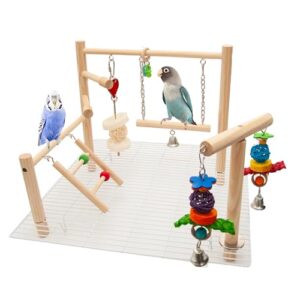
While a feeder skewer keeps your bird busy inside the cage, sometimes you need to expand their world beyond those bars. That’s where the Wondwo Bird Playground comes in.
It mounts directly on top of the cage, turning unused space into a full activity zone. Made from FSC certified wood with food-grade coloring, it’s safe for chewing and climbing.
It fits most standard cages and works well for parakeets and cockatiels — just make sure your cage roof is flat.
| Best For | Bird owners with parakeets, cockatiels, or similar mid-sized birds who want to give their pet more space to play and climb outside the cage. |
|---|---|
| Material | Metal, Plastic, Wood |
| Bird Compatibility | Parrots, Cockatiels |
| Installation | Mounts on cage top |
| Entertainment Value | Multiple perching and toys |
| Ease of Cleaning | Easy to maintain |
| Weight | 14.72 oz |
| Additional Features |
|
- Made from FSC certified wood with food-grade coloring, so it’s safe even for curious chewers
- Mounts on top of the cage to create extra play space without taking up room in your home
- Toys are replaceable, so the playground stays fresh and engaging over time
- Needs a flat cage roof to install properly, so it won’t work with every setup
- Some users had issues with the screws and washers, and assembly may need a power screwdriver
- Perches may be too large for very small birds
5. Colorful Bird Toy Hammock Set
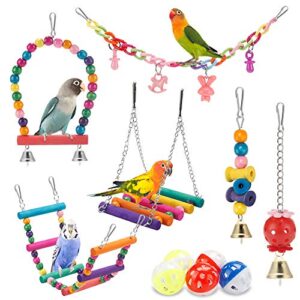
Rest isn’t just downtime for birds — it’s when they feel safe enough to thrive. The Colorful Bird Toy Hammock Set gives your bird exactly that kind of comfort.
Made from non-toxic cotton and polyester with bird-safe dyes, it comes in small, medium, and large sizes to fit finches up to macaws. Dangling bells and hidden treat pockets add play value beyond just lounging.
It clips on in seconds and washes easily, making it a practical addition to any setup.
| Best For | Bird owners who want to keep their small feathered friends entertained, active, and mentally stimulated throughout the day. |
|---|---|
| Material | Natural Wood |
| Bird Compatibility | Small Bird Species |
| Installation | Hooks on cage top |
| Entertainment Value | Swings, ladders, chewing |
| Ease of Cleaning | Easy to clean |
| Weight | 10.86 oz |
| Additional Features |
|
- 11-piece set gives your bird plenty of variety — swings, ladders, hammocks, and chew toys all in one package
- Made from natural wood with edible color dye, so it’s safe for curious beaks
- Easy to hang and swap out, with simple hooks that attach right to the cage top
- A few users have questioned the safety of the dyes, so it’s worth keeping an eye on your bird at first
- May feel a bit small if you have a larger cage setup
- Some owners found the toys wore down faster than expected with heavy chewers
Safety and Maintenance Tips for Bird Toys
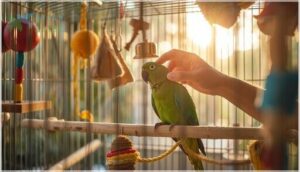
Keeping your bird’s toys safe isn’t just a one-time task — it’s an ongoing habit that protects your bird every single day. A little routine care goes a long way in preventing accidents, illness, and boredom.
Here’s what you need to know to keep things clean, safe, and working the way they should.
Choosing Non-toxic and Bird-safe Materials
Not all bird toys are created equal — and the wrong material can quietly put your bird at risk. Stick to bird safe woods like pine, balsa, or manzanita, and choose non toxic plastics made from food-grade acrylics.
For eco friendly options, 100% cotton or sisal rope works well. Smart material selection is the foundation of real pet safety and security.
Inspecting and Cleaning Toys Regularly
Even the safest toy can become a hazard if you’re not keeping a close eye on it. Build a simple cleaning schedule — wipe down pet toys weekly and disinfect bird toys every two weeks using a bird-safe solution.
During each session, do a quick toy inspection: check for fraying, cracks, or buildup. Consistent bacterial control keeps your bird cage setup hygienic and your bird healthy.
Replacing Damaged or Worn Toys
A cracked perch or fraying rope might look minor, but to your bird, it’s an accident waiting to happen. Regular damage inspection is the backbone of smart cage maintenance. During your checks, watch for:
- Splintered wood or sharp edges
- Frayed or knotted rope ends
- Loose or broken parts on pet toys
- Discoloration that signals failed toy sanitizing
Don’t hesitate — swap it out immediately for bird safety.
Storing Unused Toys Properly
Most bird owners focus so much on what’s inside the cage that they forget good toy storage outside of it’s just as important for keeping things safe and ready to use. Keep unused toys in a dry area maintenance spot — a sealed bin works well.
Follow basic sanitation methods before storing: wipe down each piece, let it air dry completely. This assists your toy rotation schedules and simplifies cage maintenance and cleaning whenever you’re ready to swap things out.
Frequently Asked Questions (FAQs)
How many toys should be in a bird cage?
For most pet birds, three to five toys strike the right balance of play variety and open space. Too many toys crowd the cage setup and cause stress, while too few limit bird enrichment and pet stimulation.
How to organize a bird cage?
Organizing a bird cage can feel like a million-piece puzzle, but it doesn’t have to be.
Focus on cage layout, Bird Behavior, and Toy Rotation to create a smart, stress-free space your bird will love.
How often should I replace my birds toys?
Replace toys as soon as you spot cracks, fraying, or sharp edges.
For bird enrichment and cage hygiene, swap out worn pieces every four to six weeks, even if they look fine.
Can birds share toys with other pet birds?
Yes, birds can share toys, but don’t rush it. Toy Hygiene matters with Shared Play — clean everything between uses.
Watch Flock Dynamics closely, since Bird Compatibility affects whether Shared Play fosters Bird Socialization or causes stress.
What toys are best for anxious or shy birds?
Soft, gentle playthings work best for anxious or shy birds. Focus on calming toys like small swings, cozy hammocks, and soothing objects made from natural materials.
These support anxiety reduction and shy bird stimulation without overwhelming your pet.
How do I know if my bird dislikes a toy?
Watch your bird’s body language closely. Toy rejection signs include ignoring it completely, showing fear, or moving away.
Trust your pet observation skills — avian preferences vary, and bird behavior rarely lies.
Conclusion
A thoughtful layout does more than fill space—it speaks your bird’s language. When you learn how to arrange toys in a bird cage with zones, height variation, and clear pathways, you’re not just decorating. You’re designing a world your bird can actually live in.
Watch how quickly confidence replaces restlessness when the environment finally makes sense to them. Small, intentional changes in placement can turn a cage into a place your bird genuinely thrives.