This site is supported by our readers. We may earn a commission, at no cost to you, if you purchase through links.

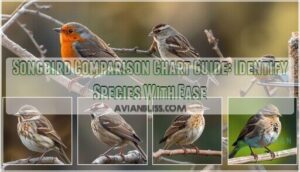
Two brown birds land ten feet apart. Both have streaked breasts, similar size, and nearly identical posture. One is a Song Sparrow. The other is a Lincoln’s Sparrow. Miss the subtle buffy wash on the breast or the fine streaking pattern, and you’ve missed the ID entirely.
This scenario plays out constantly in the field, where dozens of species share overlapping ranges, similar habitats, and frustratingly alike appearances. Learning how to distinguish between similar bird species transforms these moments from guesswork into confident identification. The difference lies in knowing exactly where to look and what specific features separate one species from another.
Table Of Contents
- Key Takeaways
- Key Features for Distinguishing Similar Birds
- Using Behavior and Habitat for Identification
- Identifying Birds by Plumage and Age Variations
- Leveraging Bird Vocalizations for Species ID
- Tools and Techniques for Accurate Bird Comparison
- Overcoming Common Challenges in Bird Identification
- Frequently Asked Questions (FAQs)
- Can Google Lens identify birds?
- Can I use AI to identify a bird?
- What is the best way to identify birds?
- How do juveniles differ from adult plumage?
- What lighting conditions affect field mark visibility?
- Can hybrids be reliably identified in the field?
- How do worn feathers change identification clues?
- What role does molt timing play in identification?
- Conclusion
Key Takeaways
- Master bird topography terminology and focus on specific field marks like eye rings, wing bars, and tail patterns to separate lookalike species with precision rather than relying on vague impressions.
- Use behavior and habitat as identification filters before examining plumage—foraging style, flight patterns, and microhabitat preferences often reveal identity faster than visual marks alone.
- Account for plumage variations across seasons, ages, and sexes since the same species transforms appearance throughout the year, creating false matches with entirely different birds.
- Practice systematic observation by forcing yourself to articulate three separating features between similar species before declaring an identification, building recognition through repeated field experience rather than memorization.
Key Features for Distinguishing Similar Birds
When two birds look nearly identical at first glance, you need a systematic way to tell them apart. Learning to spot key physical features turns confusing observations into confident identifications.
A guide to identifying birds with similar appearances helps you focus on subtle differences in plumage, behavior, and habitat that separate lookalike species.
Focus on these four fundamental characteristics that separate similar species in the field.
Importance of Bird Topography and Anatomy
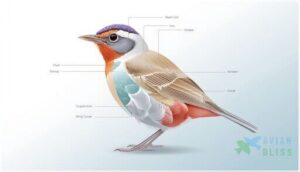
Bird topography gives you a shared language for pinpointing what you see. Instead of vague notes, you’ll use precise terminology like crown, supercilium, or coverts to describe field marks. This framework links colors to specific feather grouping and skeletal structure, letting you compare morphological differences across similar species. Understanding bird anatomy transforms guesswork into systematic identification. Details such as are especially critical when distinguishing between species that appear similar in the field.
- Topography maps body regions, creating consistent comparison points
- Precise terminology eliminates confusion when describing subtle differences
- Feather grouping reveals patterns on primaries, secondaries, and coverts
- Skeletal structure shapes proportions like neck length and chest depth
- Standard vocabulary connects your field notes to guide descriptions
Recognizing Field Marks (Eye Rings, Wing Bars, Etc.)
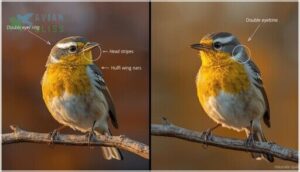
Once you know where to look, field marks become your fastest identification tool.
Eye rings separate Nashville Warblers from similar species with a bold white circle. Wing bars appear as horizontal stripes on folded wings, instantly distinguishing two-bar warblers from plain ones.
Head stripe types—supercilium, eyeline, malar—cut through confusion among brown sparrows. Tail marks flash in flight, revealing outer feather patterns.
Combine multiple plumage patterns for confident calls. Understanding the importance of bird anatomy zones is key for observing these field marks accurately.
Assessing Size, Shape, and Proportions
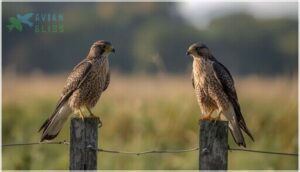
Beyond field marks, study a bird’s overall outline to separate lookalikes at a glance. Compare body proportions against familiar species—is it sparrow-sized or robin-bulky? Notice head-to-body ratio: Cooper’s Hawks show larger heads than Sharp-shinned Hawks. Check wing length against tail tip. Posture matters too—upright flycatchers contrast with horizontal warblers.
Master these size and shape cues through relative comparisons in mixed flocks.
Evaluating Bill and Tail Differences
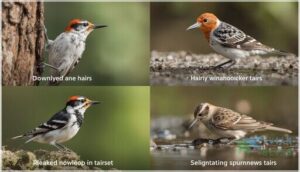
Shape and length of the bill reveal how a bird feeds. Finches crush seeds with short, thick bills, while sandpipers probe mud with long, slender ones. Compare Downy and Hairy Woodpeckers—Hairy bills nearly match head length; Downy bills stay much shorter.
Tail shape matters equally: notice whether edges end square, graduated, or forked to separate wrens from sparrows at a glance.
Using Behavior and Habitat for Identification

Field marks and plumage aren’t the whole story. Watch how a bird moves through its environment, note where it chooses to spend time, and track when it appears throughout the year.
Apps like Merlin Bird ID help you identify bird habitats by sound, adding another layer to your field observations beyond visual cues alone.
These behavioral and habitat clues often seal the deal when two species look nearly identical.
Identifying Birds by Foraging and Flight Patterns
Watching how a bird moves often reveals its identity faster than plumage alone. Use these foraging strategies and flight patterns to separate lookalikes:
- Ground foraging styles: Robins run and pause on lawns, while towhees double-scratch leaf litter with both feet at once.
- Tree trunk foraging: Creepers spiral upward using stiff tails; nuthatches move headfirst downward.
- Aerial chases: Swallows swoop low over fields; swifts feed constantly at higher altitudes with crescent-shaped wings.
- Flight rhythm: Finches show bounding, rollercoaster paths; sparrows fly more directly with rapid continuous wingbeats.
- Landing behavior: Song Sparrows brake with tail-forward swoops; House Sparrows flap rapidly and stall into perches.
Behavior and movement become your sharpest tools once you recognize these distinctive feeding habits and wing shape differences.
Role of Habitat Preferences and Geographic Range
Before field marks, filter your species list by habitat and range—you’ll cut out dozens of lookalikes instantly. Use habitat preferences and geographic range together to rule out birds that never appear locally. Similar species often split by microhabitat specialization: one favors forest canopy, another stays in dense understory within the same woods.
| Habitat Type | Example Species Pair | Range Boundary Effects |
|---|---|---|
| Forest canopy vs. understory | Blackburnian vs. Black-throated Blue Warbler | Microhabitat separation within overlapping range |
| Freshwater vs. saltwater marsh | Similar herons/egrets | Contact zone hybrids form where wetland types meet |
| Island endemics vs. mainland forms | Island warbler vs. continental cousin | Narrow geographic range limits island species entirely |
Habitat specificity and habitat and range analysis let you anticipate which contact zone hybrids might appear where ranges meet, especially along coastlines or river valleys.
Seasonal Occurrence and Migration Clues
During migration, seasonal timing separates similar birds more reliably than field marks alone. Many confusing warblers pass through on tight schedules, often just one or two weeks apart in spring.
Check these migration patterns:
- Peak passage dates for shorebirds differ by species at key stopover sites
- Climate shifts advance arrival dates, altering traditional overlap windows
- Geographic range boundaries funnel migrants along predictable corridors
Stopover ecology reveals habitat and range analysis: coastal scrub concentrations signal active migration rather than local breeding.
Identifying Birds by Plumage and Age Variations

Plumage changes throughout the year and differs between ages and sexes, creating one of the trickiest challenges in bird identification. A bird you saw in spring may look completely different by fall, and males often display patterns that females and juveniles don’t share.
Recognizing these variations will help you avoid misidentifying the same species multiple times.
Recognizing Seasonal Plumage Changes
Many birds grow bright breeding plumage in late winter or early spring, then molt into duller nonbreeding plumage by late summer. Watch for these seasonal plumage variations, as feather wear and plumage cycles transform familiar species. Note how Scarlet Tanagers shift from striking red to greenish-gold, while Common Loons trade bold checkered patterns for plain gray-brown winter tones.
| Species | Breeding Plumage | Nonbreeding Plumage |
|---|---|---|
| Scarlet Tanager | Red body, black wings | Green-gold overall |
| Common Loon | Black-and-white checkered | Gray-brown and white |
| Yellow-rumped Warbler | Vivid blues, blacks, whites | Brownish with yellow patches |
Recognize that plumage patterns change through molt patterns and seasonal colors, making age variations easier to track when you observe the same site across months.
Sex-Based Color and Pattern Variations
Males and females often differ dramatically through sexual dichromatism, where bright colors in one sex contrast with muted tones in the other. Observe how male Northern Cardinals show vivid red while females wear warm brown with reddish hints.
Pattern variance matters too—male warblers display bolder face masks and breast streaks than females. Recognize these plumage variations to separate sexes and avoid confusing them with different species entirely.
Leveraging Bird Vocalizations for Species ID

When two birds look nearly identical, their songs and calls often hold the answer. Learning to recognize these sounds sharpens your identification skills and helps you confirm species in seconds.
This section covers why vocalizations matter, which tools help you learn them, and how to compare sounds among lookalike birds.
Importance of Calls and Songs
When visually identical species share plumage and structure, vocalizations and calls become your most reliable tool for audio identification. Song patterns and call variations let you identify birds by ear, especially when foliage hides plumage or distance obscures field marks.
Vocal identification of birds through bird communication unlocks species that behavior and appearance alone can’t separate. Vocal learning transforms how you distinguish songs and calls in the field.
Tools and Apps for Learning Bird Sounds
Sound identification has transformed how you learn bird vocalizations. The Merlin app features a real-time listening tool that separates multiple songs at once, while the BirdNET app analyzes audio recordings through spectrogram analysis to identify over 6,000 species globally.
Both bird identification apps pair playback with visual spectrograms, helping you connect each species’ pitch patterns and trills with what you hear in the field.
Comparing Vocalizations Among Similar Species
Apps give you spectrograms, but real vocal identification of birds requires direct comparisons. Listen for pitch patterns between White-throated and Golden-crowned Sparrows—one holds steady notes while the other steps down. Focus on these features when applying bird vocalizations:
- Frequency analysis reveals 1-3 kilohertz shifts separating similar species
- Timbre differences distinguish smooth from rough-sounding bird calls
- Note shapes and syntax variations follow fixed, species-specific orders
- Rhythm differences separate faster from slower phrase delivery
- Vocalization analysis of contact and alarm calls often outperforms song comparisons
Tools and Techniques for Accurate Bird Comparison

You can’t reliably identify birds by memory alone. Field guides, apps, and cameras turn fleeting glimpses into clear comparisons you can study at your own pace. The right tools make the difference between guessing and knowing what you saw.
Utilizing Field Guides and Standardized Vocabulary
A well-organized field guide transforms confusing sightings into confident species accounts. Look for guides that group similar birds together, label field marks with standardized vocabulary like “supercilium” and “malar stripe,” and include range maps. Mastering ornithological terminology lets you compare species systematically. Use the glossary to learn shape terms—chunky, slender, long-winged—and color descriptors such as rufous or slate for precise identification techniques.
| Guide Feature | What to Look For | Why It Helps |
|---|---|---|
| Visual Index | Silhouettes and color groups | Jump quickly to likely sections |
| Species Accounts | Plumage, voice, behavior details | Compare multiple ages and sexes |
| Topography Diagrams | Labeled crown, mantle, wing coverts | Describe field marks accurately |
| Comparison Plates | Lookalikes side by side with arrows | Spot diagnostic differences fast |
Smartphone Apps and Digital Photography
Modern smartphone apps and digital photography now enhance what your field guides teach. Merlin Bird ID analyzes uploaded photos with machine learning trained on millions of images, while its Sound ID feature displays real-time suggestions as multiple species call.
Set your phone’s camera to high resolution and raise shutter speed to freeze wingbeats. Digiscoping methods pair your phone with a spotting scope, turning distant raptors into detailed portraits you can compare at home.
| Tool Category | Recommended Feature |
|---|---|
| Photo ID Apps | Crop images to isolate field marks |
| Sound ID Tools | Download offline regional packs |
| Camera Settings | Boost ISO in dim forest light |
Overcoming Common Challenges in Bird Identification

Even experienced birders mix up similar species—it’s part of the learning curve. The real advancement comes when you know which field marks cause the most confusion and how to adjust your approach.
Focus on these three strategies to tackle identification challenges head-on.
Differentiating Frequently Confused Species
Many identification puzzles arise because certain avian lookalikes share broad coloration yet differ in subtle field marks. Focus on these details to separate similar species:
- Bill variations separate Downy from Hairy Woodpeckers—note bill length against head size.
- Feather patterns on outer tail feathers reveal black spots on Downies, pure white on Hairies.
- Beak shapes distinguish seed crackers from insect probers.
- Wing tips and bar counts split confusing warblers.
- Tail feathers show length differences between wrens.
Tips for Side-by-Side Comparisons
Use structured checklists that order field marks from size and shape down to fine plumage details for comparative bird identification. Review field guide side panels that group confusion species together, then compare range maps to rule out birds absent from your region.
Crop photos to the same frame height so distinguishing similar species becomes easier—subtle tail length and wing shape differences stand out clearly.
Developing and Practicing Observation Skills
Repeatedly scanning each bird from head to tail sharpens your focused attention and locks in field marks before the moment passes. Practice visual drills by listing three features from memory after brief sightings, then confirm them with field guides.
Keep detailed notes on size judgment, bill shape, and bird topography to polish observation habits.
Return to familiar spots often—consistent field observation skills build species recognition faster than chasing rarities ever will.
Visiting the same locations repeatedly sharpens your bird identification skills faster than chasing rare species
Frequently Asked Questions (FAQs)
Can Google Lens identify birds?
Yes, Google Lens can identify birds from photos with decent accuracy—often 78 percent under ideal conditions—but it makes geographic errors and ignores seasonal range, so cross-check results with dedicated birding apps.
Can I use AI to identify a bird?
Before you could telegraph a sighting, AI bird ID tools like Merlin use machine learning and deep learning for image analysis and bird recognition by sound, delivering instant suggestions using field marks and bird identification techniques.
What is the best way to identify birds?
Field marks like eye rings and wing bars paired with bill shape, tail features, and behavior form your foundation.
Master bird topography terms, then practice comparing plumage patterns across similar species regularly.
How do juveniles differ from adult plumage?
Watch a young Bald Eagle—it leaves the nest in all-dark feathers, gaining the crisp white head years later.
Juvenile plumage shows duller colors, streakier markings, softer feather quality, and lighter soft part colors than adults.
What lighting conditions affect field mark visibility?
Sun angle and light intensity dramatically alter field mark visibility. Low sun enhances texture through shadow effects, while harsh midday light washes out wing patterns.
Overcast skies reveal subtle plumage variations better than bright conditions.
Can hybrids be reliably identified in the field?
Hybrid detection through visual cues alone proves unreliable in most cases. Genetic testing offers species verification, yet field identification remains a best guess when plumage mimicry blurs boundaries between pure birds and genetic variation.
How do worn feathers change identification clues?
Worn plumage fades bright field marks, erodes wing bars, and blunts feather edges. Abrasion shifts blacks to grays, removes streaks, and alters structural shapes, so seasonal and age variations blur distinctions between similar species.
What role does molt timing play in identification?
Molt timing places each bird within its annual cycle, revealing aging birds through seasonal and age variations.
Molting patterns, plumage wear, and molt limits provide comparative identification clues when geographic range and similar species overlap.
Conclusion
Test this approach in the field tomorrow: choose two similar species and force yourself to articulate three separating features before declaring an ID. You’ll discover that learning how to distinguish between similar bird species isn’t about memorizing everything—it’s about training your eye to ask the right questions.
Each observation sharpens that skill. The streaked sparrows that once looked identical will soon reveal themselves as distinct, recognizable individuals you can name with certainty.
- https://www.allaboutbirds.org/news/bird-id-skills-field-marks/
- https://mdc.mo.gov/discover-nature/activities/birdwatching/identifying-birds
- https://daretobird.blogspot.com/2017/08/how-to-get-good-at-bird-identification.html
- https://mdbirds.org/young-birders/birding-basics/bird-identification/
- https://www.aba.org/field-identification-of-subspecies/