This site is supported by our readers. We may earn a commission, at no cost to you, if you purchase through links.
A birdbath sitting in full afternoon sun turns into a petri dish faster than most people expect—green water within a week, a film of biofilm within two, and suddenly your backyard oasis looks more like a neglected fish tank.
The culprit isn’t laziness. It’s placement, materials, and a few biological forces working against you around the clock.
Bird droppings spike nitrogen levels, fallen leaves leach tannins, and stagnant warm water practically rolls out the welcome mat for mosquito larvae. The good news? Keeping birdbath water clean naturally comes down to a handful of smart habits that work with nature instead of against it.
Table Of Contents
- Key Takeaways
- Why Birdbath Water Gets Dirty
- Place The Birdbath Strategically
- Change Water Before Problems Start
- Clean The Basin Naturally
- Use Natural Algae Prevention Tools
- Choose Materials That Stay Cleaner
- Frequently Asked Questions (FAQs)
- How do you keep the water in a bird bath clean?
- How often should a bird bath be cleaned?
- Can bleach be used to clean a bird bath?
- How do you prevent algae growth in a bird bath?
- Why put tennis balls in bird bath?
- Can I use Dawn to clean a bird bath?
- Can enzyme cleaners replace manual scrubbing entirely?
- How do aquatic plants help filter birdbath water?
- Are UV sterilizers safe for backyard birdbaths?
- How do you winterize a birdbath naturally?
- Conclusion
Key Takeaways
- Placing your birdbath in partial shade and at least 10–15 feet from feeders is one of the most effective things you can do to slow algae growth and reduce contamination.
- Changing the water every one to two days — and daily during summer heat — keeps mosquito larvae, bacterial buildup, and algae from ever gaining a foothold.
- A weekly scrub with diluted white vinegar or a baking soda paste cleans the basin safely without exposing visiting birds to harmful chemical residue.
- Adding a small piece of copper pipe or a solar-powered bubbler gives you a simple, chemical-free way to discourage algae and keep water moving between cleanings.
Why Birdbath Water Gets Dirty
Birdbath water doesn’t stay clean on its own — a few common culprits work against you every single day. Understanding behind the mess makes it a lot easier to stay ahead of it.
Knowing what stirs up the mess is half the battle — the other half is setting up your birdbath the right way from the start.
Here’s what’s actually going on in that basin.
Sunlight, Heat, and Algae Growth
Sunlight is basically algae’s best friend.
When your birdbath sits in full sun, water temperatures can climb into the 24–32°C range where algae thrive. That warmth accelerates diurnal rhythm cycles, boosts nutrient release from evaporation concentration, and ramps up temperature-dependent algae growth, fast.
High light intensity combined with heat can turn clean water green within five to seven days.
Leaves, Seeds, Feathers, and Droppings
Algae isn’t the only problem. Leaves, seeds, feathers, and droppings all work against your bird bath maintenance routine every single day.
Decaying leaf litter releases tannins that stain water brown. Seeds from nearby feeders sink and trap bacteria. Feathers collect oils and dust. And bird droppings? They spike nitrogen levels, fueling algae fast.
A simple debris removal habit keeps all of it in check.
Stagnant Water and Mosquito Breeding
Still water doesn’t just grow algae — it rolls out the welcome mat for mosquitoes. A birdbath left untouched for even a week gives larvae enough time to complete development, thanks to temperature-driven growth in warm weather.
Daily water flushing to reduce algae spores also disrupts mosquito egg viability before breeding starts. water movement to deter algae and mosquitoes is your simplest, chemical‑free fix.
Following CDC guidance, weekly removal of standing water helps break the mosquito breeding cycle.
How Dirty Water Affects Bird Health
Dirty water isn’t just unpleasant — it’s genuinely dangerous for the birds visiting your yard.
Algal toxins build up in bird tissues, stressing the liver and kidneys over time. Bacterial infections from Salmonella or E. coli spread fast through shared water.
Add parasite transmission from Giardia, heavy metal exposure, and immune suppression, and a neglected birdbath becomes a quiet health hazard.
A neglected birdbath quietly becomes a health hazard, exposing birds to parasites, toxins, and immune damage
Place The Birdbath Strategically
Where you put your birdbath matters more than most people realize. The right spot can slow algae growth, cut down on debris, and make birds feel safe enough to actually use it.
Here’s what to think about before you set it down.
Why Partial Shade Slows Algae

Think of shade as a slow switch for algae. Water in full sun can climb to 35°C — warm enough to double algae’s growth rate.
Partial shade keeps temperatures lower, boosting higher dissolved oxygen and encouraging microbial competition that crowds out green growth.
Shorter daylight exposure also means reduced nutrient release from debris. Following a regular water replacement schedule further limits algae buildup.
- Cooler water slows temperature-dependent algae growth considerably
- Shaded baths need 30–50% fewer deep cleanings per season
- Dappled light cuts the lower photosynthetic rate algae can exploit
Keeping Distance From Feeders
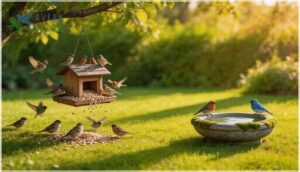
Your feeder and birdbath shouldn’t be neighbors. Droppings, spilled hulls, and seed debris travel fast — and when birds hop directly from feeding to bathing, contamination sources follow them.
Feeder spacing guidelines recommend at least 10–15 feet of separation. That gap reduces disease transmission reduction substantially, since salmonella spreads quickest when birds move between stations without a buffer.
| Distance | Contamination Risk | Bird Behavior |
|---|---|---|
| Under 5 ft | High | Stressed, crowded |
| 5–10 ft | Moderate | Some separation |
| 10–15 ft | Low | Calmer, diverse species |
Proper placement of bird baths away from feeders helps territorial behavior separation too — quieter baths attract species that feeders’ dominant birds crowd out.
Avoiding Trees That Drop Debris
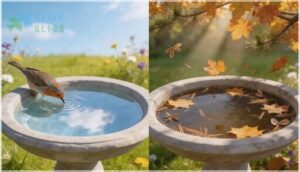
Trees look inviting beside a birdbath, but the wrong ones turn it into a debris trap fast. Maples, sweet gums, and pines constantly shed leaves, needles, and seed clusters — filling your basin between cleanings.
Bird bath placement guidelines exist for good reason.
Worst offenders nearby:
- Box elders dropping papery samaras
- Pines shedding needles year-round
- Cottonwoods losing branches after rain
Move bird bath away from trees and bird feeders, favoring low‑debris trees instead.
Choosing a Level, Sheltered Spot
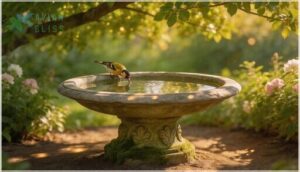
A wobbly birdbath is an invitation for trouble.
Level Ground is your starting point — a stable base prevents cracks and keeps water depth consistent all around. Slight Tilt of one to two degrees helps drain splashed water away from the edge.
Wind Shielding matters too. shaded spot with partial shade and sunlight reduction keeps water cooler and cleaner longer.
Providing Nearby Cover for Birds
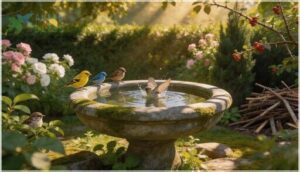
Birds won’t linger at a bath that feels exposed. Give them an escape route and they’ll visit far more often.
- Place dense shrubs within 10–20 feet for quick cover retreats
- Use thorny underbrush to deter ground predators naturally
- Add evergreen screening for year-round shelter, especially in winter
- Stack brush piles nearby as multi-level hiding spots for fledglings
Change Water Before Problems Start
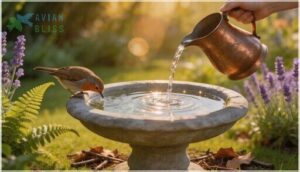
Dirty water doesn’t announce itself — it just quietly becomes a problem. The good news is that staying ahead of it takes less effort than cleaning up after it.
Here’s what actually matters.
How Often to Refresh Water
A good seasonal refill cadence keeps things simple: change bird bath water 2 to 3 times a week as your baseline. That’s your temperature threshold rule — once conditions warm up, shorten the interval.
Shade exposure timing matters too. A shaded bath enjoys a natural algae lag period compared to one baking in full sun.
Regular maintenance schedules like this genuinely reduce disease risk.
Daily Changes in Hot Weather
When summer hits its midday heat peak, 2–3 times weekly aren’t enough. Temperature-dependent algae growth kicks into overdrive once the morning temperature rise warms your water past comfortable levels. Daily water flushing to reduce algae spores becomes your best move during a hot afternoon.
- Dump and refill every morning before the day heats up
- Add fresh water again after the midday heat peak passes
- Watch for the evening cooling trend — cooler water stays cleaner overnight
- Account for rapid water evaporation by checking levels twice daily
- Use humidity swings as your cue — muggy days breed algae faster
Removing Debris During Each Refill
Each refill is a chance to reset. Before pouring, scoop out leaves and feathers using the Scoop Net Technique — a quick pass with a fine mesh cover or net. Then use the Side Pour Method: pour slowly along the basin edge to avoid stirring settled debris. Rubber gloves and a scrub brush handle the stubborn bits.
| Debris Type | Removal Approach |
|---|---|
| Floating leaves | Scoop net or cup |
| Settled sediment | Tilt-and-pour technique |
| Feathers/twigs | Hand-pick before refilling |
| Pollen/fine particles | Mesh cover + wipe rim |
Your Bird-Safe Tool Selection matters too — avoid metal scrapers that scratch surfaces and invite more debris accumulation over time.
Ideal Water Depth for Backyard Birds
Depth matters more than most people realize.
Most songbirds want just 1 to 2 inches — shallow enough to stand, splash, and feel safe. Species-specific depth preferences vary: chickadees love a shallow splash zone near the edge, while robins can handle a 2-inch center.
safety slope and shallow edge design let every visitor wade in comfortably on their own terms.
When Weather and Bird Traffic Matter
Weather changes the math quickly.
A rainy afternoon brings rainfall dilution but also runoff that shifts water pH.
Humidity biofilm creeps onto surfaces above 70 percent.
During the morning bird rush, concentrated bird droppings can sour water within hours.
Wind-driven debris piles up faster than you’d expect.
Temperature swings, sunlight versus shade, and temperature-dependent algae growth all signal when it’s time to refresh sooner.
Clean The Basin Naturally
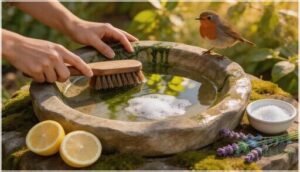
Changing the water often is a great habit, but the basin itself needs attention too. Grime, algae, and bacteria cling to surfaces even after you rinse them out.
clean your birdbath naturally, without harsh chemicals.
Emptying and Rinsing The Bath Fully
Start with drainage techniques before anything else. For lightweight baths, simply tip the basin sideways and pour out the residual water in one motion.
Heavier models need a bucket or siphon.
Debris removal comes next — hand-pick leaves and feathers, then flush sediment with a pressure hose. Multi-cycle rinsing until runoff runs clear keeps residue out.
Sun-dry drying for an hour finishes the job cleanly.
Scrubbing With Water and a Brush
Once the bath is empty, grab a stiff nylon scrub brush — bristle stiffness matters here, since soft bristles won’t lift embedded algae. Warm water around 40°C improves your cleaning ratio by loosening organic film fast.
Apply moderate pressure control using circular strokes, focusing on stained spots first.
This simple brush-and-water pass takes care of most buildup between your weekly vinegar scrub sessions.
Using Vinegar for Deep Cleaning
When the scrub brush isn’t enough, a weekly vinegar scrub does the heavy lifting. Mix a vinegar cleaning solution at a 1:9 dilution ratio, put on your protective gloves, and pour it in.
Let it soak for 15 to 30 minutes — the soak duration breaks down mineral deposits and algae film. Surface compatibility is excellent on ceramic and glazed basins. Rinse completely before refilling.
Using Baking Soda on Stubborn Stains
Baking soda is your quiet workhorse for hard water stains. Mix three parts baking soda to one part water for paste application, then work it into the basin using gentle circular motion — that abrasive action lifts mineral buildup without scratching.
Let the stain dwell for 15–30 minutes. Always test colorfastness on a small spot first.
Chemical-free cleaning doesn’t get simpler.
Rinsing Thoroughly Before Refilling
Rinsing feels like the boring part — but skip it and you’re just topping off a problem. After scrubbing, use a gentle hose spray to flush every corner; a small brush treats stubborn edges with the corner brush technique.
Do a quick drainage check, then rinse the basin with cool water. Refill the basin with water only once it smells clean.
Natural Cleaners to Avoid Using in Water
Not everything labeled "natural" is bird-safe — some well-meaning choices can backfire.
- Citric acid and lemon juice cause Citric Acid Risks like etching metal finishes and corroding stone.
- Essential oils trigger Essential Oil Irritation in sensitive respiratory systems.
- Hydrogen peroxide leaves Hydrogen Peroxide Residues that irritate skin and eyes.
Stick to white vinegar, baking soda, copper pennies, and simple organic cleaning methods.
Use Natural Algae Prevention Tools
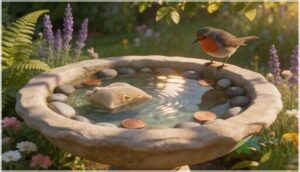
Cleaning your birdbath is only half the battle — keeping it clean between scrubs is where these tools earn their place. A few simple additions can slow algae, cut debris, and reduce how often you’re out there with a brush.
Here’s what actually works.
Solar Fountains, Bubblers, and Drippers
A solar bubbler does more than look pretty — it’s one of the smartest chemical-free cleaning tools you can add to your setup. Solar powered water features run without wiring or chemicals, and panel orientation toward direct sun keeps the pump running consistently. Choose your flow patterns based on bird size and noise control needs.
| Feature | Benefit |
|---|---|
| Solar fountain | Continuous water circulation |
| Battery capacity | Cloudy-day operation |
| Dripper nozzle | Gentle, low-splash flow |
| Bubbler head | Natural cleaning agitation |
| Seasonal performance | Year-round algae deterrence |
How Moving Water Limits Buildup
Still water is basically an open invitation for algae. Moving water changes that quickly.
Gentle Surface Ripples from a solar bubbler break algae’s grip before it settles. Low Current flow from a dripper keeps particles suspended. Bubble Aeration and Water Motion Oxygenation discourage mosquito larvae from taking hold.
Active Flow — even minimal — means adding water movement to deter algae and mosquitoes without a single chemical.
Mesh Covers for Debris Control
mesh cover is your bath’s first line of defense. Fine mesh blocks leaves, seed hulls, and feathers before they break down into algae-feeding sludge. Look for UV-Resistant Fabric with Ripstop Reinforcement and an Elastic Hem Design for snug, gap-free fit and sizing. Wind Anchoring straps keep it centered during gusts.
| Feature | Benefit | Best For |
|---|---|---|
| Elastic Hem Design | Stays snug on rim | Debris accumulation control |
| UV-Resistant Fabric | Won’t degrade in sun | Year-round bird bath maintenance |
| Ripstop Reinforcement | Resists tearing in wind | Organic matter buildup prevention |
Copper Pieces Vs Copper Pennies
Not all copper is equal.
Pre-1982 copper pennies work because they’re 95% copper — releasing enough copper ions to inhibit algae growth.
Post-1982 pennies? Mostly zinc with a thin copper plating, so their ion release rate is too low to matter.
A small piece of copper pipe is the better natural biocide — more surface area, faster patina formation, better cost efficiency, zero chemical-free cleaning tradeoffs.
The Myth of The “magic Coin”
Here’s the honest truth: dropping a copper coin into your birdbath feels satisfying, but it rarely delivers. Copper ion concentration has to reach a meaningful threshold to hit algae inhibition limits — and a single coin can’t get there.
Coin age impact matters too; zinc toxicity concerns rise with post-1982 pennies. Chemical-free cleaning and regular water changes outperform any coin-based algae prevention every time.
Safe Ways to Reduce Stagnation Naturally
Stagnant water is the real enemy here — and you don’t need chemicals to fight it. A few smart habits go a long way:
- Add a solar bubbler for gentle water circulation
- Use biodegradable enzymes and beneficial bacteria treatments
- Try plant filtration with a small water lily
- Position the bath in partial shade
- Do a weekly vinegar scrub to reset the basin
Choose Materials That Stay Cleaner
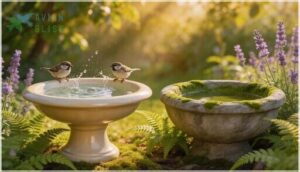
The material your birdbath is made from matters more than most people think.
Some surfaces practically invite algae, while others stay cleaner with far less effort.
Here’s what you need to know before choosing — or upgrading — yours.
Why Non-porous Surfaces Are Easier
Smooth texture isn’t just pretty — it’s practical.
Nonporous bath materials like glazed ceramic or enameled metal give algae nowhere to grip, which means easy rinsing with just water and minimal scrubbing. Fewer microbial hotspots form because bacteria can’t hide in tiny surface cracks. You also get better stain resistance and longer longevity, making chemical-free cleaning the norm, not the goal.
Concrete Vs Plastic Vs Metal
Each material has its trade-offs.
A concrete bird bath stays heavy and stable — great for Weight Stability — but its porous surface fights you every cleaning session and cracks under freeze-thaw cycles, hurting Winter Durability.
Plastic bird baths are lightweight and budget-friendly, but tip easily in wind.
Metal bird baths resist cracking and rinse clean fast, making chemical-free cleaning methods for bird baths genuinely simple.
How Thermal Mass Affects Algae Growth
Think of your birdbath as a slow cooker. Materials with high thermal mass — like concrete — absorb heat gradually and release it slowly, so water stays warmer longer.
That Surface Temperature Lag extends the window for temperature-dependent algae growth well past midday.
In a Shallow Basin, this Material Heat Capacity matters enormously.
High Heat Retention and Thermal Inertia quietly feed algae between cleanings.
Which Materials Stay Cooler Longer
Light hue matters more than you’d think. A pale ceramic or glazed basin reflects sunlight rather than drinking it in, keeping water cooler through lower material conductivity and reduced heat retention.
Plastic with insulation thickness built in also performs well. Metal heats fastest. Reflective coatings on light-colored metal split the difference.
Cooler water means slower temperature-dependent algae growth — simple physics working in your favor.
Best Birdbath Materials for Easy Upkeep
Glazed ceramic surface tops the list — sealed, smooth, and quick to wipe down. Resin crack resistance makes it a smart pick for cold climates. Stainless steel longevity speaks for itself.
Lightweight plastic design wins on portability, though UV-stable coating matters if you want it to last.
When weighing plastic vs concrete bird baths, concrete stays cooler but needs more scrubbing.
Frequently Asked Questions (FAQs)
How do you keep the water in a bird bath clean?
Keep it simple: change the water every one to two days, give the basin a quick vinegar scrub weekly, and add a small copper piece to slow algae naturally.
How often should a bird bath be cleaned?
Clean it at least once a week — more in summer heat. Rainfall-triggered cleaning, migration season timing, and UV exposure intervals all shift that schedule.
Your best cue? If it looks off, it’s time.
Can bleach be used to clean a bird bath?
Yes, but carefully. A 1:9 chlorine bleach solution works well. Rinse until the chlorine fumes are completely gone. Residue removal matters — leftover bleach harms birds fast.
How do you prevent algae growth in a bird bath?
Shade is your first line of defense. Morning sun with afternoon shade slows algae considerably.
Change water every two to three days, scrub weekly with vinegar, and add a copper piece for natural inhibition.
Why put tennis balls in bird bath?
A floating tennis ball does old-fashioned work in modern birdbaths. It manages ice disruption, surface agitation, temperature buffering, debris collection, and acts as a bird visual cue — all chemical-free.
Can I use Dawn to clean a bird bath?
Dawn works in a pinch. Use a tiny amount, scrub the basin, then rinse until there’s zero soap residue left. Any leftover film can disrupt feather oil and irritate birds.
Can enzyme cleaners replace manual scrubbing entirely?
Enzyme cleaners handle biofilm digestion well, but they can’t remove mineral deposits or heavy debris. You still need to scrub. Think of them as helpful maintenance, not a full replacement.
How do aquatic plants help filter birdbath water?
Aquatic plants pull excess nutrients straight out of the water. Their roots trap sediment and feed good bacteria.
Fewer nutrients mean less algae — and cleaner, safer water for every bird that visits.
Are UV sterilizers safe for backyard birdbaths?
Yes — UV sterilizers are completely safe for backyard birdbaths. They use UV light disinfection with no chemical residue, leaving water clean and healthy.
It is a solid choice for chemical-free cleaning that promotes bird health without compromise.
How do you winterize a birdbath naturally?
Winter care for outdoor bird baths starts with seasonal drainage before the first freeze.
Use an insulated cover for heat retention, a bird-safe heater, or a solar heated bird bath to manage frozen water naturally.
Conclusion
Who knew a birdbath could be such a drama queen? Yet here we’re outsmarting algae and mosquitoes with simple science.
By placing it wisely, cleaning water regularly, and using vinegar or baking soda instead of chemicals, you’ve turned a petri dish into a lifeline.
Moving water and smart materials keep things spotless without constant scrubbing. The payoff? Birds thrive, and your oasis stays inviting.
Mastering how to keep birdbath water clean naturally isn’t just maintenance—it’s a quiet act of care that ripples through your whole backyard.
- https://www.audubon.org/magazine/why-you-should-keep-your-birdbath-clean
- https://www.sacramentoaudubon.org/news/birdbath-tips-help-wild-birds-by-creating-a-clean-water-source-in-your-yard
- https://www.reconnectwithnature.org/news-events/the-buzz/how-to-take-care-of-a-birdbath/
- https://www.countryliving.com/gardening/a65091407/summer-birdbath-maintenance-tips/
- https://bird-watching.co.uk/how-to-stop-algae-in-a-bird-bath-effective-garden-tips-for-the-uk/