This site is supported by our readers. We may earn a commission, at no cost to you, if you purchase through links.

Most binoculars spend their first hour out of the box frustrating their new owners. You peer through the lenses, twist the focus wheel, and still get nothing but blur—or worse, a doubled image that makes your eyes ache within minutes. The problem isn’t the equipment. It’s that proper focusing requires adjusting three separate mechanisms in a specific sequence, and the instruction manual probably glossed over half of them.
Once you understand how the central focus wheel, diopter adjustment, and interpupillary distance work together, you’ll transform those expensive optics into the sharp, comfortable viewing tool they were designed to be. The entire calibration process takes about two minutes when you know the right steps.
Table Of Contents
Key Takeaways
- Most binocular frustration comes from not adjusting three mechanisms in sequence—the central focus wheel, diopter adjustment, and interpupillary distance—which takes only two minutes once you understand the proper order.
- You must set the interpupillary distance first by flexing the barrels until you see one round circle instead of two, then adjust eyecup height based on whether you wear glasses, before touching any focus controls.
- Focus by closing your right eye and using the central wheel for the left eye first, then close your left eye and rotate the diopter ring on the right barrel until both eyes see clearly together—this eliminates the vision difference between your eyes.
- Record your personalized diopter setting and interpupillary distance with tape or a photo because these values stay constant for you, letting you skip the calibration process on future outings.
Key Parts Involved in Binocular Focusing
Before you can bring distant views into sharp focus, you need to know which parts of your binoculars actually do the work.
Understanding how focal length affects your binocular’s performance helps you pick the right pair for spotting birds in dense woodland settings.
Each component plays a specific role in delivering that crystal-clear image you’re after. Let’s break down the four key pieces that control your binocular focusing so you can use them with confidence.
Keeping those lenses spotless with a quality binocular cleaning kit ensures every adjustment you make delivers the sharpest view possible.
Objective Lenses and Eyepieces
Think of your binoculars as a light-gathering system with two critical players: the objective lenses at the front that capture incoming light from your target, and the eyepieces at the back where your eyes receive the magnified image. Understanding the importance of optical performance is essential for selecting the right binoculars.
The objective lenses determine how much light enters your system, directly affecting image brightness and clarity. Larger objective lenses collect more light, giving you better views in dim conditions. The eyepieces magnify what those lenses capture, working with lens coating and optical quality to deliver sharp, color-accurate images to your eyes.
Understanding how magnification and objective lens size work together helps you choose binoculars that match your viewing needs without sacrificing brightness or stability.
Central Focus Wheel
Your central focus wheel sits on the hinge bridge between the eye tubes, and it’s your primary focus mechanism for sharp images. Turning it clockwise reduces focal length, bringing closer objects into view, while counterclockwise extends it for distant targets. The wheel adjusts both eyepieces simultaneously, working alongside diopter settings for precision tuning.
Here’s what you need to know:
- Smooth rotation indicates proper optical alignment and maintenance
- Stiffness signals lubrication or mechanical issues requiring attention
- The wheel controls interpupillary distance positioning during adjustment
- Regular wheel calibration ensures consistent eye relief and clarity
- Combined with diopter settings, it delivers crisp, focused imagery
Diopter Adjustment
Your diopter adjustment sits on the right eyepiece—usually a ring or dial—and it compensates for vision differences between your eyes. This vision correction mechanism lets you fine-tune focus precision for each eye independently, delivering optical clarity once you’ve set your interpupillary distance.
Once you’ve dialed in both adjustments, protect that precision by maintaining your optics properly—budget-friendly birding binoculars under $300 often include lens cleaning kits to help you preserve clarity in the field.
Most binoculars offer a -5 to +5 diopter range, and proper diopter calibration prevents eye strain while sharpening eye alignment across your entire field of view.
Eyecups and Interpupillary Distance
Once you’ve dialed in your diopter adjustment, turn your attention to eyecup adjustment and interpupillary settings—they’re what truly lock in binocular alignment. Eyecups should be rolled down if you wear glasses, allowing proper eye relief so you see the full field without vignetting. Match the interpupillary distance between barrels to your pupil spacing for focus calibration that eliminates double vision.
- Roll eyecups down for eyeglass wearers to maintain correct eye relief distance
- Adjust barrel spacing until you see one sharp circle, not two overlapping images
- Misaligned interpupillary settings force your eyes to work harder, causing strain fast
Preparing Your Binoculars for Focusing
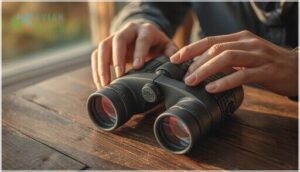
Before you can sharpen your view and lock onto distant details, your binoculars need a proper baseline setup. Think of this as laying the foundation—skip these adjustments, and even the best focus knob won’t give you the clarity you’re after.
Before you chase sharp focus, dial in the baseline—your binoculars won’t deliver clarity until the foundation is set
Here’s what you need to dial in first.
Setting Interpupillary Distance
Before you can sharpen your view, you need to match the binoculars to your face. Grab the barrels with both hands and flex them at the center hinge, moving the eyepieces closer together or farther apart until you see one perfectly round field instead of two overlapping circles.
Most binoculars adjust from around 55 to 75 millimeters to accommodate different interpupillary distance measurements. Adjusting the binoculars for proper interpupillary distance is essential for a clear view.
Adjusting Eyecup Height
After you’ve aligned the eyepieces, twist or roll the eyecups to position your eyes at the correct eye relief—the sweet spot where the full field of view opens up without blackouts at the edges.
If you wear glasses, fold the eyecups down to bring your eyes closer to the eyepiece.
For a deeper look at eyecup adjustment and other fit considerations, check out this guide to choosing birding binoculars.
Lock them firmly at your chosen eyecup height settings to maintain binocular ergonomics and eye comfort optimization throughout your viewing session.
Cleaning Lenses for Clarity
Smudges and dust sabotage image clarity faster than most people realize. Before wiping, use a blower bulb for dust removal from objective lenses and eyepieces—this optical care step prevents scratches.
Then gently wipe with a microfiber cloth in circular motions. For stubborn marks, apply lens cleaning solution to the cloth, never directly on the glass.
These lens maintenance habits preserve optical instruments and improve lens quality.
Step-by-Step Guide to Properly Focus Binoculars
Getting sharp, clear images through your binoculars comes down to mastering two key adjustments. The central focus wheel manages most of the work, while the diopter fine-tunes the view for your individual vision.
Here’s how to dial in perfect focus every time you pick up your binoculars.
Focusing With The Central Focus Wheel
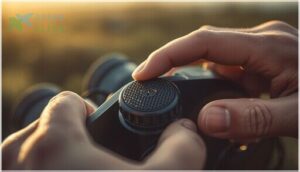
Start by closing your right eye and looking through the left eyepiece at a distant target. Turn the central focus knob slowly clockwise or counterclockwise until the image becomes sharp. Use smooth, moderate wheel calibration movements rather than abrupt twists.
Fine-tune with minor sharpness adjustment to achieve edge-to-edge clarity. This optical alignment technique establishes your baseline before diopter correction.
Calibrating The Diopter for Each Eye

Now close your left eye and look through the right eyepiece. Locate the diopter adjustment ring, usually on the right barrel, and rotate it until the image appears crisp. This vision correction compensates for the refractive difference between your eyes.
Once both eyes see clearly together, you’ve achieved proper eye calibration. This focus technique eliminates double vision and delivers true binocular clarity.
Troubleshooting Common Focusing Issues

Even when you’ve followed every step correctly, binoculars don’t always cooperate right away. You might see blurry images, double vision, or feel that nagging strain behind your eyes after just a few minutes of viewing.
Here’s how to identify what’s going wrong and fix it so you can get back to crisp, comfortable viewing.
Fixing Blurry or Double Vision
If your view looks soft or you’re seeing two overlapping images, check your diopter calibration first—it compensates for vision differences between your eyes. Clean both lenses with a microfiber cloth to remove smudges that distort the image.
Adjust the interpupillary distance until the double vision disappears and the circles merge.
Persistent blur may signal prism alignment issues or a damaged focus mechanism requiring professional service.
Addressing Eye Strain and Discomfort
Even with sharp focus, your eyes can betray you during long sessions. Take 20-second breaks every 20 minutes to let your ciliary muscles recover from the strain. Here’s how to protect your vision:
- Position your eyes level with the eyecups—no tilting your head
- Adjust eye relief by rotating the eyecups to match your viewing comfort
- Confirm your diopter setting eliminates compensatory squinting
- Maintain consistent target depth to reduce muscle workload
- Clean lenses regularly—smudges force your eyes to work harder
Ensuring Correct Diopter and Focus Settings
Your diopter adjustment isn’t a set-it-and-forget-it dial. Cover your right eyepiece, focus the left eye using the central focus knob, then switch sides and rotate the diopter ring until both barrels deliver matching sharpness.
Record this value—temperature shifts and eye fatigue can throw off binocular alignment. When optical precision falters, return to this two-step calibration before blaming your equipment.
Best Practices for Consistent Clear Viewing

Getting sharp, clear images through your binoculars isn’t just about the initial setup—it’s about keeping them in top shape for every use.
A few simple habits will save you from frustration in the field and extend the life of your equipment.
Here’s what you need to do to maintain consistent, crystal-clear viewing every time you pick up your binoculars.
Regular Binocular Maintenance
Your binoculars won’t stay sharp without routine care. Establishing maintenance schedules keeps your optical instrument performing at its peak, preventing costly repairs down the road.
- Clean lenses with a dedicated lens cloth after each outing, protecting the optical coating from scratches
- Inspect eyecups regularly for cracks or deterioration that affect eye relief
- Lubricate focus mechanisms with manufacturer-approved products during equipment inspection
- Check binocular adjustment alignment monthly to catch mechanical issues early
Storing Binoculars Safely
After keeping your optical instruments clean, protect that investment with smart storage habits. Place binoculars in padded storage cases with lens caps secured, shielding glass from scratches and dust. Add protective wraps for travel safety when heading outdoors.
Control moisture by storing in cool, dry locations away from direct sunlight—humidity degrades coatings and prisms. Keep heavy objects off your gear to maintain precise alignment between viewings.
Noting and Reusing Personalized Settings
Once you’ve dialed in your perfect view, record your customized calibration values for quick setup next time. Write down your interpupillary distance, diopter adjustment for each eye, and eyecup position—these setting profiles eliminate guesswork during future outings.
- Label entries with binocular model and date for diopter memory accuracy
- Switch focus reuse profiles when changing activities like birding or stargazing
- Follow calibration standards by verifying binocular adjustment against sharp targets periodically
Frequently Asked Questions (FAQs)
What magnification power is best for beginners?
For first-time users, 7x or 8x magnification strikes the ideal balance. These models offer steady image stabilization without excessive shake, generous field views for quick target acquisition, and comfortable eye relief during extended viewing sessions.
Can I focus binoculars while wearing glasses?
Yes, you can focus binoculars while wearing glasses. Adjust eyecups down for proper eye relief, then use the diopter settings and central focus wheel to compensate for your prescription lenses and achieve sharp vision correction.
How does weather affect binocular image quality?
Weather conditions dramatically affect image quality through your optics. Humidity impact causes lens fogging, while atmospheric clarity decreases as light scattering from dust or haze reduces contrast.
Temperature effects and aerosols further degrade your field of view.
Whats the difference between porro and roof prisms?
Prism design fundamentally shapes your binoculars’ form and performance. Porro prisms offset the optical axis, creating a wider body, while roof prisms align it for a slender profile with enhanced light transmission and image quality.
How do I focus on fast-moving objects?
Track moving targets by keeping them centered in view while smoothly turning the central focus knob. Use quick, small adjustments instead of large turns, and maintain steady hand positioning to minimize motion blur.
Conclusion
The hardest part of learning how to properly focus binoculars is that it feels complicated until you’ve done it once—then it becomes second nature. Those three adjustments that seemed confusing now take seconds, and you’ll dial in sharp focus without conscious thought.
Your binoculars will finally deliver the crisp, comfortable views they promised. Mark your diopter setting with tape or a photo, and you’ll never start from scratch again.
- https://www.bestbinocularsreviews.com/how_to_focus_binoculars.php
- https://www.bushnell.com/through-the-lens/bu-blog-blog-how-to-properly-set-the-diopter-on-a-binocular.html
- https://www.birdwatching.com/optics/education/diopter_setting.html
- https://gagadget.com/en/377585-focus-mechanisms/
- https://tractoptics.com/blog/using-binoculars-with-glasses/