This site is supported by our readers. We may earn a commission, at no cost to you, if you purchase through links.
 You spot a small brown bird flitting through the underbrush, and before you can raise your binoculars, it vanishes. Was that a song sparrow or a Lincoln’s sparrow? The challenge isn’t your eyesight—it’s that countless species share remarkably similar appearances, turning what should be a straightforward observation into a puzzle.
Even experienced birders struggle with lookalikes, from nearly identical woodpeckers to sparrows that seem designed to confuse us. The difference between confident identification and educated guesswork comes down to knowing which features matter most. By focusing on specific field marks, behaviors, and vocalizations, you’ll transform those fleeting glimpses into reliable identifications and finally tell those tricky species apart.
Table Of Contents
Key Takeaways
- Spotting subtle differences in field marks, size, and silhouettes is key to telling similar birds apart.
- Watching behaviors, feeding style, and habitat choice often helps when birds look nearly identical.
- Using field guides, reliable apps, and organized notes boosts your accuracy in challenging IDs.
- Learning and comparing bird songs can reveal species differences that looks alone can’t solve.
Key Features for Comparing Similar Birds
When two birds look almost alike, it’s easy to miss the subtle clues that set them apart. Paying attention to key features can help you sort out these tricky matches.
Here are the main things to watch for when comparing similar species.
Bird Topography and Anatomy Essentials
Think of bird topography as your map for bird identification. Knowing the zones—like crown, rump, and wing coverts—helps you spot field marks with confidence. Beak morphology, limb proportions, and skeletal structure all play a part, while the muscular system shapes posture and movement.
Mastering these basics makes identifying similar birds much easier, especially when plumage alone isn’t enough. A helpful tool can be a regional field guide for specific areas.
Recognizing Field Marks and Plumage Patterns
Once you’ve mapped out the bird’s anatomy, your next step is pattern recognition. Key fieldmarks like eye rings, superciliary stripes, and wing bars reveal hidden clues. Plumage variations and seasonal plumage changes can make similar species look entirely different. Regional differences also play a role in bird identification. Birdwatchers often use bright colored stripes to identify bird species.
- Eye rings
- Superciliary stripes
- Wing bars
- Throat patch coloration
- Distinct crown markings
Importance of Size, Shape, and Silhouettes
After you’ve spotted those field marks, don’t overlook the power of relative bird size and silhouette recognition. A bird’s posture, bill length, and tail shape often separate similar species. Integrated ID methods—using both structural feature ID and silhouettes—boost your accuracy. Still, statistical ID limits exist.
Here’s a quick comparison:
| Feature | What to Watch For |
|---|---|
| Relative bird size | Compare with known birds |
| Bill shape | Short, long, thick, thin |
| Tail silhouette | Square, wedge, forked |
| Wing posture | Flat, dihedral, arched |
| Body proportions | Head, neck, legs, torso |
Using Standardized Vocabulary for Accuracy
When you match bird topography and field marks, using standardized vocabulary sharpens your accuracy. AvianLexiconAtlas usage and nomenclature consistency help you communicate with confidence and cut down error rates. Precise ornithological communication isn’t just for scientists—it’s for you, too. Educational tools now make learning these terms easy.
- Clearer bird characteristics
- Reliable avian identification
- Fewer missteps in the field
Common Bird Pairs Often Misidentified
Some birds look so much alike that even experienced birders pause for a closer look. You’ll find a few pairs come up again and again in field guides and conversations.
Let’s walk through the most common ones that tend to trip people up.
Crows Vs. Ravens

Spotting the difference between corvids like crows and ravens is a classic birding challenge. Size differences are striking—ravens are up to 40% larger. Notice Tail Feathers: ravens show a wedge, crows a fan. Beak Comparison helps, too; ravens have thicker, curved bills.
Vocal Patterns and field marks matter, especially where Habitat Overlap leads to confusion between similar species.
Downy Vs. Hairy Woodpeckers
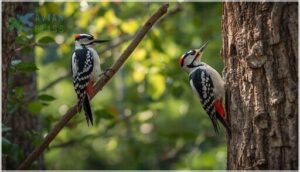
Woodpecker identification often hinges on subtle field marks. Look for differences in Woodpecker Beak length—Downy Woodpecker shows a short bill, while Hairy Woodpecker’s is nearly head-length.
Feather Patterns help: Downy’s outer tail feathers have black spots, Hairy’s are plain white.
Tree Selection and Foraging Styles also differ, with Downies favoring smaller branches and Hairies preferring mature trunks.
House Finch Vs. Purple Finch
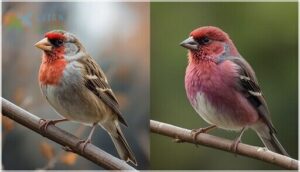
Contrast is your ally when untangling House Finch from Purple Finch. Focus on Plumage Patterns—House Finches show red on the forehead, breast, and rump, while Purple Finches wear a raspberry wash across head and back.
Beak Shapes matter: Purple Finch bills are bulkier. Size Differences and Habitat Preferences further separate these similar species, especially in forest versus urban settings.
Black-headed Grosbeak Vs. Spotted Towhee

Ever puzzled by two birds sharing the same feeder? Black-headed Grosbeaks and Spotted Towhees often fool even sharp eyes.
Plumage Patterns—orange-cinnamon breast versus rufous flanks—are key field marks. Size Comparison helps, but Beak Shapes give away the chunky grosbeak.
Listen for Vocalization Tips, and use Habitat Analysis: grosbeaks prefer trees, towhees scratch in dense undergrowth.
Similar Sparrow, Gull, and Tern Species

You might think sparrow identification is simple, but similar species like House and Eurasian Tree Sparrows test your eye for field marks—gray crown or black ear spot?
Differentiating gulls and terns hinges on leg color, beak morphology, and seasonal plumage adaptation.
Bird species hybridization and genetic variation further complicate things, especially in mixed flocks or during migration patterns.
Behavioral and Habitat Clues for Identification

When birds look almost identical, their habits and habitats can tip the scales. Paying close attention to how and where a bird behaves often reveals clues you won’t find in plumage alone.
Here are some ways you can use behavior and habitat to separate lookalike species.
Observing Feeding and Flight Behaviors
Spotting differences in feeding behavior types and flight patterns can reveal bird ID puzzles. For instance, selective foraging or filter feeding reveals much about avian diet and personality. Watch for posture ID aids—some species feed upright, others crouched.
Flight duration strategies, wingbeat identification, and migration patterns also separate lookalikes when plumage fails. Analyzing bird behavior sharpens your skills.
Recognizing Habitat Preferences and Ranges
When feeding and flight behaviors leave you guessing, habitat selection and range dynamics often clear the fog. Recognizing habitat preferences narrows your bird species comparison, since ecological niches shape where birds thrive. For example, forest-loving warblers rarely mix with farmland sparrows.
Use these clues:
- Local vegetation
- Water sources
- Urban density
- Seasonal range
- Conservation strategies
Using Posture and Movement as ID Aids
After you’ve narrowed down your options by habitat, pay close attention to posture and movement patterns. Posture Analysis—like upright flycatchers versus crouched warblers—often reveals hidden field marks.
Gait Recognition and Bird Tracking, including motion capture, highlight subtle differences. A horizontal stance or unique walking style can be the key to species differentiation when visual identification gets tricky.
Seasonal and Age-related Plumage Changes
Just as posture gives clues, plumage variation and molting patterns are key for species differentiation and age identification. You’ll notice color changes as birds shift from breeding to winter plumage, or as juvenile birds mature.
Feather wear can blur field marks, but knowing how plumage changes with age and season helps you avoid missteps in visual identification.
Distinguishing Birds by Sounds and Calls

Sometimes, birds look so much alike that their voices become the best clue. Listening closely can reveal differences you won’t see in feathers or flight.
Here’s how you can use sounds and calls to sort out those tricky identifications.
Using Vocalizations for Tricky Identifications
Ever tried to untangle a flock of lookalike birds? Vocalization patterns often hold the key. Acoustic analysis—measuring frequency modulations and bird call variations—lets you pinpoint species differentiation when field marks blur.
Audio identification isn’t just about songs; alarm and flight calls matter, too. By weaving bird behavior and calls into your toolkit, you sharpen your auditory identification skills.
Accessing Bird Song Recordings and Apps
With bird song databases like eBird and apps such as Merlin Bird ID, you can tap into millions of recordings for audio identification. These bird apps feature spectrogram analysis, real-time detection, and broad reference libraries.
By exploring app features and recording techniques, you make vocalization analysis part of your bird identification toolkit—giving bird sounds and songs a practical role in bird ID using AI.
Comparing Calls of Lookalike Species
How do you separate lookalike species by sound alone? Focus on these five practical comparisons:
- Call Pattern Analysis—note rhythm and repetition.
- Vocalization Types—distinguish between songs, alarms, and flight calls.
- Acoustic Similarity—listen for subtle pitch overlaps.
- Frequency Metrics—track high and low tones below 12,000 Hz.
- Syllable Structure—spot differences in syllable length and shape.
Tips for Learning Bird Sounds by Ear
How do you train your ear to catch subtle avian calls? Start with focused listening—single out one bird song and analyze rhythm, pitch, and repetition. Use playback tools and mnemonic devices for recall. Pair field practice with daily review and sleep consolidation. Combining visual cues with bird sounds and calls makes utilizing vocalizations for identification more reliable.
| Technique | Benefit |
|---|---|
| Focused listening | 42% faster learning |
| Playback tools | 88–96% accuracy |
| Mnemonics | 31% improved recall |
Tools and Techniques for Accurate Identification

Identifying birds that look alike calls for more than a sharp eye. The right tools and techniques can make all the difference in sorting out subtle field marks.
Here’s what you’ll want to have on hand as you work through tricky IDs.
Field Guides, Diagrams, and Checklists
You’d be surprised how much guide effectiveness depends on clear diagram formats and standardized vocabulary. Field guides show up to four plumage photos per species, while quick ID guides use visual indices for fast lookup.
Multispecies checklists improve count accuracy, especially when identifying field marks and distinguishing features. Reliable bird identification resources hinge on checklist accuracy and practical, portable diagrams.
Mobile Apps and AI-powered Bird ID Tools
Ever wonder how AI-powered mobile applications changed bird ID? With app accuracy reaching 90% for field marks and sound, user adoption has soared—over 10 million Merlin downloads.
Feature integration means photo, audio, and GPS work together, boosting real-time identifying birds.
Community science thrives as sightings feed global databases, fueling research and driving AI growth in bird identification.
Taking and Using Field Notes and Photos
Field notes sharpen your bird identification skills by forcing you to observe diagnostic features before checking field guides. Note-taking accuracy improves when you jot down bill shape, wing bars, and behavior on-site rather than relying on memory later. Digital photography paired with quick sketches boosts photo integration and data standardization, making your records valuable for scientific submissions and personal growth in bird identification.
- Record size, shape, and color immediately
- Sketch distinctive field marks you notice
- Photograph birds from multiple angles
- Note habitat, time, and weather conditions
Practicing Relative Comparisons in The Field
Once you’ve captured your notes and photos, comparing similar species side-by-side in the field sharpens your observational skills like nothing else. Habitat comparison reveals that field identification accuracy jumps when you study species overlap zones.
Using relative comparisons, you’ll spot subtle field marks that guides miss—bill thickness, posture differences, or tail length. This field technique drives error reduction through real-time avian identification tips you can trust.
Relative comparisons in the field sharpen your eye for subtle marks that field guides often overlook
Frequently Asked Questions (FAQs)
How do hybrids affect bird identification confidence?
Hybrid ID errors chip away at your confidence level when you’re sorting out similar species. Observer reliability loss ramps up in hybrid zones, making genomic validation and targeted training essential for reducing common bird misidentifications.
What role does genetics play in visual similarities?
Genetic variation shapes avian characteristics, directly influencing plumage color, beak morphology, and feather patterns.
Convergent evolution can cause similar species to develop strikingly alike visual traits, making bird plumage identification and morphology comparison both fascinating and challenging.
Can environmental changes cause birds to look alike?
Picture a runway where every bird looks like it got the same memo on feather patterns. Climate Impact and Environmental Drivers often force Convergent Evolution, nudging unrelated species toward shared Adaptive Traits—confounding even your sharpest bird identification tips.
Why do unrelated species develop similar plumage?
Unrelated species often show similar plumage because of Convergent Evolution. This results from Environmental Pressures, Genetic Constraints, and Adaptive Camouflage advantages—driving Plumage Mimicry that helps with survival and complicates bird ID in field guides and species identification.
Are there conservation risks with misidentifying species?
Imagine trying to fix a leaky roof blindfolded—that’s what conservationists face with misidentified birds. Even modest Error Rates skew Data Quality, hiding declining species and leading Wildlife conservation astray.
Species Misidentification undercuts Bird conservation, fueling further Biodiversity Loss.
Conclusion
Picture your next walk: sunlight spilling through leaves, crisp air alive with song, every branch holding a new mystery. When you pause and focus, details sharpen—streaked chests, notched tails, a call that breaks the stillness.
With patience and sharp eyes, you begin to identify birds with similar appearances, drawing on habits, field marks, and subtle clues. In these moments, observation becomes understanding, and every lookalike transforms into a well-marked individual in your story of discovery.
- https://news.cornell.edu/stories/2016/08/warbler-genomes-look-be-9997-percent-alike
- https://www.frontiersin.org/news/2019/11/26/genetics-spot-difference-identical-bird-species-different-genes
- https://www.audubon.org/news/new-study-doubles-worlds-number-bird-species-redefining-species
- https://cals.cornell.edu/news/2019/04/study-some-woodpeckers-imitate-neighbors-plumage
- https://www.allaboutbirds.org/news/are-woodpeckers-evolving-to-look-like-each-other-a-new-study-says-yes/