This site is supported by our readers. We may earn a commission, at no cost to you, if you purchase through links.

North America hosts roughly 900 songbird species, and your backyard alone might shelter a dozen of them—each with field marks, songs, and habits tied directly to where you live. Region shapes everything: plumage variation, vocal dialects, seasonal timing, and which species even show up at all.
A Hermit Thrush singing in a Vermont spruce grove sounds nothing like its counterpart wintering in a Texas woodlot, even though it’s the same bird.
Learning to identify songbirds by region cuts through the noise and turns every walk outside into something sharper, more focused, and genuinely rewarding.
Table Of Contents
Key Takeaways
- Your region shapes everything about the songbirds you’ll encounter — from plumage and song dialects to which species show up and when.
- Combining visual field marks, vocal cues, and range maps gives you a reliable three-part system for confident bird ID wherever you are.
- Tools like Merlin and eBird take the guesswork out of the field by filtering species to your exact location, date, and habitat.
- Habitat loss, climate shifts, and light pollution are quietly reshaping songbird behavior and ranges — knowing your local birds puts you on the front line of noticing those changes.
Key Techniques for Identifying Songbirds by Region
Knowing what to look for makes all the difference when you’re out in the field. Songbird ID comes down to a handful of reliable techniques that work no matter where you’re in the country.
Once you know how to read them, songbird field guide markings turn confusing field sightings into confident, accurate IDs.
Here’s what every birder needs in their toolkit.
Visual Identification—Color, Size, and Markings
Start with what you can see. Visual identification relies on four things:
- Plumage Color Patterns and Size And Shape — compare to familiar birds like robins or sparrows
- Head Facial Markings — eye rings, masks, crown stripes
- Wing And Tail Marks — wing bars, rump patches, outer tail feathers
As you compare birds, pay special attention to key plumage field marks, which change with age, season, and feather wear and are vital for confident IDs.
Age and sex differences matter too — females are often duller. Trust your eyes first.
Recognizing Regional Bird Songs and Calls
Your ears are just as useful as your eyes. Songs handle territory and courtship, while shorter calls manage alarms and flock contact — understanding Song And Call Functions sharpens every listen. Use Mnemonic Listening Tricks like "Oh sweet Canada" for White-throated Sparrows.
Notice Pitch Rhythm Cues and Regional Song Dialects, since western birds often sing differently than eastern ones. For more on how species develop regional birdsong dialects that function like local “accents,” you can compare recordings from different parts of the country.
Dawn Chorus Timing peaks in early spring — that’s your best window.
Using Range Maps and Seasonal Patterns
Range maps pick up where sound leaves off. Decoding Range Legends turns colors into real knowledge — red marks breeding zones, blue shows wintering areas, yellow flags migration corridors. Interpreting Abundance Shading reveals where birds are common versus sparse. Use Seasonal Presence Clues to narrow your search:
- Red = active breeding zones
- Blue = wintering areas
- Yellow = migration corridors
- Purple = year-round presence
- Darker shading = higher abundance
Elevation-Filtered Ranges sharpen mountain searches. Citizen Science Map Data from eBird tracks seasonal movement live.
Together, these tools pair perfectly with local bird identification guides by region and habitat to help you pinpoint exactly which species call your area home.
Leveraging Birding Apps and Field Guides
Once you’ve read the map, let the tools do the heavy lifting. Apps like Merlin use downloadable Regional Bird Packs that filter species by your GPS location and date — so your bird identification stays grounded in what’s actually nearby.
For deeper field guide comparisons, the Sibley app packs over 6,600 images into your pocket. Digital identification has genuinely changed birdwatching resources for the better.
Songbirds of The Northeast
The Northeast is one of the richest regions for songbird watching in the entire country. From dense hardwood forests to coastal migration corridors, the landscape shapes which birds you’ll find and when.
Here’s what to look for as you get to know this region’s most memorable species.
Common Species and Their Habitats
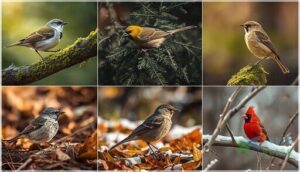
The Northeast’s habitat diversity makes it a hotspot for bird species diversity. Common North American songbirds here occupy distinct niches tied to forest type and structure:
- Wood Thrush — mature deciduous forest interior
- Black-throated Green Warbler — spruce and hemlock stands
- Ovenbird — unbroken forest floor with dense leaf litter
- Gray Catbird — dense shrubland and hedgerow edges
- Northern Cardinal — suburban gardens and woodland margins
Urban wildlife thrives here too, supporting ecosystem balance across residential corridors.
Notable Seasonal Migrants

Spring migration patterns bring some notable visitors your way. Watch for these key arrivals:
| Species | Migration Window |
|---|---|
| Blackpoll Warbler | Boreal breeder; May passage |
| Wood Thrush | April 1–May 30 |
| Scarlet Tanager | Early April–late May |
Seasonal movements and habitat shifts follow predictable timelines. Bird tracking through eBird strengthens regional distribution models and aids conservation efforts for these songbird migration corridors.
Unique Vocalizations to Listen For

Northeastern bird songs and vocalizations reveal a lot once you know what to catch. These five acoustic signals are worth your attention:
- Ovenbird’s rising "teacher, teacher" — classic vocal learning on display
- Veery’s downward spiral — haunting regional dialects near shady streams
- White-throated Sparrow’s "Oh sweet Canada" — carries far across lakes
- Black-throated Blue Warbler’s lazy "beer, beer, bee" — key songbird mimicry cue
- Eastern Towhee’s "drink your tea" — unmistakable bird call patterns for any songbird identification guide
Songbirds of The South and Southeast

The South and Southeast are alive with birdsong year-round, and that’s no accident. Warm climates, dense shrublands, and sprawling forest edges create the perfect setup for a remarkably diverse cast of species.
Here’s what you’ll find when you start paying attention.
Iconic Year-Round Residents
You won’t find a more reliable companion for bird species exploration than the Northern Cardinal. Its year-round residency highlights classic Resident Bird Traits.
Southeastern Species like Carolina Wren and Tufted Titmouse show Nonmigratory Patterns and thrive in Year Round Habitats. These birds anchor Regional Biodiversity. Their presence helps you decode Songbird ecology and track American Robin habits across the South.
Edge and Shrubland Specialists
Shrubland Ecology shapes some of the Southeast’s most fascinating specialists. The Prairie Warbler nests low in dry scrub and overgrown clearings — a true edge species thriving where Habitat Fragmentation creates brushy pockets. Blue-winged Warblers and Yellow-breasted Chats work similar Edge Effects along stream corridors.
Your bird species exploration here reveals how habitat suitability in dense shrublands directly drives Bird Migration patterns and Conservation Strategies.
Distinctive Song Patterns and Behaviors
Southern songbirds don’t just sing — they communicate entire life stories. The Carolina Wren’s "teakettle" call hits up to 110 decibels, a masterclass in Territorial Defense from a tiny body. Cardinal Song Complexity reflects Vocal Learning through regional dialects, while Seasonal Singing shifts with migration patterns.
The Carolina Wren packs 110 decibels of territorial fury into a body smaller than your fist
Recognizing these Bird Songs and Vocalizations sharpens your Bird Identification Techniques and deepens your grasp of Bird Behavior and Ecology.
Songbirds of The Midwest and Great Plains

The Midwest and Great Plains stretch across an enormous range of habitats — from tallgrass prairies to river corridors to suburban backyards.
Each one draws a distinct set of songbirds shaped by the landscape around them. Here’s what you’ll find when you start looking closer.
Grassland and Wetland Songbirds
The Midwest’s open grasslands and wetlands hold some of North America’s most fascinating songbird ecology. Grassland conservation efforts directly shape which species you’ll find — and where.
Look for these key species:
- Bobolink — breeds in tall hayfields, sings in tumbling metallic bursts during display flights
- Marsh Wren — thrives in cattail wetlands, weaving dome nests above water
- Grasshopper Sparrow — favors mid-height pastures, producing thin insect-like trills
Forest Edge and Suburban Species
Beyond the wetlands, your backyard might surprise you. Forest Edge Ecology plays out right along your fence line — Northern Cardinals nest low in dense shrubs while American Robins work suburban lawns nearby.
Edge Habitat Dynamics bring Backyard Biodiversity closer than you’d expect. These Urban Songbird Adaptations make Suburban Birding rewarding year-round, turning ordinary neighborhood greenery into surprisingly productive Forest Edge bird habitats.
Regional Migration Hotspots
Spring migration through the Midwest is where Flyway Patterns become impossible to ignore. Magee Marsh in Ohio draws over 30 warbler species each May — a masterclass in Stopover Ecology.
The Mississippi River corridor sustains 325 species twice yearly, showcasing impressive Habitat Connectivity. These Migration Routes reveal regional variations in songbird populations, making Midwest birdwatching locations and hotspots central to Bird Conservation efforts nationwide.
Songbirds of The West and Pacific Regions

The West and Pacific Regions stretch from sun-baked desert floors to fog-drenched coastlines and high alpine ridges — and the songbirds here reflect every bit of that variety.
Each habitat tells its own story, and so does the bird living in it. Here’s what you’ll find across three of the region’s most defining songbird themes.
Mountain and Desert Songbird Diversity
The West is where bird diversity gets serious. Mountain and desert habitats sit miles apart yet share surprising species — like hermit thrushes summering in mountain ravines then wintering in desert thickets.
- Mountain chickadees thrive in conifer forests from 6,000 to 12,000 feet
- Desert songbirds like cactus wrens nest directly in cholla cactus arms
- Habitat fragmentation threatens climate adaptation across regional variations in songbird populations
Coastal and Urban Adaptations
Cities reshape songbirds in surprising ways. Urban Noise Pollution pushes City Song Frequency higher — song sparrows in busy neighborhoods sing slower, simpler trills than rural birds. Coastal Bill Adaptation helps coastal sparrows sing twice as fast in heat. Watch these Urban Bird Migration shifts yourself:
| Species | Suburban Habitat Use | Adaptation |
|---|---|---|
| Song Sparrow | Greenbelts, backyards | Raised song frequency |
| Lesser Goldfinch | Urban feeders, yards | Northward range shift |
| Spotted Towhee | Lawn edges, woodlots | Urban foraging behavior |
Birdwatching in the US rewards patience here.
Key Regional Conservation Concerns
Habitat Fragmentation and Climate Shift are hitting western songbirds hard. Repeated droughts slash insect abundance, and fire cycles strip old-growth canopy that species like the Hermit Warbler depend on.
You’re watching real Species Decline unfold — Ecosystem Disruption reshaping ranges upward on mountain slopes.
Conservation Efforts matter here. Supporting habitat preservation and wildlife conservation through platforms like eBird directly strengthens bird conservation efforts and improves conservation status tracking across the region.
Frequently Asked Questions (FAQs)
How do songbirds adapt to climate change?
Songbirds don’t wait for permission to adapt. A third of U.S. species now lay eggs two weeks earlier than historical averages.
Climate Shifts are reshaping Migration Patterns, Elevational Movements, and Body Size Changes across songbird ecology.
Which songbirds are most endangered nationwide?
Several U.S. songbirds face serious extinction risks. The Florida Grasshopper Sparrow has fewer than 200 individuals left. Habitat loss and climate change drive most declines.
Conservation efforts remain critical for these endangered species.
How does light pollution affect songbird behavior?
Light pollution disrupts songbird behavior in measurable ways. Robins sing up to 20 minutes earlier under artificial lighting. Migrating birds lose magnetic orientation at night.
Urban ecology research links nocturnal migration failures directly to artificial lighting near buildings.
Can songbirds recognize individual human faces?
Yes — some songbirds do recognize individual human faces. Mockingbirds, cardinals, and chickadees distinguish specific people from strangers, remembering faces tied to threat or trust across days, weeks, or even full breeding seasons.
How do juveniles differ visually from adults?
Juveniles show duller plumage patterns, streaked feather quality, pale gape flanges, and softer bill shape. Eye coloration runs darker. Molt cycles gradually shift these traits toward crisp adult form.
Conclusion
The funny thing about learning to identify songbirds by region is that the more you learn, the quieter your mind gets. What once sounded like noise becomes a conversation you actually understand.
A flash of rufous in the West, a buzzy trill drifting through Midwestern grass, a warbler threading through Northeastern canopy—each one lands differently now. You’re not just outside anymore. You’re reading a landscape that’s been speaking all along.
- https://science.ebird.org/en/status-and-trends/abundance-maps
- https://ebird.github.io/ebirdst/articles/status.html
- https://www.allaboutbirds.org/guide/Song_Sparrow/id
- https://www.audubon.org/field-guide/bird/song-sparrow
- https://app.mybirdbuddy.com/birds/european-robin/a8231088-e943-420f-b72e-10aa25916a41