This site is supported by our readers. We may earn a commission, at no cost to you, if you purchase through links.
goldfinch you spotted last November—dull, olive‑streaked, easy to overlook—returns in May transformed into something almost unrecognizable: electric yellow, black‑winged, unmistakable.
Same bird, completely different creature.
Seasons don’t just change the weather; they rewrite the field guide on every species you think you know.
Plumage shifts, songs start and stop, flocks assemble and dissolve, migrants appear overnight.
Identifying birds across different seasons means tracking a moving target—and once you understand the patterns driving those changes, every walk outside becomes a masterclass in reading what the natural world is telling you.
Table Of Contents
- Key Takeaways
- How Seasons Affect Bird Appearance and Behavior
- Identifying Birds During Spring and Summer
- Identifying Birds During Fall and Winter
- Step-by-Step Seasonal Bird Identification Techniques
- Attracting and Observing Birds Year-Round
- Frequently Asked Questions (FAQs)
- How do birds adapt to different seasons?
- Do bird watchers know the changes in the seasons?
- Can you see birds during summer?
- Why is bird watching enjoyable?
- What are the 5 S’s of birding?
- Where are all the birds in September?
- Which birds are easiest to spot while traveling?
- How do weather events disrupt normal migration timing?
- Can bird behavior predict incoming seasonal storms?
- What role do wetlands play in seasonal birdwatching?
- Conclusion
Key Takeaways
- Birds shift dramatically in plumage, song, and social behavior across seasons, making the same species look and sound like a completely different bird depending on the time of year.
- Pairing visual cues — silhouette, bill shape, wing bars — with seasonal vocalizations like the dawn chorus or nocturnal flight calls gives you the fastest, most reliable ID in any season.
- Fall and winter demand a sharper eye: subtle feather wear, ear patch contrast, and flock structure replace the vivid colors and songs that make spring ID feel easy.
- Consistent record-keeping through tools like eBird, combined with habitat design and strategic feeding, turns your backyard into a year-round observation lab that trains your eye over time.
How Seasons Affect Bird Appearance and Behavior
Birds don’t look or act the same year‑round — and that’s exactly what makes seasonal identification so rewarding.
Tracking those shifts is especially satisfying with grey and white birds, whose plumage and habits offer some of the clearest seasonal cues to watch for.
A few key changes in plumage, sound, and social behavior can tell you a lot about what you’re seeing and why. Here’s what to watch for as the seasons shift.
Plumage Changes for Breeding and Camouflage
Plumage is one of your sharpest tools for bird species identification — but it shifts with the calendar. Male American Goldfinches (Spinus tristis) swap dull olive-brown for vivid yellow-green each spring through seasonal molting timing. Reflective feather structures intensify those breeding colors at dawn and dusk.
Meanwhile, females rely on mottled camouflage patterns year-round. Sexual dimorphism colors make this seasonal bird behavior essential to understand before heading out.
Shifts in Bird Vocalizations and Activity
Just as plumage shifts signal the seasons, so does the soundscape. Dawn chorus timing peaks from March through May — that explosive first hour after sunrise is your best window for bird species identification. Seasonal song rate drops sharply after breeding ends.
- Light pollution effects push urban singers up to 30 minutes earlier
- Weather-driven calling slows when temperatures fall below 5°C
- Nighttime vocal shifts mark summer’s end as territorial songs fade
Recent research shows that artificial night lighting effects(https://www.mpg.de/9043097/light-pollution-songbirds) cause several songbird species to start singing earlier in the year.
Formation of Flocks and Territorial Displays
Beyond song, watch how birds organize in space. Winter flock size explodes — starling murmurations can reach tens of thousands, with sentinel positioning around feeding groups alerting the whole crowd to predators.
Come spring, that flocking behavior dissolves. Males launch territory edge flights, drumming or singing from fixed perches.
Mixed-species coordination fades as seasonal bird behavior shifts toward competition, making bird identification sharper and more rewarding. Reduces individual vigilance allows birds to spend more time feeding and conserving energy.
Identifying Birds During Spring and Summer
Spring and summer are when birdwatching really comes alive. landscape fills with color, sound, and movement — and knowing what to look for makes all the difference.
A good family bird field guide helps everyone — kids included — put names to the wings flashing past.
what to focus on when you head outside.
Spotting Migratory Arrivals and Nesting Behaviors

Spring migration doesn’t wait for a calendar — bird migration patterns shift with weather, so Migrant Arrival Timing varies week to week.
Check Tree Edge Hotspots at Early Dawn Stops, right after sunrise, when nocturnal fliers land exhausted and hungry.
Watch for Nest Box Inspection by chickadees and nuthatches — paired birds circling cavities signal nesting is beginning.
Seasonal Food Peaks drive all of it.
Recognizing Breeding Plumage and Songs
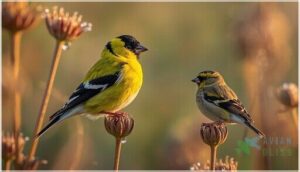
Catching a male American Goldfinch (Spinus tristis) mid‑molt is one of bird identification’s great rewards. Crown Contrast and Throat Color Markers sharpen dramatically — use those first. Wing Bar Patterns confirm what color alone can’t.
Then listen: Dawn Chorus Timing peaks an hour before sunrise, when Song Phrase Structure repeats clearly. Songbird concerts reveal Breeding behaviors faster than any visual scan.
Noting The Presence of Fledglings and Juveniles
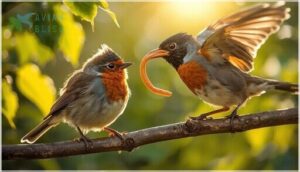
Spotting juvenile birds takes a sharp eye — they don’t look like their parents yet.
Watch for Patchy Down on the crown, a visible Gape Flange at the bill corners, and a Short Tail that makes the body look oversized.
Begging Behavior seals it: a fledgling quivering its wings while an adult delivers food is unmistakable.
That Parent Feeding moment links juvenile to species instantly.
Identifying Birds During Fall and Winter
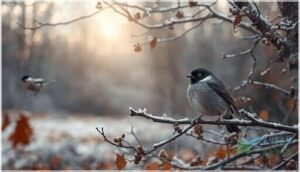
Fall and winter flip the script on everything you learned about birds in spring.
The species change, the behaviors shift, and even familiar birds can look surprisingly different once temperatures drop.
Here’s what to watch for as the cold months roll in.
Observing Migration Departures and Flocking
Fall migration is a slow unraveling — not a sudden exit. Billions of migratory birds use nocturnal departure to travel under darkness, and radar migration maps reveal staggering single‑night movements.
Fall migration is not a sudden exit but a slow unraveling, as billions of birds vanish silently into the night
Watch for these clues in your region:
- Mixed-species leaders like chickadees anchor flocks at edge stopover habitats
- Wind-assisted flocks move faster, merging and splitting unpredictably
- Seasonal migration peaks September through October across North America
- Bird identification techniques sharpen quickly when migration patterns concentrate species
Detecting Subtle Winter Plumage Differences
Winter plumage hides its secrets in the details. Look for feather wear cues — pale tips that slowly abrade, revealing richer pigment beneath.
Ear patch contrast separates similar gulls at a glance.
Wing bar sharpness signals age: juvenile feather mix shows patchy, worn coverts alongside fresh ones.
Sex‑specific gloss differs subtly in cardinals and finches.
These birdwatching tips sharpen your seasonal birding guide skills fast.
Identifying Cold-adapted and Resident Species
Some bird species never leave — and knowing them transforms your winter birding from guesswork into confidence.
- Willow Ptarmigan shift to white camouflage plumage and dig snow burrows for warmth, with foot insulation built right into their feathering.
- Black-capped Chickadees hug habitat edge preference — anywhere birch and alder grow.
- Northern Cardinals flash red against snow, unmistakable at feeders.
- American Tree Sparrows twitter softly in weedy fields, their resident call patterns unchanged all season.
Step-by-Step Seasonal Bird Identification Techniques
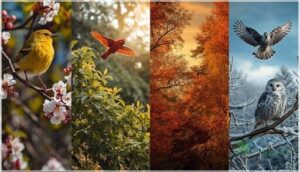
Knowing what to look for makes all the difference between a frustrating outing and a rewarding one.
A few reliable techniques can sharpen your eye and ear across every season.
Here’s where to start.
Using Field Guides, Apps, and Smart Feeders
Your toolkit makes or breaks a successful ID. Modern field guides use digital range filters to show exactly which seasonal birds appear in your area by month.
Merlin’s AI photo ID hits roughly 92% accuracy for backyard visitors, while smart feeder analytics — like those from the Scout smart birdfeeder — log visit patterns automatically.
Crowdsourced data integration through eBird keeps seasonal checklist sync sharp and current.
Focusing on Size, Shape, and Behavior Cues
Apps give you the "what" — but your own eyes catch the "how." Silhouette comparison, bill proportion, and tail shape work together as fast bird identification techniques. Watch for these seasonal patterns:
- Posture shifts — puffed in cold, upright when breeding
- Bill proportion — chunky for seeds, slender for insects
- Tail shape — forked, squared, or cocked
- Flight pattern — sweeping vs. fluttering
- Flock behavior — tight winter groups vs. solo summer foragers
Listening for Seasonal Bird Calls and Songs
Sound is one of the sharpest tools in bird identification. The Dawn Chorus Timing peaks mid‑March through May — robins start as early as 3 AM.
Summer Territorial Songs taper by August.
Fall brings Nocturnal Flight Calls and Autumn Flock Communication: distinct sparrow chips and warbler zeeps.
Winter Contact Calls — chickadee fee‑bees, nuthatch yanks — carry clearly through bare, quiet trees.
Attracting and Observing Birds Year-Round
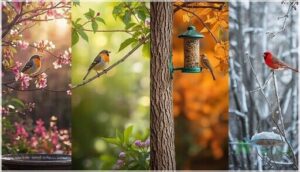
Knowing how to identify birds is one thing — getting them to show up consistently is another.
The good news is that a few simple changes to your yard and habits can turn any outdoor space into a reliable spot for year-round observation.
Here’s what actually works.
Seasonal Bird Feeding and Garden Planning
Feeding strategically transforms your garden into a year-round hotspot. Feeder placement matters — position them 1.5 meters up, near native planting like hawthorn or elderberry. Seasonal food choices sharpen your bird identification techniques too: suet draws woodpeckers in winter, mealworms signal spring arrivals.
- Switch to high-fat foods during seasonal changes and cold snaps
- Practice hygiene practices: scrub feeders weekly to prevent disease
- Prioritize water management with a shallow birdbath for backyard birding success
Creating Habitats for Diverse Seasonal Visitors
Beyond bird feeding, habitat design is where backyard birding truly deepens.
Layer native vegetation — evergreens for shelter, berry shrubs for year-round food, and open snags for woodpeckers. Add seasonal water with a heated birdbath in winter.
Install nest boxes 2–4 meters high.
Protective shelter like dense hedgerows gives shy species cover, making bird identification far richer across every seasonal migration wave.
Recording Sightings and Tracking Annual Patterns
careful records transforms casual birdwatching into something genuinely revealing. Log each sighting with GPS logging, weather annotation, and habitat coding — these details expose real count trends over time.
Apps like eBird handle data visualization automatically, letting you compare migration patterns and seasonal migration windows across years. Recording sightings consistently is how bird identification sharpens: patterns emerge, surprises get explained, and your backyard becomes a living dataset.
Frequently Asked Questions (FAQs)
How do birds adapt to different seasons?
nature’s shapeshifters.
Hormonal molting triggers feather changes, thermal insulation strategies keep small birds warm, and torpor energy conservation cuts overnight energy use — all while food resource shifts and habitat microclimate selection drive seasonal bird migration.
Do bird watchers know the changes in the seasons?
experienced birders are basically accidental phenologists.
Through seasonal timing cues, feeder adjustments, and citizen science data, they track weather-driven behavior and phenology observations, reading the seasons through every migration, molt, and dawn chorus.
Can you see birds during summer?
Summer is actually peak season for Bird Identification.
Morning activity peaks early, when Backyard Birds flood Garden feeder placement spots.
Heat‑tolerant species crowd Sun‑baked perches near every water source — Summer Birding and Bird Behavior are unmissable.
Why is bird watching enjoyable?
Birdwatching delivers a real mood boost — just 30 minutes outside sharpens focus, eases anxiety, and deepens your nature connection.
It’s a mindful pause, a skill mastery journey, and community bonding all at once.
What are the 5 S’s of birding?
Think of the 5 S’s as your birding compass: Shape Silhouette, Size Proportions, Shade Patterns, Sound Cues, and Space Habitat. Together, they sharpen your birding techniques across every season.
Where are all the birds in September?
September’s Garden Quietness isn’t displacement. Birds are molting in thickets, massing in Roosting Aggregations, or riding Flyway Hotspots south.
Fall Migration peaks now. Step outside your backyard for the real show.
Which birds are easiest to spot while traveling?
As the saying goes, the early bird catches the worm.
Urban Pigeons, Coastal Gulls, Roadside Starlings, Migratory Warblers, and Winter Chickadees are your easiest targets — visible, predictable, and perfect for sharpening seasonal bird species identification while traveling.
How do weather events disrupt normal migration timing?
Weather throws avian migration into chaos.
Storm‑induced delays, cold‑snap impacts, drought‑driven rerouting, and hurricane‑force displacements all scramble bird migration patterns — climate‑mismatch effects make arrival timing increasingly unpredictable for environmental impact on birds and habitat conservation.
Can bird behavior predict incoming seasonal storms?
bird behavior offers real storm clues. Pressure Sensitivity triggers Feeding Frenzy at feeders, Flight Altitude Shifts drop swallows low, Vocal Silence falls over gardens, and Flock Consolidation tightens before rain arrives.
What role do wetlands play in seasonal birdwatching?
Wetlands are Migration Stopover Hubs — bustling refueling stations where Food Resource Richness draws thousands of birds each spring.
Their Habitat Diversity Shifts and Water Level Dynamics make them essential for habitat conservation and tracking bird migration patterns.
Conclusion
Like a puzzle that reshapes itself every few months, identifying birds in different seasons rewards patience with genuine surprise. The goldfinch that confused you in November becomes unmistakable by May—and that shift is your teacher.
Build your field skills one season at a time: track plumage, follow the songs, note who stays and who vanishes.
Each outing sharpens your eye.
Eventually, the birds stop hiding. You just learn to look at the right things.
- https://birdaware.org/solent/summer-to-winter-plumage/
- https://academy.allaboutbirds.org/plumage-variations/
- https://www.rspb.org.uk/birds-and-wildlife/identifying-birds/bird-song-identifier
- https://www.nhm.ac.uk/discover/bird-song-identification-common-garden-birds.html
- https://www.woodlandtrust.org.uk/blog/2024/02/identify-bird-song/