This site is supported by our readers. We may earn a commission, at no cost to you, if you purchase through links.
Spotting a songbird isn’t just about color or size—sometimes, it’s the sharp streak across a breast or the flash of yellow on a tail that sets one species apart from another.
You’ll notice how a goldfinch moves through your garden with a bounce, while a sparrow sticks to low hedges, blending in with streaky plumage.
Field marks aren’t random; they’re the fingerprints of each bird, shaped by diet, habitat, and family history.
When you know what to look for—bill shape, wing bars, head stripes—you start seeing patterns everywhere.
Suddenly, the backyard chorus turns from noise to names.
Table Of Contents
Key Takeaways
- Field marks like bill shape, wing bars, head stripes, and breast streaks are your fastest clues for telling songbirds apart.
- Behavior and habitat choices—how a bird moves and where it hangs out—add context and help confirm identification.
- Plumage color contrasts, flashes on wings or tail, and seasonal changes make certain species stand out, especially during breeding.
- Reliable field guides and audio tools sharpen your skills, letting you decode tricky markings and song patterns in the field.
Essential Field Marks for Songbird Identification
Spotting a songbird starts with knowing what to look for. Certain field marks give you quick clues about who’s perched in front of you.
If you want to sharpen your skills, this guide to identifying songbirds by their unique markings breaks down what to notice first.
Here’s what matters most when you’re trying to tell them apart.
Size and Shape Comparisons

When you’re sizing up a songbird, pay attention to body proportion ratios—think Golden-crowned Kinglet versus Common Raven. Tail length variance and wing shape diversity stand out, too.
Compare silhouettes: warblers’ compact forms, sparrows’ slim bodies, cardinals’ long tails. Bill-to-body scaling helps, but shape is key. Field marks start with size and shape—your first clues.
Additionally, observing a bird’s flight style and wingbeats can provide essential identification clues.
Bill Shape and Size

After gauging bird’s size and shape, zero in on the bill.
Conical Finch Bills—short, thick, and perfect for seeds—contrast sharply with Slender Warbler Bills designed for insects.
Spot Hooked Vireo Bills for beetle‑grabbing, Curved Thrasher Bills for digging, or Stout Thrush Bills for fruit and worms.
Beak shape and size reveal a bird’s feeding strategy and family.
For deeper context, see how field guides organize birds by order and family.
Wing Bars and Wing Patterns

Once you’ve checked the bill, your next clue sits right on the wings—bars and patterns reveal a lot. Notice these field marks:
- Single or double wing bars—think white stripes on a vireo or warbler.
- Bar Color Contrast—broad, bold in goldfinches; faint, narrow in sparrows.
- Wing Patch Shape—solid blocks, not stripes.
- Underwing Patterning—hidden until flight, but key for tricky IDs.
Head Markings (Supercilium, Eye Stripes)

Now look up — head markings are where IDs get interesting. The supercilium, that pale “eyebrow” stripe above the eye, is one of the sharpest field marks in bird identification. Supercilium shapes vary widely: uniform in Northern Waterthrush, broadening behind the eye in Louisiana Waterthrush.
Eye stripe patterns add another layer — a dark line cutting through the eye, like Song Sparrow’s bold brown streak. Color contrast and species-specific eyebrow variations make all the difference.
Breast Streaks and Flank Markings

Breast streaks are one of the most reliable field marks in bird identification — if you know what you’re seeing. Streak intensity tells you a lot, fast. Song Sparrows show bold, messy brown streaks converging into a central spot. Lincoln’s Sparrows: Fine, etched lines on a buffy chest. Fox Sparrows go heavy with rusty triangular marks.
- Song Sparrow – thick streaks, prominent central breast spot
- Lincoln’s Sparrow – narrow, delicate streaks on buff underparts
- Fox Sparrow – bold rusty streaks, coalescing into a large spot
- Vesper Sparrow – even, fine streaks; clean cream belly below
- Hermit Thrush – rounded dark spots extending onto flanks
Plumage Color Patterns and Contrasts
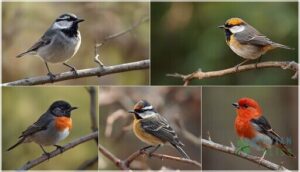
Plumage color patterns are your fastest shortcut in the field.
If you’re curious about how plumage patterns relate to a bird’s environment, check out this guide to bird identification with white stripes and habitat clues.
Crown Patterns alone tell the story — the Golden-crowned Kinglet‘s bold black-and-yellow cap versus the Ruby-crowned’s hidden ruby patch.
Nape Contrasts, Belly Contrasts, and Countershading work together as a full-body ID system.
| Species | Key Plumage Contrast |
|---|---|
| Dark-eyed Junco | Slate upperparts, clean white belly |
| White-throated Sparrow | Gray back, white belly, yellow lores |
| Golden-crowned Kinglet | Black-striped crown, orange patch |
| Painted Redstart | Black plumage, crimson belly |
| Hepatic Tanager | Scarlet top, paler orange below |
Flashes of Color on Wings and Tail

Catch a Dark‑eyed Junco’s white tail patches as it flares up—those flashes aren’t just pretty. They’re field marks with purpose: predator confusion flashes, flock cohesion, even courtship flash displays.
Wing flash timing matters too—mockingbirds’ wing bars pop mid‑display, while warblers’ tail flash angles shift with each fan.
Watch for:
- Wing bars revealed in flight
- Tail patch shape changes
- Seasonal flash variation
- Underwing color blocks
Behavioral and Habitat Clues in Songbirds

Spotting a songbird isn’t just about colors and markings—you’ll want to pay attention to how it moves and where it hangs out.
Behavior and habitat choices can tell you a lot about what you’re seeing.
Here’s what to watch for next.
Movement Patterns (Hopping, Flitting, Perching)
Ever notice how a sparrow’s Ground Hopping Mechanics look like a spring-loaded toy? That’s not random—bird behavior studies show it’s efficient for scanning lawns.
Warblers, on the other hand, use Flitting Flight Dynamics, zigzagging through foliage.
Perch Approach Strategies vary: song sparrows swing tails forward, house sparrows hover.
Tail Flick Signaling and Wing Undulation Types reveal alertness and migration readiness.
Feeding Behavior and Diet Indicators
Spot a songbird’s bill morphology and you reveal its menu—finches wield stout bills for seed handling, warblers use thin beak shapes for insect gleaning, while nuthatches pry bark with chisel-like bill structure.
Foraging tactics clue you in: aerial flycatchers hawk bugs, chickadees glean, some sip nectar.
Bird behavior and field marks connect diet to identity.
Preferred Habitats and Microhabitats
Think a songbird’s home is random? Not a chance.
Cerulean Warblers stick to forest interior niches, while Field Sparrows thrive in shrubland edge mosaics.
Bobolinks demand grassland open patches, and Waterthrushes hug riparian buffer corridors.
Urban garden layers pull in goldfinches.
Bird habitats shape behavior and migration—understanding these microhabitats is key for bird ecology and conservation.
Key Songbird Songs and Vocalizations

Songbird songs aren’t just background music—they’re clues that help you spot species fast.
Knowing what to listen for can make identification easier, even when plumage is tricky.
Here’s what to pay attention to next.
Recognizing Common Songbird Calls
Recognizing bird songs and calls starts with tuning your ear to a few key patterns.
Call types split neatly: songs are longer, richer, and tied to seasonal timing — think spring breeding season. Calls are short, functional.
Sharp “seet” notes signal alarm; contact calls keep flocks moving. Pitch patterns and rhythm cues lock in acoustic identification fast — buzzy, whistled, or trilled tells you plenty.
How Songs Aid in Field Identification
Songs do half the work for you. Rhythm pattern cues, pitch variation markers, and repetition signature analysis narrow down a species before you even raise your binoculars.
A Prairie Warbler’s rising buzz is unmistakable.
Spectrogram visual clues confirm what your ear catches. Pair habitat-specific song traits with bird vocalizations, and your bird identification techniques sharpen quickly.
Geographic Variations in Song Patterns
Geography rewires what a bird sings. Dialect zones carve up species ranges the way state lines carve maps — invisible but real. White-crowned Sparrows alone sing six distinct dialects along the Pacific Coast, each covering hundreds of miles.
Birdsong dialects carve invisible boundaries across species ranges, with White-crowned Sparrows singing six distinct regional tunes along the Pacific Coast
Key geographic song patterns to track:
- Song clines shift gradually across elevation and latitude
- Altitude song variation affects pitch and note length in Hermit Thrushes
- Regional trill types split Eastern, Rocky Mountain, and West Coast Towhees
- Population song shifts can spread continent-wide within decades
- Geographic variations and subspecies boundaries often overlap but don’t always match DNA
Tools for Recording and Analyzing Birdsong
Dialects are only half the story — capturing them is where the real work begins. Your gear shapes everything.
| Tool | Best Use | Key Spec |
|---|---|---|
| Parabolic Mic Setup | Isolating single birds | 20–30 dB amplification |
| Shotgun Mic Techniques | Birds in flight or flocks | Up to 100ft range |
| Portable Recorder Settings | Long field sessions | 32-bit float, 24hr battery |
Spectrogram Software Features in Raven Pro let you compare bird songs and vocalizations across populations. For quick bird recording and documentation, AI Identification Apps like BirdNET — an AI‑powered Bird ID Scanner — process bird vocalizations and sounds into matches within seconds.
Top Field Guides for Identifying Songbird Marks
A good field guide can make or break your time in the field — the right one turns a confusing brown bird into a confirmed ID in seconds.
With so many options out there, it helps to know which ones birders actually trust.
Here are five guides worth keeping in your pack.
1. Kaufman Field Guide Birds North America
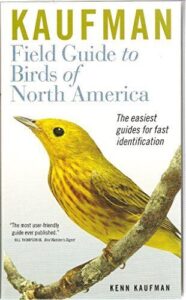
Ever tried to decode a bird’s story from a single glance? The Kaufman Field Guide to Birds of North America makes it possible.
You get crisp digital images—no muddy paintings—grouped by size and shape, so similar songbirds sit side by side. Range maps, habitat notes, and clear field marks (think wing bars, supercilium, breast streaks) are right where you need them. Even beginners can spot key features fast. Durable, compact, and practical—this guide won’t slow you down in the field.
| Best For | Birdwatchers of all skill levels who want a handy, easy-to-use guide for quick bird identification in North America. |
|---|---|
| Field Guide | Yes |
| Color Illustrations | Yes |
| Covers Songbirds | Yes |
| Range Maps | Yes |
| For All Skill Levels | Yes |
| Physical Book | Yes |
| Additional Features |
|
- Clear photos and official names make identifying birds simple, even for beginners.
- Compact and durable design is perfect for outdoor use and nature walks.
- Includes range maps and key field marks for fast, accurate spotting.
- Limited details on each species, so advanced birders may want more information.
- Not pocket-sized and may feel heavy for some users.
- Only available in English, which could be a drawback for non-English speakers.
2. Carving Realistic Songbirds Step-by-Step Guide
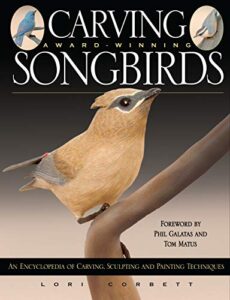
Carving lifelike songbirds isn’t just art—it’s anatomy in wood. Lori Corbett’s “Carving Award-Winning Songbirds” breaks down each step, from body contours to feather texturing. You’ll find over 850 photos, paint mixing charts, and full-size patterns for species like mountain bluebird or cedar waxwing.
The guide dives into bill shape, wing bars, and breast streaks—marks you need for realism. Power tools get priority, so hand carvers may need to adapt. Still, the technical detail helps you read a bird’s story.
| Best For | Woodcarvers who want to create realistic songbirds using detailed, step-by-step instructions and are comfortable with power tools. |
|---|---|
| Field Guide | No |
| Color Illustrations | Yes |
| Covers Songbirds | Yes |
| Range Maps | No |
| For All Skill Levels | Yes |
| Physical Book | Yes |
| Additional Features |
|
- Packed with over 850 photos and 100 illustrations for visual guidance
- Covers everything from carving to painting and making legs and feet
- Suitable for beginners and experienced carvers looking to improve their skills
- Focuses mainly on power carving, which may not suit hand tool users
- Some recommended tools and materials can be pricey
- Technical details might be challenging for absolute beginners
3. South America Passerine Songbird Field Guide
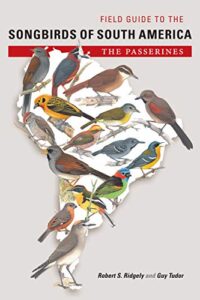
Range maps.
Color plates.
If you’re serious about South American songbirds, this field guide is your toolkit. It covers nearly 2,000 species—mainland and islands—with 121 plates showing over 1,500 birds, including subspecies and females.
Plates sit opposite concise species accounts for quick reference. You’ll get updated taxonomy, abundance, habitat, and elevational details.
It’s heavy, sure, but splitting plates and text helps. For birders who want accuracy and depth, this guide doesn’t leave you guessing.
| Best For | Dedicated birders and ornithologists who want a thorough, authoritative guide to South American songbirds. |
|---|---|
| Field Guide | Yes |
| Color Illustrations | Yes |
| Covers Songbirds | Yes |
| Range Maps | Yes |
| For All Skill Levels | Yes |
| Physical Book | Yes |
| Additional Features |
|
- Detailed color plates and range maps make identification easier.
- Covers nearly 2,000 species with up-to-date information on abundance, habitat, and range.
- A valuable resource for both field study and at-home reference.
- The book is heavy and bulky, not ideal for carrying on long birding trips.
- About 500 species are not illustrated in the plates.
- Some users may find the layout quirky or less intuitive.
4. Stokes Field Guide Birds North America

Need a bird guide that doesn’t skimp on detail? The Stokes Field Guide packs 3,400 color photos across 853 species—showing male, female, seasonal, and immature plumages.
It’s a hefty book, but you get clear shape comparisons, labeled images, and a CD with 600 bird sounds for fieldwork.
Range maps and ABA codes help pinpoint rarity and migration.
You’ll spot wing bars, supercilium, breast streaks—every mark a birder needs.
It’s thorough, practical, and built for real identification challenges.
| Best For | Birdwatchers and nature lovers who want a deep, visual guide to identifying North American birds. |
|---|---|
| Field Guide | Yes |
| Color Illustrations | Yes |
| Covers Songbirds | Yes |
| Range Maps | Yes |
| For All Skill Levels | Yes |
| Physical Book | Yes |
| Additional Features |
|
- Packed with clear photos and detailed shape comparisons for easy identification
- Includes a CD of bird sounds and thorough descriptions of behaviors and habitats
- Covers a huge range of species with helpful range maps and migration info
- Heavy and bulky, so not ideal for carrying on long hikes or field trips
- Some rare species aren’t included
- The sheer amount of information can be overwhelming for beginners
5. Sibley North American Bird Guide
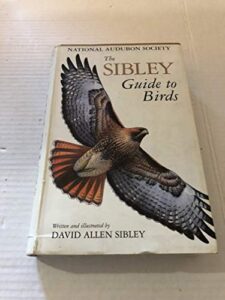
Think of Sibley as your birding blueprint—810 species, 6,600 illustrations, and captions that flag supercilium lines, wing bars, and breast streaks. You get side-by-side comparisons for tricky warblers, plus voice descriptions to cut through confusion when birds stay silent.
Flexible cover, detailed maps, and annual updates mean you’re not chasing outdated info. It’s hefty at 2.5 pounds, but worth the carry for clarity.
If you want precision in the field, Sibley’s got your back.
| Best For | Birders who want a thorough, visual guide for identifying and comparing North American species, whether they’re beginners or seasoned pros. |
|---|---|
| Field Guide | Yes |
| Color Illustrations | Yes |
| Covers Songbirds | Yes |
| Range Maps | Yes |
| For All Skill Levels | Yes |
| Physical Book | Yes |
| Additional Features |
|
- Packed with over 6,600 illustrations and clear captions for quick ID.
- Side-by-side comparisons make tricky species easier to tell apart.
- Includes detailed maps, voice descriptions, and measurements for every bird.
- Heavy and bulky, so not the easiest to carry on long hikes.
- Range maps may lack some detail for rare occurrences.
- No digital version included, so updates require buying a new edition.
Frequently Asked Questions (FAQs)
What are the field marks of birds?
Field marks are nature’s shorthand — the visual clues written into a bird’s feathers, shape, and size that tell you exactly what you’re looking at before it flies away.
How do weather conditions affect songbird markings?
Weather shifts what you see. Rain mutes iridescence by up to 50%, wet feathers clump stripes, and cold below 15°C deepens melanin — darkening streaks, supercilium marks, and flank patterns noticeably.
Can juvenile songbirds have different field marks?
Yes — juvenile songbirds often look like a completely different species.
Their plumage runs duller, streakier, and browner than adults.
A young Chipping Sparrow, for example, shows brown head stripes instead of the crisp black-and-white adult pattern.
What time of year are markings most visible?
Markings peak in visibility from April through July, especially on males.
Fresh alternate feathers, bold wing bars, and crisp head stripes stand out during breeding season—right when birds are courting, defending territory, and showing off for mates.
Do songbird markings change during molting?
Molting reshapes what you see—new feathers pop against faded ones, wing bars shift, breast streaks blur, and overall color dulls or brightens.
You’ll notice patchy, uneven plumage, especially in first-year birds and during spring migration.
How reliable are photos for identifying field marks?
Ever wondered if photos tell the whole story?
Bold field marks like chickadee wing bars hold up well—even in poor light or blurry shots.
But bland marks, such as faint supercilia, often vanish, making photo ID tricky.
Conclusion
Think of songbird ID as piecing together a jigsaw—each key field marks slots in, revealing a clearer picture. Bill shape, wing bars, and head stripes aren’t just details; they’re the clues that reveal names from the chorus outside your window.
Behavior and habitat add context, like the background of a painting. With the right guides, your skill sharpens.
Next time you step outside, let curiosity lead—there’s always another feathered puzzle waiting to be solved.
- https://vineyardgazette.com/news/2015/09/16/songbird-identification-101
- https://www.basicsofbirding.com/blog/how-to-identify-birds-looking-for-key-field-marks
- https://www.birdwatchingdaily.com/birds/david-sibleys-id-toolkit/patches-in-birds-tail-feathers-can-lead-you-to-id-them/
- http://www.naturephotographers.net/articles1002/kac1002-1.html
- https://avianreport.com/bird-plumage/