This site is supported by our readers. We may earn a commission, at no cost to you, if you purchase through links.
 You’ll discover mountain bird breeding grounds nestled in alpine meadows and rocky outcrops between 3,000 and 12,000 feet, where sparse vegetation creates perfect hunting corridors for species like Mountain Bluebirds. These high-elevation sanctuaries feature natural tree cavities, woodpecker holes, and nestboxes that secondary cavity nesters depend on for successful reproduction.
Temperature swings and changing snowpack patterns shape these unique ecosystems, forcing birds to time their breeding with precision. Climate change now threatens these delicate habitats, making conservation efforts more critical than ever. Understanding how these feathered mountain dwellers choose their nesting sites reveals fascinating survival strategies you won’t expect.
Table Of Contents
Key Takeaways
- You’ll find mountain bird breeding grounds between 3,000–12,000 feet elevation, where alpine meadows and rocky outcrops create perfect hunting corridors and shelter for species like Mountain Bluebirds.
- You can’t overlook how these birds depend on natural tree cavities, woodpecker holes, and nestboxes, since they’re secondary cavity nesters who can’t excavate their own nesting sites.
- You’ll witness climate change disrupting breeding patterns through temperature swings and changing snowpack, forcing birds to time reproduction with increasing precision as traditional habitats shift.
- You should support conservation efforts, since mountain bird populations have declined 23–25% over recent decades, making habitat restoration and sustainable tourism practices critical for species survival.
Key Features of Mountain Bird Breeding Grounds
When you’re studying mountain bird breeding grounds, you’ll notice they often share specific characteristics that make high-altitude nesting successful. These sites feature open alpine meadows, rocky outcrops for shelter, and sparse vegetation that won’t obstruct the birds’ impressive hunting flights—think of it as nature’s version of a perfectly designed airport runway.
Mountain bird breeding grounds share specific characteristics that make high-altitude nesting successful, featuring alpine meadows and rocky outcrops like nature’s perfectly designed airport runways
Typical Habitats and Elevations
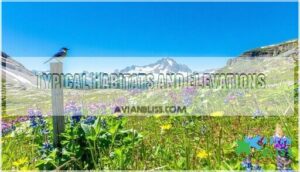
Mountain Bluebirds nest at elevations ranging from 3,000 to 12,000 feet across western mountain ranges. This wide elevation range creates distinct vegetation zones, with alpine meadows providing some of the best breeding conditions.
Alpine meadows represent prime breeding habitat, while geographical distribution spans western mountain ranges. Mountain bird habitats showcase striking adaptability to elevation’s challenges.
Common Vegetation and Terrain

Mountain bird habitats present a patchwork of challenging environments shaped by elevation and exposure.
Alpine plants form distinct microhabitats – from cushion plants anchored to windy ridges to wildflower meadows tucked in sheltered valleys, each supporting different bird communities where forest meets sky.
- Scattered cushion plants clinging to windswept slopes
- Stunted krummholz forming twisted natural sculptures
- Sparse grasses dotting well-drained rocky surfaces
- Dense wildflower carpets in protected valley pockets
- Bare scree fields interrupted by hardy alpine shrubs
Rocky Outcrops and Alpine Meadows

You’ll discover Rocky Shelters tucked into cliff faces provide perfect windbreaks for Rocky Outcrop Birds. These High Altitude Environments create Alpine Microclimates that protect eggs from harsh weather.
Meanwhile, Alpine Meadow Birds benefit from abundant Meadow Food sources blooming nearby. Smart Outcrop Nesting strategies near these flower-rich areas boost Breeding Success greatly in mountain Breeding Grounds and prime Nesting Sites.
Mountain Bluebird Nesting Habits
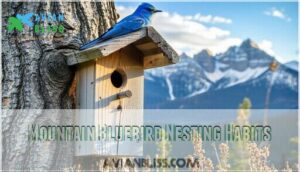
Mountain Bluebirds scout nest sites like seasoned house hunters, seeking open cavities in snags and nestboxes across western mountain ranges from 3,000 to 12,000 feet elevation.
As secondary cavity nesters, they can’t dig their own holes and rely on woodpecker cavities, natural tree hollows, and human-provided nestboxes in alpine meadows and burned forest areas.
Nest Site Selection Process
When selecting nesting sites, you’ll notice Mountain Bluebird pairs engage in complex territory defense and mate selection behaviors. Males establish territories first, defending cavity availability through aggressive displays.
Females assess nest site quality, evaluating factors like site fidelity from previous seasons and nest competition levels. This nest site selection process determines Mountain Bluebird nesting behavior success, as prime nesting sites directly influence breeding outcomes.
Preferred Nesting Locations
Mountain Bluebirds show up in predictable places when they’re hunting for the perfect nest site. Males stake out territories in open grasslands dotted with trees, burned forests full of dead snags, and those beautiful mountain meadows just below the treeline—and they fight hard to keep the prime real estate.
- Open grasslands – Short grass prairies with occasional perches for hunting
- Burned forest areas – Fire-damaged zones with dead trees perfect for cavity nesting
- Mountain meadows – High-elevation clearings surrounded by scattered conifers
- Ranch pastures – Working lands with fence posts and minimal ground cover
- River valleys – Riparian areas offering diverse insects and nesting opportunities
Use of Natural Cavities and Nestboxes
Mountain Bluebirds are cavity nesters who’ll take what they can get. You’ll find them using old woodpecker holes, natural tree cavities, and cliff crevices.
Nest boxes become prime real estate when cavity competition heats up. Proper nestbox design, placement, and materials matter—think entrance holes sized just right and monitoring access.
These adaptable birds make any nest cavity work, transforming simple spaces into cozy mountain nurseries.
How Mountain Bluebirds Build and Use Nests
You’ll discover that female Mountain Bluebirds construct their deep cup nests with striking precision, weaving grasses and pine needles into cavities while males stand guard like feathered sentinels.
These sky-blue architects don’t just build homes—they engineer nurseries that can withstand mountain weather, sometimes adding unexpected materials like colorful trash that makes their nests look like tiny recycling projects.
Nest Construction and Materials
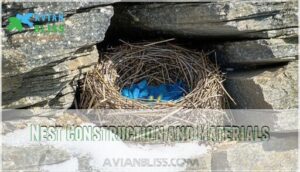
After you’ve located the ideal spot, the real magic begins with nest building. Female mountain bluebirds weave together grasses, pine needles, and bark strips to create their deep cup homes.
Though they’re surprisingly resourceful, some will work feathers or even bits of human debris into the mix, depending on what’s available nearby.
The nest building timeline spans 4-7 days, with nesting cavity size determining final nest cup depth and overall structure.
Roles of Male and Female Bluebirds

Once nesting materials are in place, you’ll observe distinct breeding behavior patterns between partners. The male bluebird focuses on territory defense, patrolling boundaries, while the female bluebird takes care of nest building and incubation duties.
During courtship, males bring food offerings. After hatching, cooperative parenting takes over—both share post-fledging care responsibilities, teaching fledglings hunting techniques across their mountain territory.
Unusual and Alternative Nest Sites

Beyond typical woodpecker cavities, you’ll discover mountain bluebirds adapting to unusual nest sites with striking creativity. They’ll repurpose mailboxes, fence posts, and even urban nests in streetlights when human impact reduces natural options.
Some pairs practice nest sharing or nest relocation when predators threaten. Nest reuse becomes common when suitable nest cavity locations grow scarce at higher elevations.
Environmental Factors Influencing Mountain Bird Breeding
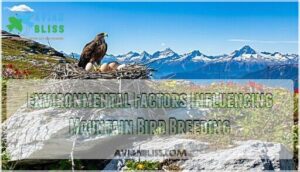
Mountain birds face a gauntlet of environmental pressures that determine whether their nesting efforts succeed or fail.
Temperature swings, lingering snowpack, and scarce food sources create an intricate puzzle these hardy species must solve during their most vulnerable breeding months.
Climate and Seasonal Changes
Temperature impacts reshape when you’ll spot mountain birds beginning their breeding cycles. Changing snowpack patterns and habitat shifts force species to adapt their migration timing, directly affecting breeding success. Climate change creates unpredictable environmental influences on nesting, often shortening breeding season length as temperatures rise faster than historical norms. Mountain Bluebirds, for example, generally lay pale blue eggs.
- Higher prebreeding temperatures advance breeding start by approximately 6 days per +1°C
- Heavy spring precipitation can delay nesting onset by up to 39 days
- Two-thirds of high-elevation broods hatch during snowmelt periods
- Mountain temperatures have increased 0.8°C over recent 16-year studies
Food Availability and Predation
Mountain bird breeding success hinges on prey abundance and predator impact. Avian species adapt their foraging strategies as insect populations fluctuate with elevation. Dietary shifts occur when traditional food sources become scarce. Nest predation increases near habitat edges, where threats to bluebirds are more concentrated.
| Elevation Range | Primary Diet | Main Predators |
|---|---|---|
| 5,000-7,000 ft | Flying insects, beetles | Hawks, weasels |
| 7,000-9,000 ft | Ground insects, larvae | Squirrels, snakes |
| 9,000+ ft | High-altitude arthropods | Ravens, marten |
Effects of Altitudinal Migration
You’ll witness how these migration triggers shape breeding success across high elevations. Mountain Bluebird populations rely on these vertical journeys to best use energy during breeding seasons. Climate change increasingly disrupts traditional migration patterns, forcing genetic adaptation at exceptionally fast rates.
- Temperature fluctuations: Cold snaps drive birds to lower breeding grounds temporarily
- Food scarcity: Insects become scarce at peak elevations, prompting downward movement
- Weather windows: Brief favorable periods allow return to ideal high-altitude sites
- Predator avoidance: Lower elevations often harbor more nest predators than alpine zones
- Seasonal timing: Late spring snowmelt delays access to preferred mountain breeding territories
Conservation Challenges and Protection Strategies

You’ll find that mountain bird populations face serious threats from climate change, habitat loss, and human disturbance, making conservation efforts more critical than ever. Researchers have documented population declines of at least 25% since the late 1990s, but targeted protection strategies like habitat restoration and sustainable tourism can help reverse these troubling trends.
Threats to Mountain Bird Breeding Grounds
Three major dangers stalk your favorite mountain birds at their breeding grounds. Climate change shrinks snowpacks and raises temperatures, forcing species higher up slopes. Habitat loss from human disturbance and deforestation eliminates critical nesting sites. Invasive species and pollution impacts compound these threats to mountain birds. According to recent research, climate change poses the greatest threat to North American birds.
| Threat Category | Primary Impact | Affected Species |
|---|---|---|
| Climate Change | Temperature shifts, reduced snowpack | High-elevation specialists |
| Habitat Loss | Deforestation, development | Cavity nesters, ground nesters |
| Human Disturbance | Recreation pressure, infrastructure | Sensitive breeding species |
| Invasive Species | Competition, nest predation | Native mountain birds |
Conservation Efforts and Research
Mountain bird conservation requires a hands-on approach that combines field monitoring with active habitat management. Researchers now track declining species numbers while working to restore critical aspen groves and forest edge habitats where these birds depend on for nesting.
Climate studies help shape these conservation strategies, and targeted nest box installations provide immediate support for struggling populations. Meanwhile, genetic analysis reveals which bird communities face the greatest risks, allowing conservationists to direct limited funding toward the most threatened breeding areas.
Sustainable Tourism and Habitat Management
Beyond crowded trails, sustainable tourism initiatives create win-win scenarios for conservation funding and community involvement.
You’ll find habitat restoration projects flourish when ecotourism benefits back conservation actions. These conservation measures protect natural habitats while tourism impact stays minimal through careful management.
Frequently Asked Questions (FAQs)
What temperatures can mountain birds tolerate during breeding?
High-altitude species routinely endure freezing conditions, with mountain birds successfully breeding in temperatures ranging from -40°F to 80°F.
You’ll find they’ve evolved striking physiological adaptations like enhanced oxygen utilization and thick insulating plumage to handle these extreme temperature swings.
How long do mountain bird breeding seasons last?
You’ll find that mountain bird breeding seasons generally span 3-4 months, from late spring through early summer.
Mountain bird breeding seasons typically last 3-4 months, stretching from late spring into early summer.
Which mountain ranges have highest breeding bird diversity?
It’s not rocket science, but you’ll want to focus on the Andes and Himalayas. The Andes host over 1,700 bird species, with about one-third endemic, while the Himalayas harbor nearly 1,000 species across their elevational gradients.
Do mountain birds return to same territories annually?
Yes, you’ll find many mountain bird species exhibit strong site fidelity, returning to familiar territories annually due to previous nesting success and resource knowledge.
How do extreme weather events affect breeding success?
Serene sunrise meets violent storm. You’ll find storms and late snowpack devastate nesting schedules, flooding nests and killing chicks through increasingly frequent weather extremes.
Conclusion
Studies show that mountain bird populations have declined by 23% over the past two decades, making these high-altitude sanctuaries increasingly precious. These alpine ecosystems face mounting pressure from climate change, yet they remain critical for species like Mountain Bluebirds.
You’ve now explored how mountain bird breeding grounds provide essential nesting sites through natural cavities, nestboxes, and diverse terrain features.
You can champion conservation efforts by participating in citizen science projects and furthering sustainable recreation practices in these fragile environments.
- https://www.nature.com/articles/s41597-022-01723-6
- https://www.sciencedirect.com/science/article/pii/S2351989421003498
- https://www.cambridge.org/core/books/ecology-and-conservation-of-mountain-birds/avian-adaptations-to-high-mountain-habitats/DD546D6240AA88583E6008B1A2EC00B0
- https://luonnontila.fi/en/indicators-by-major-environment-type/fells/breeding-mountain-birds/
- https://vtecostudies.org/blog/updated-for-2020-state-of-the-mountain-birds-report/