This site is supported by our readers. We may earn a commission, at no cost to you, if you purchase through links.
A song sparrow can weave a nest tight enough to hold water—and it does this almost entirely from memory, selecting fibers by feel and flex. What makes that possible isn’t luck. It’s the right raw material, and native grasses deliver it in ways no imported lawn grass can match.
Little Bluestem stems hold their rigidity through rain and wind. Switchgrass tussocks hide ground nests in plain sight.
The fiber lengths, natural waxed surfaces, and seasonal timing of native grasses all align with what birds actually need. Knowing which grasses to grow—and how to manage them—turns your yard into a reliable nesting supply for the birds already in your neighborhood.
Table Of Contents
- Key Takeaways
- Best Native Grasses for Bird Nesting Material
- Why Native Grasses Outperform Non-Native Alternatives
- Which Bird Species Use Native Grass Nesting Materials
- How to Grow and Manage Native Grasses for Nesting Birds
- When and Where to Offer Native Grass Nesting Materials
- Frequently Asked Questions (FAQs)
- Conclusion
Key Takeaways
- Little Bluestem and Switchgrass are your two hardest-working natives — one builds the frame, the other hides the nest from predators.
- Native grasses produce fibers in just the right length, stiffness, and texture that songbirds need to weave a nest that actually holds together through wind and rain.
- warm-season and cool-season natives keeps fresh nesting material available almost continuously, so birds aren’t left scrambling when the season shifts.
- Skipping pesticides and leaving clumps standing through winter aren’t just nice ideas — they directly protect the chicks and ground-nesters depending on your yard.
Best Native Grasses for Bird Nesting Material
Not all native grasses are equal with respect to what birds actually want to build with. Some offer sturdy structure, others provide soft insulation or hidden cover, and the best yards tend to have a mix of both.
Pairing the right grasses with flowering plants and shrubs—like those listed among the best native plants for birds—gives your yard layers that birds rely on from nesting season straight through winter.
Here are the native grasses that pull the most weight during nesting season.
Little Bluestem as a Sturdy Nest Frame Builder
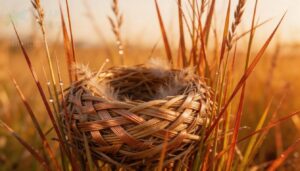
Little Bluestem is one of those native vegetation workhorses that birds keep coming back to. Its ribbed stem rigidity gives songbirds a reliable scaffold for weaving dry grass and other natural materials into a tight frame.
The vertical support clumps stay upright even after rain. It’s drought resistant, fire adapted, and shifts to bronze-red in fall — clear seasonal color cues that signal fresh birdfriendly nesting materials are ready.
Its deep root system prevents erosion and improves soil health.
Switchgrass Tussocks for Ground-Nesting Concealment
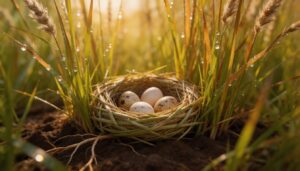
Switchgrass works differently than little bluestem — it’s built for concealment. Growing 3 to 6 feet tall, its dense tussocks act as a natural Tussock Predator Shield for ground‑nesting species like meadowlarks.
Here’s what makes it stand out as nesting material:
- Moisture Retention stabilizes the soil base beneath nests
- Microhabitat Temperature stays cooler in summer shade pockets
- Seed Head Insulation adds dry padding into late fall
- Structural Diversity Benefits multiple species with varied canopy density
Its native vegetation roots hold firm, making it genuinely bird‑friendly habitat.
Warm-Season Vs Cool-Season Natives for Year-Round Supply
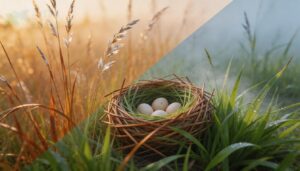
Not every grass grows on the same clock, and that’s actually a gift.
Warm-season natives like little bluestem push up stiff, wiry stems after the last frost — their Fiber Stiffness Contrast with cool-season grasses is real and useful. Cool-season types start earlier, offering softer fibers for lining.
Together, their Seasonal Biomass Overlap means your yard keeps delivering bird nesting material almost continuously.
How Seed Heads Extend Nesting Material Availability
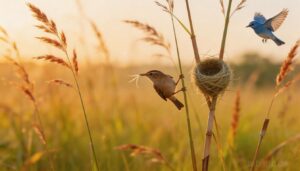
seed heads do double duty in a bird-friendly habitat — they’re food and building material at once. That Food Nest Link is real.
Perennial native plants keep Multi-Year Seed Production going without your help, offering Seasonal Seed Persistence well into winter.
The Structural Seed Benefits are practical too: coarse fibers and hollow stems give birds ready-made weaving material, naturally extending the seasonal provision of nest materials beyond what grass clippings alone can offer.
Why Native Grasses Outperform Non-Native Alternatives
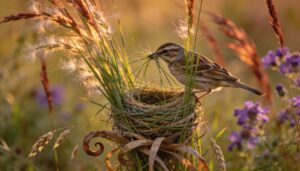
Native grasses don’t just look good in your yard — they’re genuinely better building materials for birds than anything non-native.
Native stems and seed heads are especially valuable come cold months, which is why they pair so well with winter bird houses designed for cozy, safe shelter.
A specific reasons explain why local species keep coming back to them season after season.
Here’s what makes native grasses stand apart.
Regional Growth Patterns and Early Spring Availability
Native plants are tuned to your local calendar in ways non-natives simply aren’t.
In urban areas, heat island effects can push spring greenup up to 10 days earlier, giving birds like sparrows and robins faster access to fresh nesting material.
But false spring risk in the Great Plains, where late frosts disrupt microclimate phenology shifts and leave birds scrambling.
Natural Fiber Length and Weavability for Songbirds
Think of grass fibers like thread — the right length makes all the difference. Songbirds prefer a fiber length range of 2–6 centimeters from native plants, which hits that sweet spot between pliable and sturdy.
Here’s what makes native grass clippings and dry grass so effective for bird nest building:
- Twist stiffness balance — slight natural stiffness locks weaves tight
- Elasticity wind resilience — moderate flex keeps nests intact through gusts
- Waxed surface texture — natural wax helps fibers grip each other
- Uniform diameter cohesion — consistent strands create a tight, reliable cup
This organic nesting material simply weaves itself into something birds can rely on.
Rot Resistance and Moisture Control in Nest Sites
Keeping a nest dry is half the battle. Pine needle hydrophobicity channels rain away from the nest core, while coarse grass pockets trap air that slows moisture transfer. Reed fiber capillary action and moisture-wicking layering pull dampness outward. Microclimate evaporation does the rest.
| Material | Moisture Benefit |
|---|---|
| Pine needles | Channel water away from nest core |
| Coarse grass stems | Create air pockets, reduce dampness |
| Dry grass layers | Wick moisture toward outer shell |
| Reed/sedge fibers | Shed standing water efficiently |
| Native grass clippings | Resist rot, support long-term nest durability |
Native plant diversity gives birds exactly what they need — natural nest insulation that actually lasts.
Compatibility With Local Bird Species
Local birds didn’t evolve alongside non-native grasses — and it shows. Species fiber preferences vary widely, from sparrows selecting intermediate lengths for tight cup nests to meadowlarks favoring coarse stems for bulky frames.
Native plant diversity facilitates this microhabitat selection naturally, aligning with seasonal breeding calendars. Grass clippings from regional natives offer nest architecture compatibility that exotic species simply can’t match.
Which Bird Species Use Native Grass Nesting Materials
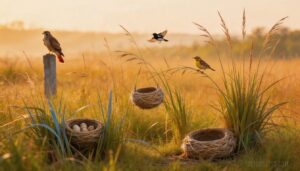
Not every bird builds the same kind of nest, and the grasses they reach for tell you a lot about how they live. Native grasses attract a surprisingly wide range of species, from ground-nesters tucked into wetland edges to hawks perched high overhead.
Here’s a closer look at which birds are actually using these materials and why.
Meadowlarks and Ground-Nesting Ducks in Grassy Wetlands
Few birds rely on native grasses more completely than meadowlarks and ground-nesting ducks. Meadowlarks scrape shallow cups from dry grass at the base of tussocks, using dense cover for chick fledging and predator deterrence.
Ducks nesting near floodplain moisture weave cattails and grass clippings into hidden bowls, where egg incubation stretches nearly a month.
Habitat fragmentation threatens both — your intact grass patches genuinely matter.
Sparrows and Perching Birds in Tall Native Stands
Sparrows treat tall native stands like a layered apartment building — each height serving a different purpose. Perch height preference shifts throughout the day, with birds using upper stems for territorial song display and dropping low for foraging.
Predator vigilance strategies rely on thick tussocks for quick cover.
Your tall grasses quietly support:
- Insect forage integration within microhabitat moisture gradients
- Concealed nesting between 0.5 and 2.0 meters up
- Native shrubs and native trees as boundary anchors
- Birdfriendly landscaping that connects foraging and nesting zones
Robins and Bluebirds Using Dry Grass Clippings
While sparrows favor taller stems, robins and bluebirds work closer to the ground, gathering dry grass clippings in small mouthfuls and weaving them into tight nest cups. Robins rely on clipping collection behavior to reinforce cup rim reinforcement with mud-bound fibers, while bluebirds pack fine lining texture benefits into cavities for microclimate temperature regulation.
Keep your yard chemical-free — safe and non-toxic choices matter for mold prevention practices.
Hawks and Larger Birds Selecting Coarser Grass Stems
Hawks move up in scale from the fine clippings, bluebirds prefer, reaching instead for coarser stems that offer real perch strength and edge ledge formation. Thick native vegetation stems resist bending — solid wind resistance that keeps large nests stable.
Their seasonal stem supply aligns naturally with late-winter growth, and the temperature buffering from dense stem mats protects eggs during cool spring mornings.
How to Grow and Manage Native Grasses for Nesting Birds
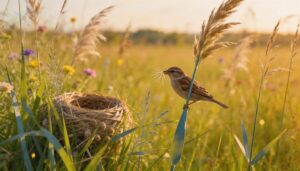
Growing native grasses for birds isn’t complicated, but a few management habits make a real difference. How you plant, mow, and care for your grass patches directly shapes what birds can find and use.
Here’s what actually works.
Leaving Clumps Unmowed Through Late Winter
Resist the urge to tidy everything up in late fall. Leaving native grass clumps unmowed through winter does more than you’d expect — it helps soil moisture retention, microclimate stabilization, and nutrient cycling as residue breaks down slowly.
Those standing stems also create invertebrate habitat and predator protection for ground nesters.
It’s a simple choice that quietly keeps your bird-friendly habitat working all winter long.
Planting a Mix for Continuous Seasonal Coverage
Think of your grass patch as a relay race — one species hands off to the next. A clump-tuft mix of cool-season and warm-season natives, sown in a staggered sowing window, keeps seasonal fiber timing consistent through breeding months.
Overlapping germination fills gaps naturally.
Moisture-adapted species hold up in drier spells, giving birds a steady, bird-friendly habitat with nesting material whenever they need it.
Avoiding Pesticides and Synthetic Fertilizers Near Grass Patches
What you put in the soil ends up in the nest. Synthetic fertilizers and pesticides contaminate grass fibers, and treated clippings have been found in 100% of sampled nests where chemicals were used nearby. That’s a real risk to chicks.
What you put in the soil ends up in the nest, and for chicks, that’s a risk you can’t afford
Keep your patches clean with:
- Compost mulch use for slow-release nutrients without chemical buildup
- Organic soil amendments like bone meal or seaweed extract
- Buffer zone plantings of native forbs to block chemical drift prevention
- Beneficial insect habitats instead of pesticide sprays for pest control
Creating Ground-Cover Diversity for Multiple Nesting Microhabitats
A layered yard gives birds more than materials — it gives them choices. Mix bunch grasses low with native forbs mid-height and tall grasses above three feet, and you’ve built a living system.
| Layer Type | Nesting Benefit |
|---|---|
| Ground bunch grasses | Shelter for ground nesters |
| Leaf litter zones | Insulation and camouflage |
| Brush piles | Safe foraging and concealment |
| Mid-height forbs | Texture variety for weaving |
| Tall native stands | Phenology overlap across seasons |
Patchy spatial design, moisture gradients, and layered vegetation together create a wildlife-friendly yard that birds genuinely use.
When and Where to Offer Native Grass Nesting Materials
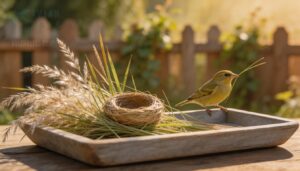
Getting native grass materials in front of birds is really about two things: timing and location. Put them out too late or in the wrong spot, and most birds have already moved on.
Here’s what actually works.
Timing Placement From Late February Through Early Summer
Start your Late February Deployment before birds even begin scouting — they move fast. By Early March Perch setups should already be stocked, since fresh fibers disappear within days.
Do a Mid-April Refresh as the April Seed Surge kicks in and demand spikes.
May Weather Timing matters too; dry spells produce fluffier, more collectible material.
Keep supplies going into early summer for a truly bird-friendly yard.
Positioning Materials Near Shrubs and Existing Perches
Location is everything — place fibers within 1–2 meters of native shrubs, right along natural foraging routes. won’t detour far when they’re building. Keep Shrub Proximity tight, and match Perch Height between 0.5 and 1.5 meters for small songbirds.
bird-friendly yard does these things well:
- natural materials near native shrubs, not in open clearings
- Stay 30–60 cm from existing perches for quick collection
- Rotate spots every two weeks for Predator Buffer Zones
- Keep ground beneath well-drained for solid Moisture Management
- Avoid dense low cover that traps dampness around fibers
Using Mesh Bags or Baskets to Display Grass Fibers
Mesh bags are one of the simplest tools you’ll reach for.
Mesh Ventilation keeps grass fibers dry and breathable, cutting down on mold before birds even get there. Light or Color-Coded Mesh lets you check fiber density at a glance.
Eco-Friendly Baskets with Portable grips make repositioning easy, and the right Basket Height — eye-level with nearby perches — keeps natural materials accessible for any bird-friendly habitat.
Replenishing Supplies Every Two Weeks During Peak Breeding
Think of nesting season like a pantry that birds empty faster than you can stock it. Every two weeks during the breeding season, swap out old grass fibers for fresh ones — this is your Supply Rotation Timing in action.
- Target 50 grams minimum per nest site daily
- Moisture Control Protocol: store fibers in shaded, breathable containers
- Weight Tracking System to spot weather-related shortages early
- Patch Distribution Strategy across four or more locations
- Predator Risk Mitigation by repositioning if activity drops
Frequently Asked Questions (FAQs)
How do invasive plants compete with native grasses for birds?
Invasive plants don’t just crowd out natives — they quietly drain the resources birds depend on.
Through nutrient competition and microhabitat alteration, they disrupt the delicate balance that makes natural materials available when birds need them most.
Are native grasses beneficial for winter bird habitat too?
Absolutely. Native grasses pull double duty year-round.
Their sturdy stems provide Winter Shelter and Snow Insulation for roosting birds, persistent seed heads offer a Cold Food Source, and dense clumps deliver Microhabitat Protection during harsh months.
Conclusion
Investigate the truth of a simple yet powerful act: supporting local wildlife with native grasses. By choosing Little Bluestem, Switchgrass, and other native species, you’re providing essential nesting material for birds.
This thoughtful approach to gardening both benefits your neighborhood’s bird population and also fosters a deeper connection with nature. With native grasses nesting material, birds love and use; you’ll be cultivating a haven for wildlife, one yard at a time, with native grasses.