This site is supported by our readers. We may earn a commission, at no cost to you, if you purchase through links.
Most people stare at a small brown bird for ten seconds, shrug, and move on. That moment of defeat is familiar to almost every birder who started without the right tools.
North America hosts over 900 bird species, and roughly a third of them are native songbirds that look frustratingly similar at a glance. The difference between a Song Sparrow and a Lincoln’s Sparrow often comes down to one subtle breast streak.
A native songbird identification chart collapses that gap fast—pairing visual field marks, song patterns, and seasonal range data into one compact reference you can actually use outdoors.
Table Of Contents
- Key Takeaways
- Native Songbird Chart Basics
- Visual Field Marks to Compare
- Song and Call Pattern Clues
- Species Groups on The Chart
- Habitat and Season Filters
- Printable and Digital Chart Features
- Frequently Asked Questions (FAQs)
- What colors not to wear when birding?
- What are some common songbirds?
- What are common Indian birds?
- How do invasive species affect native songbird populations?
- Which songbirds are most affected by window collisions?
- How do feeders influence songbird range expansion?
- What role do native plants play in songbird survival?
- Conclusion
Key Takeaways
- A songbird identification chart is most useful when it combines visual field marks, song patterns, and regional range data into one compact, field-ready reference.
- Shape, size, and pattern are more reliable ID clues than color alone, especially in low light or at distance.
- Pairing your chart with audio tools like Merlin or BirdNET—and QR-linked calls—turns a visual guess into a confident, sound-backed identification.
- Habitat and season work as your sharpest filters: knowing where and when a species appears cuts your candidate list in half before you even raise your binoculars.
Native Songbird Chart Basics
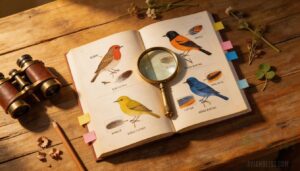
identification chart does more than show pretty pictures — it gives you a system. Once you understand what goes into one, spotting an unfamiliar bird gets a whole lot easier.
The more you practice, the faster it clicks — and tracking your own sightings alongside a guide like this Indiana woodpecker identification resource helps patterns stick in a way that staring at a chart alone never quite does.
Here’s what every solid native songbird chart should cover.
What a Native Songbird Identification Chart Includes
Think of a songbird identification chart as your field-ready cheat sheet. A well-built visual guide packs a lot into a small space — and that’s the point.
| What’s Included | Why It Helps |
|---|---|
| Spectrograms & QR-linked calls | Match songs instantly in the field |
| Standardized Symbol Set & Color‑blind Friendly Palette | Spot key marks fast, no guessing |
| Quick Reference Index | Jump straight to your bird |
| Compact Foldable Design on Durable Waterproof Paper | Survives rain, pockets, and rough trails |
Audio cues paired with visual field marks make every ID stick.
Check out visual identification techniques for more detail.
How to Organize Species by Family and Size
Once you’ve got your chart in hand, knowing how it’s structured saves real time. A songbird identification chart groups birds by family hierarchy first — taxonomic clusters like finches or thrushes — then sorts within each group by size brackets.
| Family Group | Size Range | Key Trait |
|---|---|---|
| Finches | Small (under 15 cm) | Conical bill |
| Thrushes | Medium (16–25 cm) | Spotted breast |
| Sparrows | Small–Medium | Streaked plumage |
| Warblers | Small (under 13 cm) | Thin, pointed bill |
| Cardinals/Grosbeaks | Medium–Large | Heavy, seed-cracking bill |
Cross-referencing families this way turns your visual guide into a real quick-reference card.
Why Native Status Matters in Bird Identification
Knowing a bird’s native status sharpens your native songbird identification by narrowing down real candidates fast. Natives share historical plant ties with local ecosystems — that ecological relevance means they actually belong in your bird identification guide.
Invasive species differentiation gets easier too.
| Native Status | Identification Benefit |
|---|---|
| Resident native | Confirms year-round presence |
| Non-native species | Flags potential misidentification |
| Conservation focus | Improves habitat accuracy |
Regional Range Notes for Accurate Matching
Your native status knowledge pays off even more when you pair it with solid regional range notes. A good songbird identification chart shows exactly where each species shows up — and when. From Altitude Elevation Limits in mountain zones to Coastal Salt Tolerance near shorefront scrub, range map details sharpen your match fast.
| Range Factor | What It Tells You |
|---|---|
| Migration Timing Windows | Months the species is regularly present |
| Seasonal Range Shifts | When and where movement occurs |
| Microhabitat Corridors | Fence lines, hedges, garden paths used |
| Altitude Elevation Limits | Elevations where species regularly appear |
| Coastal Salt Tolerance | Coastal versus inland population behavior |
Quick reference cards and your bird identification guide work best together this way.
Beginner-friendly Chart Layout and Color Coding
Picking up a songbird identification chart shouldn’t feel like reading a technical manual. A clean Single Column Header keeps family groups visible at a glance, while a High Contrast Palette and Colorblind Friendly Scheme make color variations readable for everyone outdoors.
| Chart Feature | Why It Helps You |
|---|---|
| Icon Legend Design | Identifies habitat and status instantly |
| Foldable Printable Sections | Fits easily into a field pack |
| Quick Reference Cards | Speeds up matching in the field |
| UserFriendly Interface | Reduces confusion for first-time birders |
| Visual Identification Guide | Links image, name, and song together |
Visual Field Marks to Compare
Once you know what to look for, spotting a new bird goes from guesswork to something almost instinctive. Field marks are the real shortcut — the small but reliable details that separate one species from another.
what to compare when a bird lands in view.
Eye Rings, Crown Stripes, and Wing Bars

Three tiny details can crack a tough ID: the eye ring, crown stripe, and wing bars.
Eye Ring Morphology stays stable even when a bird shifts posture, making it reliable under tricky Field Lighting Effects. The eye‑ring feathers are stable provide consistent visual signals across postures.
Crown Stripe Function is simple — it separates look-alike sparrows instantly.
Pair that visual trick with bird calls that distinguish similar-looking species and you’ll rarely second-guess a sparrow ID again.
Mark Contrast between wing bars and darker feathers works beautifully on DIY Bird Identification Charts and backyard setups alike.
Bill Shape, Tail Length, and Body Silhouette
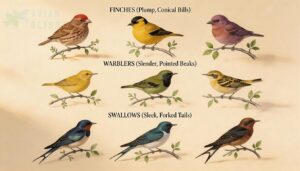
Beyond color, a bird’s overall shape tells you more than you’d expect.
Conical bill types signal seed crackers like finches, while slim, pointed bills mark insect hunters.
Forked tail patterns versus short, compact tails reveal how a species moves and forages.
A rounded body silhouette paired with bill-tail proportion gives your DIY Bird Identification Charts a reliable shape-based keying system for fast visual identification in the field.
Streaking, Spotting, and Breast Coloration

Look closely at the breast — it’s basically a fingerprint for songbirds. Streak Density Variation, from light wisps to bold lines, separates sparrow species fast. Edge Patterns and Breast Hue Contrast — like a robin’s bright orange breast versus a bluebird’s softer rust — are key to using a Backyard Songbird Identification Chart effectively.
A songbird’s breast is its fingerprint — streak density and color contrast make every species unmistakable
Watch for Seasonal Streak Fading and Plumage Camouflage role too.
- Streaks run parallel to feather growth, narrow and regular
- Heavy versus light streaking separates similar sparrow species
- A white eyering or black cap and throat sharpens ID instantly
- Breast color contrast is central to Visual and Audio Bird Identification Techniques
- Seasonal Streak Fading occurs gradually as feathers wear through molt
Perching Posture and Feeding Position

How a bird sits tells you almost as much as its feathers do. The Toe Lock Mechanism keeps songbirds secure without constant effort — tendons engage when the ankle flexes. Watch the Tail Counterbalance Role: a robin tilts forward, then re-centers. Hip Angle Variation separates compact finches from horizontal sparrows instantly.
| Species | Hip Angle | Feeding Position |
|---|---|---|
| House Finch | High | Upright at feeder |
| Song Sparrow | Low | Forward-leaning crouch |
| Eastern Bluebird | Mid | Slight forward reach |
These perching habits are reliable field marks — especially when using a Backyard Songbird Identification Chart alongside visual and audio identification techniques.
Male, Female, and Juvenile Plumage Differences
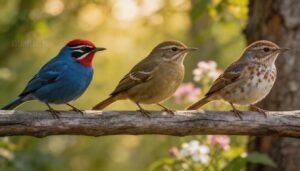
Same species, totally different look — that’s sexual dimorphism at work. Adult males wear bold, saturated plumage patterns, while females show muted tones and subtle facial pattern contrast — perfect juvenile camouflage for nesting.
Juveniles often carry underpart speckling that fades after molt timing completes.
These visual cues and field marks make bird identification sharper once you know what age and sex you’re actually looking at.
Why Size and Pattern Matter More Than Color

Color fools you more than you’d think — wash out the light, add some shadows, and suddenly that "obvious" blue looks gray. That’s where size-based distance cues and pattern reliability save you.
Bold wing bars and eye rings hold up in low-light detection conditions when hue disappears entirely. Field identification speed improves when you train your eye on shape and plumage patterns first, color second.
Song and Call Pattern Clues
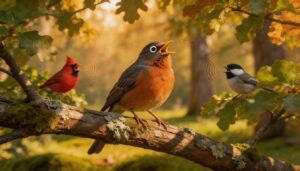
bird you can’t see isn’t lost — it’s just asking you to listen instead. Song patterns are often the fastest way to confirm what you’re looking at, sometimes before you even raise your binoculars.
Here’s how to start reading those audio clues with confidence.
Matching Species With Simple Song Descriptions
Ever hear a sharp, rising whistle and think, "What was that?"
Simple song identification starts with short, memorable phrases — like "drink-your-teeeea" for Eastern Towhee.
These mnemonic phrases act as quick filters, matching vocal energy levels and call length indicators to a handful of likely species.
Paired with QR-linked calls and audio recordings of birds, even a two-second snippet gets you surprisingly close.
Rhythm, Pitch, and Repetition Patterns
Once you’ve matched a mnemonic phrase, rhythm becomes your next clue. Most native songbirds repeat phrases every two to six seconds — that’s refrain timing you can count.
Beat count variations, like a robin’s short-slur-short pattern, separate it from finch ticking rhythms. Pitch range shifts and syllable cluster density narrow things further.
Together, these vocalization patterns make song identification surprisingly reliable.
Using Spectrograms on an Identification Chart
Rhythm gets you close — spectrograms get you there. A good identification chart shows spectrogram patterns as visual images, turning each song into a readable fingerprint.
Frequency Band Highlighting marks where a species concentrates its energy, while Amplitude Color Mapping shows loud versus soft elements at a glance.
Temporal Motif Visualization reveals repeated phrase blocks, and Zoomed Frequency Detail lets you inspect narrow vocal ranges precisely.
Apps like Merlin Bird ID use AI-powered song matching tied to these same patterns.
QR-linked Audio for Instant Call Playback
Scan a QR code on your field guide, and you’re hearing the exact call within seconds — no app login, no searching. Modern charts pair QR-linked calls with a mobile-friendly player design for instant access.
Here’s what makes this system work:
- Audio Hosting Security keeps files on HTTPS servers, so playback is safe and reliable.
- Live QR Updates let publishers swap audio without reprinting your chart.
- Multilingual Playback Options serve birders across languages through the same code.
- Scan Analytics Dashboard helps guide creators see which species get the most listens.
- Audio Cue Integration via QR Links connects directly to BirdNET and Merlin Bird ID databases.
Mnemonics for Remembering Common Bird Songs
A few simple tricks can lock bird songs into memory fast.
Syllable Mapping turns calls into short phrases — "drink-your-teeeea" for the Eastern Towhee.
Pitch Contour and Temporal Pacing capture whether a song rises, falls, or pulses steadily.
Visual Mnemonics and Mnemonic Flashcards pair spectrogram patterns with images.
These mnemonic devices for birdsong memory help you decode seasonal singing patterns of songbirds wherever you are.
Separating Similar Species by Voice Alone
When two birds look nearly identical, their voices tell them apart. Trill rate, pitch range, and Call Note Diagnostics reveal vocal differences that eyes miss.
BirdNET uses AI-powered song matching and Acoustic Template Matching against spectrogram patterns to flag Frequency Modulation and Temporal Variation instantly. Dialect Mapping catches regional song shifts.
Auditory identification this way turns a frustrating guess into a confident call.
Species Groups on The Chart

A good identification chart doesn’t just list birds randomly — it groups them by family so your eyes learn faster. Once you know the shape and habits of one cardinal, spotting the next one takes half the time.
Here’s how the chart breaks down the most common native songbird groups you’ll encounter.
Cardinals, Finches, and Grosbeaks
Cardinals, finches, and grosbeaks share one unmistakable trait — that thick, conical bill built for cracking seeds. It’s your fastest bird ID shortcut for this group.
The Northern Cardinal’s vivid red crest, the House Finch’s rosy wash, and the Blue Grosbeak’s deep indigo all reward feeder attraction setups.
Each species shows vocal learning and distinct nesting sites.
| Species | Key Field Mark | Feeder Attraction |
|---|---|---|
| Northern Cardinal | Red crest, orange bill | Sunflower seeds |
| House Finch | Rosy head, streaked flanks | Mixed seed blends |
| Blue Grosbeak | Deep blue, rusty wing bars | Millet, open ground |
Use quick reference tabs to track migration patterns and predator avoidance behaviors by season.
Robins, Thrushes, and Bluebirds
Orange breast, blue wings, flute-like song — robins, thrushes, and bluebirds cover a lot of ground in your field guide.
| Species | Key ID Trait |
|---|---|
| American Robin | Bold orange breast, gray back |
| Eastern Bluebird | Vivid blue above, rusty chest |
| Hermit Thrush | Spotted breast, reddish tail |
| All Three | Insect Diet, Vocal Learning |
Range Expansion and winter roosting patterns shift bird identification across seasons.
Sparrows and Towhees
Sparrows and towhees are the bread-and-butter of any field guide — easy to overlook, hard to master. Watch for tail flicking and posture clues during bird identification, and check Seed Preference differences between species.
| Species | Key ID Trait |
|---|---|
| Song Sparrow | Streaked breast, central spot |
| White-throated Sparrow | Bold crown stripe, yellow lore |
| Spotted Towhee | Black hood, rufous flanks |
| Eastern Towhee | White spots, long rounded tail |
Social Structure, Nest Site Selection, and Predator Avoidance shape where you’ll find them using visual and audio identification techniques.
Wrens, Chickadees, and Nuthatches
Wrens, chickadees, and nuthatches punch above their weight in bird identification. Each uses distinct movement — wrens probe dense shrubs, chickadees hang upside-down, and nuthatches walk head-down along a tree trunk. Your field guide’s quick reference tabs make separating them fast.
| Species | Key ID Trait |
|---|---|
| Carolina Wren | Upright tail, bold eyebrow stripe |
| Black-capped Chickadee | Black cap, chickadee-dee call |
| White-breasted Nuthatch | Head-down posture, yank call |
| House Wren | Compact, barred wings, buzzy trill |
Visual and audio identification techniques — including mnemonic phrases like "yank-yank" for nuthatches — sharpen predator detection awareness and reveal cache storage habits. Family cohesion keeps these birds together through winter.
Warblers and Other Small Insect-eaters
Chickadees hang upside-down, but warblers — members of the Parulidae family — take insectivorous birds to a whole new level of agility. These WoodWarblers specialize in foraging microhabitats from ground thickets to mid-canopy leaves. Molt timing shifts their bright breeding colors, complicating songbird identification outside spring.
| Warbler | Field Guide Mark | Behavior |
|---|---|---|
| Yellow Warbler | All-yellow, streaked chest | Mid-canopy gleaner |
| Common Yellowthroat | Black mask, sharp chip call | Dense thicket forager |
| American Redstart | Orange wing patches | Flycatches mid-air |
Migration stopovers reveal mixed flocks using predator avoidance and territory defense calls together.
Example Species: Northern Cardinal, American Robin, Eastern Bluebird, Song Sparrow
After warblers, it helps to anchor your bird ID skills with four familiar backyard species. Each one tells a clear story through plumage, behavior, and song.
| Species | Key Field Mark | Behavior |
|---|---|---|
| Northern Cardinal | Red crest, black mask | Territorial displays near feeders |
| American Robin | Orange-red breast, white eye ring | Ground forager, courtship songs at dawn |
| Eastern Bluebird | Blue back, rusty chest | Open-perch hunting, nesting sites in cavities |
| Song Sparrow | Streaked breast, bold face stripe | Winter residency, feeding strategies near shrubs |
Habitat and Season Filters
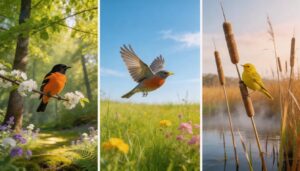
Knowing a bird’s name is only half the puzzle — knowing where and when to look seals the deal. Habitat and season are your best filters for narrowing down a sighting fast.
Here’s how each factor plays into spotting the right bird at the right time.
Backyard, Woodland, Grassland, and Wetland Songbirds
Where a bird lives tells you half the story before you even raise your binoculars. House finches and American robins thrive in your backyard, while woodland species like thrushes prefer shaded understories.
Your field guide for songbird identification should filter by habitat first. Invasive species impact native plant selection and habitat layering, so citizen science participation helps track these shifts across backyard, woodland, grassland, and wetland zones.
Spring Migration Versus Summer Breeding Species
Spring migrants and summer breeders behave like two different neighbors using the same yard. Migration Speed picks up in spring because birds are racing to claim territory.
seasonal clues:
- Food Availability drives arrival timing
- Nesting Density peaks during breeding season behavior
- Physiological Adaptations fuel Territory Defense and song output
Knowing both patterns sharpens your identification chart fast.
Fall Movement and Winter Resident Birds
As fall settles in, Temperature Triggers like dropping overnight lows and cold fronts push Migration Timing into high gear — often peaking in October and early November. Food Scarcity in northern breeding grounds sends thrushes, warblers, and sparrows moving south in waves.
Watch your Habitat Refuges: shrubby edges and feeders become prime stopover points.
Flock Dynamics shift too, as winter residents like cardinals and chickadees tighten their social bonds for seasonal bird migration and winter survival strategies.
How Molt Changes Seasonal Appearance
Molt Timing catches many birders off guard — that "new" bird at your feeder might just be an old friend in fresh feathers. Hormonal Triggers and day length drive Feather Color Shift and Flight Feather Replacement in stages.
Regional Molt Variation means timing differs by latitude. Watch for seasonal plumage clues in Common Backyard Songbird Species:
- Dull late-summer plumage brightens before spring breeding
- Winter feathers often appear lighter or washed out
- Flight feathers molt last, temporarily affecting bird identification
- Northern birds molt earlier than southern counterparts
- New feathers restore insulation and flight efficiency
Song Activity by Breeding Season and Daylight Length
Longer days quietly flip a switch inside every songbird. Photoperiod hormone effects drive dawn chorus timing earlier and louder as breeding season arrives.
Your backyard fills with daylength-driven territory calls because males are racing to claim space.
Seasonal song peaks align with egg-laying and nest-building — not random chance.
Understanding these seasonal singing patterns of songbirds tells you exactly when breeding stage vocalization is loudest.
Using Location and Month to Narrow Identification
Think of location and month as your two sharpest filters. A Month Location Matrix instantly cuts your species list in half.
In a Saxony woodland during May, Regional Timing Grids point you toward late migrants, not winter residents.
Zone-specific Checklists and Elevation Seasonal Guides sharpen that further.
Cross your Microhabitat Calendar with seasonal bird migration patterns, and you’ll land on the right species fast.
Printable and Digital Chart Features

identification chart isn’t much help if it’s clunky to use out in the field. Whether you prefer paper in your pocket or a phone in your hand, the format makes a real difference.
Here’s what to look for in both printable and digital versions.
Printable Chart Sections for Quick Field Use
A well-designed printable chart is your best field companion when your phone dies mid-hike. Built around Space-Efficient Design, each single-page layout covers a field guide to 20 common songbird species with Color Contrast Guidelines that make Rapid Identification easy in any light.
| Feature | Purpose | Field Benefit |
|---|---|---|
| Weatherproof Lamination | Durable Materials resist rain | Stays readable outdoors |
| Field Note Integration | Space for date and location | Tracks your Bird ID Skills |
| field guide illustrations | North American songbird silhouettes | Speeds visual matching |
Mobile-friendly Chart Design for Birdwatchers
Your phone can do what that laminated sheet can’t — update in real time. A good mobile app for bird enthusiasts uses an Adaptive Layout Grid that scales cleanly across screen sizes, so nothing gets clipped.
| Feature | Field Benefit |
|---|---|
| Touch Target Sizing | Easy tapping with gloves on |
| High Contrast Palette | Readable in bright sunlight |
| Offline Data Sync | Works without cell service |
| Haptic Confirmation | Silent feedback mid-observation |
This progressive web app approach, paired with interactive flashcard learning, turns your bird identification app into a true digital field guide.
Icons for Feeder Birds, Ground Foragers, and Canopy Species
Adjustable Vector Formats keep every icon sharp across print and screen — perfect for active birdwatching and ground foraging observation at any zoom level.
| Icon Type | Songbird Characteristics | Canopy Color Palette |
|---|---|---|
| Feeder Bird | Short bill, stocky body | Warm amber tones |
| Ground Posture Silhouettes | Forward lean, flat stance | Earth browns |
| Canopy Species | Slender bill, curved tail | Cool blue-greens |
| Woodpecker/Nuthatch | Stiff tail, clinging grip | Muted grays |
| Sparrow/Towhee | Stubby tail, seed bill | Rust and tan |
Scalable Vector Formats keep every icon sharp across print and screen — perfect for active birdwatching and ground foraging observation at any zoom level.
Range Maps and Seasonal Presence Labels
Range maps take species distribution from guesswork to fact.
Seasonal Color Coding uses distinct hues — red for Breeding Zone Delineation, blue for Migration Boundary Layers, purple for year-round presence — so you read a map instantly.
Data Gap Indicators show lighter shading where eBird Integration is thin.
Seasonal variations in presence reflect Seasonal Bird Behavior and Song Variations tied to daylight shifts.
| Season Label | Map Color |
|---|---|
| Breeding | Red |
| Non-Breeding | Blue |
| Year-Round | Purple |
| Data Gap | Light/Gray |
App Integration With Merlin and BirdNET
Your chart gets a real upgrade when you pair it with digital tools. Integration with Merlin Bird ID gives you eBird Sync, Offline Pack Management, and AI-powered song matching right from your pocket.
BirdNET adds spectrogram use in bird call identification with Confidence Scoring on every result.
Both apps support User-Generated Audio and Cross-Platform Data Sharing.
| Feature | App |
|---|---|
| eBird Sync & Offline Packs | Merlin Bird ID |
| Spectrogram Analysis | BirdNET |
Building a DIY Chart for Local Native Songbirds
Building your own field guide to 20 common songbird species starts with smart Material Choices.
Use water-resistant paper or Durable Lamination so it survives wet mornings.
Pick a Color Palette that separates families at a glance.
Add flashcards for Interactive Flashcard Learning, and leave space for User Feedback and Data Integration as your North American songbird knowledge grows.
| Chart Element | Purpose |
|---|---|
| Color-coded rows | Quick family sorting |
| Laminated surface | Weather resistance |
| Flashcard section | Bird identification review |
| QR code column | Audio call access |
| Notes field | Personal Data Integration |
Frequently Asked Questions (FAQs)
What colors not to wear when birding?
Skip bright red, neon orange, and fluorescent yellow completely. High contrast patterns and metallic accessories spook birds fast.
For birdwatching success, wear muted earth tones — your bird identification process starts before you even raise your binoculars.
What are some common songbirds?
Common North American songbirds include the Northern Cardinal, American Robin, Eastern Bluebird, Song Sparrow, and House Finch. These popular species are ideal starting points for birdwatching and territory defense observation.
What are common Indian birds?
India’s cities, fields, and wetlands are alive with birds.
From the House Sparrow nesting in building crevices to the vivid Indian Roller perched on roadside wires, birdwatching here rewards every curious glance.
How do invasive species affect native songbird populations?
Invasive species hit native songbirds from every angle — habitat degradation, predation pressure, food web disruption, and acoustic interference all compound into real population decline.
Protecting native plant species is your first step toward meaningful bird conservation.
Which songbirds are most affected by window collisions?
Ever wonder why warblers keep turning up dead near buildings?
Bay-breasted warblers, Ovenbirds, and Red-eyed Vireos top the list — ground forager strikes and urban edge species face the worst migration season spikes.
How do feeders influence songbird range expansion?
Feeders act like stepping stones across the landscape.
Feeder network connectivity pulls birds further from their core ranges, especially during lean seasons when seasonal feeder effects push them to explore new habitat corridors.
What role do native plants play in songbird survival?
Native plants are the backbone of songbird survival. They drive insect abundance, provide seasonal forage, and offer nesting resources — everything birds need, right outside your door.
Conclusion
Who knew a small brown bird could teach such patience? That frustrating moment when you just… can’t… place it? Now, imagine flipping that script.
With your native songbird identification chart, those field marks, songs, and habitat clues transform confusion into quiet confidence. No more shrugs—just clear answers.
Whether you’re scanning woodlands or your own backyard, this tool turns fleeting glimpses into identified species. So grab your binoculars, head outside, and listen.
The birds are waiting. Your adventure starts now.
- https://cakebar.io/
- http://mailto:hello?subject=Songbird%20Scout
- https://schoolriverside.com/Birds
- https://www.cse.iitk.ac.in/users/amit/birds/
- https://timesofindia.indiatimes.com/life-style/spotlight/web-stories/chirping-wonders-10-common-birds-that-are-native-to-urban-landscapes/photostory/123716904.cms