This site is supported by our readers. We may earn a commission, at no cost to you, if you purchase through links.
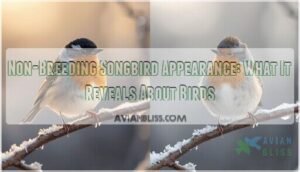
That drab little bird at your feeder in January? It might be the same species you admired in full color last spring—you just wouldn’t recognize it. Most songbirds undergo a dramatic shift in appearance after breeding season, trading their vivid plumage for muted browns, grays, and buffs that blend seamlessly into winter’s palette.
This isn’t deterioration—it’s deliberate biology. Non-breeding songbird appearance reflects a finely tuned survival strategy, driven by hormonal shifts, molting cycles, and nutritional state. Once you understand what’s happening beneath those understated feathers, you’ll never look at a "plain" bird the same way again.
Table Of Contents
- Key Takeaways
- What is Non-Breeding Songbird Appearance?
- Key Features of Non-Breeding Plumage
- Age and Sex Differences in Non-Breeding Songbirds
- Biological Mechanisms Behind Plumage Changes
- Conservation Implications of Non-Breeding Plumage
- Frequently Asked Questions (FAQs)
- Why would a bird be non-breeding?
- What do Bobolinks look like?
- Why do non-breeding male ducks look different?
- Are all songbirds altricial?
- How does urban noise pollution affect songbird behavior?
- Can songbirds recognize individual birds by appearance?
- How do predators respond to dull non-breeding plumage?
- What role does sleep play in feather condition?
- Conclusion
Key Takeaways
- Non-breeding plumage isn’t dullness by default — it’s a survival system triggered by hormonal shifts and molt cycles that swap vivid pigments for camouflage-ready browns, grays, and buffs.
- What a songbird eats shows up in its feathers: carotenoid pigments come entirely from diet, so washed-out winter coats can signal poor nutrition or environmental stress, not just seasonal change.
- Age, sex, and individual health all shape non-breeding appearance differently — first-year birds wear frayed juvenile feathers, males retain subtle dominance markers, and no two birds molt on exactly the same schedule.
- Dull winter plumage is a conservation signal worth reading: habitat loss, pesticide exposure, and climate-compressed molt windows are quietly showing up as patchy, faded coats on birds at your feeder.
What is Non-Breeding Songbird Appearance?
Most people walk right past a drab little bird in November without a second glance — and that’s exactly what the bird wants. Non-breeding plumage is the quiet, understated wardrobe songbirds wear outside the breeding season, built for survival rather than spectacle.
It’s a deliberate disguise — and songbird seasonal color changes explain exactly how birds swap one wardrobe for the other.
Here’s what’s actually going on beneath those muted feathers.
Definition of Non-Breeding Plumage
Think of non-breeding plumage as a songbird’s off-season uniform — functional, understated, and built for survival. During the nonbreeding period, most songbirds wear basic plumage, their quieter default state. Here’s what defines it:
- Appears after the post-breeding molting cycle, typically late summer
- Plumage duration spans three to eight months depending on species
- Feather coloration shifts toward browns, grays, and buffs
- Feather maintenance peaks during this seasonal adaptation window
- Color variation reflects both age and individual health
Understanding the role of bird plumage types is vital for identifying songbirds during their non-breeding seasons.
Differences From Breeding Plumage
Breeding plumage is basically a songbird’s billboard — loud, vivid, impossible to ignore. Non-breeding plumage is the opposite. Feather coloration drops dramatically: male Scarlet Tanagers swap blazing red for olive-green, Indigo Buntings trade deep blue for patchy brown.
This color shift isn’t random wear — it’s deliberate seasonal camouflage, written into molt patterns and plumage variation that reshape a bird’s entire appearance outside the breeding season. The Scarlet Tanager’s appearance change is a result of its seasonal plumage adaptations.
Role of Molting in Appearance Changes
Molting is what actually drives those dramatic color shifts — not some magic seasonal "color change." Once a year, after breeding wraps up, most songbirds go through a prebasic molt, replacing nearly all their feathers.
New feathers grow in with different pigment levels, producing duller, more cryptic plumage dynamics. Feather replacement is the engine behind all nonbreeding season appearance changes in avian biology.
Key Features of Non-Breeding Plumage
Non-breeding plumage isn’t just "dull feathers" — it’s a carefully tuned set of traits that tells you a lot about a bird’s survival strategy. The colors, patterns, and textures all work together in ways that make more sense once you see them laid out.
Each of these traits fits into a broader picture of how birds adapt physically to survive, which bird identification through physical features breaks down in a way that’s genuinely easy to follow.
Here’s what to look for when you’re trying to read a songbird’s off-season appearance.
Typical Colors and Patterns
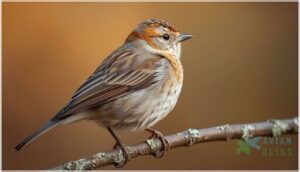
Non-breeding plumage isn’t drab by accident — it’s a masterclass in understated design. Molt cycles swap vivid carotenoid pigments for softer browns, grays, and warm buffs, while feather edging adds scaled or streaked pattern variation across the back and breast.
Plumage texture shifts too, with pale feather margins creating a checkered, layered look that gradually wears clean as seasonal color changes progress.
Camouflage and Survival Benefits
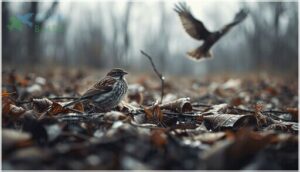
Dull feathers aren’t a downgrade — they’re a survival strategy hiding in plain sight. Plumage adaptation toward browns, grays, and streaked buff tones delivers serious predator avoidance through winter concealment.
Feather camouflage works especially well for ground-foragers like sparrows, whose streaked underparts dissolve into leaf litter. These plumage changes aren’t cosmetic; they’re ecological adaptation — finely tuned feather coloration that makes bird identification harder for hawks than for you.
Examples in Common Songbird Species
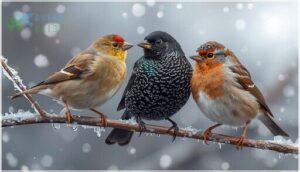
Take three birds you’ve probably already seen this winter:
- The American Goldfinch — its dramatic seasonal color changes strip away that electric yellow, leaving olive-brown plumage variation that’s easy to overlook.
- European Starlings — dense white-tipped feather coloration creates a spotted winter look that fades before breeding.
- Song Sparrows — fresh feathers reveal warmer rufous tones mid-flocking behavior.
Carotenoid pigments drive the boldest transformations.
Age and Sex Differences in Non-Breeding Songbirds
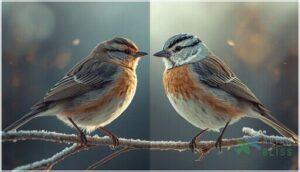
Not every songbird you spot in winter is working with the same set of rules — age and sex shape appearance in ways that go well beyond simple seasonal shifts.
A first-year bird and a mature female can look surprisingly similar, yet the differences are there if you know where to look. Here’s what separates them.
Juvenile Vs. Adult Plumage
Spotting the difference between a juvenile and adult songbird isn’t always obvious — but feather development tells the whole story. Juveniles wear loose, fluffy plumage with streaked underparts, while adults show crisp, solid coloration. Molting patterns drive these coloration differences hard.
| Feature | Juvenile | Adult |
|---|---|---|
| Feather texture | Loose, fluffy | Sleek, tight |
| Plumage variation | Streaked, mottled | Solid blocks |
| Primary shape | Narrow, tapered | Broad, rounded |
Bird identification gets easier once you understand these plumage changes.
Sexual Dimorphism Outside Breeding Season
Winter doesn’t erase sexual dimorphism — it just turns down the volume. Plumage variation between sexes persists through the nonbreeding period, though it’s subtler. Bird identification gets trickier, but the clues are still there:
- Male goldfinches fade to olive-brown, narrowing the color signaling gap with females
- House Sparrow males keep their black bib and chestnut nape year-round
- Painted Buntings maintain full dimorphism evolution regardless of season
Ornithology rewards patience here.
Identifying First-Year Songbirds
First-year songbirds are virtually wearing their age on their wings — literally. Molt patterns tell the story: juvenile flight feathers stay browner and more frayed than the crisp body feathers from the post-juvenile molt. Beak coloration helps too — dusky, pale bills versus the sharper tones of nonbreeding adults.
Stack feather wear, plumage variation, and bill color together, and aging techniques become surprisingly reliable.
Biological Mechanisms Behind Plumage Changes

Feathers don’t just grow—they’re built on a timed biological schedule your bird has no say in ignoring. Everything from hormones to what’s on the menu shapes how that plumage looks come fall.
Here’s what’s actually driving the change under the surface.
Hormonal Triggers and Seasonal Timing
Think of it as an internal clock that reads the sky. Photoperiod cues — shifting daylengths — trigger hormonal regulation that sets the whole molt cycle in motion.
As days shorten, testosterone drops, prolactin rises, and thyroid hormones surge, driving feather renewal. These precise seasonal shifts mean a songbird’s plumage changes aren’t random; they’re tightly orchestrated hormonal changes responding to light itself.
Pigments and Structural Coloration
Once those hormonal triggers fire, the real artistry begins — three separate systems actually build the colors you see. Carotenoid pigments handle yellows and reds, but songbirds can’t manufacture them internally; every carotenoid effect comes straight from diet.
Melanin roles cover the durable browns and blacks. Structural blues? Pure physics — nanostructures scatter light, no pigment required. Feather coloration is chemistry and architecture working together.
Impact of Diet and Health on Appearance
Diet shapes plumage quality more than most people realize. Nutrient deficiency during molting can shorten feathers by up to 20 percent — and protein shortages leave visible white fault bars across flight feathers.
Carotenoid pigments depend entirely on dietary access, so poor seasonal color changes aren’t random; they’re health indicators written in feather coloration.
What a bird eats, you’ll see it wearing.
Conservation Implications of Non-Breeding Plumage
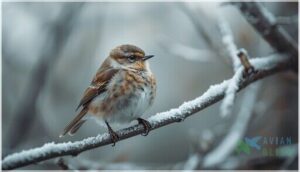
Non-breeding plumage isn’t just about looks — it’s quietly telling you something important about a bird’s health and the health of its environment. When feathers look off outside of normal molt windows, that’s worth paying attention to.
Here’s what the science says about the conservation signals hidden in those dull winter coats.
Dull Plumage as a Red Flag for Health
Feather quality doesn’t lie. Dull plumage indicators tell you more about a bird’s internal state than almost any other signal.
Nutrient deficits from low carotenoid intake, chronic parasite loads, and molt-disrupting stress markers all show up as washed-out feather coloration, fault bars, or patchy coverage — making plumage your clearest window into bird ecology and overall health.
Environmental Threats Affecting Appearance
What’s dulling birds isn’t just biology — it’s their zip code. Urbanization impacts and habitat loss strip away carotenoid-rich insects, flattening seasonal color changes that once signaled peak health.
Chemical exposure from pesticides disrupts molt timing; pollution effects from traffic emissions cloud habitat quality.
Climate shifts compress molt windows further, leaving songbirds wearing patchy, faded coats that quietly document every environmental conservation failure around them.
Songbirds now wear climate failure on their feathers, in every patchy, faded coat
Importance for Bird Identification and Monitoring
Knowing non-breeding plumage isn’t just trivia — it’s the backbone of serious bird identification and long-term monitoring work. Here’s what it unlocks:
- Species Classification becomes possible when fall warblers lose their vivid breeding colors — subtle traits like undertail patterns separate look-alikes.
- Seasonal Surveys and Christmas Bird Counts depend on reading dull plumage field marks accurately.
- Bird Tracking programs use molting patterns and feather wear to age individuals across seasons.
- Migration Patterns get mapped through NonBreeding Birds observed on stopover sites needing protection.
- Plumage Variation tied to bird behavior — like feeder aggression — reveals social dominance in winter flocks.
Frequently Asked Questions (FAQs)
Why would a bird be non-breeding?
Think of a soldier who won’t march without the right supplies — birds work the same way.
Genetic Factors, Health Status, Environmental Pressures, Social Hierarchy, and hormonal changes all quietly decide who sits out the breeding season.
What do Bobolinks look like?
Bobolinks are compact grassland songbirds — about the size of a golf ball — with pointed tails and a stout finch-like bill.
They exhibit striking plumage variation between breeding males and their streaky, sparrow-like counterparts.
Why do non-breeding male ducks look different?
Male ducks trade bright colors for drab eclipse plumage during their flightless period. Hormone regulation drives feather replacement, and camouflage strategies keep them hidden while molting leaves them grounded and vulnerable.
Are all songbirds altricial?
Like nearly every rule in nature, this one has edges. Almost all songbird species follow altricial development — hatching blind, naked, and helpless — making it a defining pattern across Passeriformes and songbird evolution.
How does urban noise pollution affect songbird behavior?
Urban noise pollution rewires avian behavior from the ground up. Song frequency shift forces songbirds higher in pitch, while noise-induced stress erodes foraging behavior, territorial defense, and urban habitat use — quietly unraveling bird ecology one decibel at a time.
Can songbirds recognize individual birds by appearance?
Yes — songbirds use facial patterns, plumage variation, and UV-reflective patches for visual recognition and individual distinction, pairing sight with song and behavior to navigate complex social dynamics with surprising precision.
How do predators respond to dull non-breeding plumage?
Dull feathers don’t make a bird invisible — they buy seconds. Predators respond more to movement and habitat openness than visual contrast alone, so camouflage strategies shift attack decisions mainly in exposed, snowy landscapes.
What role does sleep play in feather condition?
Sleep drives feather renewal more than most birders realize. Nighttime recovery lets barbules re-lock, melatonin effects sync molting schedules, and consistent preening cycles keep plumage flight-ready — all quietly essential to bird identification and avian conservation efforts.
Conclusion
Ironically, the bird you overlook in winter is working harder than the one you stop to photograph in spring. Non-breeding songbird appearance isn’t a sign of absence—it’s evidence of a system quietly doing its job, conserving energy, staying hidden, and preparing for what’s next.
Once you start reading plumage like a field biologist, those drab browns stop looking plain. They start looking purposeful—and suddenly, the "boring" birds at your feeder become the most interesting ones out there.
- https://academy.allaboutbirds.org/plumage-variations/
- https://paperzz.com/doc/7624792/spring-plumage-change-in-passerines--prealternate-molt-vs...
- https://pmc.ncbi.nlm.nih.gov/articles/PMC7487240/
- https://journal.afonet.org/vol96/iss4/art1/
- https://www.frontiersin.org/journals/ecology-and-evolution/articles/10.3389/fevo.2015.00040/full