This site is supported by our readers. We may earn a commission, at no cost to you, if you purchase through links.

A single miscalibrated retinoscope can introduce a ±0.50 diopter error—enough to blur your patient’s world and undermine months of clinical training. Yet most practitioners inherit their optical equipment guides from outdated textbooks or manufacturer pamphlets that skip the nuances separating adequate tools from superior ones.
The gap between owning a slit lamp and wielding it with ISO/IEC 17025-accredited precision defines the boundary between routine eye care and diagnostic mastery. Today’s optometry landscape demands more than catalog browsing; you need curated insight into which instruments deliver ±0.25 diopter accuracy, how quarterly calibration protocols preserve measurement integrity, and where emerging fiber-optic technologies intersect with patient outcomes.
From retinoscopes to tonometers, the equipment choices you make ripple through every prescription you write.
Table Of Contents
Key Takeaways
- Calibration precision directly impacts patient outcomes—maintaining ±0.25 diopter accuracy through quarterly protocols prevents measurement drift and ensures every prescription reflects true refractive error rather than instrument degradation.
- Your diagnostic toolkit divides into three essential layers: core instruments (retinoscopes, slit lamps, tonometers) for foundational assessment, auto refractors and phoropters for efficient refractive measurement, and specialized tools (gonioscopy lenses, wide-field imaging) for detecting pathologies that standard exams miss.
- Equipment lifecycle management isn’t optional overhead—systematic maintenance scheduling reduces unscheduled downtime by 21-35% while extending instrument working life, with practices budgeting 4.5% of purchase price annually for calibration and 10-12% for consumables to protect their investment.
- Strategic practice setup goes beyond buying devices—exam room ergonomics, proper lighting at 3,500-4,500K, and automated inventory control for 60-day supply buffers transform equipment into workflow assets that cut exam times by 2-5 minutes per patient while maintaining diagnostic confidence.
Essential Optometry Equipment Overview
Setting up an optometry practice starts with knowing which tools you actually need on day one. The right equipment doesn’t just help you diagnose—it shapes how efficiently you work and how confidently your patients trust your assessments.
Let’s break down the core instruments that belong in every practice, starting with the diagnostic backbone and moving through the fitting and finishing tools that complete your workflow.
Key Diagnostic Instruments

You’ll build your practice around core instruments that define modern optometry. Your diagnostic arsenal begins with the retinoscope and ophthalmoscope for foundational eye exams, while the slit lamp delivers detailed optical imaging of anterior and posterior structures.
Auto refractors provide rapid vision testing—achieving ±0.50 diopter accuracy in 70–85% of cases—and the binocular indirect ophthalmoscope expands peripheral retina assessment by detecting 25–40% more pathology than direct methods alone.
Understanding human emotions is essential in patient care.
Eyewear Fitting and Finishing Devices

Once you’ve mastered diagnostic precision, your attention shifts to the craft of eyewear delivery. Finishing devices transform raw lenses into polished products—92% of practices rely on dedicated systems for edgebanding and cosmetic edging daily. These tools cut polishing time by 34% per pair, keeping your workflow lean and patient-ready. Understanding AP study resources can help you enhance your practice’s efficiency.
Your finishing suite should include:
- Lens Edging machines that shape lenses to frame specifications with micron-level accuracy
- Frame Tracing systems capturing precise frame dimensions for perfect lens fits
- Eyewear Polishing stations delivering smooth, professional edges in minutes
- Edgebanding Tools ensuring durable, cosmetically refined lens perimeters
Diagnostic Tools and Their Functions
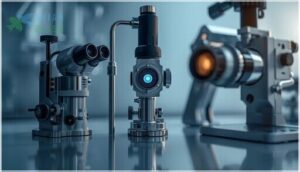
Your diagnostic toolkit forms the backbone of every examination you’ll conduct, and choosing the right instruments means understanding what each one actually does. The tools below serve distinct but complementary roles—some measure refractive error, others reveal structural details, and a few do both.
Let’s break down how retinoscopes, ophthalmoscopes, slit lamps, tonometers, auto refractors, and phoropters fit into your daily workflow.
Retinoscopes and Ophthalmoscopes
Your retinoscope and ophthalmoscope are essential tools for refractive error detection and fundus evaluation. Modern retinoscopes offer ±0.25 diopter accuracy through LED illumination, while direct ophthalmoscopes provide a 5–7 degree central field for detailed posterior segment views. Binocular indirect ophthalmoscopes, when paired with wide-field contact lenses, significantly expand the observable retina from 20% to 80%, enhancing pediatric and peripheral assessments.
| Vision Testing Tools | Key Features |
|---|---|
| Retinoscope | ±0.25 D accuracy; LED reflex visibility |
| Direct Ophthalmoscope | 5–7° field; handheld portability |
| Binocular Indirect (BIO) | Stereoscopic view; 80% fundus coverage |
| Digital Ophthalmoscope | 2–20 MP imaging; EMR integration |
Routine maintenance, including quarterly retinoscope calibration checks, ensures measurement drift remains below ±0.05 diopters annually, preserving clinical precision. Adhering to ISO/IEC 17025-accredited maintenance and regular cleaning protects your optometry equipment and upholds industry standards. These tools directly impact eye exam techniques, as accurate refractive baselines lead to better prescriptions and improved patient outcomes.
Slit Lamps and Tonometers
After you’ve mapped the fundus, your slit lamp and tonometer become the gateway to anterior segment health and eye pressure management.
Slit lamp calibration with 10–40x magnification reveals corneal microcysts and lens opacities that handheld tools miss, while Goldmann tonometers offer gold-standard accuracy within 2–3 mmHg.
Daily cleaning and quarterly checks keep your diagnostic equipment reliable, reducing measurement drift by up to 25% and strengthening your optical maintenance protocols.
Auto Refractors and Phoropters
Your refractive accuracy hinges on auto refractor and phoropter settings working in tandem—modern autorefractors deliver objective sphere and cylinder measurements within ±0.25 diopters, then digital phoropters adjust those values with sub-2-second lens exchanges.
This diagnostic equipment pairing cuts exam time by 2–5 minutes per patient while delivering:
- Objective initial measurements in 90% of adult exams
- Reduced clinician-adjusted lenses by 0.25–0.50 diopters
- Improved first-pass prescription acceptance in 60–75% of cases
- Lower retest rates through better fixation monitoring
- Enhanced cylinder axis repeatability with Quarterly calibration of auto refractors, traceable to national metrology institutes, keeps measurement errors at just 0.25 diopters
This instrument validation directly bolsters clinical decision making and efficiency, delivering measurement accuracy you can stake your reputation on.
Routine Maintenance and Compliance
Think of maintenance protocols as your quality assurance backbone—73% of practices lock in manufacturer-recommended calibration schedules to preserve warranty validity and meet compliance standards. You’ll safeguard instrument validation with these steps:
- Monthly checks on slit lamps, tonometers, and diagnostic kits reduce service calls by 28%.
- Quarterly audits minimize downtime for ophthalmic instruments by 14–22% annually.
- Annual NIST-traceable calibration keeps optometric equipment within ±0.25 diopters.
- Digital logs improve audit pass rates by 25–35% across medical equipment portfolios.
Advanced Optical Technologies in Practice

You’ve built a solid foundation in equipment standards and calibration—now it’s time to see how pioneering optical technologies actually perform in the field.
From coatings that eliminate glare to fiber-optic diagnostics that pinpoint faults with surgical precision, these innovations directly impact your diagnostic accuracy and patient outcomes.
Here’s what you need to know about the pioneering technologies shaping modern optical practice.
Antireflective Coatings and Surface Quality
Modern nano coatings on ophthalmic instruments reduce reflectance control below 0.5% per surface, boosting light transmission across your optical instruments. Optical interference in multilayer stacks delivers broadband performance for medical equipment and technology, while hardcoat variants resist abrasion—critical for optical store management and daily optometry equipment use.
You’ll find coating materials deposited via ion-assisted methods minimize surface roughness under 1 nanometer, cutting scatter and improving contrast.
Imaging Resolution and Objective Lenses
Your optical instruments—from the slit lamp to the binocular indirect ophthalmoscope—perform near diffraction limits when properly maintained. Resolution enhancement follows the Rayleigh criterion: halving wavelength or doubling numerical aperture cuts minimum resolvable distance in half.
Image contrast declines as spatial frequency rises, so you’ll need lens calibration that corrects optical aberrations. High-NA objectives on retinoscopes and ophthalmoscopes resolve finer cellular detail, pushing practical imaging boundaries.
Fiber-Optic and OTDR-Based Diagnostics
When you extend fiber testing beyond imaging optics, OTDR calibration becomes your frontline defense against signal attenuation and optical faults. Network diagnostics rely on a 40–50 dB operational range to pinpoint breaks within meters—just as your ophthalmoscope and diagnostic kit demand traceability.
Optometric equipment and optical instruments for eye care share the same rigor: clean connectors, verified standards, and routine maintenance keep diagnostic tools audit-ready.
Setting Up an Optometry Practice

Setting up your optometry practice isn’t just about buying equipment—it’s about creating a space where efficiency and patient comfort work hand in hand. The physical layout, lighting, and how you organize your instruments will shape every exam you perform.
Let’s walk through the three core elements that turn an empty room into a fully functional practice.
Exam Room Furniture and Layout
Your exam room isn’t just a clinical space—it’s where precision meets patient comfort. Ergonomic design paired with strategic optometry equipment placement transforms your optometry clinic into an efficient, welcoming optometry center.
Key considerations for your optometry center setup include:
- Layout dimensions: Independent optometric practices generally dedicate 10–12 ft by 12–14 ft per room, ensuring ample clearance for instrument placement and patient flow.
- Work zones: Separate your refractive area, diagnostic station, and slit lamp by at least 3 feet to minimize cross-traffic interference during optometric practice and procedures.
- Wheelchair accessibility: ADA-compliant rooms require a 5-foot turning radius—adjustable, accessible exam chairs reduce patient transfer strain by 32%.
- Lighting optimization: Target 300–500 lux at eye level with antiglare surfaces to reduce reflected glare by 28% during examinations.
Strategic optometry center setup adheres to accessibility standards while supporting smooth workflows throughout your optometry practice.
Instrument Stands and Lighting
Precision begins with stable instrument arms and thoughtfully engineered lighting design. Your exam room demands LED lighting at 3,500–4,500K for accurate color rendering during retinoscope and ophthalmoscope procedures.
Mount your slit lamp and transilluminator on adjustable optical mounts with 60–90 cm reach, ensuring ergonomic access. Integrated anti-glare shields cut stray reflections by 40–60%, while weighted bases eliminate drift.
Every diagnostic kit component benefits from flicker-free illumination exceeding 95 CRI—don’t settle for less.
Inventory and Supply Management
Smart stock management transforms supply chains from liability to asset. Deploy automated inventory control for demand forecasting that cuts ordering errors by 58% and prevents stockouts plaguing 74% of optometry equipment users quarterly.
Maintain a 60-day buffer on essential optometry equipment selection items—tonometer tips, diagnostic lenses, and specialty tools for optometric practices—while logistics optimization reduces carrying costs by 25% through precise reorder triggers on medical devices for eye examination and optometrist equipment and tools.
Equipment Selection for Specialized Examinations
When your practice expands beyond routine eye exams, you’ll need specialized equipment that goes deeper than standard diagnostics.
The right tools for gonioscopy, pediatric assessments, or glaucoma screening can mean the difference between catching a condition early and missing critical warning signs.
Here’s what you should consider when selecting equipment for these sophisticated examinations.
Gonioscopy and Peripheral Retina Assessment
Evaluating the anterior chamber angle and detecting peripheral retinal pathologies demands specialized optometrist equipment and tools. Gonioscopy techniques achieve 60–75% interobserver agreement using standardized grading, while peripheral retina assessment via ophthalmoscopy methods with scleral depression identifies tears in 6–20% of screening cases. Your diagnostic lenses—paired with a slit lamp, ophthalmoscope, or retinoscope—guarantee accurate retinal imaging when you:
- Select gonioscopy lenses for angle classification
- Use binocular indirect ophthalmoscopy for peripheral coverage
- Apply wide-field imaging capturing up to 200° retina
- Perform scleral depression to reveal hidden tears
- Maintain quarterly calibration for ±1 diopter accuracy
Pediatric and Low Vision Tools
Children under seven present unique challenges in child eye care, so you’ll need handheld autorefractors for pediatric refraction—they reduce exam time by 20–35% and boost cooperation.
Low vision aids like spectacle-mounted magnifiers improve reading speed by 1.5–4.0x when matched properly.
Your retinoscope, ophthalmoscope, slit lamp, transilluminator, and trial frames become essential when standard vision therapy and infant optics demand **lighter (
- https://gradcoach.com/research-topics/
- https://www.sjsu.edu/writingcenter/docs/handouts/Methodology.pdf
- https://www.keelerglobal.com/wp-content/uploads/2024/03/BRO-StudentCatalog-UK-EN-0922-REV-A.pdf
- https://www.volk.com/
- https://medexsupply.com/good-lite-universal-adult-trial-frames/?sku=GL-455400&gad_source=1&gad_campaignid=14632986939&gbraid=0AAAAADmq-Dcu7R8IPRS3y4OA8Asx4L4tq&gclid=Cj0KCQiAiKzIBhCOARIsAKpKLAPkyMrO0fImHyuWEHii8gxuBhKiTzQxw9yTDvfpBOm7FCULNUMabI8aAqwuEALw_wcB