This site is supported by our readers. We may earn a commission, at no cost to you, if you purchase through links.

You don’t need exotic destinations or expensive gear to spot remarkable birds—some of the most fascinating species are probably visiting your backyard right now. Northern Cardinals flash their crimson feathers at feeders across the eastern United States, while Blue Jays announce their presence with bold calls and even bolder attitudes.
These popular bird species for watching offer endless entertainment and surprisingly complex behaviors once you know what to look for. Learning to identify common backyard visitors opens up a whole new world hiding in plain sight.
The right combination of food, water, and habitat can transform any outdoor space into a front-row seat for nature’s daily drama.
Table Of Contents
Key Takeaways
- You don’t need exotic trips or fancy gear to watch fascinating birds—species like Northern Cardinals, Blue Jays, and American Robins are already visiting backyards across North America with behaviors as complex as any rare species once you know what to look for.
- Simple habitat additions like the right feeders, shallow water sources, and native plants can transform any yard into a bird magnet, with details like feeder color and seed type making huge differences in which species show up.
- Birdwatching has exploded into a massive movement with 96 million Americans participating, generating $107.6 billion in spending and driving real conservation wins like protecting over 6 million acres and saving species from extinction.
- Technology like smartphone apps with AI identification and citizen science platforms has democratized birding completely, letting anyone instantly identify species and contribute meaningful data to conservation efforts without needing field guides or expert knowledge.
Most Popular Bird Species for Watching
If you’re stepping into birdwatching, you’ll want to know which birds you’re most likely to spot. Some species show up at feeders and backyards across North America more than others, making them perfect for beginners and seasoned watchers alike.
Let’s look at eight birds that consistently rank as favorites among birdwatchers everywhere.
Northern Cardinal
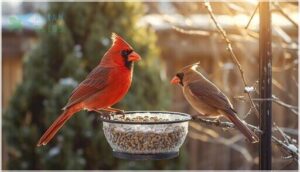
The Northern Cardinal is a backyard birdwatching superstar you can’t miss. Males flash vivid red plumage year-round, while females sport warm brown tones with red accents. You’ll spot them in woodland edges and suburban gardens, cracking sunflower seeds at your feeders.
These non-migratory birds defend their territory fiercely, sometimes even attacking their own reflections in windows. They often raise two or three broods each year.
American Robin
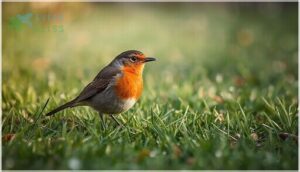
You’ll recognize the American Robin by its warm orange-red breast and gray back, a combination that stands out on any lawn. With around 370 million individuals across North America, these urban robins have mastered backyard living.
Watch them run-pause-run across your grass—they’re hunting earthworms by sight, not sound. Their cheerful spring song signals hope and renewal wherever you’re.
These birds are also known to gather in large groups, forming roaming flocks in winter.
Blue Jay
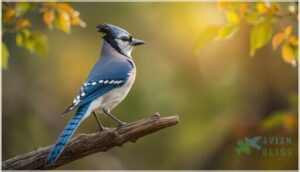
Bold and beautiful, the Blue Jay brings electric blue, white, and black plumage to your backyard birds scene. You’ll spot their distinctive crest and hear their loud calls echoing through oak and beech woodlands.
With 17 million strong across eastern North America, these intelligent corvids show a complex jay social structure—they mate for life, mimic hawks, and travel in tight family groups at bird feeders year-round.
Mourning Dove
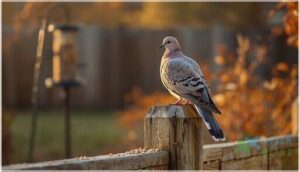
You’ll recognize the Mourning Dove by its soft brown-gray plumage and gentle “coo-OO-oo” call drifting through your neighborhood. With 337 million strong across North America, this dove species identification favorite feeds almost exclusively on seeds during morning and evening hours.
Despite dove abundance, migration patterns shift northern populations southward each fall, while southern birds stay put year-round, making them reliable common backyard birds at feeders.
House Finch
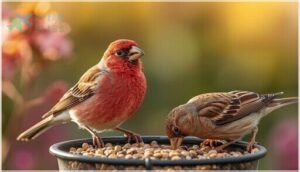
This cheerful songbird breaks the mold with rosy-red males and streaky brown females visiting feeders coast to coast. House Finch identification reveals their five-inch frame and conical bill perfect for cracking seeds. Their urban adaptation story shows how range expansion transformed them from southwestern natives to 40 million strong nationwide.
Watch for these finch species identification favorites:
- Males sport red coloring influenced by dietary habits
- Females resemble sparrows with blurry streaks
- They’re common backyard birds at sunflower feeders
- Conservation outlook remains stable despite past disease
This bird identification guide favorite thrives wherever you’re attracting birds to feeders.
Black-capped Chickadee
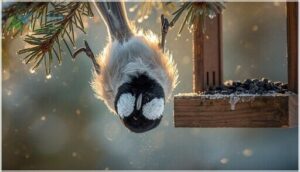
You’ll spot this five-inch dynamo by its tuxedo look—jet-black cap and bib framing striking white cheeks. Chickadee identification is a snap with that fluffy, large-headed silhouette hopping upside-down through branches.
Their feeding habits shift seasonally, favoring insects in summer and sunflower seeds at bird feeders come winter.
Blackcapped Chickadee nesting behavior centers on tree cavities, while their 43-million-strong population trends show considerable stability across backyard birdwatching hotspots throughout North America.
Dark-eyed Junco
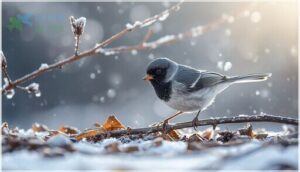
When snow blankets your yard, the Dark-eyed Junco arrives like clockwork—you’ll recognize this “snowbird” by its slate-gray hood and bright white belly flashing those telltale outer tail feathers.
With 630 million strong across North America, these winter birds dominate feeders from October through March. Their foraging behavior is pure ground-level action, spending 65% of their time hopping through leaf litter hunting seeds.
House Sparrow
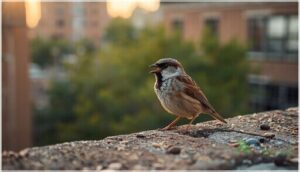
You’ll find House Sparrows everywhere humans settle—740 million strong globally, though urban declines tell a darker story. These invasive sparrows dominate backyard birdwatching with their brown-streaked backs and gray crowns, but they’re tough competitors.
Nest competition with native birds and seed dispersal habits reshape local ecosystems. Citizen science tracking reveals their numbers dropped 22% in city flocks since 1995, making them unexpected conservation indicators.
Key Identification Tips for Birdwatchers
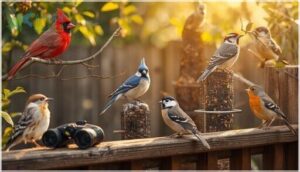
You don’t need to be an expert to identify birds in your backyard. The trick is knowing what to look for—and it’s easier than you might think.
Let’s break down the key features that’ll help you tell one species from another with confidence.
Distinctive Plumage and Markings
You’ll notice plumage coloration first—that’s your fastest clue for bird identification by appearance. Male Northern Cardinals flaunt vibrant reds from carotenoid pigments, while Blue Jays use structural tricks for their vivid blue. Look for feather patterns too: wing bars, facial stripes, and chest patches.
Seasonal changes matter—European Starlings shift from speckled winter coats to glossy summer looks. Even camouflage adaptations, like the Common Snipe’s streaky marsh-blend, help confirm tricky species.
Bird Calls and Songs
Bird songs open up a whole new world for species identification—think of them as nature’s fingerprints. Technology like BirdNET now recognizes around 3,000 bird vocalizations globally, helping you identify bird sounds with precision above 90%.
Small birds generally vocalize between 1,500 to 8,500 Hz, creating acoustic characteristics you can learn to distinguish.
Listen for temporal patterns too—many species sing most actively during the dawn chorus, making early mornings your best time for vocalization monitoring.
Size, Shape, and Behavior
Once you’ve tuned your ear to calls, shift your eyes to physical traits. Size comparison matters—Northern Cardinals stretch 8.3 to 9.1 inches while Black-capped Chickadees clock in at just 4.75 inches. Shape variations tell stories too: notice the cardinal’s prominent crest versus the mourning dove’s sleek body.
Watch foraging behavior and flight styles—robins run and stop when hunting worms, while blue jays glide between strong wing beats.
Regional Variations and Range Maps
Beyond behavior, understanding species distribution helps you know what to expect in your backyard. Range maps powered by citizen science reveal seasonal shifts—Northern Cardinals expanding northward due to climate influence, while Dark-eyed Juncos migrate south each winter.
Habitat preference shapes regional presence too. Check eBird’s color-coded maps showing breeding zones, migration routes, and year-round territories for common North American birds in your area.
Bird Habitats and Where to Find Them

Finding birds isn’t about luck—it’s about knowing where to look. Different species have their own favorite hangouts, from your backyard feeder to dense forests and quiet wetlands.
Let’s break down the main habitats where you’ll spot these popular birds and what makes each location a hotspot for certain species.
Backyard and Urban Birds
Your own backyard is where the action happens—it’s ground zero for bird identification and behavior watching. Urban birds have adapted to city life in fascinating ways, though urban bird decline remains a real concern. Bird-friendly cities with green spaces help counter this trend.
- Feeders bring the show to you: Different feeder food types attract cardinals, finches, and chickadees right to your window
- Listen for urban bird songs: Robins and mockingbirds often sing louder in noisy neighborhoods to be heard
- Nesting site availability matters: Provide native plants and proper cover for backyard birdwatching success
Forest and Woodland Species
Step into the woods and you’ll find a whole different cast of characters. More than 650 species nest in North America’s forests, but habitat fragmentation and species decline hit hard here—over 70% of forest birds are losing ground.
Conservation efforts focus on forest management that protects woodpeckers like downys and pileateds, plus white-breasted nuthatches. Their survival depends on older trees and smart habitat choices.
Wetland and Water Birds
Near water, the action unfolds in stunning variety. Great Blue Herons—700,000 strong across their range—wade through shallow marshes hunting fish, while Sandhill Cranes and Roseate Spoonbills forage in restored wetlands.
Habitat loss threatens these species, but wetland conservation efforts help stabilize populations. You’ll spot feeding habits that reflect species diversity: some fish, others probe for invertebrates in nutrient-rich bird habitats.
Migratory Vs. Resident Birds
When comparing migratory birds to resident species, you’ll notice striking differences in survival rates and territory acquisition. Migrants face challenges over vast migration distances, often showing lower fitness than residents who maintain year-round territories.
Bird identification reveals these bird migration patterns matter for protection status—only 9% of migratory bird species have adequate safeguards across their routes, with significant ecological implications for conservation efforts.
Attracting Popular Birds to Your Yard
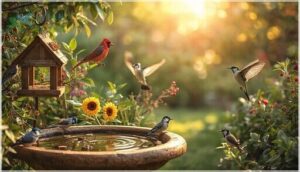
You’ve spotted these beautiful birds in the wild—now it’s time to bring them right to your backyard. The trick isn’t just tossing out some seeds and hoping for the best.
Let’s look at what really works to turn your yard into a bird magnet.
Bird Feeders and Food Preferences
Your choice of bird feeders and seed types can make or break your backyard birding experience. Hulled sunflower seed attracts nearly 89% of feeder-visiting species, while black oil sunflower and cracked corn each appeal to over half.
Cardinals and sparrows prefer mixed seeds in platform feeders, while woodpeckers favor peanuts in mesh designs.
Silver and green feeder colors receive the highest visitation rates across common species.
Creating Bird-Friendly Habitats
Think beyond feeders and transform your yard into a layered habitat that birds can’t resist. Native plants provide natural food sources and support the insects that feed hungry nestlings. Mix canopy trees with understory shrubs and groundcovers to create vertical structure.
Limit your lawn, skip the pesticides, and add dense evergreens for shelter. Managing outdoor cats dramatically reduces predation risk, letting urban restoration flourish right in your backyard.
Water Sources and Nesting Sites
Water depths matter more than you’d think when setting up bird baths—aim for shallow edges (one to two inches) that invite smaller species while accommodating larger visitors. Clean water sources also serve as key migration stopovers, supporting bird habitats year-round and attracting birds to your yard naturally.
For nesting habits, add platforms or birdhouses near wetland vegetation and urban infrastructure. Predator protection improves when nest sites sit higher, away from ground threats.
Seasonal Strategies for Attracting Birds
Your attracting birds to your yard strategy shifts as the calendar turns. Winter feeding strategies focus on high-energy suet and seeds when natural resources vanish. Come spring nesting season, offer nesting materials and protein-rich insects. Summer bird feeding strategies emphasize year-round water sources during summer molting. Fall migration demands high-fat foods like berries, supporting bird nesting habits and feeding needs through every season’s rhythm.
Birdwatching Trends and Conservation Impact

Birdwatching has grown into something bigger than just a backyard hobby. It’s bringing people together, pumping real money into local economies, and sparking conservation work that has a real effect.
Let’s look at how this pastime is shaping both communities and the natural world around us.
Growth of Birdwatching in North America
Across backyards and wilderness areas, birdwatching has exploded into one of North America’s fastest-growing outdoor pursuits. You’re part of something big—96 million Americans now engage in birding, more than doubling since 2016.
The National Survey of Fishing, Hunting, and Wildlife-Associated Recreation shows participation trends climbing steadily, with demographic shifts bringing younger and more diverse faces to the field. Technology’s influence and rising conservation awareness are fueling this significant growth.
Economic and Community Benefits
Behind that recent growth sits serious money. Birders spent $107.6 billion in 2022 on trips, gear, and feeders, generating $279 billion in total economic output. That’s 1.4 million jobs across retail, tourism, and hospitality.
Local economies thrive when rare birds show up—one sighting in New England brought $750,000 in visitor spending. You’re not just watching birds; you’re fueling community engagement and job creation.
Conservation Efforts Inspired by Birding
That spending fuels real change on the ground. Your observations through citizen science platforms track species recovery and habitat loss across 300+ bird species.
Birdwatchers have helped protect over 6 million acres through advocacy efforts and community engagement. You’re not just recording data—you’re driving wildlife conservation, pushing for habitat protection policies, and supporting bird conservation efforts that bring California Condors back from the edge.
Birdwatchers have driven real conservation impact, protecting over 6 million acres and bringing species like California Condors back from extinction
How Technology Enhances Birdwatching
Your smartphone turns birding into something anyone can jump into—no field guides required. Apps like Merlin Bird ID nail species from photos in seconds, while eBird growth shows over 140,000 active users sharing sightings monthly. AI identification systems even protect birds at wind turbines, cutting fatalities by 85%. Technology’s social media impact spreads the word fast, though cameras and binoculars still capture moments apps can’t replicate.
- Snap a photo and get instant AI species matches
- Join 140,000+ birders tracking migrations on eBird
- Watch turbines shut down automatically to protect eagles
- Share rare finds that inspire thousands through social feeds
- Carry powerful cameras that reveal feather details you’d miss
Frequently Asked Questions (FAQs)
What equipment do beginner birdwatchers need to start?
You’ll want quality binoculars—8×42 models work best for beginners. Add a field guide for bird identification, comfortable outdoor clothing, and maybe a backyard birdwatching feeder. Budget around $100 to $200 for decent starter gear.
When is the best time of day for birdwatching?
Early morning—especially dawn chorus—offers peak bird behavior and vocal activity. Midday raptors use thermals effectively. Evening flocking reveals social dynamics.
Weather impact and seasonal variations shape bird migration and feeding habits throughout backyard birdwatching adventures.
How do weather conditions affect bird activity patterns?
Weather shapes bird behavior in dramatic ways. Temperature swings trigger migration, while rain and storms disrupt foraging behavior and breeding season timing.
Extreme weather also alters physiological responses, affecting feeding habits and habitat use year-round.
What are common mistakes new birdwatchers should avoid?
The biggest pitfalls? Disturbing birds for photos, skipping gear preparation, ignoring species knowledge, poor timing location choices, and ethical mistakes.
Master bird identification, understand bird behavior, and you’ll transform your backyard birdwatching adventures.
How can I keep ethical birding practices in mind?
Keep your distance to minimize disturbance, respect bird habitats by staying on trails, and follow local regulations for legal adherence.
Prioritize bird welfare during observations and support conservation efforts that protect these amazing creatures.
Conclusion
Your backyard might as well be a theater, and you’ve just scored season tickets to the best show in town. Once you start recognizing these popular bird species for watching, every glance out your window becomes a mini wildlife documentary.
Set out a feeder, add a water source, and suddenly you’re not just observing nature—you’re part of the ecosystem. The birds were always there. You just needed to know where to look.
- https://www.birdcount.org/2024-final-results/
- https://www.willamettevalley.org/backyard-bird-watching-a-fun-addition-to-your-next-walk
- https://news.mongabay.com/2025/06/in-colombia-bird-watching-brings-tourism-and-a-love-for-conservation/
- https://www.allaboutbirds.org/news/birds-decline-strongholds-ebird-models-offer-hope/
- https://www.bbc.com/future/article/20191211-crows-could-be-the-smartest-animal-other-than-primates