This site is supported by our readers. We may earn a commission, at no cost to you, if you purchase through links.
Step outside on a spring morning and count how many bird sounds you can separate from the noise—most people pick out two, maybe three, before the layers blur together.
A single acre of woodland might hold a dozen species calling at once, each voice shaped by millions of years of evolutionary pressure into something precise and purposeful.
The northern cardinal alone throws out up to 200 whistle songs per hour at dawn.
Learning to recognize common bird vocalizations isn’t just a birder’s party trick—it’s a way of reading a landscape that most people walk through completely deaf to its conversations.
Table Of Contents
- Key Takeaways
- Why Birds Use Different Vocalizations
- Types of Common Bird Sounds
- Step-by-Step Guide to Identifying Bird Calls
- Tools and Technology for Bird Sound Recognition
- Tips for Improving Bird Call Recognition Skills
- Frequently Asked Questions (FAQs)
- How do you find out what bird it is by sound?
- What’s the best app to identify bird sounds?
- Can Google recognize bird sounds?
- Can baby birds recognize their parents calls?
- How do injured birds change their vocalizations?
- Do birds mimic sounds from their environment?
- How does urban noise pollution affect bird calls?
- Can humans train their ears like professionals?
- Conclusion
Key Takeaways
- Birds split their sounds into two types: short calls for quick alerts and longer songs for claiming territory or attracting a mate.
- The syrinx — a bird’s unique voice box — can produce two independent notes at once, which is why their songs sound so rich and layered.
- Apps like Merlin Bird ID and BirdNET can identify thousands of species in real time, making them your best starting tools in the field.
- With consistent practice — dawn listening, field notes, and memory tricks like "Who cooks for you?" — most people can recognize dozens of species within a season or two.
Why Birds Use Different Vocalizations
Birds don’t make noise randomly — every sound has a job to do. Whether it’s a sharp alarm call or a complex morning song, each vocalization carries meaning.
From pitch to rhythm, birds use precise acoustic features in bird vocalizations to pack real meaning into every chirp, trill, and call.
Here’s what’s actually going on when birds open their beaks.
Purposes of Calls Vs. Songs
Bird vocalizations split into two categories: short calls and longer songs. Calls handle quick jobs — alarm signaling when a hawk appears, flock coordination during foraging, or nestling begging at the nest. Songs do heavier lifting: territory defense and mate attraction.
Mastering this distinction is your foundation for birding by ear and sharpens every bird song identification technique you’ll build from here. Birds often sing in dense forests where visibility is low, using songs for mate attraction.
How Birds Communicate Through Sound
Sound production starts deep inside a bird — in the syrinx, a voice box where the windpipe splits near the lungs. Tiny tissue folds vibrate as air passes through, shaping every chirp and trill you hear.
Bird vocalization characteristics go beyond simple noise:
- Syrinx anatomy allows two independent notes simultaneously
- Nonvocal sounds like drumming carry territorial messages
- Contextual meanings shift the same call’s purpose entirely
- Vocal learning shapes songs through imitation during youth
- Cultural dialects emerge as regional song traditions spread
Food-associated vocalizations can also signal feeding opportunities to conspecifics. food-associated vocalizations
Seasonal and Regional Variations in Calls
Just as regional accents vary across human communities, bird vocalizations shift with the seasons and landscape.
Spring dawn choruses erupt earlier and longer — cardinals alone push out up to 200 whistle songs per hour.
In fall, migratory call changes kick in: shorter, sharper winter contact calls replace complex songs.
Regional dialect shifts and altitude vocal differences mean the same species can sound noticeably different depending on where you’re listening.
Types of Common Bird Sounds
Bird sounds aren’t all the same — and once you know the difference, you’ll start hearing the forest in a whole new way.
From alarm calls to mating songs, this bird songs and calls guide breaks down exactly what you’re hearing — and why it matters for spotting species hidden deep in the trees.
There are a few key types worth knowing before you head out with your binoculars. Here’s what to listen for.
Songs, Calls, Chirps, and Whistles
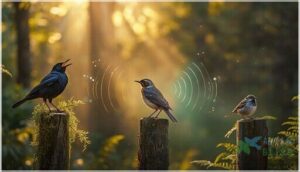
Not all bird vocalizations are the same.
Bird songs last over two seconds and feature complex mating song structures — male blackbirds deliver rich, flute-like phrases, while song thrushes repeat each verse three times.
Bird calls are shorter, serving as predator alarm whistles or contact signals year-round.
Chirps carry diurnal chirp timing cues, and clear whistles cut through dense habitat-specific calls with minimal distortion.
Trills, Warbles, and Repetitive Patterns

Trills, warbles, and repetitive patterns each tell a different story. Trill Speed matters — Chipping Sparrows fire off rapid, mechanical notes, while Pine Warblers deliver a slower, liquid quality. Warble Pitch Variation creates that flowing, musical effect you hear in wrens.
Repetitive Territory Calls, like a male sparrow looping the same phrase, signal ownership. These Species-specific Trill Patterns are your clearest clues.
Identifying Pitch, Rhythm, and Tone
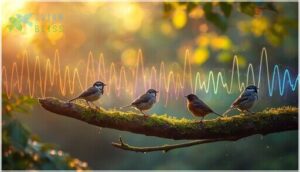
Tuning your ear to pitch, rhythm, and tone unlocks bird sound identification quickly. Pitch tells you size — smaller birds sing higher, up to 8,000 Hz.
Frequency Contour and Spectral Shape Patterns reveal whether notes rise, fall, or curve. Temporal Modulation captures rhythm: fast, slow, or accelerating. Harmonic Richness and Varying Volume Shifts color the tone — harsh, liquid, or thin. These bird song characteristics are your field decoder.
Step-by-Step Guide to Identifying Bird Calls

Identifying bird calls gets easier once you have a simple process to follow.
A few reliable techniques can turn confusing noise into clear, recognizable patterns. Here’s how to start building that skill, one step at a time.
Active Listening Techniques in The Field
Listening well is half the battle in field ornithology. Start with a Silence Period — stay still for 1–2 minutes before actively listening. Your ears will adjust naturally.
- Sound Isolation: Focus on the closest call first, filtering ambient noise.
- Directional Localization: Rotate slowly toward repeated calls to pinpoint the source.
- Visual Pairing: Watch for open bills to confirm what you’re hearing.
Using Mnemonics and Memory Aids
Memory hooks make bird song memorization stick faster than raw repetition ever will. The American Robin’s "Cheerily, cheer up" or the Barred Owl’s "Who cooks for you?" are classic Rhythmic Phrase Associations worth learning first.
Better yet, try Personal Mnemonic Creation — pair Visual Imagery with the actual sound. The wilder your mental picture, the stronger your bird song recognition becomes.
Observing Bird Behavior During Vocalizations
A bird’s body never lies. Watching Posture Cues and Feather Displays alongside sound sharpens your Bird Song Identification Skills quickly.
- Alarm Responses — neck extended, head raised, short sharp calls
- Courtship Rituals — breast puffed, wing flicks, complex song
- Flock Dynamics — relaxed posture, soft contact calls
- Territorial singing — upright chest‑forward stance, facing rivals
Documenting What You Hear for Practice
Your field notebook is your best teacher.
Jot down Field Note Templates with date, time, and Environmental Context Tags like weather or habitat.
Try Onomatopoeia Transcriptions — write “wheet” or “zree” to capture exact tones.
Add Pitch Change Symbols to note rising or falling sounds.
Paired with Audio Recording and Audio Metadata Logging, these notes sharpen your Bird Identification through Sound over time.
Tools and Technology for Bird Sound Recognition

Technology has made identifying bird calls easier than ever before.
Whether you’re a beginner or a seasoned birder, the right tools can sharpen your ear and build your confidence fast.
Here’s what’s worth knowing in 2026.
Top Bird Sound Identification Apps (2026)
Two apps stand out for bird identification through sound in 2026: Merlin Bird ID and BirdNET.
Merlin’s real-time audio recording and AI accuracy cover 2,000+ species globally, with user integration directly into eBird checklists.
BirdNET’s global coverage reaches 3,000 species.
Both are free birdsong identifier tools — no subscription models required.
Try running them together for cross‑checking tricky calls.
Using Spectrograms for Visual Analysis
Apps like Merlin give you a sound match, but spectrograms show you why it matches. Think of them as X-rays for bird vocalizations — time runs left to right, frequency range runs bottom to top.
Harmonic stacks appear as stacked parallel lines, your visual fingerprint for species ID. Adjust contrast settings to reduce noise, then use zoom techniques for pattern recognition in dense audio analysis. Bird song identification techniques get sharper fast.
Creating and Using a Birdsong Journal
Spectrograms show you the shape of a sound — your journal captures the story behind it.
Jot down date, location, and Weather Impact Notes like wind or rain, since these shape vocal activity.
Use a Color-Coding System for confirmed versus unknown calls. Audio Clip Integration ties recordings to entries.
Over time, Seasonal Trend Tracking turns your notes into a personal Field Layout Design for Bird Song Identification Techniques.
Tips for Improving Bird Call Recognition Skills

Getting better at recognizing bird calls takes practice, but the right habits make a real difference.
simple ways to sharpen your ear faster than you’d expect. Here’s what actually works.
Practicing at Different Times and Weather
Timing is everything for sharpening your ear for bird calls and bird songs. Dawn Chorus Timing gives you the richest soundscape—roughly one hour before sunrise through two hours after. Here’s when and where to practice:
- Dawn: Peak bird sound analysis opportunity, especially May–June
- Dusk Activity Peaks: Thrushes and others sing again at sunset
- Rainy Day Listening: Post-storm hours trigger vocal bursts
- Windy Condition Effects: Sheltered valleys beat exposed ridges every time
- Urban Noise Windows: Early weekends offer cleaner acoustic ecology than rush hour
Learning From Regional Bird Dialects
Studying regional dialects sharpens your bird identification skills fast.
White-crowned Sparrows in the Bay Area carry over ten distinct dialects across just a few miles—a clear sign of vocal learning and cultural transmission at work.
White-crowned Sparrows in the Bay Area speak ten distinct dialects within just a few miles
Habitat influence and seasonal shifts shape these bird vocalization patterns over generations.
Dialect mapping your local area makes bird song learning and bird sound analysis surprisingly personal and rewarding.
Joining Birding Groups and Guided Walks
Joining a local birding group might be the fastest shortcut to sharper bird identification skills you’ll ever find. Guided walks connect you with leaders who can name a call on the spot and explain exactly why.
Many beginner resources and events are free.
Good social etiquette—quiet voices, no sudden moves—keeps birds calm and everyone learning.
Community benefits stack up quickly when you show up regularly.
Frequently Asked Questions (FAQs)
How do you find out what bird it is by sound?
Think of bird sound like a fingerprint — no two species sound the same. Listen for pitch, rhythm, and tone. Apps like Merlin Bird ID can name the bird in seconds.
What’s the best app to identify bird sounds?
Merlin Bird ID is hard to beat.
It delivers real-time feedback, works offline, and pulls from community data integration across 2,000+ species — making bird identification fast, accurate, and genuinely reliable in the field.
Can Google recognize bird sounds?
Yes — but with limits. Google’s Pixel Sound Search can identify common bird vocalizations on-device, no upload needed.
Rare species and noisy environments challenge it. For deeper bird sound analysis, Merlin Sound ID leads.
Can baby birds recognize their parents calls?
Baby birds can. Many start recognizing parental calls within days of hatching. Some even begin prenatal listening inside the egg, imprinting on their mother’s voice before they’ve seen the world.
How do injured birds change their vocalizations?
Like a cracked bell, an injured bird’s voice gives it away.
Distress call changes include harsher tones, broken rhythms, and weaker volume — clear signs something’s wrong when you’re doing bird sound analysis in the field.
Do birds mimic sounds from their environment?
Yes, many birds mimic sounds from their environment. Lyrebirds copy chainsaws and rain. Parrots repeat household noises.
This mimicry fulfills real purposes — attracting mates, confusing rivals, and signaling danger to nearby birds.
How does urban noise pollution affect bird calls?
Urban noise forces birds to raise pitch, sing louder, and shift their dawn chorus timing earlier.
Song simplification follows.
These fitness consequences ripple through acoustic ecology, making habitat preservation a core concern for environmental science.
Can humans train their ears like professionals?
birding by ear is a learned skill, not a gift.
With ear training drills, rhythm recognition, and vocal imitation exercises, most people identify dozens of species within one or two seasons of steady practice.
Conclusion
You don’t need perfect pitch or years of field experience to recognize common bird vocalizations—you just need a willing ear and a little patience. cardinal outside your window has been trying to tell you something all along.
one bird, one sound, one morning. Over time, the blur of noise sharpens into a conversation you can actually follow.
landscape hasn’t changed. You’re just finally learning how to listen.
- https://link.springer.com/article/10.1007/s10489-023-04486-8
- https://search.macaulaylibrary.org/catalog?mediaType=audio
- http://biology.allaboutbirds.org/features/bird-song-hero/bird-song-hero-challenge
- https://www.massaudubon.org/nature-wildlife/birds/bird-songs-vs-bird-calls
- https://abcbirds.org/news/birdsong/