This site is supported by our readers. We may earn a commission, at no cost to you, if you purchase through links.
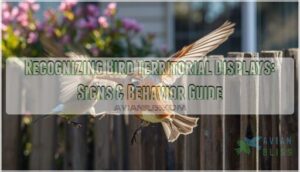
A robin puffing its chest and dive-bombing past your window isn’t showing off—it’s defending its turf. Birds invest enormous energy into claiming and protecting specific areas, sometimes battling intruders dozens of times a day during peak breeding season.
This territorial instinct drives some of the most dramatic behaviors you’ll witness in your backyard or local park. Recognizing bird territorial displays helps you understand what’s really happening when cardinals chase each other through shrubs or mockingbirds attack their own reflections.
Once you know what to look for, you’ll spot the difference between a casual visit and a serious boundary dispute. These behaviors reveal how birds solve one of nature’s toughest challenges: securing enough resources to survive and raise their young.
Table Of Contents
Key Takeaways
- Birds use vocalizations, physical displays, and chasing to mark and defend their territories, especially during breeding season.
- Territorial behavior helps birds secure food, nesting sites, and mates, directly impacting their survival and reproductive success.
- Habitat loss, resource availability, and population density strongly influence how aggressively birds defend their space.
- Human actions like habitat management, buffer zones, and nest box placement can support territorial birds and improve their breeding outcomes.
What is Bird Territorial Behavior?
Bird territoriality is a natural behavior where birds claim and defend a specific area to protect essential resources.
This behavior plays a key role in survival, especially during breeding season when competition for food and nesting sites intensifies.
Understanding what drives territorial behavior helps you recognize why birds act the way they do in the wild and even in your own backyard.
Definition of Territoriality in Birds
Territorial behavior in birds is the active defense of a fixed area against competitors, usually to monopolize key resources like food, mates, or nesting sites. Understanding territorial behavior helps you recognize how birds maintain space through repeated aggressive displays within spatially consistent areas.
Core Elements of Territorial Behavior:
- Resource monopolization – Birds defend territories to control access to limited food, water, and nesting locations
- Spatial scale – Territory sizes vary dramatically, from mere centimeters in colonial gulls to 9,000 hectares in golden eagles
- Temporal dynamics – Defense intensity shifts throughout breeding seasons, often decreasing as nesting progresses
- Site fidelity – Many territorial birds return to the same defended areas year after year
- Selective exclusion – Birds commonly target same-species intruders that threaten reproductive success or resource access
Territorial birds use songs as keep-out signals to warn potential intruders.
Importance of Territory for Survival
You need a territory to survive—it’s that simple. Territorial defense gives you exclusive access to food, water, and safe nesting spots, directly boosting breeding success and survival benefits. Studies show territorial birds experience higher survival rates and better reproductive outcomes compared to non-territorial species.
Territorial defense isn’t optional—it secures the food, water, and nesting sites that directly determine whether birds survive and reproduce
Resource availability shapes territory size: abundant food means smaller territories, while scarcity drives expansion. Experienced residents of breeding colonies, like Cliff Swallows, exhibit higher daily survival probabilities.
This survival strategy balances energy costs against critical resource competition, influencing population dynamics across entire bird communities.
Types of Territories and Their Purposes
Birds defend different types of territories depending on their needs. You’ll encounter three main categories:
- All-purpose territories cover mating, nesting, and feeding—songbirds generally claim these during breeding season, with territory size shrinking as population density increases.
- Mating territories focus solely on courtship, like Sage Grouse display grounds.
- Nesting territories protect nest sites in colonial waterbirds.
Non-breeding territories provide winter feeding grounds.
Common Territorial Displays in Birds
Birds don’t just claim territory—they put on quite a show to let everyone know it’s theirs. From bold songs that echo through the trees to dramatic aerial stunts, these displays are hard to miss once you know what to look for.
Let’s break down the most common ways birds announce and defend their turf.
Vocalizations and Song Patterns

You’ll often hear territorial birds before you spot them—their vocalizations serve as living boundary markers. Song amplitude increases when rivals get close, while countersinging behavior creates back-and-forth vocal exchanges that assess dominance without physical contact.
Overlapping songs may signal escalating tension, though environmental noise can mask these signals. Pay attention to territorial calls and song patterns; they reveal the intensity of boundary disputes unfolding above you.
Physical Displays and Posturing

When defending space, you’ll notice striking physical displays and posturing that reveal aggression intensity. Feather displays include puffing, while wing spreading makes birds appear larger—threat displays meant to intimidate. Watch for a forward-facing, lowered body position in 42% of encounters.
Species interaction displays show similar postures whether facing their own kind or competitors, with face and throat regions highlighted in 77% of territorial confrontations.
Drumming, Aerial Maneuvers, and Chasing

Beyond physical displays, you’ll hear drumming tempo as a territorial signal—woodpeckers produce over 20 beats per second for species recognition. Aerial attacks include high-speed stoops that intimidate rivals, while swallows and martins patrol at different flight altitudes above breeding territories.
Chasing aggression appears in nearly one-third of perching bird species, with individuals pursuing intruders to enforce territorial boundaries during breeding season.
Recognizing Aggressive and Defensive Behaviors
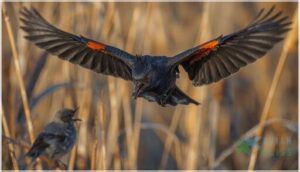
When birds feel their space is threatened, they don’t just sit back and watch. You’ll see a range of behaviors that can quickly escalate from subtle warnings to full-on attacks.
Let’s look at how to spot these signs and understand what’s driving them.
Signs of Aggression and Boundary Defense
When you observe territorial aggression up close, you’ll notice birds employ a predictable set of boundary defense tactics. Urban song sparrows, for example, maintain higher aggressive behavior throughout breeding season than their rural cousins, ramping up vocal escalation and approach proximity near territorial boundaries. Watch for these signs:
- Rapid movement toward intruders, often within meters of perceived threats
- Sustained close-range monitoring along territorial boundaries
- Seasonal modulation of intensity, peaking during resource competition
- Individual consistency in defensive responses across encounters
- Interspecific defense against competing species sharing habitat overlap
Physical aggression intensifies where resources coincide.
Chasing, Threat Displays, and Attacks
Chasing stands out as the most frequent territorial response you’ll see—especially at hummingbird feeders, where chase intensity ramps up with resource value. Before physical attacks occur, birds escalate through threat displays: hovering, chip calls, and close flyovers that signal intent without contact.
Cavity-nesting species deliver considerably more physical strikes during territorial encounters. Seasonal attacks peak during breeding when nests are active, with human-directed aggression concentrated near nesting sites.
Differences Between Defensive and Competitive Aggression
You’ll notice defensive aggression targets intruders near nests or resources—it’s about protecting what’s already claimed. Competitive aggression, however, centers on establishing boundaries through patrols and rival encounters. Identifying triggers helps you distinguish between these behaviors:
- Resource Scarcity intensifies defensive responses by 50% in sparse areas
- Mate Competition sustains territorial aggression regardless of habitat overlap
- Population Density increases competitive displays by 35% during abundant years
- Hybridization Effects trigger competitive responses independent of niche sharing
- Secondary Cavity use heightens defensive competition in dual-purpose territories
Warning signs of aggression differ: defensive birds prioritize conspicuous displays over combat, while competitive territorial aggression involves persistent boundary patrols.
Factors Influencing Territorial Displays

Territorial displays don’t happen in a vacuum—they’re shaped by what’s going on around the bird. Everything from breeding season timing to how many neighbors are nearby can dial aggression up or down.
Let’s look at the key factors that influence when and how intensely birds defend their space.
Breeding Season and Resource Availability
During the breeding season, resource availability directly shapes how aggressively birds defend their territories. When food is abundant—whether from rainfall-triggered insect blooms or predictable urban feeders—stronger boundary defense and extended territory tenure are observed. Conversely, resource scarcity forces birds to abandon territories entirely, intensifying competition among those that remain.
Food supplementation experiments reveal that well-fed males achieve higher paternity success and initiate breeding earlier. The table below summarizes the relationship between resource conditions, territorial behavior, and breeding impacts:
| Resource Condition | Territorial Behavior | Breeding Impact |
|---|---|---|
| High food availability | Increased aggression at borders | Earlier breeding onset, double brooding |
| Supplemented territories | Strengthened seasonal defense | Higher within-pair paternity |
| Drought/scarcity | Reduced or absent defense | Delayed or skipped breeding |
Population Density and Habitat Changes
As more birds crowd into shrinking habitat, you’ll see territory sizes compress by 30–50% at high population density sites. Urban bird density often defies expectations—city song sparrows show fiercer aggression despite lower neighbor counts, revealing how habitat loss and fragmentation reshape competitive pressure.
Climate impacts and human impact increase resource competition, forcing territory monitoring programs to track these shifts for effective conservation.
Species Differences and Interspecific Territoriality
Beyond population pressures, species differences fuel surprising conflicts. Nearly one-third of North American passerines defend against other species—a behavior called interspecific territoriality. You’ll spot this when hybridization impacts blur boundaries or song similarity confuses rivals.
Resource overlap intensifies guild competition, especially where foraging zones coincide. Spatial patterns reveal that closely matched body sizes and overlapping diets trigger the fiercest cross-species territorial behavior.
Human Impact and Conservation Considerations

Human activity has reshaped bird habitats in ways that directly affect territorial behavior. When we appreciate these impacts, we can make better choices about how we interact with territorial birds in our own backyards and communities.
Let’s look at three key areas where human influence matters most for these territorial displays.
Effects of Habitat Loss and Fragmentation
When forests shrink and fragment, you’ll notice dramatic shifts in territorial behavior. Fragment size directly affects reproduction impacts—smaller patches squeeze birds into reduced territories with harsher edge effects.
Habitat loss and habitat fragmentation intensify resource competition and aggression changes at higher population density. Dispersal disruption limits movement between patches, trapping territorial birds in declining habitats where breeding success plummets and survival rates drop.
Managing Human-Bird Interactions
Human influence and habitat changes demand careful management. You’ll need buffer distances of 100–300 meters around nesting areas and temporal restrictions during breeding seasons to lessen disturbance considerably. Strong visitor management through signage boosts compliance above 80%. Reduce sensory disturbance from noise and light near feeding stations. Non-lethal deterrents like lasers disperse problem birds without harm, helping you as an avian caretaker balance recreation with conservation despite urban sprawl and habitat fragmentation.
Here are key management approaches:
- Maintain 25–50 meter approach distances to reduce aggressive encounters by 70%
- Close trails during peak nesting to increase fledging success by 10–30%
- Use clear signage and ranger presence to raise rule compliance 20–30 percentage points
- Apply visual deterrents like lasers away from critical breeding sites
- Limit dawn recreation to avoid peak territorial activity periods
Strategies to Support Territorial Birds
To reverse declines, you can combine proven tools. Habitat restoration has successfully converted degraded bottomland forests into breeding grounds for 42 species over a decade. Nest box provisioning adds cavity territories where natural sites are scarce, while supplemental feeding boosted hihi clutch sizes from 3.9 to 4.4 eggs. Conservation planning maps critical habitat patches, and policy frameworks like the Federal Duck Stamp secure long-term funding.
| Strategy | Key Benefit |
|---|---|
| Habitat restoration | Increases breeding territory availability for diverse species |
| Nest box provisioning | Compensates for cavity shortages and boosts density |
| Supplemental feeding | Advances nesting phenology and increases reproductive output |
| Conservation planning | Protects high-quality habitat patches through targeted action |
| Policy frameworks | Ensures dedicated funding and institutional support for avian behavior research |
Frequently Asked Questions (FAQs)
How do weather patterns affect territorial display intensity?
While a calm morning may ring with bird songs, heavy rainfall can silence those same singers. Temperature influence and wind impact shape territorial intensity dramatically—elevated heat reduces displays by 10%, and storms quiet territorial behavior entirely as environmental factors shift survival priorities.
Can birds recognize individual neighbors versus strangers?
Yes, birds can recognize individual neighbors versus strangers through acoustic signatures and visual displays. Species like Northern Mockingbirds and African wood doves show reduced stranger aggression toward familiar neighbors, promoting territorial stability and interspecies recognition.
Do juvenile birds practice territorial displays before maturity?
Juvenile birds do practice territorial displays before maturity through playful aggression, subadult prospecting, and juvenile song learning.
These seasonal displays, modulated by developing hormones, help young birds hone the territorial behavior they’ll need as adults.
How long do birds typically maintain territories?
Some storm-petrels defend the same breeding territory for over a decade—that’s multi-year fidelity in action.
Territory duration varies widely: seasonal changes drive breeding season defenses lasting 4–8 weeks, while winter territory use extends several months.
What role does moonlight play in nocturnal displays?
Moonlight amplifies nocturnal displays by enhancing vocalizations and visual signals like white throat patches.
Birds balance territory defense with foraging activity and predator avoidance, as lunar brightness increases calling rates while improving detection of threats.
Conclusion
You’ve learned to read the language birds speak through motion and sound. You’ve discovered what drives them to patrol, sing, and fight.
Now recognizing bird territorial displays transforms every backyard observation into something deeper—a glimpse into survival itself. Watch for puffed feathers, repeated songs, and sudden chases. These aren’t random acts but calculated strategies refined over millions of years.
The next time a robin charges past your window, you’ll know exactly what’s at stake.
- https://ornithology.com/ornithology-lectures/territoriality-of-birds/
- https://digitalcommons.usf.edu/cgi/viewcontent.cgi?article=17247&context=auk
- https://www.frontiersin.org/journals/ecology-and-evolution/articles/10.3389/fevo.2020.587120/full
- https://onlinelibrary.wiley.com/doi/10.1111/ele.14525
- https://pmc.ncbi.nlm.nih.gov/articles/PMC8268463/