This site is supported by our readers. We may earn a commission, at no cost to you, if you purchase through links.
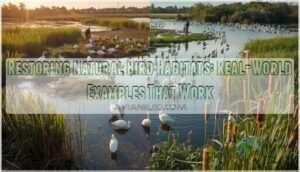
A wetland restoration project in California’s Central Valley increased waterbird populations by 365% in just five years. That’s not a fluke. Across North America, targeted habitat restoration is bringing birds back to landscapes they’d abandoned for decades.
The difference between projects that succeed and those that stall often comes down to a few key strategies. Native plantings, invasive species removal, and reconnecting fragmented habitats form the backbone of effective restoration work.
When you understand what makes these restoring natural bird habitats examples successful, you can replicate their results in your own community—whether you’re managing a wetland, a backyard, or miles of farmland.
Table Of Contents
Key Takeaways
- Native vegetation restoration with over 70% native plant coverage creates measurable results—waterbird populations increased by 365% in five years in California’s Central Valley, while yards with high native plant selection sustain healthy breeding bird populations through increased insect abundance.
- Wetland reconstruction and hydrology restoration serve dual purposes by filtering water (reducing nitrogen and phosphorus by over 70%) while creating critical stopover habitats for migratory birds, with projects like Ducks Unlimited restoring 87,000 acres in Michigan and Texas Prairie Wetlands providing for 4.5 million waterfowl annually.
- Wildlife corridors connecting fragmented habitats extend bird species survival from 754 years to over 2,000 years by increasing colonization rates by 5% and boosting bird movement by 68% compared to isolated patches.
- Invasive species removal combined with native replanting requires long-term commitment—native perennial cover needs 10+ years to recover fully, but mechanical removal achieves up to 88% success when targeting specific areas first, with native species richness increasing consistently even without supplemental seeding if existing native propagules are protected.
Native Vegetation Restoration for Birds
Native vegetation is the foundation of any successful bird habitat restoration project. When you plant the right trees, shrubs, and grasses, you’re not just adding greenery—you’re building a living ecosystem that provides food, shelter, and nesting sites for birds.
Let’s look at how native plantings work in practice and explore some real examples that have made a difference.
Planting Native Trees, Shrubs, and Grasses
By choosing native trees, shrubs, and grasses for bird habitat restoration, you set the stage for measurable success. Native vegetation supports higher insect abundance and diversity, which directly feeds breeding birds. Research shows yards with over 70% native plant selection can sustain healthy populations. These plants are essential because they support insectivorous birds.
Long-term maintenance and community engagement strengthen these efforts, while climate change adaptation ensures resilience for future generations.
Creating Food and Shelter for Bird Species
Food source diversity and nesting structure form the backbone of effective bird habitat restoration. When you plant native vegetation, you’re addressing both needs at once. Dense shrubs provide shelter from predators while seed-bearing plants sustain year-round feeding.
Quantitative practices reveal community outcomes worth celebrating:
- Restored sites show 40–60% higher bird diversity with diverse native grasses and sunflowers
- Multi-layered vegetation increases woodland bird abundance by 35–40%
- Water integration in wetlands boosts waterbird densities by 30–50% within two years
These habitat restoration techniques deliver measurable results, proving that invasive species removal paired with thoughtful native plantings creates thriving ecosystems where birds can nest, feed, and flourish throughout the seasons. Vineyards can support bird populations by providing effective nesting boxes.
Case Studies of Successful Native Plantings
Urban forest studies prove that native vegetation works. Over 72 years, 25 restoration sites showed steady increases in bird species richness as canopy structure matured.
Riparian zone plantings in the Willow Wind project established 3,000 native trees and shrubs, boosting wintering bird abundance over 18 years.
Community-led replanting efforts demonstrate that native plant coverage above 70% bolsters breeding populations—biodiversity increases follow ecological restoration techniques that prioritize local species.
Wetland and Waterway Habitat Projects
Wetlands act as nature’s water treatment plants while providing critical habitat for waterfowl and migratory birds. When you restore these areas, you’re bringing back both ecological function and bird diversity in one project.
Here are three approaches that deliver measurable results for waterbirds and the ecosystems they depend on.
Wetland Reconstruction for Migratory Birds
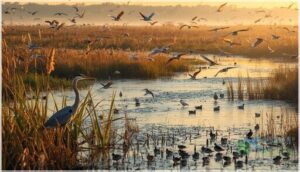
Migratory birds depend on wetlands as critical flyway stopovers during their long journeys. When you restore these habitats, you create essential feeding and resting sites that support species recovery along major routes like the Atlantic Flyway.
Projects targeting seasonal abundance patterns have proven successful—restoration outcomes show waterbird populations increasing by 365% in some areas. Migratory bird joint ventures coordinate these efforts, protecting species like the saltmarsh sparrow through strategic wetland reconstruction.
Restoring Natural Hydrology and Water Filtration
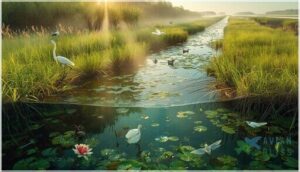
Beyond creating bird habitat, wetland hydrology restoration acts like installing nature’s water treatment system. When you reestablish natural water flow patterns, you’re improving water quality through filtration techniques that reduce nitrogen and phosphorus by over 70% in some projects.
- Removing drainage ditches restores natural hydrologic connectivity and water retention
- Pond-and-plug methods recreate seasonal flooding patterns that benefit migratory species
- Restored wetlands recharge groundwater supplies by 10-30% compared to degraded sites
- Natural filtration removes sediment and contaminants through vegetation and soil processes
- Ecosystem benefits include doubled bird diversity within years of hydrologic restoration
Examples of Waterfowl Habitat Restoration
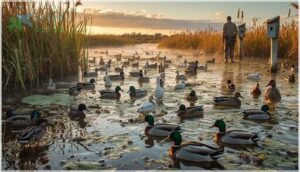
Across North America, waterfowl habitat restoration is delivering measurable results. Ducks Unlimited invested over $46 million to restore 87,000 acres in Michigan alone. The Texas Prairie Wetlands Project now provides for 4.5 million waterfowl annually. These efforts demonstrate impressive wetland restoration ROI while highlighting waterfowl population benefits that ripple across entire flyways.
| Project Location | Restoration Impact |
|---|---|
| Michigan wetlands | 87,000 acres restored |
| Texas Prairie | 4.5M waterfowl provided for |
| South Carolina | 24,300 nest boxes installed |
| Lake Ontario marsh | 180 acres breeding habitat |
Combating Invasive Species in Bird Habitats
Invasive plants can quickly take over bird habitats and crowd out the native species that birds depend on for food and shelter. Removing these aggressive invaders requires strategic control methods and a clear plan for what comes next.
Here’s how restoration teams tackle invasive species and help native plant communities reclaim their ground.
Invasive Plant Removal Strategies
You can tackle invasive species through mechanical removal, chemical control, prescribed burning, or IPM strategies that blend all three. Case studies show mechanical removal achieves up to 88% success when you target specific areas first. Chemical control reduces woody invaders by 95% in wetlands, while prescribed burning cuts seedling density by 60%.
Combining methods works best for lasting habitat restoration and ecosystem restoration success.
Re-establishing Native Plant Communities
Once you’ve cleared invasives, re-establishing native plant communities becomes your next priority for lasting bird habitat restoration. Native ecotypes matter because they’re adapted to your local climate and soil—research shows they establish more successfully than generic stock. Seed bank dynamics play a key role, too. Native seeds already hiding in your soil can spring back when conditions improve.
Here’s your practical roadmap for native vegetation recovery:
- Seed diverse native mixes across restoration sites to rebuild depleted seed banks and support varied bird food sources
- Target riparian vegetation with native trees and shrubs that produce 96% more caterpillar biomass than non-natives
- Plan for long-term recovery—native perennial cover needs 10+ years to approach pre-disturbance levels
- Protect remnant native patches during invasive removal; they’re propagule sources that speed ecosystem restoration
- Match species to microsites by letting environmental conditions filter which natives thrive where
Studies tracking invasive removal impact found that native species richness and cover increased consistently even without supplemental seeding—if you preserve existing native propagules. That’s why protecting what’s already there matters as much as planting new stock. Research across 491 sites showed cooler, wetter areas recovered faster, but all locations benefited from strategic habitat restoration techniques.
Remember that re-establishment isn’t instant. You’re rebuilding complex relationships between native species, soil communities, and the birds that depend on them. Seed-based approaches scale well because you can cover large areas efficiently. Focus on regionally appropriate plants, and you’ll create the insect-rich habitats insectivorous birds need to thrive.
Monitoring Ecosystem Recovery After Removal
You can’t just remove invasives and walk away—tracking recovery timeframes tells you if your habitat restoration techniques are actually working. Monitoring protocols should capture biodiversity indicators like native plant cover and bird population trends.
Post-removal surveys averaging 6.1 years show restoration increases biodiversity by 20% compared to degraded sites.
Watch for challenges like re-invasion or slow ecosystem restoration, and adjust your approach accordingly.
Wildlife Corridors and Buffer Zones
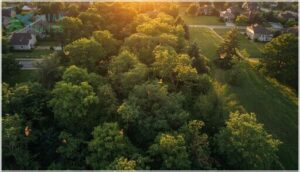
When bird habitats become fragmented by development or land use changes, many species struggle to find food, shelter, and safe nesting sites. Wildlife corridors reconnect these isolated patches, while buffer zones create protective boundaries around sensitive areas.
Let’s look at how these strategies work in real restoration projects.
Connecting Fragmented Bird Habitats
When forest fragments become isolated islands, bird populations dwindle rapidly. Wildlife corridors are the lifelines that reconnect these scattered patches. Research shows targeted forest regeneration between fragments can extend bird species survival from 754 to over 2,000 years.
Wildlife corridors reconnect isolated forest fragments, extending bird species survival from centuries to millennia
Here’s what makes wildlife habitat corridors effective:
- Corridor effectiveness increases colonization rates by 5% while reducing extinction rates by 2%
- Connectivity mechanisms boost bird movement by 68% compared to isolated habitats
- Project outcomes demonstrate that functional diversity thrives in connected landscapes
Real-world habitat restoration projects prove that even stepping-stone habitats support both resident and migratory species across fragmented terrain.
Designing Buffer Zones to Protect Nesting Sites
After you’ve linked habitat patches with corridors, buffer zones become your next line of defense for sensitive nesting areas. These protected boundaries keep human disturbance at a safe distance during the breeding season.
Buffer zone widths vary by species and site conditions. Here’s what research shows works:
| Bird Type | Minimum Buffer Width | Key Considerations |
|---|---|---|
| Bald Eagles | 201 meters (660 feet) | Reduce to 101 meters with vegetation screening |
| Colonial Waterbirds | 50–200 meters | Based on observed flushing distances |
| Riparian Birds | 150 meters | Retains 90% of species diversity |
| Tree-nesting Waterbirds | 100 meters | Depends on habitat structure |
| Ground-nesting Ducks | 40–50 meters | Requires low vegetation cover |
Vegetation composition matters as much as width. Native grasses and shrubs provide nesting cover while reducing predator access. Insect abundance doubles in well-vegetated riparian buffers compared to bare shores—that’s critical food for nestlings.
Visible markers like flagging tape or signage help prevent accidental intrusions. Studies confirm that physical boundaries work best when paired with breeding season enforcement.
Don’t set buffer distances once and forget them. Adaptive management requires adjusting boundaries based on monitoring data and changing site conditions. Policy adaptation balances scientific recommendations with local conservation needs.
Success depends on collaboration among wildlife biologists, land managers, and regulatory agencies for ongoing site assessment.
Real-world Examples of Effective Corridors
Now let’s look at proven projects that deliver real results for bird populations.
Powerline corridors wider than 50 meters support high-priority early successional species with increased nesting density. Urban greenways in cities create functional pathways where seven focal species overlap with human use.
Forested strips boost chickadee movement across gaps under 200 meters by 3.5 times. Corridor width directly influences genetic diversity and reproductive success across fragmented landscapes.
Urban and Agricultural Habitat Restoration
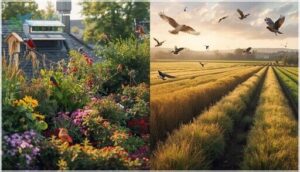
You don’t need vast wilderness to make a difference for birds. Cities and farms can become thriving habitats when restoration meets real-world needs.
Here are three proven approaches that bring birds back to working landscapes and urban spaces.
Bird-friendly Urban Green Spaces and Backyards
Cities often overlook how powerfully native backyard gardens transform urban habitats into thriving refuges for birds. By planting native vegetation in your green spaces, you create year-round food sources and nesting sites that directly boost urban bird diversity. Community involvement amplifies restoration impact—when neighborhoods embrace bird-friendly practices together, habitat structure improves across entire areas.
| Native Feature | Bird Benefit | Restoration Action |
|---|---|---|
| Native trees | Food and shelter | Plant diverse canopy layers |
| Shrub coverage | Nesting sites | Create dense understory zones |
| Unsealed soil | Foraging habitat | Maintain natural ground surfaces |
Studies in Paris recorded 36 distinct species in urban parks, proving green space size and quality matter. Larger areas with central undisturbed zones supported more breeding birds. Your backyard becomes part of a functional network when you prioritize native plants—restoration data shows species richness increases as plantings mature, eventually mirroring natural systems. Small spaces make big differences for bird conservation when designed thoughtfully.
Restoring Grasslands and Farmland for Birds
Beyond urban gardens, agricultural landscapes offer immense potential for grassland restoration and farmland conversion that benefits bird populations. Converting cropland to native perennial grasses under programs like the Conservation Reserve Program has reversed population declines, with restored sites showing 44% increases in bird abundance and 35% gains in species richness. Long-term outcomes prove habitat diversity pays off:
- Actively seeded grasslands support 4-5 times more birds than intensive cropland
- Native vegetation plantings boost specialist species presence by up to 261%
- Sustained monitoring confirms habitat restoration techniques maintain bird communities for years
These techniques demonstrate how invasive species removal combined with strategic native planting creates functional bird conservation zones within working landscapes.
Managed Flooding and Hedgerow Planting Initiatives
Farmland conversion through managed flooding and hedgerow planting delivers measurable economic benefits while supporting migratory birds. Floodplain dynamics create temporary wetland habitat used by millions of birds annually, while hedgerow planting increases bird species richness by 51% on diversified farms.
These habitat restoration techniques demonstrate how adaptive management of hydrology impacts and native vegetation creates functional bird habitat restoration within agricultural landscapes.
Frequently Asked Questions (FAQs)
How long does habitat restoration typically take?
Habitat restoration timelines vary widely depending on project type and ecosystem complexity. Initial native plantings establish in 3 to 5 years, while full ecosystem recovery and long-term habitat health generally require 5 to 10 years or more.
What permits are required for wetland restoration projects?
You’ll need federal permits like Section 404 under the Clean Water Act and state wetland regulations.
Permit timelines vary from 60 days to nine months depending on project size, while mitigation banking expedites approvals.
How much does bird habitat restoration cost?
Bird habitat restoration costs vary widely based on project scale and complexity. You can expect $2,000 to $10,000 per acre for native vegetation, while wetlands range from $170 to $25,000 per acre.
Which bird species benefit most from restoration efforts?
Regarding habitat specialists and endangered species getting a “second wing” at life, targeted restoration delivers the biggest wins.
Migratory waterfowl, grassland birds, and even urban adapters show measurable population rebounds through species conservation efforts.
Can climate change affect restoration success rates?
Yes. Climate change reduces restoration success by 15–20% through altered habitats, phenological mismatch, and hydrological change.
Spatial shifts require adaptive strategies like climate-smart plantings and wildlife corridors to improve climate resilience in ecosystem restoration efforts.
Conclusion
The smallest actions can yield the greatest change. Restoring natural bird habitats shows that targeted efforts—native plantings, wetland reconstruction, invasive species removal—create measurable results.
You don’t need vast resources to make a difference. Start with one project in your community. Monitor progress. Adapt as you learn.
Each restored acre becomes a refuge for species that once thrived there. The birds will return when you build back what they’ve lost.
- https://klamathbird.org/callnote/a-case-study-in-urban-habitat-restoration-at-willow-wind-community-learning-center/
- https://www.nan.usace.army.mil/Media/News-Stories/Story-Article-View/Article/3123184/restoring-bird-habitats-while-sustaining-ours/
- https://academic.oup.com/condor/article/127/3/duaf034/8124731
- https://www.birdlife.org/news/2025/10/10/restoring-habitats-key-to-fighting-extinctions/
- https://besjournals.onlinelibrary.wiley.com/doi/10.1111/1365-2664.14148