This site is supported by our readers. We may earn a commission, at no cost to you, if you purchase through links.
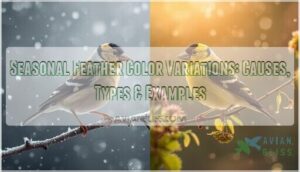
A male American Goldfinch in January looks almost nothing like the same bird in July.
That dull, olive‑streaked creature perched at your winter feeder transforms—feather by feather—into a blazing yellow showpiece by breeding season.
This isn’t a coincidence or accident.
Seasonal feather color variations are precisely timed biological events, driven by hormones, daylight cues, and millions of years of evolutionary pressure.
Birds don’t just change colors; they’re responding to environmental signals with impressive accuracy, often down to the week.
Understanding what triggers these shifts—and what they reveal about a bird’s health, age, and survival strategy—opens up a completely different way of reading the birds around you.
Table Of Contents
- Key Takeaways
- What Are Seasonal Feather Color Variations?
- How Molting Drives Color Changes
- Hormonal and Physiological Triggers
- Pigments and Feather Structure Explained
- Evolutionary Benefits of Color Variation
- Examples of Birds With Seasonal Color Changes
- Differences by Age and Sex
- Environmental Factors Affecting Color Change
- Observing and Identifying Seasonal Plumage
- Conservation Implications of Plumage Variation
- Frequently Asked Questions (FAQs)
- Conclusion
Key Takeaways
- Birds change feather colors seasonally in response to hormones, daylight, and environmental cues, which helps them survive and reproduce.
- Molting is the process that drives these color changes, with timing shaped by energy needs, migration, and breeding cycles.
- Feather coloration comes from both pigments like melanins and carotenoids, and structural features that reflect light, creating vibrant or camouflaged appearances.
- Climate shifts and artificial light can disrupt natural color changes, affecting bird health, breeding, and population monitoring.
What Are Seasonal Feather Color Variations?
If you’ve ever watched a goldfinch goes from blazing yellow to a muted olive-brown between summer and winter, you’ve already seen seasonal plumage change in action.
This dramatic transformation is just one of many fascinating traits covered in this guide to backyard birds of Nebraska, where seasonal plumage gets the spotlight it deserves.
Birds don’t stay the same color year-round — their feathers shift in ways that serve very specific biological purposes. Here’s a closer look at what seasonal feather color variations actually are and the different forms they take.
Definition of Seasonal Plumage
Seasonal plumage is the complete set of feathers a bird grows during a single molting process — what ornithologists call a plumage generation.
The Humphrey-Parkes system gives each generation a formal name, distinguishing basic vs. alternate plumages within the molt cycle naming framework.
Photoperiodism triggers these shifts, driving feather coloration changes that serve camouflage, communication, and survival across seasons.
The seasonal plumage changes of black‑tailed godwits illustrate this shift from bright terracotta to muted grey‑white tones.
Types of Seasonal Color Changes
Beyond basic molting, birds actually use five distinct strategies.
Complete plumage swaps replace nearly all feathers — think goldfinches going full olive in winter. Partial plumage changes update only key patches like the throat or breast. Eclipse plumage shifts briefly make male ducks cryptic and flightless. Abrasion revealed color uncovers hidden brightness as feather tips wear away. Pigment intensity shifts describe how carotenoid‑based hues naturally fade between seasons.
During the eclipse moult, male ducks gain cryptic plumage for eclipse moult camouflage.
How Molting Drives Color Changes
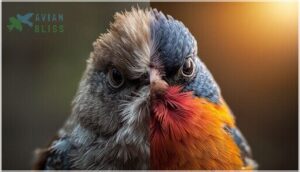
Molting is the engine behind nearly every feather color change you’ll observe in birds throughout the year.
It’s a precise, timed process — and once you understand how it works, seasonal plumage shifts start making a lot more sense.
Here’s a closer look at the two key aspects that make it all happen.
Molting Cycles and Timing
Most small songbirds follow a once-yearly prebasic molt timing cycle, replacing feathers after breeding wraps up — generally July through October. Some species add a prealternate molt in late winter, renewing plumage just before courtship begins.
These molting patterns aren’t random; energetic constraints shape every decision. Push molt too hard against migration, and the bird pays a steep price in survival.
Feather Replacement Process
Follicle Stem Cells activate, producing pin feathers that emerge with a protective sheath.
You’ll notice Keratinization Stages as these feathers harden, forming strong shafts and vanes.
Birds follow a Symmetrical Replacement Pattern, losing matching feathers on both sides.
Nutritional Demands grow, peaking, since building new feather structure requires protein.
Hormonal Regulation ensures orderly progress, supporting Seasonal Plumage Change in avian physiology.
Hormonal and Physiological Triggers
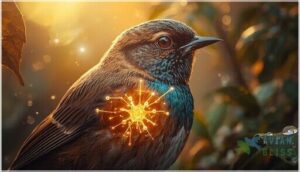
Behind every burst of breeding color or winter fade, there’s a precise set of biological signals calling the shots. Your bird’s body runs on internal timing systems that respond to the world outside, triggering everything from gland activity to feather growth.
Here’s a closer look at the two key physiological drivers making it all happen.
Role of Photoperiod and Day Length
Did you know birds sense day length not just with their eyes, but through deep brain photoreceptors? This photoperiodic gene expression triggers hormonal regulation, setting the rhythm for seasonal plumage change and feather coloration.
Melatonin rhythm shifts with night length, especially at different latitude day thresholds. Urban night lighting can disrupt avian physiology, altering natural cues for color transitions.
Pituitary and Thyroid Gland Functions
While your birds prepare for seasonal plumage change, their pituitary and thyroid glands orchestrate the process.
Prolactin molt timing ensures parents keep functional feathers until chicks are raised, while thyroid pigment deposition shapes new coloration.
Pituitary stress regulation and thyroid metabolic support fuel feather growth, and pituitary‑adrenal interaction balances Avian physiology and hormonal regulation—driving effective seasonal adaptation strategies and feather coloration.
Pigments and Feather Structure Explained
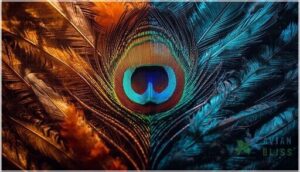
Feather color doesn’t come from a single source — it’s a mix of chemistry and physics working together.
Two main factors determine what you actually see when a bird flies past: the pigments stored inside the feathers and the way the feather’s physical structure interacts with light.
Here’s a closer look at both.
Melanins and Carotenoids
Two pigment families do the heavy lifting behind most feather coloration you’ll observe year-round. Melanin UV Protection keeps feathers durable and dark, produced through internal Pigment Synthesis Pathways inside follicle cells. Carotenoids — your bird’s Dietary Carotenoid Sources from seeds and fruits — drive vivid yellows and reds while fulfilling a Carotenoid Antioxidant Role in overall health.
- Melanistic plumage signals dominance through Pigment-Based Social Signals like dark bibs or caps
- Carotenoid-based colors reflect foraging success, making them reliable Seasonal Adaptation Strategies during breeding
- Plumage Variations in pigmentation intensity shift with diet, hormones, and molt timing
Structural Coloration and Light Refraction
Not all feather coloration comes from pigments. Structural coloration works through keratin nanostructure arrays — tiny air pockets in keratin that scatter short wavelengths via UV scattering mechanisms, producing blues and iridescent photonic crystals without a single pigment molecule.
These angle‑dependent hue shifts explain why a bird looks different as it moves.
Feather wear effects gradually disrupt these nanostructures, dulling plumage variations across the breeding season.
Evolutionary Benefits of Color Variation
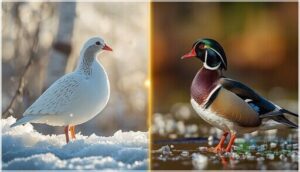
Seasonal color changes aren’t just beautiful — they serve real purposes that have been shaped by millions of years of natural selection.
Seasonal color changes aren’t mere beauty — they’re survival strategies refined across millions of years of natural selection
Birds that blend in survive longer, and birds that stand out during breeding season attract better mates. Here’s a look at the two main evolutionary advantages that make these color shifts so important.
Camouflage and Predator Avoidance
Have you noticed how a ptarmigan blends perfectly into snowy landscapes?
That’s snow camouflage at work—an evolutionary advantage shaped by seasonal color change.
Background matching and disruptive patterning help you avoid predator detection cues.
Habitat‑specific coloration lets you vanish among leaf litter or bare soil, turning feather coloration into effective camouflage.
This strategy enhances predator avoidance across changing environments.
Sexual Selection and Mating Displays
Imagine a male goldfinch flashing vivid yellow in spring—his seasonal color change isn’t just for show.
Courtship rituals rely on UV signaling and display timing, with males fluffing feathers or gathering in lek dynamics to attract females. Sexual dimorphism shapes these plumage variation types, while feather maintenance ensures breeding behaviors succeed. Your understanding of feather coloration and camouflage deepens with each observation.
Examples of Birds With Seasonal Color Changes
Some birds make these seasonal shifts hard to miss — their transformations are dramatic enough to stop you in your tracks.
A few species stand out as textbook examples of just how striking plumage changes can get.
Here are four birds that show the full range of what seasonal color change looks like in practice.
Ptarmigan
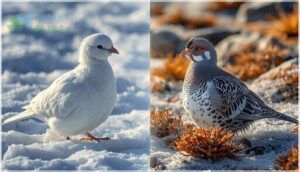
The ptarmigan is one of nature’s most precise examples of seasonal color change in action. Living across the open tundra habitat, this bird relies on feather coloration and camouflage to survive year‑round. Its molting patterns follow a strict schedule:
- Winter camouflage: pure white covers the body
- Summer molt timing: mottled brown matches tundra rocks
- Fall shift: gray‑white blends shifting terrain
Predator detection becomes harder when you’re invisible.
American Goldfinch
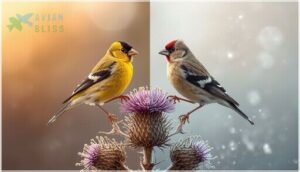
Unlike the ptarmigan’s dramatic white-to-brown shift, the American Goldfinch shows you how molt timing and pigmentation work together more subtly.
Males drop from vivid yellow to muted olive-brown each fall — a complete seasonal color change tied to migration patterns and winter diet shifts. Territory size and song variations also shift accordingly.
By late winter, molting patterns restore that bright breeding plumage.
Ruff
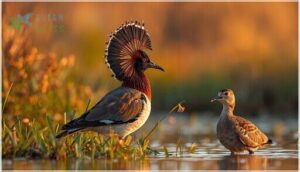
The Ruff takes seasonal color change to a theatrical extreme. During breeding season, males grow dramatic ruffs and head tufts — appearing in black, chestnut, or white — driven by hormonal regulation tied to photoperiod. This display coloration signals fitness to females, a textbook case of sexual dimorphism in action.
Females, by contrast, keep plain gray-brown plumage year‑round, making the difference unmistakable.
Snow Bunting
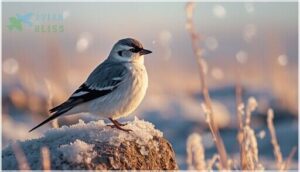
Snow Buntings use a clever trick for their seasonal color change — no second molt required.
Breeding males reveal their striking white heads and black backs simply as winter feather tips wear away, exposing vivid breeding plumage underneath.
This habitat-driven coloration aids camouflage across tundra landscapes and sharpens predator avoidance strategies during migration timing cues.
Avian adaptation, at its most elegant.
Differences by Age and Sex
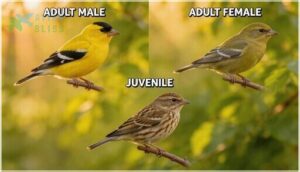
Not all birds wear the same colors at every stage of life, and sex plays a big role in what you’re likely to see in the field.
A young bird often looks nothing like its parents, and males and females of the same species can look like completely different birds.
Here’s a closer look at how age and sex shape plumage.
Juvenile Vs. Adult Plumage
Young birds and adults of the same species can look like entirely different creatures. Here’s what sets them apart:
- Feather texture in juveniles is softer and looser, wearing down faster due to higher wear rates.
- Camouflage function drives streaked juvenile patterns, reducing predator attention.
- Age signaling through plumage helps adults avoid unnecessary aggression toward non-competitors.
- Molt timing shifts juveniles into first-winter plumage within months.
- Seasonal color change stabilizes once definitive adult plumage is reached.
Sexual Dimorphism in Plumage
Sexual dimorphism in birds means males and females of the same species can look strikingly different.
Mating display brightness in males often comes from carotenoid-driven dimorphism or structural color differences, while females stay duller for camouflage.
Sex-specific molt timing ensures males develop showy plumage before breeding season.
The genetic basis of dimorphism, including the BCO2 gene, directly shapes these seasonal color change patterns.
Environmental Factors Affecting Color Change
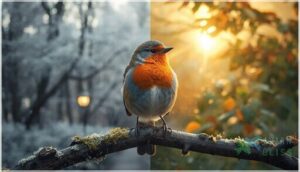
Molting and hormones set the internal clock for color change, but the outside world has a say too.
Where a bird lives, what season it’s experiencing, and even how much artificial light surrounds it can all shift the timing or outcome of plumage transitions.
Here are the key environmental factors that influence how and when birds change color.
Climate and Temperature Influences
seasonal color change directly shape in ways in ways you might might expect expect.
Warmer springs trigger Temperature‑Driven Molting Shifts up to 10 days earlier per decade, creating Climate‑Induced Color Mismatch when white winter camouflage lingers past snowmelt.
Heat‑Stress Pigment Dulling fades carotenoid‑based yellows and reds, while Humidity‑Modulated Melanin responds differently across wet and dry zones — all part of how Thermal Plumage Adaptation aids thermoregulation and seasonal adaptations under climate change.
Impact of Light Pollution
Ever wondered how city lights reshape bird plumage? Artificial illumination disrupts photoperiod cues, leading to:
- Urban plumage dullness, with faded carotenoid colors
- Disrupted molt timing, so feather replacement drags on
- Hormonal rhythm disturbance, lowering melatonin and shifting breeding signals
- Migratory disorientation, as birds circle lit skylines
These environmental cues blur seasonal color change, altering breeding and survival outcomes.
Observing and Identifying Seasonal Plumage
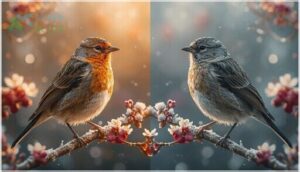
Spotting a bird in its winter coat versus its summer breeding plumage can feel like meeting two completely different species. Knowing what to look for — and where to look it up — makes all the difference.
Here’s what will help you identify seasonal plumage with more confidence.
Birdwatching Tips for Color Changes
Catching plumage changes in the field requires strategy. Time your birdwatching around migration timing — April through May for peak breeding colors, July through August for active molting.
| Strategy | What to Look For |
|---|---|
| Habitat Scouting | Tundra edges, tidal flats, wetland stopovers |
| Binocular Selection | 8×42 or 10×42 for true seasonal color change detail |
| Photo Identification Apps | Match camouflage patterns and visual signals instantly |
| Molt Signs | Wing gaps, pinfeathers, faded versus fresh plumage contrast |
Field Guide Usage
A good field guide does half the work for you. Look for consistent icon placement — labels like “breeding” and “nonbreeding” should appear in the same spot on every page so you can scan fast. Use range map integration to match seasonal labels to what’s actually outside your window right now.
- Comparison plates group similar species side by side, making seasonal labels and plumage changes easier to distinguish
- Digital filters in birding apps let you sort by breeding or nonbreeding appearance instantly
- Seasonal changes, bird molting patterns, and color abnormalities are best cross‑checked using both print plates and app photos together
Conservation Implications of Plumage Variation
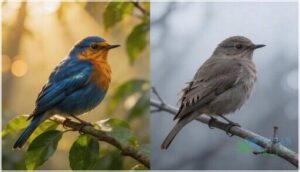
Plumage isn’t just a visual spectacle — it’s a window into how bird populations are actually doing.
As environments shift and climate patterns grow less predictable, the way birds change color carries real conservation weight.
Here’s what you need to know about the two key implications scientists are paying close attention to.
Climate Change and Adaptation Challenges
Warming temperatures are quietly reshaping how birds time and complete their plumage changes — and the consequences are serious.
| Climate Threat | Impact on Plumage |
|---|---|
| Snow Mismatch Risk | White winter birds exposed on bare ground |
| Molting Timing Shifts | Molt now overlaps breeding and migration |
| Carotenoid Availability Decline | Paler breeding colors, weakened immunity |
| Sea Ice Habitat Loss | Emperor penguins lose stable molting platforms |
| Energetic Budget Overlap | Poor feather quality entering winter |
Ecological adaptation can’t always keep pace with these rapid seasonal changes.
Monitoring Population Health Through Plumage
Feather condition tells you more than you might think. Through plumage scoring, researchers assign numeric values to specific body regions, tracking condition trends across seasons and molting cycles.
Stress indicators like fault bars, pale carotenoid patches, or abnormal detection of leucism signal environmental pressure.
Citizen monitoring projects document seasonal changes in bird coloration, connecting feather structure and function directly to ecological adaptation across wild populations.
Frequently Asked Questions (FAQs)
Can diet affect the vibrancy of feathers?
Yes, diet directly shapes feather vibrancy.
Carotenoid intake, protein quality, vitamin A levels, and mineral balance all influence feather development during molting, affecting color changes and overall feather structure and function in avian biology.
How do parasites or disease impact feather coloration?
Parasites and disease dull carotenoid dulling, trigger melanin faults, and cause fault bar formation—making ectoparasite damage and color abnormalities in birds honest health signal honesty markers visible throughout feather development.
Can feather color changes be reversed mid-season?
Reversing mid-season color changes isn’t really possible.
Once feathers finish growing, they’re dead keratin — molting drives true color shifts, while abrasion-induced shifts, UV fading dynamics, and hormonal limits prevent any genuine reversal without new feather growth.
Conclusion
Long before radar or satellites, sailors read the skies and birds to forecast seasons ahead. Seasonal feather color variations work the same way—nature’s built-in calendar, precise and unforgiving.
Every molt, every pigment shift, every flash of breeding plumage tells you something real about that bird’s health, age, and reproductive timing. Once you understand what’s driving those changes, you stop seeing random color and start reading a biological story written in feathers.
- https://chicagobirdalliance.org/blog/2025/1/3/back-to-basics-plumage-in-winter
- https://www.nordmi.com/post/meet-winter-goldfinch-1
- https://onlinelibrary.wiley.com/doi/full/10.1002/ece3.6606
- https://academic.oup.com/biolinnean/article/94/4/711/2701319?searchresult=1
- https://www.birdful.org/what-type-of-camouflage-does-a-ptarmigan-have/