This site is supported by our readers. We may earn a commission, at no cost to you, if you purchase through links.
Every autumn, roughly 5 billion birds vanish from North American skies—and then, like clockwork, most of them come back. These seasonal shifts in bird populations aren’t just impressive feats of navigation; they’re finely tuned survival strategies shaped by millions of years of evolution.
Warblers time their departures to miss hurricane season, geese fatten up on specific berries before their transcontinental treks, and hummingbirds somehow know when Mexican agave flowers will bloom 2,000 miles away. But here’s the catch: climate change is scrambling these ancient rhythms, pushing spring earlier and shuffling food sources in ways birds can’t always predict.
Understanding how and why bird populations shift with the seasons—from migration timing to nesting behaviors to winter survival tactics—gives you a front-row seat to one of nature’s most vibrant performances, and reveals exactly what’s at stake when those rhythms get disrupted.
Table Of Contents
- Key Takeaways
- Migration Patterns and Seasonal Bird Movements
- Seasonal Changes in Bird Behavior
- Nesting and Breeding Shifts Through Seasons
- Feeding Strategies and Food Availability
- Environmental Impacts and Conservation Needs
- Frequently Asked Questions (FAQs)
- What is the seasonal movement of birds?
- How do birds respond to seasonal changes?
- Which season are birds most active?
- Why do birds migrate seasonally?
- How do urban environments affect seasonal bird populations?
- What role do stopover sites play for birds?
- How does artificial lighting impact bird seasonal behavior?
- How do diseases spread during seasonal bird gatherings?
- Conclusion
Key Takeaways
- Roughly 5 billion birds migrate across North America each year, following five major flyways, using magnetic cues, celestial navigation, and visual landmarks to travel thousands of miles between breeding and wintering grounds.
- Climate change is disrupting ancient migration timing by advancing spring arrivals 1-2 days per decade, creating dangerous mismatches between when birds arrive at breeding sites and when their food sources (like insect blooms) actually peak.
- Birds completely overhaul their behavior with the seasons—flocking patterns, energy conservation tactics, nest-building strategies, and diets shift dramatically to match available resources and survival demands throughout the year.
- Conservation efforts must focus on protecting stopover sites along migration routes and restoring fragmented habitats, since habitat loss has eliminated up to 30 percent of core bird habitats in some regions over just the past decade.
Migration Patterns and Seasonal Bird Movements
Bird migration is one of nature’s most astonishing spectacles—thousands of miles traveled, often twice a year, just to survive and thrive.
These journeys aren’t random—birds rely on specific geographic features like mountain passes and coastal corridors to navigate their routes with remarkable precision.
Bird migration is one of nature’s most astonishing spectacles—thousands of miles traveled twice yearly for survival
But here’s the thing: migration isn’t just about distance. It’s about timing, routes, unique behaviors for different species, and the extraordinary ways birds navigate across continents.
Major Migration Routes and Flyways
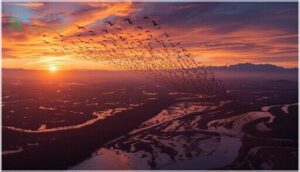
Across continents, you’ll find birds following five major flyways—massive aerial highways connecting breeding and wintering grounds. The Americas flyway stretches from Arctic Canada to South America, while the African-Eurasian route links Greenland to sub-Saharan Africa.
These migration patterns rely on stopover sites like coastal mudflats and wetlands, where birds refuel during their remarkable journeys using celestial cues and magnetic navigation. These global journeys are part of the interconnected major flyway networks that support bird migration across continents.
Timing Shifts in Spring and Fall Migration

Bird migration timing has changed dramatically—spring arrivals now come days or even weeks earlier as temperatures warm! You’ll notice long-distance migrants advancing spring departures by roughly one day per decade, racing to match insect blooms and vegetation green-up on breeding grounds.
Fall migration shows more timing variability, with some species delaying departure when berries linger, while others accelerate southbound movements as autumn temperatures drop. Recent studies have documented significant changes in autumn migration trends among North American passerines, highlighting the complexity of these seasonal shifts.
Species-specific Migration Behaviors

When you look at migration ecology closely, you’ll see each species charts its own path—leapfrog migration lets northern populations fly right past southern cousins.
Altitudinal migration keeps mountain dwellers moving vertically instead of across continents, while partial migrants mix residents with travelers in the same flock.
Species adaptation drives habitat selection at every stopover, shaping flight patterns and bird migration patterns that reflect climate change impact on birds and local food timing.
Species distribution modeling reveals these nuanced strategies beautifully.
Navigation Methods and Challenges

Those flight patterns rely on some wild navigation tricks—you’ve got magnetic cues tuning birds to Earth’s field, celestial navigation tracking star patterns, and visual landmarks like coastlines keeping them on course. Social learning means juveniles follow veterans, while energetic constraints force strategic stops every few hundred miles.
Climate change impact now shifts wind currents and throws timing off, making bird migration patterns tougher than ever!
Species like the Baltimore Oriole face breeding mismatches as they arrive at nesting grounds too late to catch peak insect availability.
Seasonal Changes in Bird Behavior
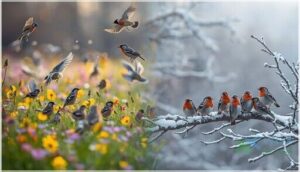
Birds don’t just pick up and leave when the seasons change—they completely shift how they live their daily lives. From the way they hang out together to how they dodge danger, every behavior gets a seasonal makeover.
Here’s how these feathered friends adapt their survival strategies throughout the year.
Flocking and Social Dynamics Across Seasons
When resource-rich seasons arrive, flock cohesion transforms—you’ll see massive groups form and shrink as food becomes scarce. Mixed flocks emerge, bringing together different species to share vital intel about predators and foraging spots.
Here’s what drives these seasonal changes in avian behavior:
- Group leadership shifts as migrants join or leave resident bird populations
- Vocal exchanges spike in spring, strengthening coordination
- Social learning accelerates when experienced adults guide younger birds through migration routes
Energy Conservation and Shelter-seeking Strategies
Survival hinges on thermal insulation—you’ll notice how birds fluff feathers to trap air, boosting energy efficiency by 40 percent during cold snaps.
Shelter design matters too: dense canopies and elevated roosts reduce temperature swings by 6 to 8 degrees Celsius. These behavioral responses to weather impact aren’t random—they’re climate adaptation strategies honed over millennia, helping birds navigate seasonal changes without burning precious fuel reserves.
Predator Avoidance During Population Shifts
Predator evasion kicks into overdrive when populations shift along flyways—you’re watching flock dynamics that slash individual risk through sheer numbers!
Migration tactics include timing departures to dodge raptor peaks and choosing dense cover at stopovers.
Risk assessment happens constantly: sentinel birds scan while others refuel, spreading alarm calls that trigger synchronized escape flights.
These adaptive behaviors turn vulnerability into collective strength during seasonal changes.
Nesting and Breeding Shifts Through Seasons

For raising the young, birds don’t just wing it—they’re actually shifting their entire breeding schedules to keep up with changing climates.
You’ll notice these adjustments playing out in three major ways: when they start nesting, how they build and choose their sites, and whether their chicks make it through to adulthood. Let’s break down what’s happening with breeding seasons across different times of year.
Breeding Season Timing and Climate Influences
You’ve probably noticed birds singing earlier each spring—that’s climate cues at work! Temperature effects drive breeding shifts as warmer springs advance egg laying by several days in temperate species.
But here’s the twist: nesting delays still happen when early rainfall hits, despite warm temperatures. Peak insect abundance and day length fine-tune these reproductive adaptations, showing how seasonal behavioral changes respond to multiple environmental signals simultaneously.
Nest-building Adaptations and Site Selection
When you spot a nest, you’re seeing architecture suited to survival! Site selection balances predator avoidance with microclimate regulation—birds position nests in dense understory for camouflage strategies while choosing heights that moderate temperature extremes.
Nest material choices reflect nesting ecology brilliance: flexible grasses absorb wind impact, feathers insulate eggs, and moisture-regulating moss keeps conditions stable. These nesting habits showcase impressive habitat selection and avian ecology adaptations!
Reproductive Success and Survival Rates
Breeding success hinges on reproductive strategies that balance energy costs with offspring viability—you’ll see how first-year survival rates shape entire populations.
Climate change impact disrupts this delicate timing, mismatching peak food with nesting habits. Adults trading current reproduction for future survival demonstrate survival strategies refined over millennia, ensuring their genetic legacy persists through unpredictable seasons and shifting reproductive cycles.
Feeding Strategies and Food Availability
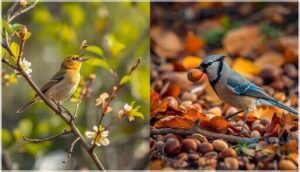
Birds don’t just show up anywhere hoping to find a meal—they follow the food! Their entire year revolves around what’s available to eat, from the spring insect explosion to the fall nut harvest.
Let’s look at how their feeding strategies shift with the seasons and why those changes matter so much for their survival.
Seasonal Diet Changes and Food Sources
You’ll notice birds changing their feeding habits with stunning speed when the seasons shift! Dietary Adaptations keep them alive through wild temperature swings and unpredictable Food Availability. Here’s what drives Seasonal Foraging:
- Insects dominate spring menus—fueling breeding and feather growth
- Seeds and nuts become winter staples when fruit disappears
- Berries peak in late summer, perfect for migration prep
- Aquatic prey sustains waterfowl during wet seasons
- High-fat foods meet Energetic Needs in cold months
Climate change is scrambling these ancient patterns!
Foraging Behaviors Linked to Migration
When birds hit their Migration Routes, their Forage Patterns shift dramatically! Stopover Ecology reveals how shorebirds exploit tidal zones to rebuild Energy Reserves, while passerines switch from insects to berries mid-journey.
You’ll see mixed-species flocks using safety-in-numbers foraging strategies at reliable sites—refueling fast before the next leg. Prey Selection depends on what’s available along flyways, shaping entire migration patterns!
Impact of Resource Fluctuations on Populations
Resource Pulses drive Population Dynamics in wild bird populations—when insect surges or berry crops explode, you’ll see breeding accelerate and clutch sizes jump.
Food Web connections mean shortages ripple fast: generalists switch diets and survive, while specialists crash.
These seasonal changes reshape Reproductive Outputs and Ecosystem Resilience, especially as climate change scrambles traditional food timing in population ecology studies.
Environmental Impacts and Conservation Needs
The world our feathered friends navigate isn’t the same one their ancestors knew—and that’s creating some serious survival challenges.
Climate shifts, disappearing habitats, and human development are reshaping migration routes and breeding success in ways we’re only beginning to understand.
Let’s look at what’s happening out there and what we can actually do to help these remarkable travelers thrive.
Effects of Climate Change on Migration and Populations
When temperatures climb, bird migration patterns shift dramatically—arrivals now happen 1 to 2 days earlier each decade.
Climate change impacts create timing mismatches between food peaks and chick hatching, boosting juvenile mortality.
You’ll see population dynamics transform as droughts reduce stopover sites and warmer springs alter breeding windows.
These behavioral adaptations reveal ecological consequences reshaping seasonal changes across entire flyways.
Habitat Loss and Fragmentation Challenges
Fragmented landscapes shatter core habitats—up to 30 percent lost in some regions over just a decade. Habitat destruction and edge effects expose nests to predators and extreme weather, while roads force dangerous detours during migration.
You’ll notice ecosystem disruption as isolated patches cut off gene flow, reducing bird species diversity and threatening ecological balance. Habitat conservation and biodiversity conservation efforts must tackle fragmentation head-on to preserve these essential corridors.
Conservation Strategies for Sustaining Seasonal Populations
You can protect seasonal populations through habitat restoration and climate adaptation strategies. Bird friendly policies and sustainable landscapes create safe corridors along flyways—boosting ecosystem services and wildlife conservation.
Conservation and habitat management teams secure stopover sites with reliable food sources, while ecological conservation and management efforts align bird conservation timing with shifting weather patterns. Habitat preservation won’t work without cross-border collaboration and community-driven action!
Monitoring and Research for Future Adaptation
Ongoing monitoring tools and research methods give you the clearest window into how climate change reshapes bird migration and species distribution. Data analysis from automated recorders, drones, and citizen science platforms reveals population trends in real time—fueling climate modeling and conservation strategies that adapt to tomorrow’s challenges.
Here’s what you can track:
- Dawn chorus timing to measure breeding readiness
- Flock movements through portable radars in key flyways
- Nest-site surveys using high-resolution drone imagery
- Vocalization patterns that reveal territory and social behavior
These approaches in conservation biology turn raw observations into actionable forecasts!
Frequently Asked Questions (FAQs)
What is the seasonal movement of birds?
Twice each year, warblers slip through darkness heading thousands of kilometers north to breed or south to winter—that’s bird migration.
Seasonal patterns drive these movements as birds follow flyway routes, food supplies, and climate cues to survive.
How do birds respond to seasonal changes?
Birds adjust their migration timing, breeding schedules, and feeding habits when seasonal cues—like temperature and insect abundance—shift.
You’ll see behavioral flexibility as they track climate changes and adapt their survival strategies year-round.
Which season are birds most active?
Like clockwork tuned to the sun, your feathered neighbors hit peak activity during spring and summer—when dawn-to-dusk foraging fuels breeding patterns, daily rhythms sync with migration cycles, and seasonal adaptations drive nonstop territorial displays.
Why do birds migrate seasonally?
You’ll see migration patterns driven by food cues and weather patterns—when insect swarms vanish in fall, birds head south.
Bird navigation using magnetic fields and seasonal adaptation helps them track the best climates year-round!
How do urban environments affect seasonal bird populations?
Urban environments reshape bird populations through heat islands and artificial light—advancing breeding, disrupting migration timing, and creating year-round food subsidies that alter seasonal distribution and challenge wildlife ecology conservation efforts.
What role do stopover sites play for birds?
You’ll find stopover sites are critical migration hubs where birds refuel and rest.
These energy replenishment zones let migrating flocks recover from fatigue, rebuild fat reserves, and prepare for their next flight leg.
How does artificial lighting impact bird seasonal behavior?
Light pollution throws off bird behavior in wild ways—it triggers earlier migration departures, extends nocturnal activity, and advances breeding cycles, creating mismatches with food availability that can hurt chick survival!
How do diseases spread during seasonal bird gatherings?
Think of a bustling airport during holiday season—that’s what migration stopovers look like for pathogen transmission.
Dense flocking behavior at shared feeding sites and waterholes accelerates avian infections through contaminated surfaces and close contact.
Conclusion
The warblers leaving your yard today might cross paths with the same storm systems their ancestors dodged—except now, those storms arrive two weeks earlier.
Seasonal shifts in bird populations aren’t just ancient routines; they’re living tests of adaptation happening in real time. Every feeder you fill, every native plant you grow, every light you dim during migration season becomes part of their evolving strategy. You’re not just watching nature’s rhythms—you’re helping write the next verse.