This site is supported by our readers. We may earn a commission, at no cost to you, if you purchase through links.
A songbird can fool you in less than a second. One flash of brown, a quick tail flick, and the bird that looked like a House Finch turns into a Purple Finch, or a sparrow into a warbler. Color often tricks beginners, because light shifts, feathers wear, and spring plumage doesn’t last.
Shape tells the truth faster. Bill thickness, tail length, wing posture, and even the way a bird moves can narrow an ID before you catch a note of song.
similar-looking songbirds guide helps you read those clues the way ornithologists do in the field daily.
Table Of Contents
Key Takeaways
- Shape, bill thickness, and movement give you a faster, more reliable ID than color alone, since light and worn feathers make color deceptive.
- Precise field marks — like where a throat patch stops, the placement of wing bars, or a flash of rump color at takeoff — matter far more than overall hue.
- Behavior and vocalizations (foraging style, tail flicks, song rhythm) often seal an uncertain ID when visual clues fall short.
- Season, habitat, and range should always be part of your checklist, since the same bird can look completely different in juvenile plumage or nonbreeding season.
Spotting Lookalike Songbirds Fast
When two songbirds look nearly identical, you need a quick way to tell them apart. It helps to focus on the features that matter most for fast identification.
For practical tips on spotting subtle differences, check out this guide to identifying similar songbird species quickly and accurately.
Here’s what you’ll want to check first.
Size and Silhouette First
Before anything else, train your eye on size and silhouette outline. A bird’s body size range — usually 5 to 9 inches for common yard species — combined with wing length ratio and tail length proportion tells you a lot before color even registers.
Stocky finches look nothing like slender warblers in a quick bird silhouette comparison. These size and shape cues are your fastest visual identification shortcut.
Bill Shape and Tail Shape
After you’ve sized up a bird’s silhouette, pay attention to its bill and tail.
Conical Bill Shape signals a seed eater, while a Thin Pointed Bill marks an insect hunter. Forked Tail Form helps swallows steer, but a Square Tail End gives sparrows balance.
Bill Edge Serration stands out on close inspection—these field marks anchor your visual identification.
Posture, Stance, and Movement
Once you’ve read the bill and tail, watch how the bird holds itself. Perch Balance tells a story — a compact Wing Fold at rest differs from an anxious, erect Head Tilt.
Leg Posture shifts from bent knees when perched to quick hops on the ground. Those subtle Tail Flicks are genuine behavioral cues, often confirming field marks that size and shape alone can’t settle.
Color Placement Versus Overall Color
Color tells you a lot — but where that color sits matters more than the shade itself. Two birds can share the same overall hue placement yet look completely different once you check Crown Nape Contrast, Wing Patch Placement, or Underparts Back Contrast.
Watch for:
- Throat patches that stop abruptly
- Rump color contrasting the back
- Breast streaking versus clean underparts
- Bold wing bars against muted overall plumage
Seasonal color shifts and plumage variation can blur these field marks, so anchor your visual bird identification to placement, not brightness.
How Lighting Can Mislead Identification
Even good eyes get tricked when light works against you.
Backlit Silhouettes inflate size and shape, making small finches look surprisingly chunky. Shadow Distortion hides eye rings and supercilium lines.
Color Temperature Shifts at dawn wash reds, orange, or cool yellows to gray. Glare on Plumage mimics white patches that don’t exist.
Artificial Light Effects at feeders compound these color perception challenges in bird identification — always reposition before you commit.
Field Marks That Matter Most
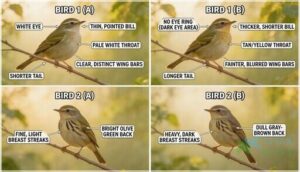
Once you know a bird’s size and shape, the next step is reading its details up close. Certain field marks do the heavy lifting when two species look nearly identical at first glance.
If you’re struggling to tell apart tricky species, the beginner songbird comparison tool with visual charts makes spotting subtle field marks much easier.
Here’s what to focus on.
Eye Rings, Eye Lines, and Supercilium
Ever wonder why some faces pop and others blend? Eye rings, eye lines, and supercilium are field marks that anchor bird identification.
Ring contrast and supercilium shape shift with age and season—juveniles often show faint markings, while adults sport bold lines.
Eye line variability helps separate species, especially when range maps and vocalizations leave you guessing.
Watch for seasonal ring changes!
Wing Bars, Streaking, and Spotting
Wing bars, streaking, and spotting are three field marks worth learning. Bar placement on the greater coverts tells you a lot at a glance — two crisp white bars on dark wings narrow your options fast.
Streak density separates sparrows from finches when colors look almost identical.
Spot distribution and contrast patterns shift with age, so field angle and lighting matter more than you’d expect.
Understanding overall color distribution helps narrow species choices quickly.
Throat Patches and Breast Patterns
How do you tell a Song Sparrow from a House Finch at a glance? Throat patches and breast patterns give you answers fast. Notice these four things:
- Patch Color Variation between seasons and sexes
- Breast Pattern Geometry—spots, stripes, or blocks
- Contrast Edge Definition—crisp or blurred
- Courtship Display Markings and Age-Related Patch Development
These field marks simplify bird identification techniques. Wingbars and patches are essential field marks for differentiating similar species, as described in the wingbars and patches guide.
Rump, Undertail Coverts, and Tail Edges
Rump patch visibility shifts the moment a bird lifts off — that flash of contrasting color is one of the fastest field marks you can catch. Yellow-rumped Warblers and Northern Flickers rely on this tail edge flash for quick ID.
Undertail contrast patterns also separate sparrows from finches: sparrows show crisp white undertail coverts, while finches blend with their body plumage.
Male, Female, and Juvenile Differences
Males often wear brighter plumage coloration to attract mates, while females stay cryptic for nesting. That’s the nesting duty split in action.
The sexual size gap is subtle but real — check your field guide.
Juvenile molt timing blurs these lines further, as young birds resemble females.
Vocal role divergence follows too: males sing complex songs, females call simply.
Common Songbird Lookalike Pairs
songbirds look so alike that even experienced birders do a double-take. Knowing the right details makes all the difference between a confident ID and a frustrating guess.
Here are five lookalike pairs worth learning well.
House Finch Vs Purple Finch

At your feeder, house finch (Haemorhous mexicanus) and purple finch (H. purpureus) look nearly identical — until you know what to check.
House finches show red only on the head and chest; purple finches spread rosy color across the face and back.
Note bill coloration, seasonal molt timing, and consult range maps or bird song recordings in your field guide to confirm.
Song Sparrow Vs Savannah Sparrow
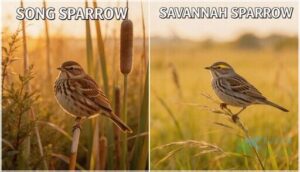
Now, the Song Sparrow (Melospiza melodia) and Savannah Sparrow (Passerculus sandwichensis) split your attention differently. Song Sparrows favor brushy nesting site preferences near marshes; Savannah Sparrows choose open grasslands.
Check the Savannah’s yellow lore — a field mark Song Sparrows lack. Their vocalizations diverge sharply too: buzzy versus rollicking.
Range maps and territorial calls seal confident songbird identification.
Black-capped Chickadee Vs Carolina Chickadee
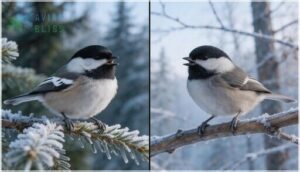
After sorting sparrows by sparrows by lore color, chickadees test your eye differently. Black-capped Chickadee (Poecile atricapillus) versus Carolina (P. carolinensis) is a classic bird ID puzzle.
- Cheek Patch Length extends farther back toward the neck in Black-capped
- Tertial Edge Contrast appears bolder with crisp white edging in Black-capped
- Neck Plumage Density looks fluffier, giving Black-capped a slightly larger silhouette
- Note Count Phrase runs faster and buzzier in Carolina’s song
- Range maps reliably split them — overlap zones are surprisingly narrow
vocalizations alongside visual checks for confident songbird identification.
Eastern Bluebird Vs Indigo Bunting
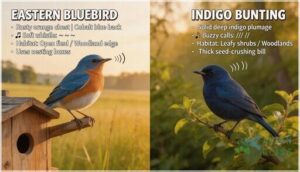
Spotting Eastern Bluebird and Indigo Bunting side by side, you’ll notice the Bluebird’s bigger body and upright stance, especially near nesting boxes.
Indigo Buntings look chunkier, with thick seed-crushing bills.
Their song frequency differs—Bluebirds offer soft whistles, Buntings repeat buzzy calls.
Range maps show overlap, but habitat preference and seasonal color shift help you nail Bird ID in breeding territory.
American Robin Vs Varied Thrush
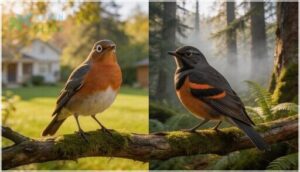
At first glance, these two can fool you — but look closer.
The American Robin sports a pale eye ring and rusty-orange chest fading to white, while the Varied Thrush shows bold orange wing bars and a sharper breast band. Tail shape contrast matters too: robins carry longer tails.
forest vs yard habitat, song rhythm in a bird vocal, and song library, and range maps in your detailed bird identification guide.
Songs, Calls, and Behavior Clues
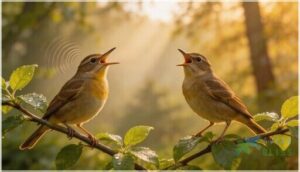
Sometimes, birds that look alike sound and act very differently. Paying attention to their songs, calls, and habits can help you tell them apart.
Here’s what to watch and listen for next.
Using Rhythm, Pitch, and Repetition
Ever noticed how rhythm signatures and pitch contours turn bird vocalizations into a musical fingerprint? You’ll spot repetitive motifs and beat intervals—some birds pace their syllable timing like clockwork.
Bird songs have their own rhythm and pitch, making each one a unique musical fingerprint you can learn to recognize
Audio recordings and bird song analysis from a sound library help you decode these patterns. Song identification often relies on these unique contours, making even lookalike birds easier to separate.
Memory Phrases for Similar Singers
Mnemonic song snippets work like acoustic signature tags for your brain.
Try giving each bird a phrase nickname — the American Robin’s "cheer-up, cheerily" versus a thrush’s slower, flute-like slur.
These cue-based recall tricks use temporal cue patterns, like where a phrase rises or stops, to anchor recognition.
Techniques for distinguishing lookalike bird species this way beat memorizing every note cold.
Foraging Style as an ID Shortcut
How a bird feeds can be just as telling as its feathers.
Ground Pecking Patterns, like slow pause-and-peck movements, signal seed-eating finches or sparrows. Crown Scanning Behavior marks chickadees working branches overhead. Hovering Insect Capture identifies warblers mid-air. Substrate Probing through leaf litter points to thrushes. Tail Flick Foraging helps separate wrens from similar species.
Utilizing behavioral cues in bird identification often closes the case fast.
Flocking, Hopping, and Tail Movements
Movement tells a story before color ever does. Watch how a group travels: finches form Cohesive Flock Shapes, moving in tight, rolling waves with that unmistakable Bouncy Finch Flight. Sparrows drift in Loose Sparrow Groups, harder to track.
- Finches bounce rhythmically between wingbeats
- Song Sparrows pump tails mid-flight
- Tail Flick Signaling reveals juncos on open ground
- House Sparrows use Hover‑Landing Techniques before perching stiffly
- Flocking size narrows your options instantly
When Behavior Confirms Visual Clues
Sometimes a visual ID feels uncertain — that’s exactly when behavior seals the deal.
Territorial Displays and Mating Dances are species-specific, making Social Aggression patterns as diagnostic as feather color.
Feeding Behavior and Vocal Timing narrow down lookalikes instantly.
| Behavior | Species | What It Confirms |
|---|---|---|
| Ground-level seed picking | Song Sparrow | Sparrow, not finch |
| High-perch singing | House Finch | Finch family |
| Tail pumping mid-flight | Song Sparrow | Sparrow ID locked |
| Methodical foliage scanning | Vireo species | Not a warbler |
| Aggressive feeder posturing | European Starling | Social Aggression confirms species |
Season, Habitat, and Range Checks
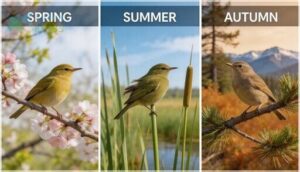
Some birds look nearly identical until you factor in season, habitat, and where they’re found. Knowing when and where to expect certain species makes identification easier.
Here’s what to check as you compare similar songbirds.
Breeding Plumage Vs Nonbreeding Plumage
When you’re comparing songbirds, the Breeding Color Boost stands out during the Seasonal Plumage Shift, thanks to partial molt patterns and the feather replacement cycle. Nonbreeding Cryptic Hue helps birds blend in, making identification tricky.
Use range maps and watch for sharper field marks in breeding plumage, since seasonal and age variations often change how a bird looks from month to month.
Juvenile Birds and First-fall Confusion
After breeding plumage fades, you face a new challenge: age-related plumage changes. Juvenile birds show dull colors, loose feathers, and often a visible fledge gape.
Molt limits and juvenile flight feathers can confuse even experienced eyes.
Family flock dynamics add to the mix, especially in late summer.
Using field marks and analyzing vocalizations helps you separate lookalike species during molting timing.
Habitat Overlap in Yards, Woods, and Fields
After sorting out juvenile plumage, you’ll notice how habitat preferences shape bird encounters. Edge Habitat Preferences matter—a Song Sparrow nests in field margins, while House Finches flock to Feeder Attraction Zones.
To recognize species, check:
- Woodland Edge Corridors
- Seasonal Yard Use
- Field Margin Resources
- Shrubby thickets
- Open lawns
Habitat and range distribution always influence identification.
Migration Timing and Regional Likelihood
Habitat clues get you close, but migration timing seals the deal.
Warblers peak in mid-April across eastern North America, while sparrows follow in October — two distinct Spring Arrival Windows and Fall Departure Peaks worth knowing.
Winter Resident Zones favor House Finches year-round, whereas Purple Finches irrupt south unpredictably.
Northern Breeder Patterns and Hybrid Zone Overlap sharpens your regional songbird coverage considerably.
Field Guide, Notes, and Photo Verification
If you want a reliable identification, weave Metadata Recording and Checklist Integration into your Verification Workflow.
Digital Field Guides and range maps help, but field note-taking paired with Bird photography and image metadata makes your record stronger.
For instance, a thorough bird identification guide, vocalizations and calls, and photo uploads give you a layered approach—each clue confirms the next.
Frequently Asked Questions (FAQs)
What American songbird mimics others?
Three American masters of mimicry stand out: the Northern Mockingbird, Brown Thrashers, and Gray Catbirds.
Each builds a stunning mimicry repertoire, borrowing freely from other species’ bird calls to expand their personal bird sound and song library.
Can weather affect songbird plumage color accuracy?
Yes, weather can impact plumage color accuracy. Wet Feather Darkening and Rain Dullness make birds look darker.
UV Plumage Contrast shifts under clouds.
Temperature Color Shift and Atmospheric Haze also complicate color perception, especially during plumage molt cycles.
How do hybrid songbirds complicate species identification?
Hybrid songbirds blur species differentiation by showing mixed plumage patterns and hybrid song variability.
In range overlap zones, age sex effects and seasonal changes add confusion, so you must use ID best practices and multiple techniques for distinguishing lookalike bird species.
Do injured birds display atypical field marks?
You might think field marks are always reliable, but injury asymmetry, feather fault bars, color bleaching, tail deformation, and quiet behavior can distort them.
Using field marks for bird identification requires evaluating plumage variations across life stages and context.
How does elevation influence regional songbird variation?
Elevation shapes songbird dialects in surprising ways.
Higher zones favor shorter, faster phrases — tempo variation and frequency shifts help songs cut through thin, windy air where habitat zonation drives dialect divergence across ridgelines.
Conclusion
Like learning a new language, mastering bird identification takes practice.
This similar looking songbirds guide enables you to decode shape, song, and range, turning fleeting glimpses into confident IDs. With each outing, you’ll spot the subtle truths—a thicker bill, a unique wing flicker—that color alone hides.
Patience and these tools transform frustration into fascination. Soon, those confusing lookalikes won’t just be birds; they’ll be old friends, revealing their secrets one clue at a time.
Keep watching—the field is yours.
- https://christineelder.com/warblers/
- https://usbirdguide.com/birding/sparrow-vs-finch/
- https://nestboxlive.com/blog/12-most-common-sparrows-in-north-america/?v=7885444af42e
- https://realitypathing.com/how-to-identify-different-types-of-grosbeaks-in-your-area/
- https://birdspal.com/pine-siskin-vs-goldfinch/